AI Overview: Past, Present, Future

Generated from prompt:

Create a presentation about artificial intelligence

This presentation explores artificial intelligence, covering its definition, key components, historical timeline, growth statistics, real-world applications like smart assistants and robots, and futur

November 10, 20259 slides
Slide 1 of 9

Slide 1 - Artificial Intelligence: An Overview

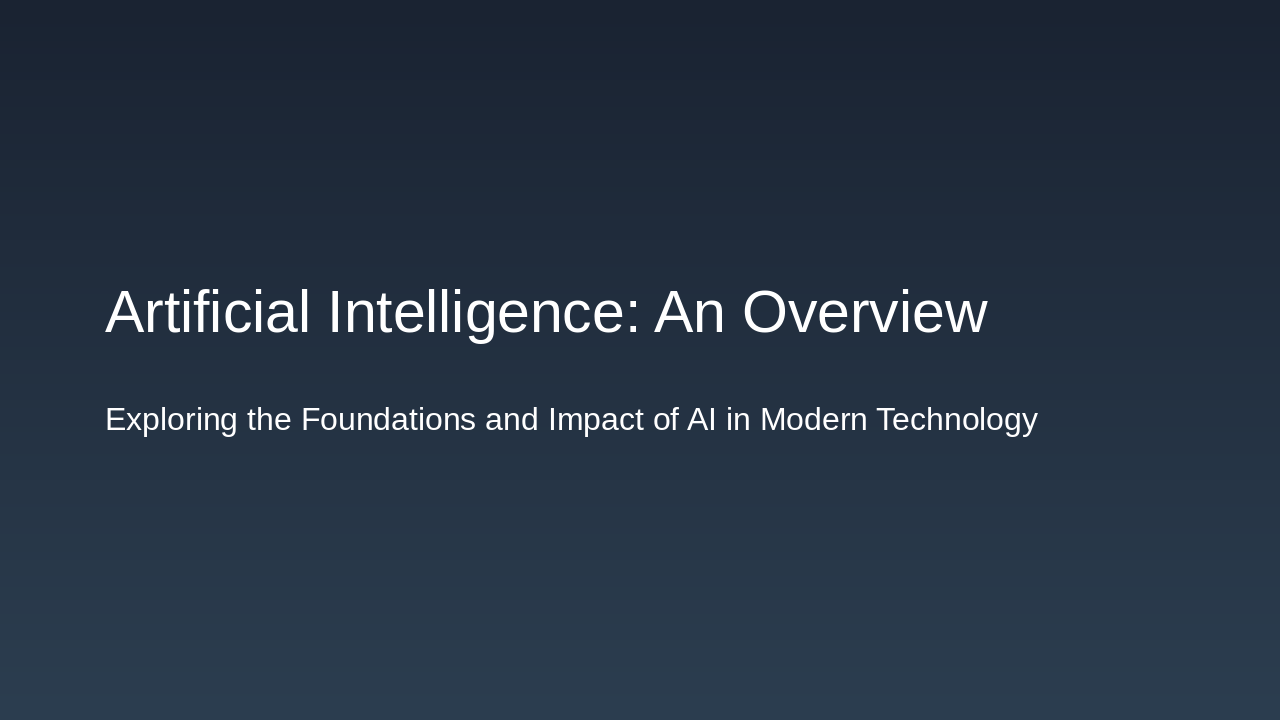
The slide serves as the title page for a presentation titled "Artificial Intelligence: An Overview." Its subtitle highlights an exploration of AI's foundational principles and its significant impact on contemporary technology.

Artificial Intelligence: An Overview

Exploring the Foundations and Impact of AI in Modern Technology

Slide 1
Slide 2 of 9

Slide 2 - Presentation Agenda

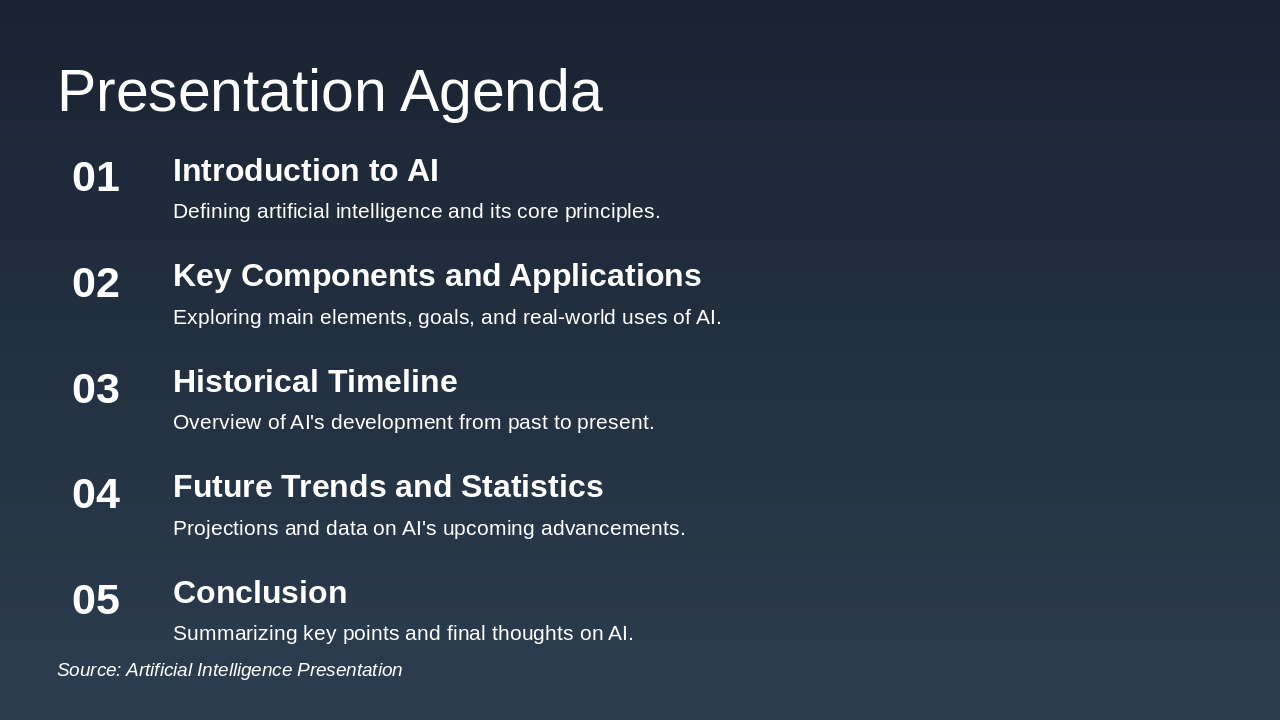
The presentation agenda outlines a structured overview of artificial intelligence, beginning with an introduction defining AI and its core principles. It then covers key components and applications, a historical timeline, future trends and statistics, and concludes with a summary of main points.

Presentation Agenda

  1. Introduction to AI

Defining artificial intelligence and its core principles.

  1. Key Components and Applications

Exploring main elements, goals, and real-world uses of AI.

  1. Historical Timeline

Overview of AI's development from past to present.

  1. Future Trends and Statistics

Projections and data on AI's upcoming advancements.

  1. Conclusion

Summarizing key points and final thoughts on AI.

Source: Artificial Intelligence Presentation

Slide 2
Slide 3 of 9

Slide 3 - What is Artificial Intelligence?

This section header slide, titled "What is Artificial Intelligence?", introduces the topic as the second section of the presentation. It features a subtitle that outlines an overview of AI's fundamental concepts and its core definition.

What is Artificial Intelligence?

02

What is Artificial Intelligence?

An introduction to the fundamental concepts and core definition of Artificial Intelligence.

--- Speaker Notes: Section introducing the core definition of AI.

Slide 3
Slide 4 of 9

Slide 4 - Definition and Key Aspects

Artificial Intelligence (AI) is defined as enabling machines to mimic human-like learning, adaptation, reasoning, and logical problem-solving. It also encompasses perception of environments, decision-making for complex tasks, and goal achievement through intelligent processes.

Definition and Key Aspects

  • AI enables machines to learn and adapt like humans
  • AI facilitates reasoning and logical problem-solving
  • AI supports perception and understanding of environments
  • AI involves decision-making for complex tasks
  • AI focuses on achieving goals through intelligence
Slide 4
Slide 5 of 9

Slide 5 - Core Components of AI

The slide titled "Core Components of AI" outlines key functionalities that drive artificial intelligence systems. It highlights how AI enables reasoning and problem-solving in complex scenarios, facilitates knowledge representation and storage, supports planning and decision-making, and promotes learning from data and experiences.

Core Components of AI

  • Enables reasoning and problem-solving in complex scenarios
  • Facilitates knowledge representation and storage
  • Supports planning and decision-making processes
  • Promotes learning from data and experiences
Slide 5
Slide 6 of 9

Slide 6 - Visualizing AI in Action

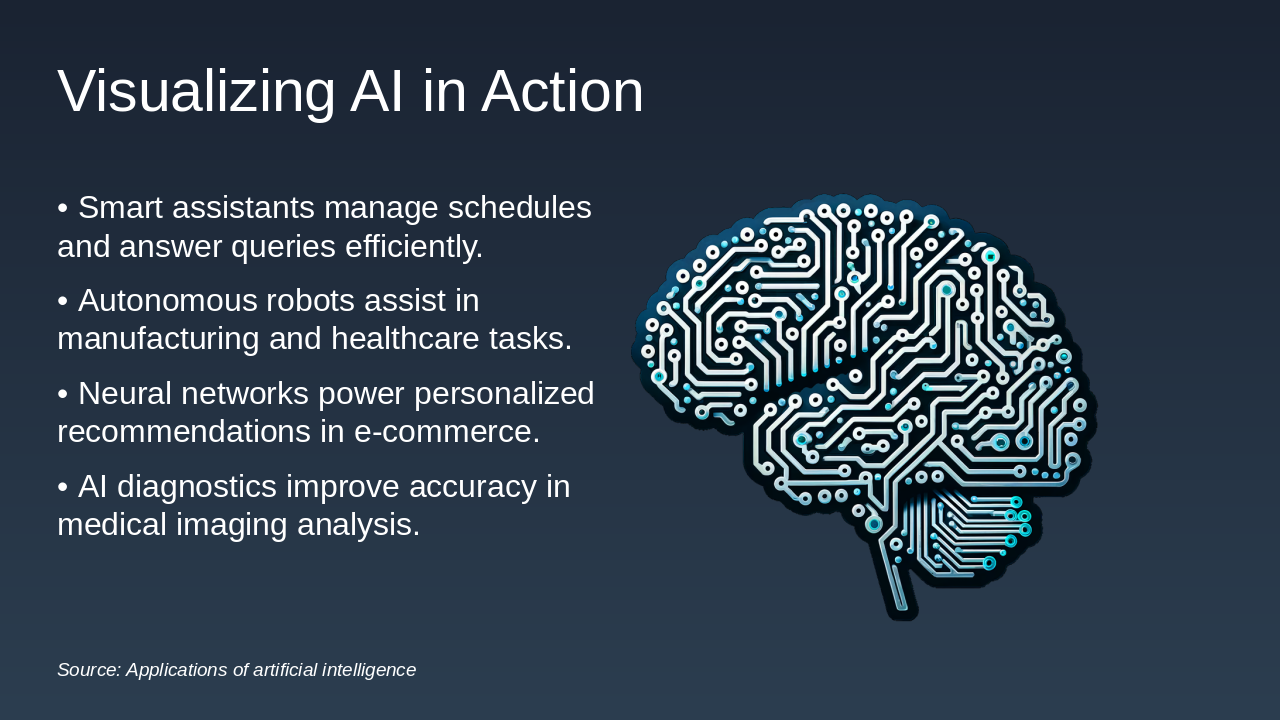
The slide titled "Visualizing AI in Action" features an image illustrating practical AI applications through four key points. These include smart assistants efficiently managing schedules and queries, autonomous robots aiding manufacturing and healthcare, neural networks enabling personalized e-commerce recommendations, and AI diagnostics enhancing accuracy in medical imaging.

Visualizing AI in Action

!Image

  • Smart assistants manage schedules and answer queries efficiently.
  • Autonomous robots assist in manufacturing and healthcare tasks.
  • Neural networks power personalized recommendations in e-commerce.
  • AI diagnostics improve accuracy in medical imaging analysis.

Source: Applications of artificial intelligence

--- Speaker Notes: Image of AI applications like robots or neural networks to illustrate practical uses in daily life. Context: Presentation about artificial intelligence.

Slide 6
Slide 7 of 9

Slide 7 - Brief History of AI

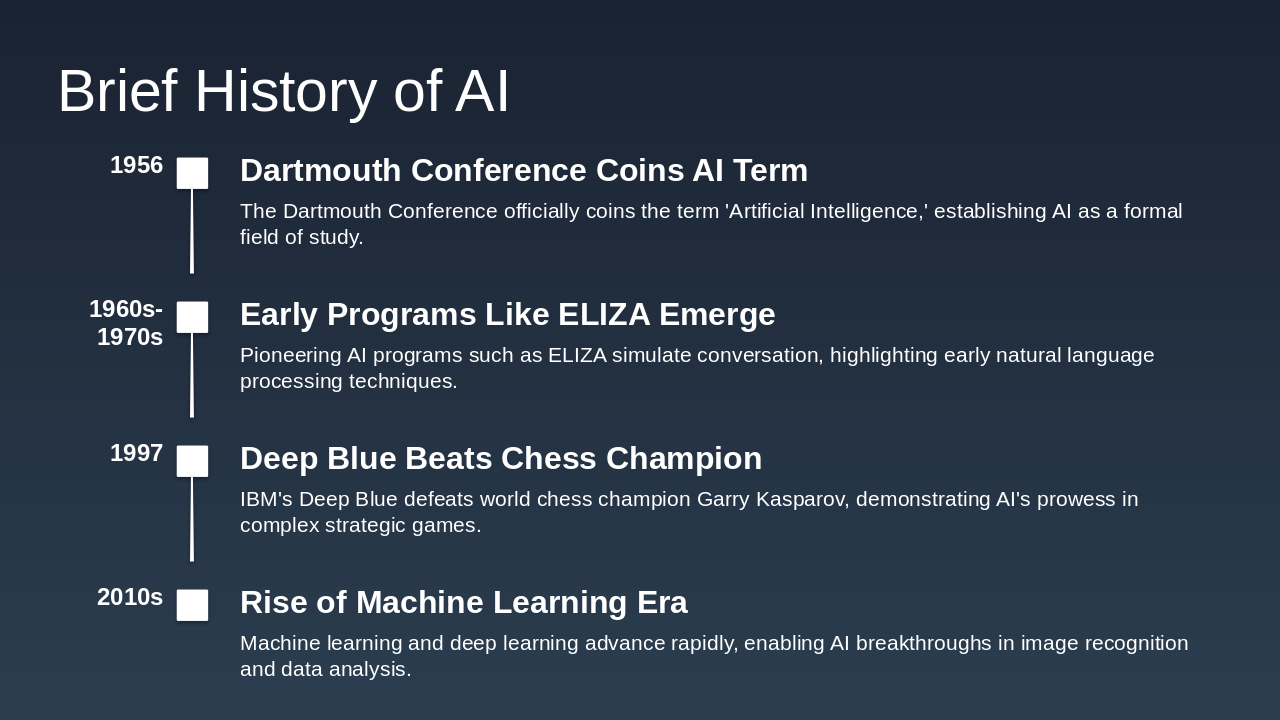
The Brief History of AI timeline slide begins with the 1956 Dartmouth Conference, which coined the term "Artificial Intelligence" and established it as a formal field, followed by the 1960s-1970s emergence of early programs like ELIZA that pioneered natural language processing. It then highlights 1997's milestone when IBM's Deep Blue defeated chess champion Garry Kasparov, and the 2010s rise of machine learning and deep learning, driving advances in image recognition and data analysis.

Brief History of AI

1956: Dartmouth Conference Coins AI Term The Dartmouth Conference officially coins the term 'Artificial Intelligence,' establishing AI as a formal field of study. 1960s-1970s: Early Programs Like ELIZA Emerge Pioneering AI programs such as ELIZA simulate conversation, highlighting early natural language processing techniques. 1997: Deep Blue Beats Chess Champion IBM's Deep Blue defeats world chess champion Garry Kasparov, demonstrating AI's prowess in complex strategic games. 2010s: Rise of Machine Learning Era Machine learning and deep learning advance rapidly, enabling AI breakthroughs in image recognition and data analysis.
Slide 7
Slide 8 of 9

Slide 8 - AI Growth Statistics

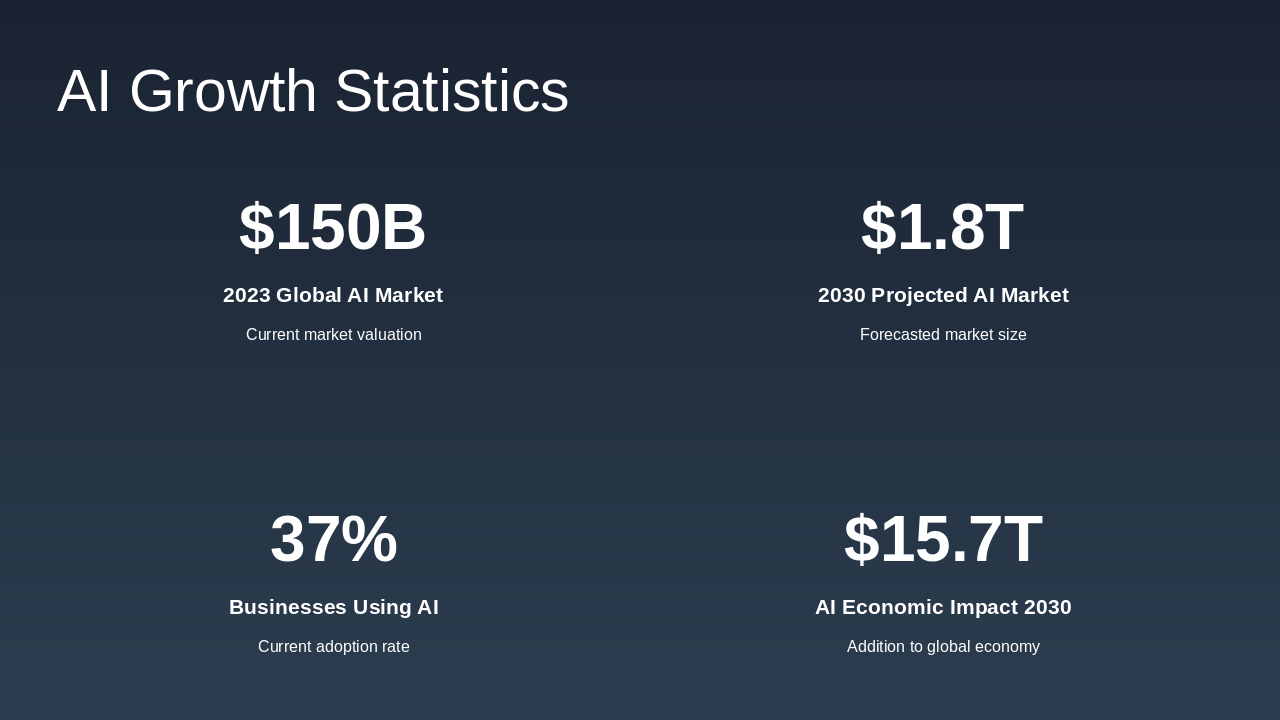
The AI Growth Statistics slide highlights the global AI market's current valuation at $150 billion in 2023, with a projected expansion to $1.8 trillion by 2030. It also notes that 37% of businesses currently use AI, which is expected to contribute $15.7 trillion to the global economy by 2030.

AI Growth Statistics

  • $150B: 2023 Global AI Market

Current market valuation

  • $1.8T: 2030 Projected AI Market

Forecasted market size

  • 37%: Businesses Using AI

Current adoption rate

  • $15.7T: AI Economic Impact 2030

Addition to global economy

Slide 8
Slide 9 of 9

Slide 9 - Conclusion: The Future of AI

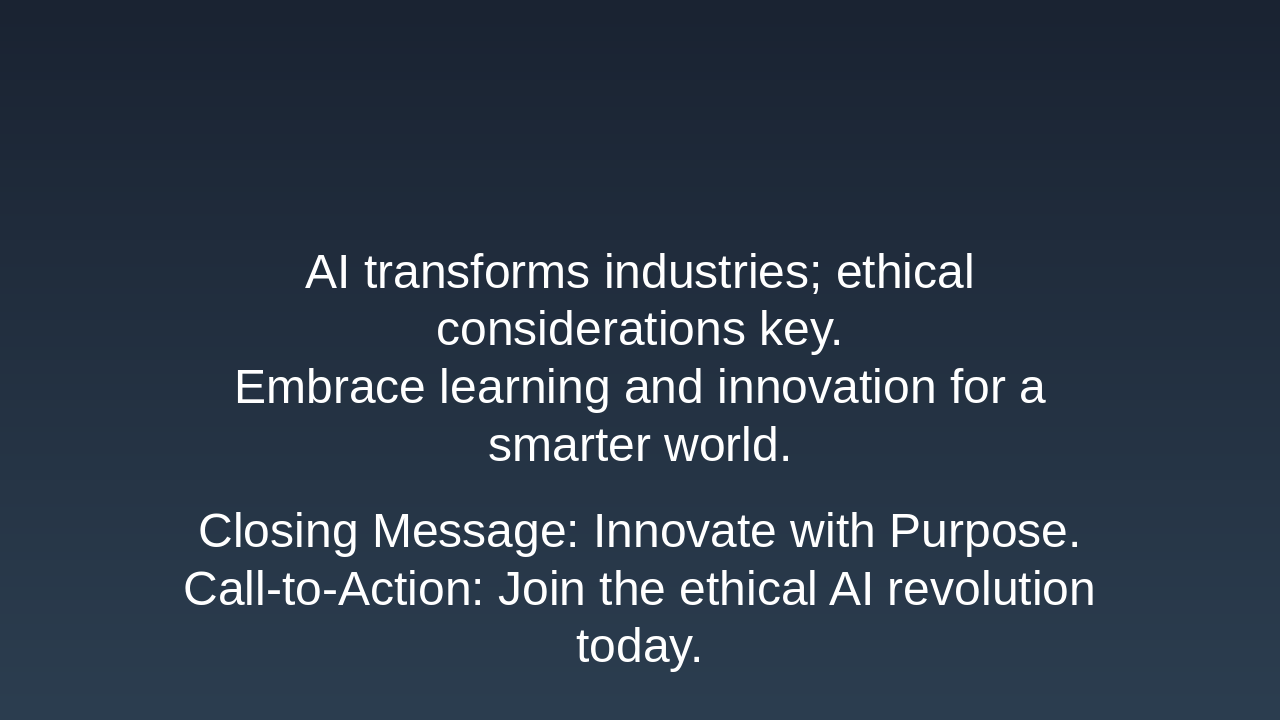
AI is revolutionizing various industries, but ethical considerations remain essential to its development. The slide urges embracing learning and innovation to build a smarter world, with a closing message to "Innovate with Purpose" and a call to join the ethical AI revolution today.

Conclusion: The Future of AI

AI transforms industries; ethical considerations key. Embrace learning and innovation for a smarter world.

Closing Message: Innovate with Purpose. Call-to-Action: Join the ethical AI revolution today.

Slide 9
Powered by AI

Create Your Own Presentation

Generate professional presentations in seconds with Karaf's AI. Customize this presentation or start from scratch.

Create New Presentation

Powered by Karaf.ai — AI-Powered Presentation Generator