Fundamentals of Linguistics Unveiled (32 chars)

Generated from prompt:

Slide 1: Language and Linguistics Nature of language Language as a system Branches of linguistics Descriptive vs prescriptive approach šŸ”¹ Slide 2: Sounds of Language (Phonetics) Speech sounds and articulation Vowels and consonants Phonetic symbols Stress and intonation šŸ”¹ Slide 3: Phonology Phoneme and allophone Minimal pairs Syllable structure Suprasegmental features šŸ”¹ Slide 4: Word Formation (Morphology) Morpheme and types Inflection and derivation Compounding Affixation šŸ”¹ Slide 5: Sentence Structure (Syntax) Phrase and clause Sentence patterns Transformational grammar Deep and surface structure šŸ”¹ Slide 6: Meaning in Language (Semantics) Meaning and sense Lexical relations Synonymy, antonymy Ambiguity and polysemy šŸ”¹ Slide 7: Language in Use (Pragmatics) Context and meaning Speech acts Presupposition and implicature Discourse analysis šŸ”¹ Slide 8: Language Variation Dialects and accents Register and style Sociolect and idiolect Language and society šŸ”¹ Slide 9: Language Change and Development Language change over time Causes of change Language acquisition First and second language learning šŸ”¹ Slide 10: Applied Aspects of Language Language and communication Language teaching English as a global language Language and power

Overview of linguistics covering language nature, phonetics/phonology (sounds), morphology (words), syntax (sentences), semantics/pragmatics (meaning), variation, change, acquisition, and applied uses

December 15, 202510 slides
Slide 1 of 10

Slide 1 - Language and Linguistics

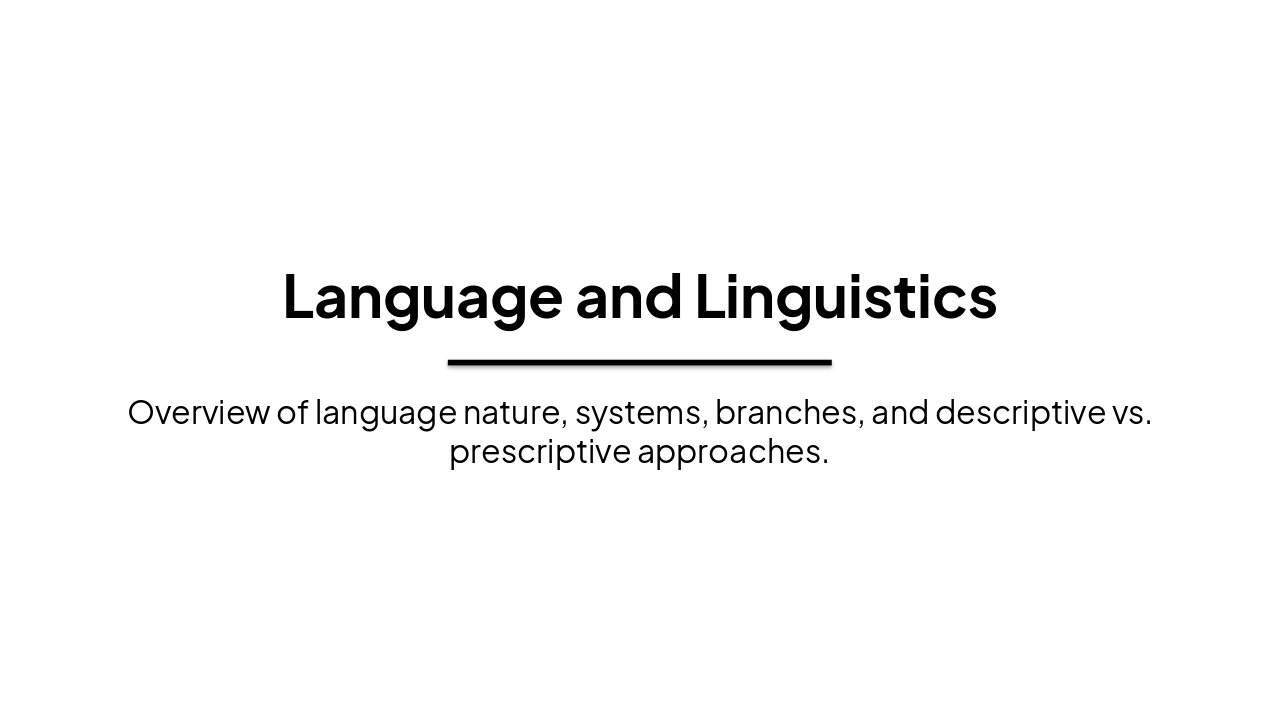
This is a title slide titled "Language and Linguistics." Its subtitle outlines an overview of language's nature, systems, branches, and descriptive versus prescriptive approaches.

Language and Linguistics

Overview of language nature, systems, branches, and descriptive vs. prescriptive approaches.
Slide 1 - Language and Linguistics
Slide 2 of 10

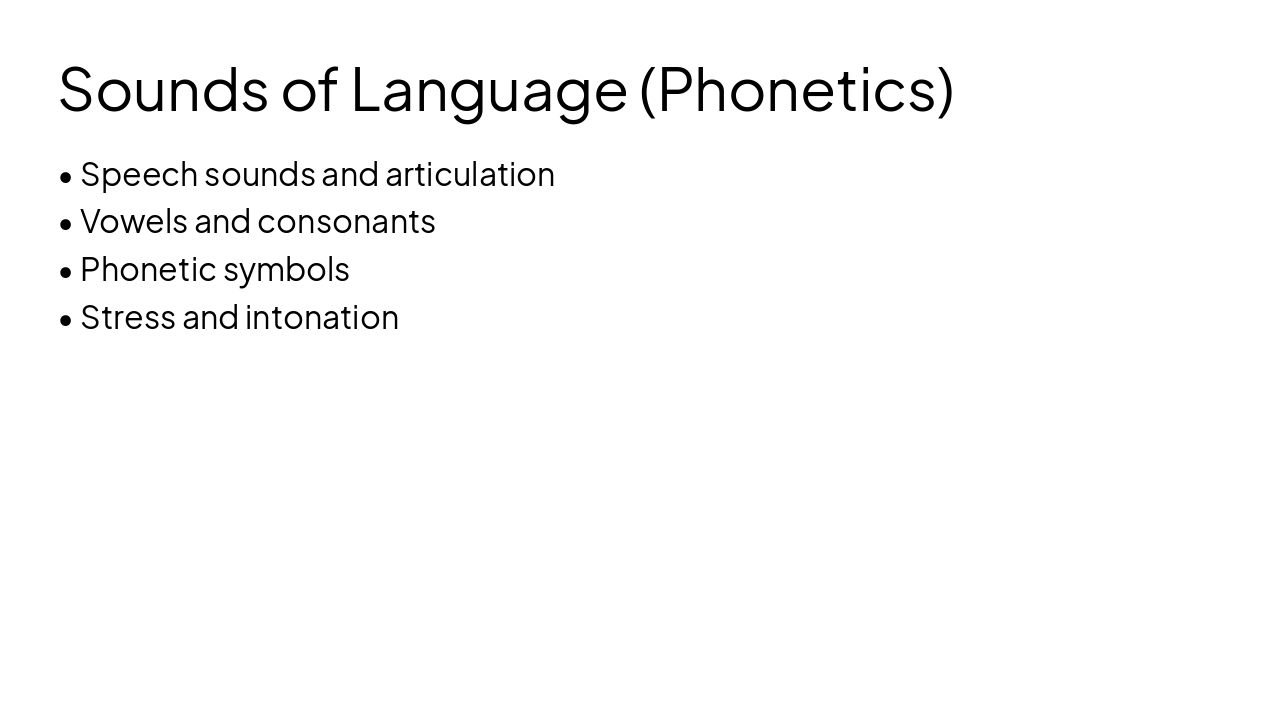
Slide 2 - Sounds of Language (Phonetics)

This slide, titled "Sounds of Language (Phonetics)," introduces key aspects of speech sounds and articulation. It covers vowels and consonants, phonetic symbols, and stress and intonation.

Sounds of Language (Phonetics)

  • Speech sounds and articulation
  • Vowels and consonants
  • Phonetic symbols
  • Stress and intonation
Slide 2 - Sounds of Language (Phonetics)
Slide 3 of 10

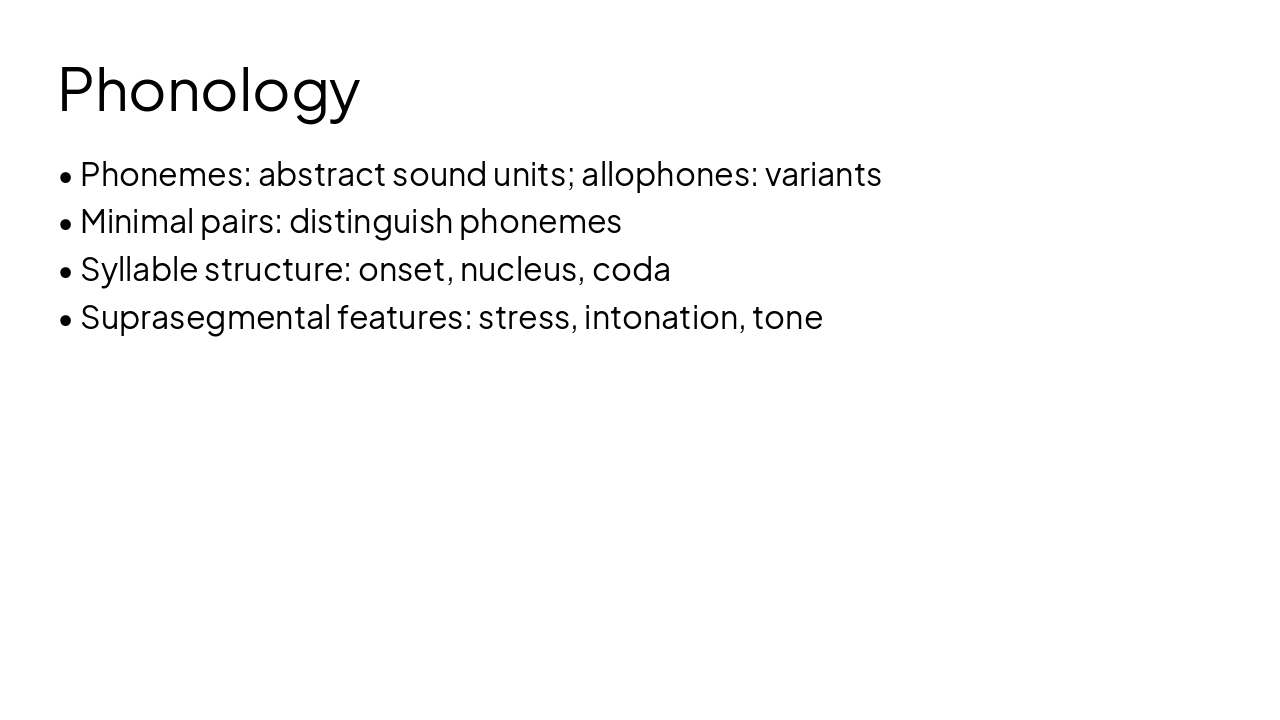
Slide 3 - Phonology

Phonology covers phonemes as abstract sound units with allophone variants, distinguished by minimal pairs. It also explains syllable structure (onset, nucleus, coda) and suprasegmental features like stress, intonation, and tone.

Phonology

  • Phonemes: abstract sound units; allophones: variants
  • Minimal pairs: distinguish phonemes
  • Syllable structure: onset, nucleus, coda
  • Suprasegmental features: stress, intonation, tone
Slide 3 - Phonology
Slide 4 of 10

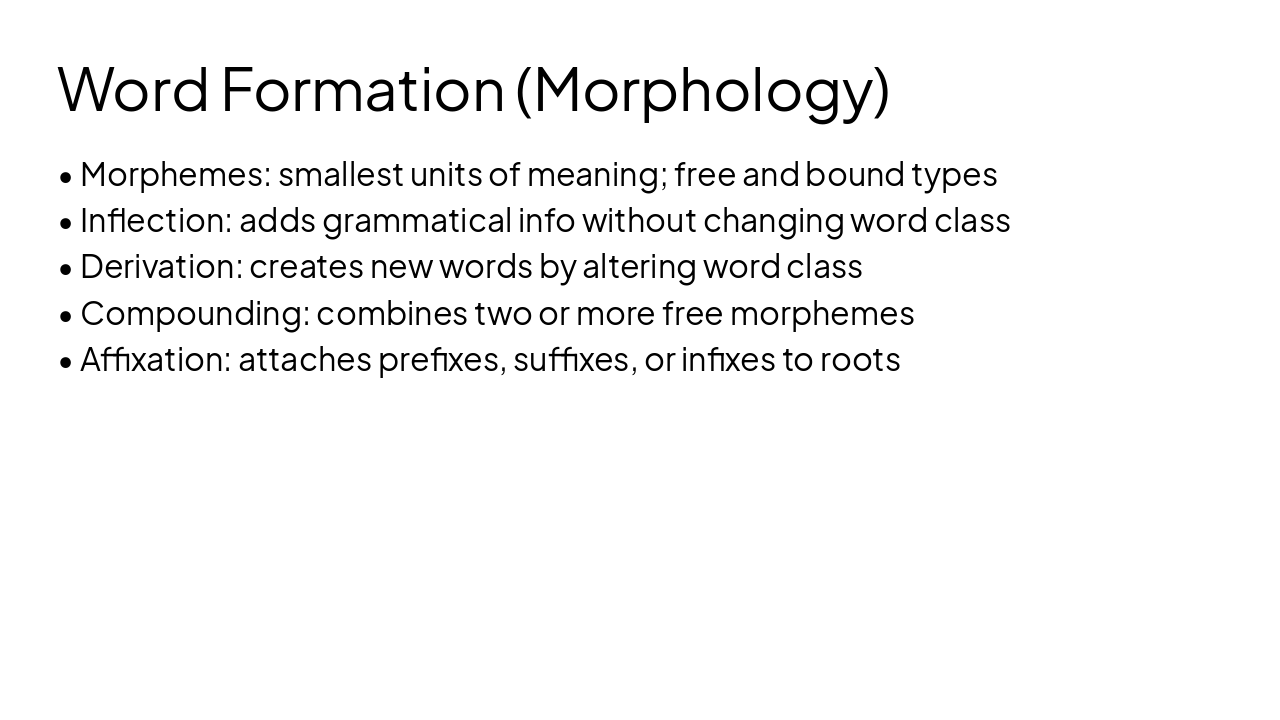
Slide 4 - Word Formation (Morphology)

Word Formation in Morphology covers morphemes as the smallest units of meaning, including free and bound types. It details processes like inflection (adds grammar without changing word class), derivation (alters word class for new words), compounding (joins free morphemes), and affixation (adds prefixes, suffixes, or infixes to roots).

Word Formation (Morphology)

  • Morphemes: smallest units of meaning; free and bound types
  • Inflection: adds grammatical info without changing word class
  • Derivation: creates new words by altering word class
  • Compounding: combines two or more free morphemes
  • Affixation: attaches prefixes, suffixes, or infixes to roots
Slide 4 - Word Formation (Morphology)
Slide 5 of 10

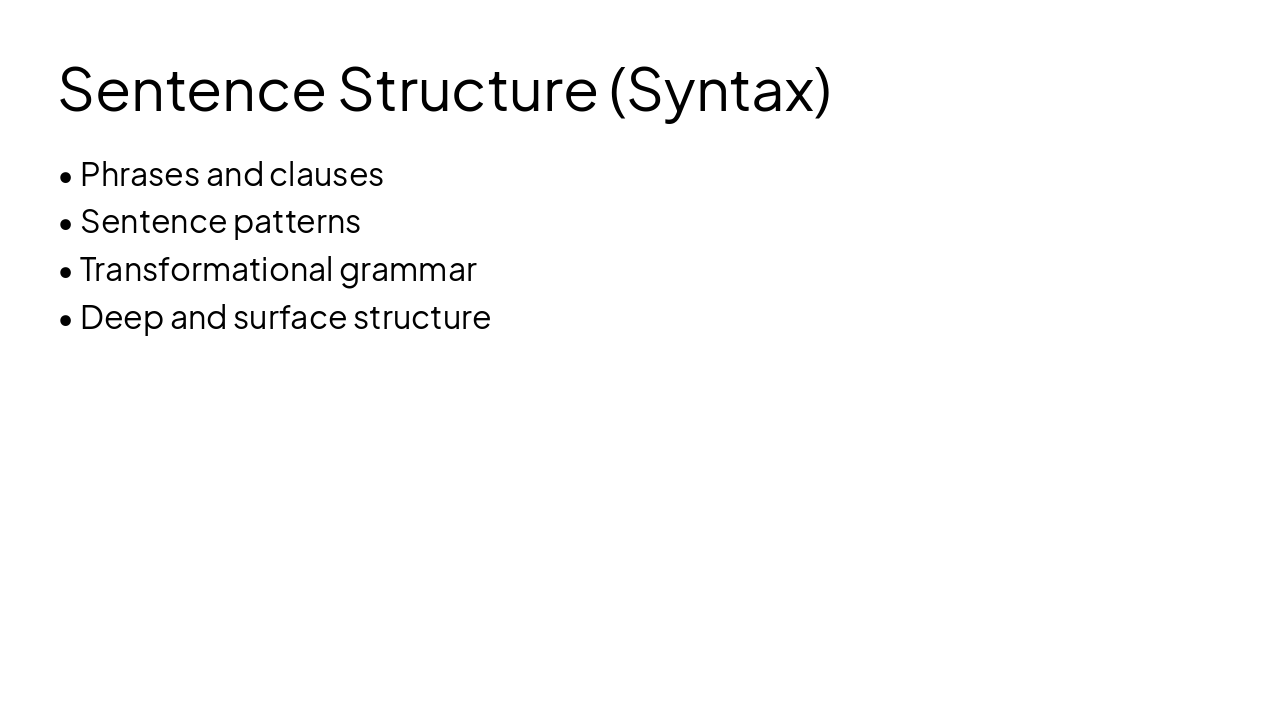
Slide 5 - Sentence Structure (Syntax)

This slide on Sentence Structure (Syntax) outlines key elements like phrases, clauses, and sentence patterns. It also covers transformational grammar and the concepts of deep and surface structure.

Sentence Structure (Syntax)

  • Phrases and clauses
  • Sentence patterns
  • Transformational grammar
  • Deep and surface structure
Slide 5 - Sentence Structure (Syntax)
Slide 6 of 10

Slide 6 - Meaning in Language (Semantics)

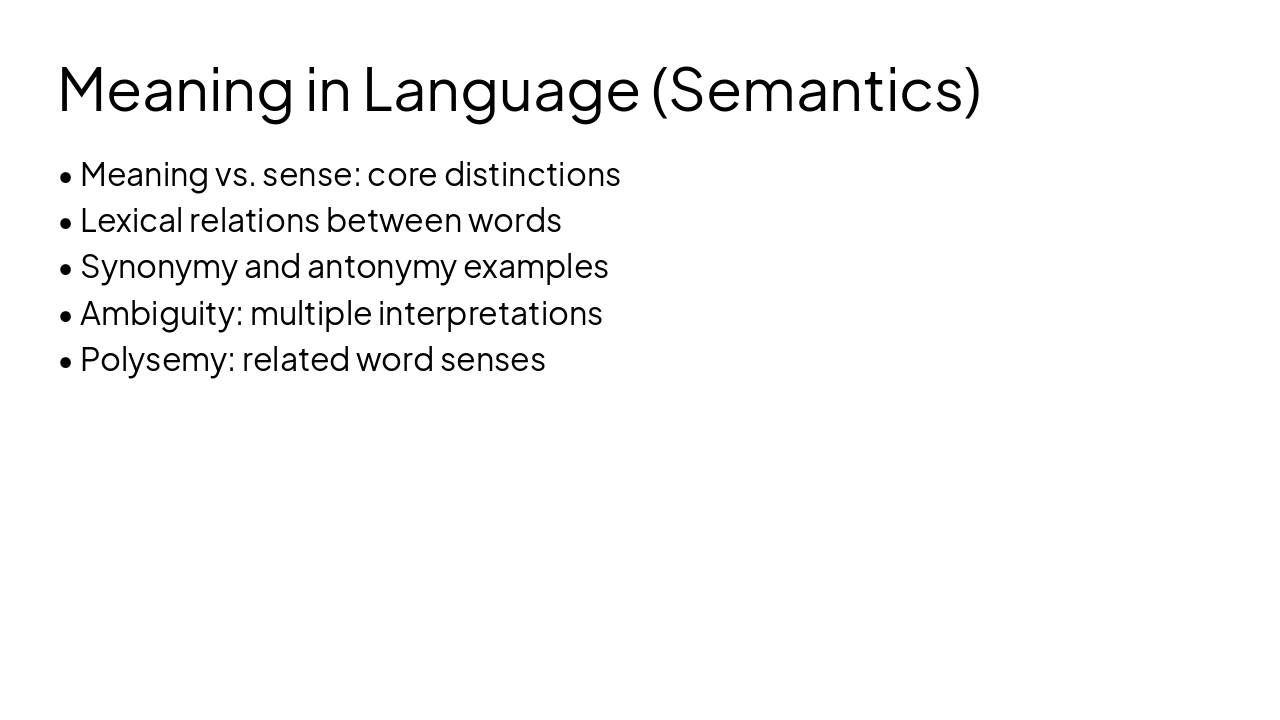
This slide on Semantics distinguishes between meaning and sense while exploring lexical relations between words. It covers examples of synonymy and antonymy, plus ambiguity (multiple interpretations) and polysemy (related word senses).

Meaning in Language (Semantics)

  • Meaning vs. sense: core distinctions
  • Lexical relations between words
  • Synonymy and antonymy examples
  • Ambiguity: multiple interpretations
  • Polysemy: related word senses
Slide 6 - Meaning in Language (Semantics)
Slide 7 of 10

Slide 7 - Language in Use (Pragmatics)

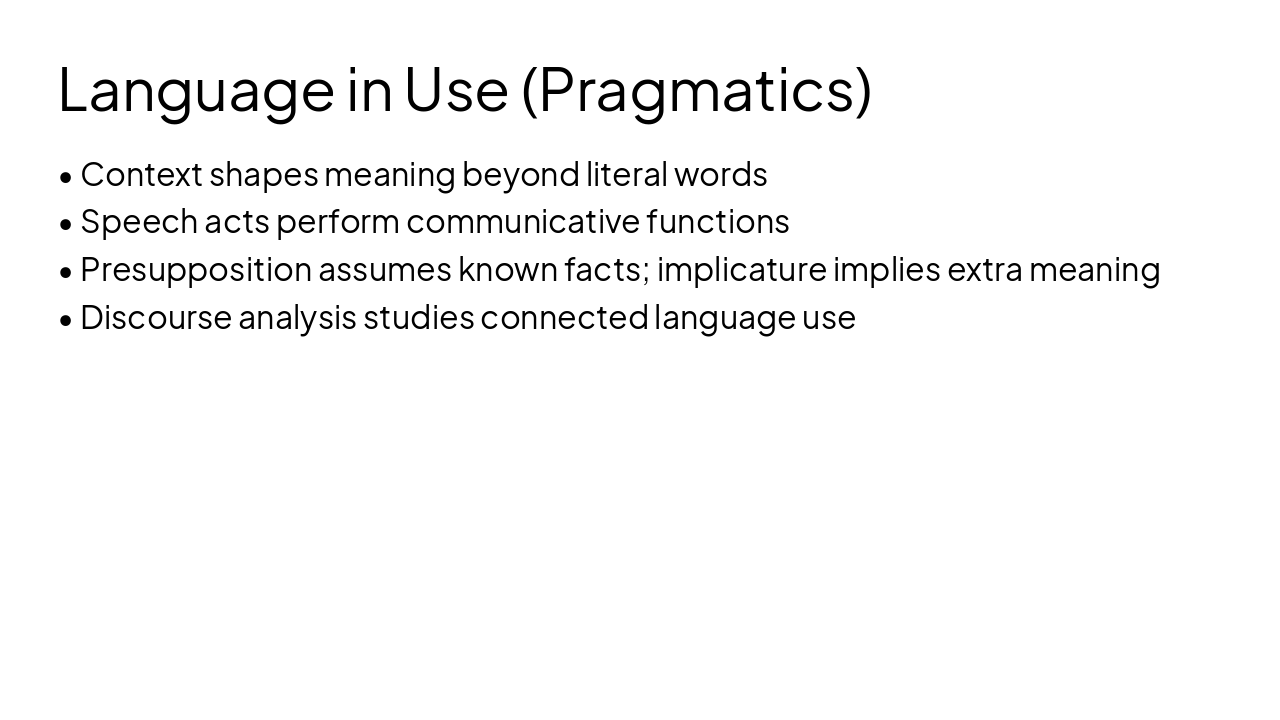
Pragmatics examines how context shapes meaning beyond literal words, including speech acts that perform functions and concepts like presupposition (assumed facts) and implicature (implied meaning). Discourse analysis studies connected language use in context.

Language in Use (Pragmatics)

  • Context shapes meaning beyond literal words
  • Speech acts perform communicative functions
  • Presupposition assumes known facts; implicature implies extra meaning
  • Discourse analysis studies connected language use
Slide 7 - Language in Use (Pragmatics)
Slide 8 of 10

Slide 8 - Language Variation

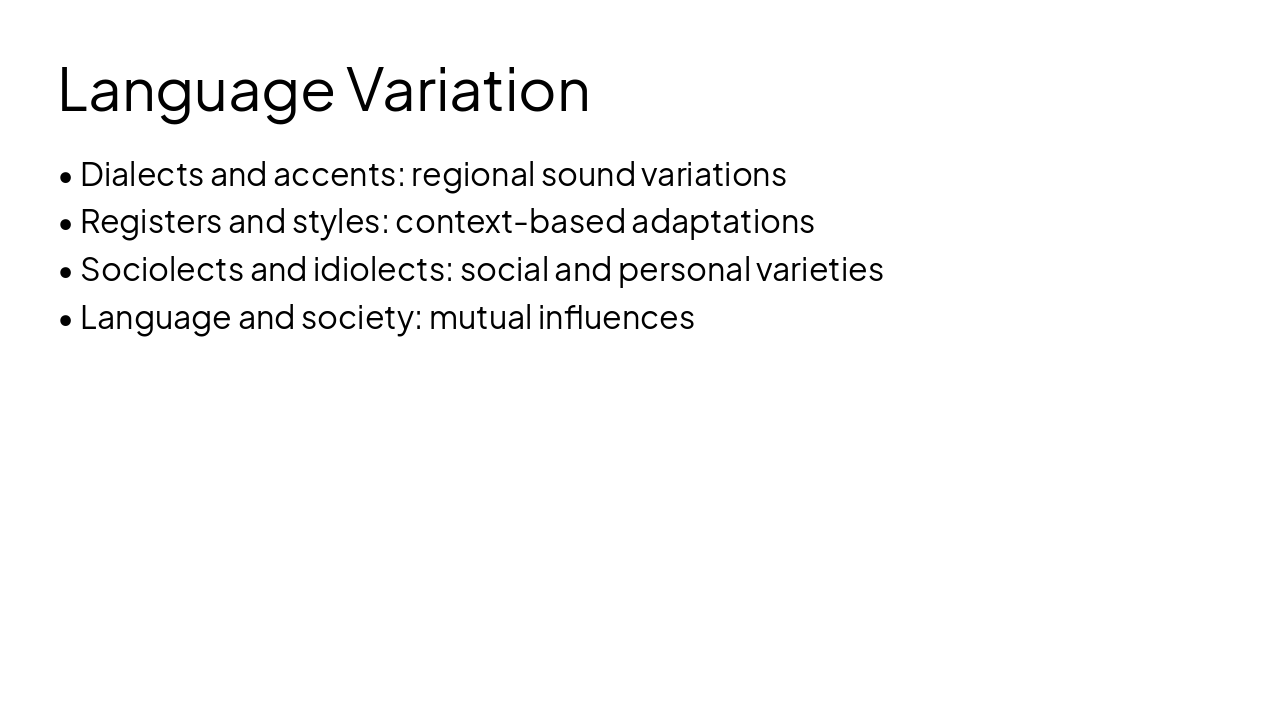
Language Variation covers dialects and accents as regional sound differences, plus registers and styles adapted to specific contexts. It also addresses sociolects and idiolects as social and personal varieties, alongside mutual influences between language and society.

Language Variation

  • Dialects and accents: regional sound variations
  • Registers and styles: context-based adaptations
  • Sociolects and idiolects: social and personal varieties
  • Language and society: mutual influences
Slide 8 - Language Variation
Slide 9 of 10

Slide 9 - Language Change and Development

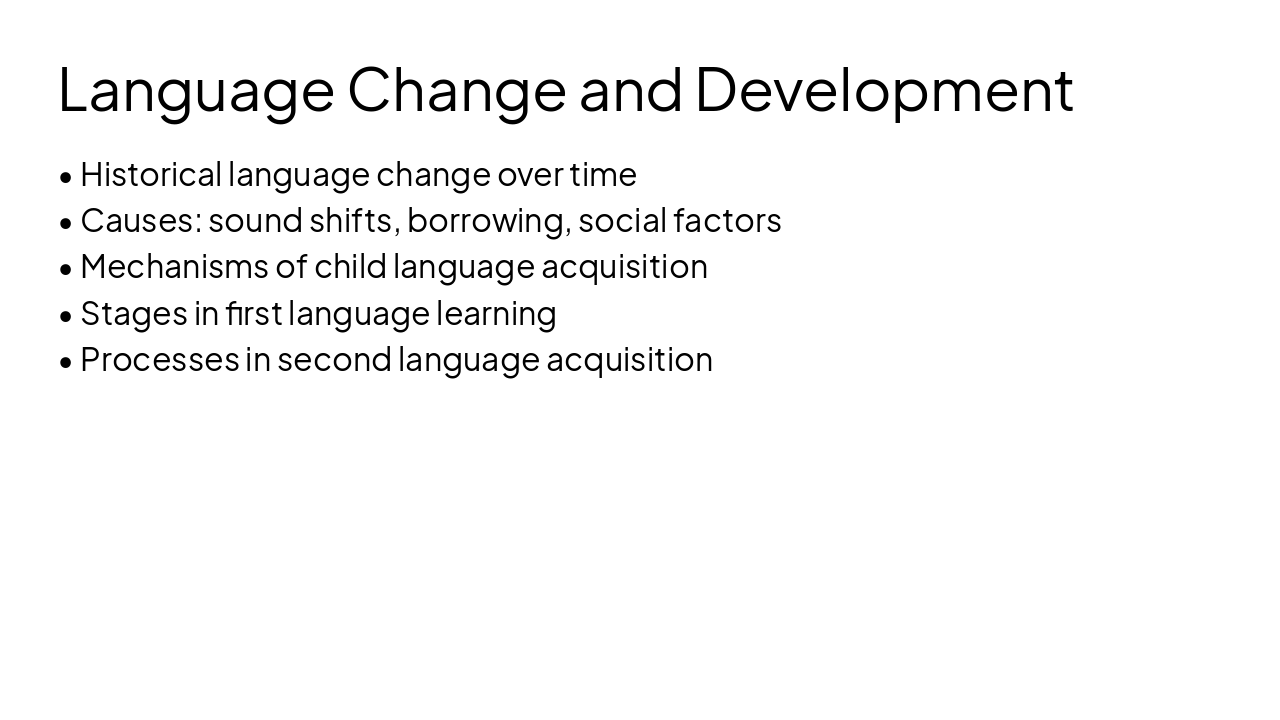
The slide explores historical language change over time and its causes, such as sound shifts, borrowing, and social factors. It also outlines mechanisms and stages of first language acquisition in children, along with processes in second language learning.

Language Change and Development

  • Historical language change over time
  • Causes: sound shifts, borrowing, social factors
  • Mechanisms of child language acquisition
  • Stages in first language learning
  • Processes in second language acquisition
Slide 9 - Language Change and Development
Slide 10 of 10

Slide 10 - Applied Aspects of Language

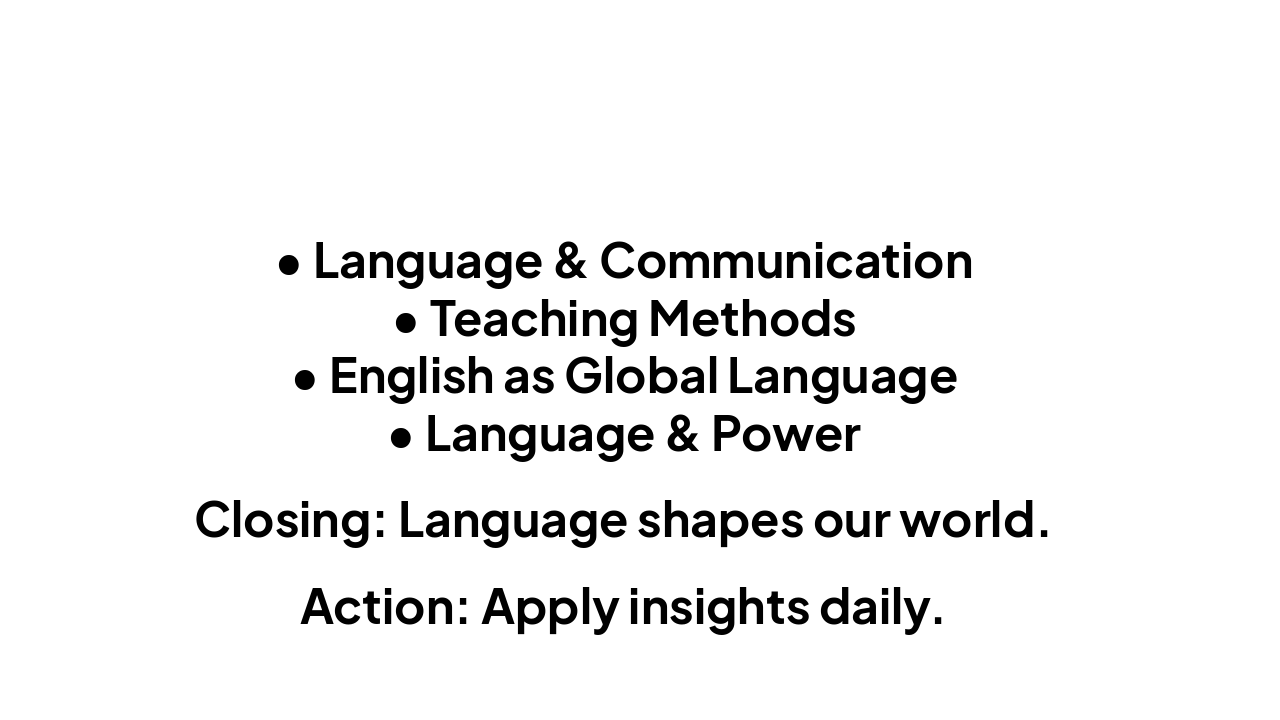
This conclusion slide on "Applied Aspects of Language" lists key topics: Language & Communication, Teaching Methods, English as Global Language, and Language & Power. It closes by stating "Language shapes our world" and calls to "Apply insights daily."

Applied Aspects of Language

• Language & Communication

  • Teaching Methods
  • English as Global Language
  • Language & Power

Closing: Language shapes our world.

Action: Apply insights daily.

Slide 10 - Applied Aspects of Language
Powered by AI

Create Your Own Presentation

Generate professional presentations in seconds with Karaf's AI. Customize this presentation or start from scratch.

Create New Presentation

Powered by Karaf.ai — AI-Powered Presentation Generator