AD & Entra ID Consolidation Roadmap

Generated from prompt:

Create a detailed PowerPoint presentation for an Active Directory & Entra ID Consolidation Project. Scope: 265 endpoints, around 60 servers. Slide 1: Title – 'Active Directory & Entra ID Consolidation and Security Modernization' Subtitle: Discovery, Design, and Implementation Roadmap Slide 2: Overview - Project Scope: 265 endpoints, 60 servers - Objective: Modernize and consolidate Active Directory with Entra ID - Key Outcomes: Unified Identity, Enhanced Security, Zero Trust Alignment Slide 3: Phase 1 – Discovery & Assessment - Architecture – Current State - Technical Environment Discovery (AD forests, trusts, routability, DCs, DNS, GPOs, PKI) - Security & Identity Baseline (MFA, Entra sync, conditional access, password policies) - Licensing & Feature Inventory (E3/E5/P1/P2 review, Defender XDR, Purview, etc.) Slide 4: Discovery Details - Tools & Assessments: dcdiag, repadmin, netdom, DNSLint - Output: Health report, GPO inventory, licensing matrix - Deliverable: Discovery report with remediation priorities Slide 5: Phase 2 – Target Architecture Design - Unified AD Strategy (single domain vs multi-forest) - OU and GPO baseline - Privileged Access Tiering (Tier 0/1/2) - IAM standardization and governance Slide 6: Entra ID Modern Identity Architecture - Lifecycle design (Joiner/Mover/Leaver) - Authentication methods (FIDO2, Passkeys, Authenticator) - Conditional Access design (baseline, high-risk) - Identity Protection (risk-based policies) Slide 7: Network & Zero Trust Alignment - Domain consolidation aligned with Zero Trust principles - Network segmentation & least privilege - Break-glass access & Privileged Access Workstations (PAWs) Slide 8: Phase 3 – Migration & Implementation - AD consolidation wave plan (users, computers, servers) - Entra hardening: Conditional access, Defender for Identity, Defender for Endpoint - M365 Security baseline: DLP, DMARC/DKIM/SPF, Safe Links, Safe Attachments Slide 9: Migration Planning Details - Phased rollout timeline - Testing and rollback procedures - Communication and training plans - KPIs for migration success Slide 10: ROI Calculation & Benefits - Cost reduction from AD domain elimination - Reduced MSP overhead and incidents - Compliance alignment (PCI, NIST, Law25) - License optimization (E5 consolidation) - Productivity gain: SSO, IAM simplification Slide 11: Next Steps - Validate discovery findings - Approve target design - Execute pilot migration - Track metrics and continuous improvement Slide 12: Summary - Unified AD & Entra ID ecosystem - Modern, secure identity framework - Foundation for Zero Trust and cloud enablement

This presentation outlines a project to modernize and consolidate Active Directory with Entra ID across 265 endpoints and 60 servers. It covers discovery, target architecture design, migration phases,

November 26, 202512 slides
Slide 1 of 12

Slide 1 - Active Directory & Entra ID Consolidation and Security Modernization

The slide's main title is "Active Directory & Entra ID Consolidation and Security Modernization," focusing on integrating and updating these identity management systems for enhanced security. Its subtitle, "Discovery, Design, and Implementation Roadmap," outlines a structured plan for assessing, planning, and executing the consolidation process.

Active Directory & Entra ID Consolidation and Security Modernization

Discovery, Design, and Implementation Roadmap

Source: Discovery, Design, and Implementation Roadmap. Overview of modernizing AD with Entra ID for unified, secure identity. Scope: 265 endpoints, around 60 servers.

Speaker Notes
Create a detailed PowerPoint presentation for an Active Directory & Entra ID Consolidation Project.
Slide 1 - Active Directory & Entra ID Consolidation and Security Modernization
Slide 2 of 12

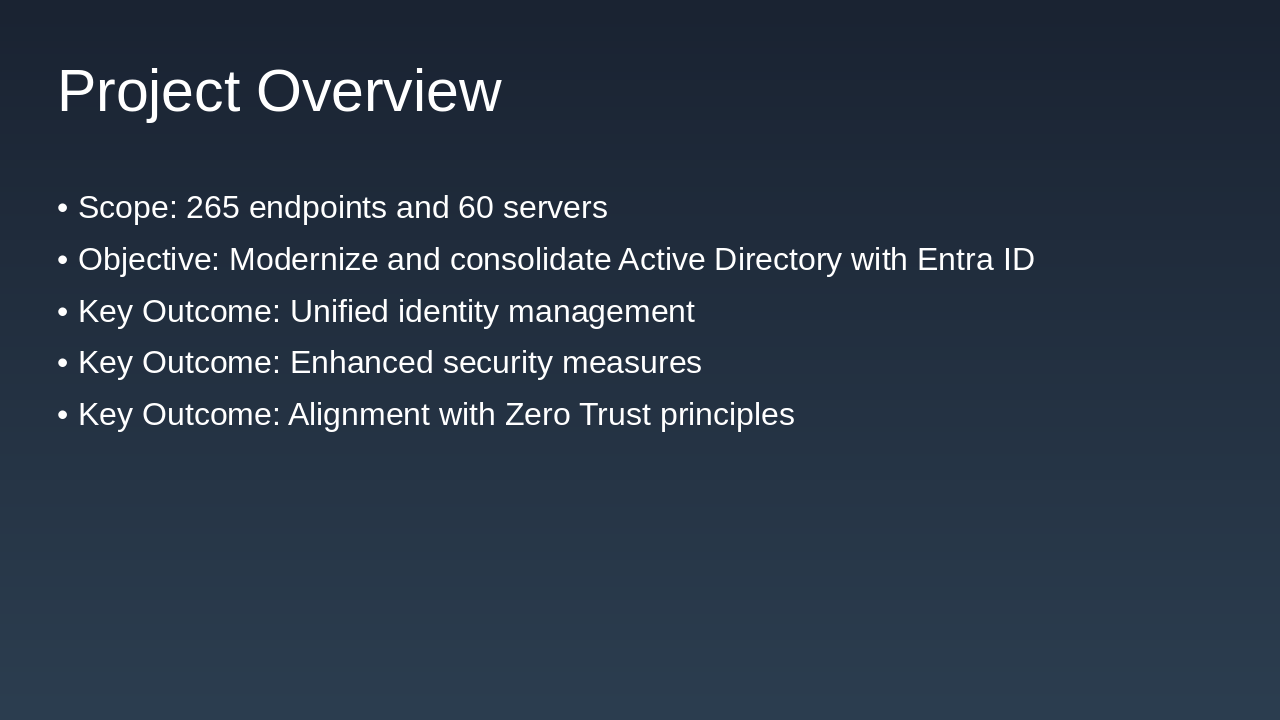
Slide 2 - Project Overview

The project overview slide outlines a scope involving 265 endpoints and 60 servers, with the primary objective of modernizing and consolidating Active Directory using Entra ID. It highlights key outcomes including unified identity management, enhanced security measures, and alignment with Zero Trust principles.

Project Overview

  • Scope: 265 endpoints and 60 servers
  • Objective: Modernize and consolidate Active Directory with Entra ID
  • Key Outcome: Unified identity management
  • Key Outcome: Enhanced security measures
  • Key Outcome: Alignment with Zero Trust principles
Slide 2 - Project Overview
Slide 3 of 12

Slide 3 - Active Directory & Entra ID Consolidation and Security Modernization

This section header slide introduces Phase 1 of the Active Directory and Entra ID consolidation and security modernization process, titled "Discovery & Assessment" as section 01. It focuses on evaluating the current AD architecture, security baselines, and licensing to develop a comprehensive modernization roadmap.

Active Directory & Entra ID Consolidation and Security Modernization

01

Phase 1 – Discovery & Assessment

Evaluating current AD architecture, security baselines, and licensing for modernization roadmap

Source: Project Presentation Outline

Speaker Notes
Architecture – Current State. Technical Environment Discovery (AD forests, trusts, routability, DCs, DNS, GPOs, PKI). Security & Identity Baseline (MFA, Entra sync, conditional access, password policies). Licensing & Feature Inventory (E3/E5/P1/P2 review, Defender XDR, Purview, etc.). Scope: 265 endpoints, around 60 servers.
Slide 3 - Active Directory & Entra ID Consolidation and Security Modernization
Slide 4 of 12

Slide 4 - Discovery Details

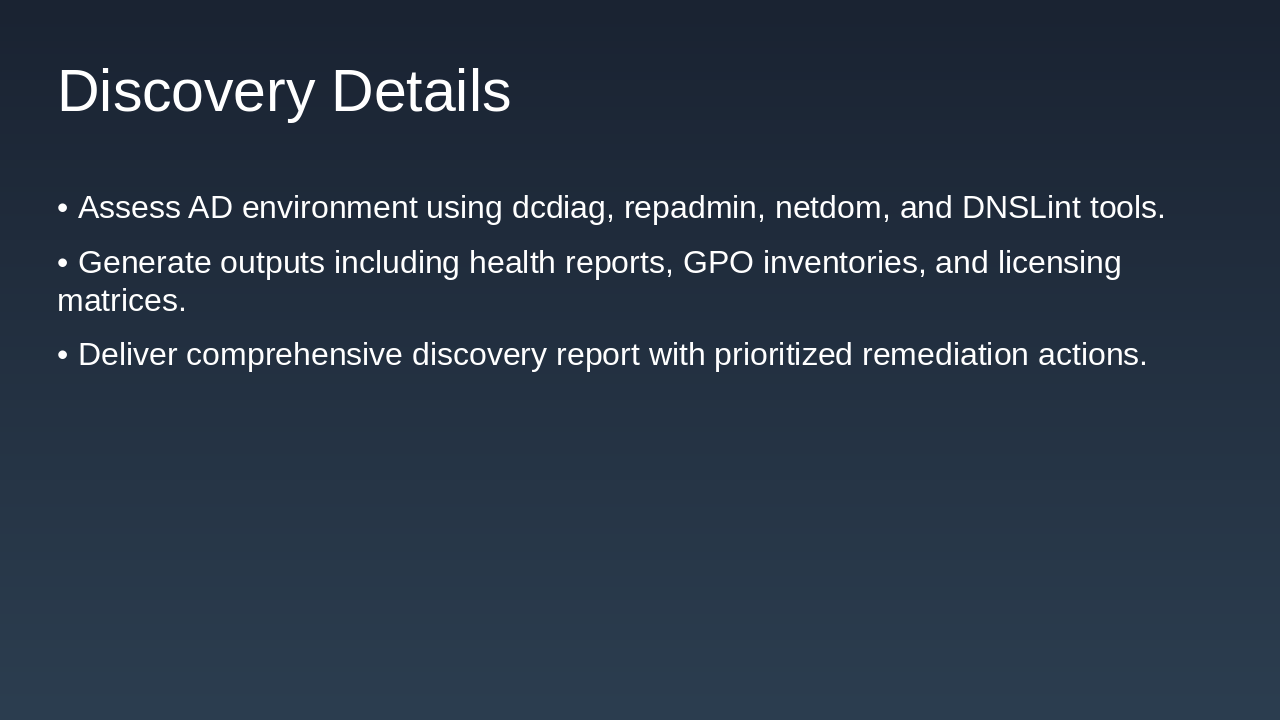
The Discovery Details slide outlines the process of assessing the Active Directory environment using tools like dcdiag, repadmin, netdom, and DNSLint to identify issues. It also covers generating key outputs such as health reports, GPO inventories, and licensing matrices, culminating in a comprehensive discovery report with prioritized remediation actions.

Discovery Details

  • Assess AD environment using dcdiag, repadmin, netdom, and DNSLint tools.
  • Generate outputs including health reports, GPO inventories, and licensing matrices.
  • Deliver comprehensive discovery report with prioritized remediation actions.
Slide 4 - Discovery Details
Slide 5 of 12

Slide 5 - Phase 2 – Target Architecture Design

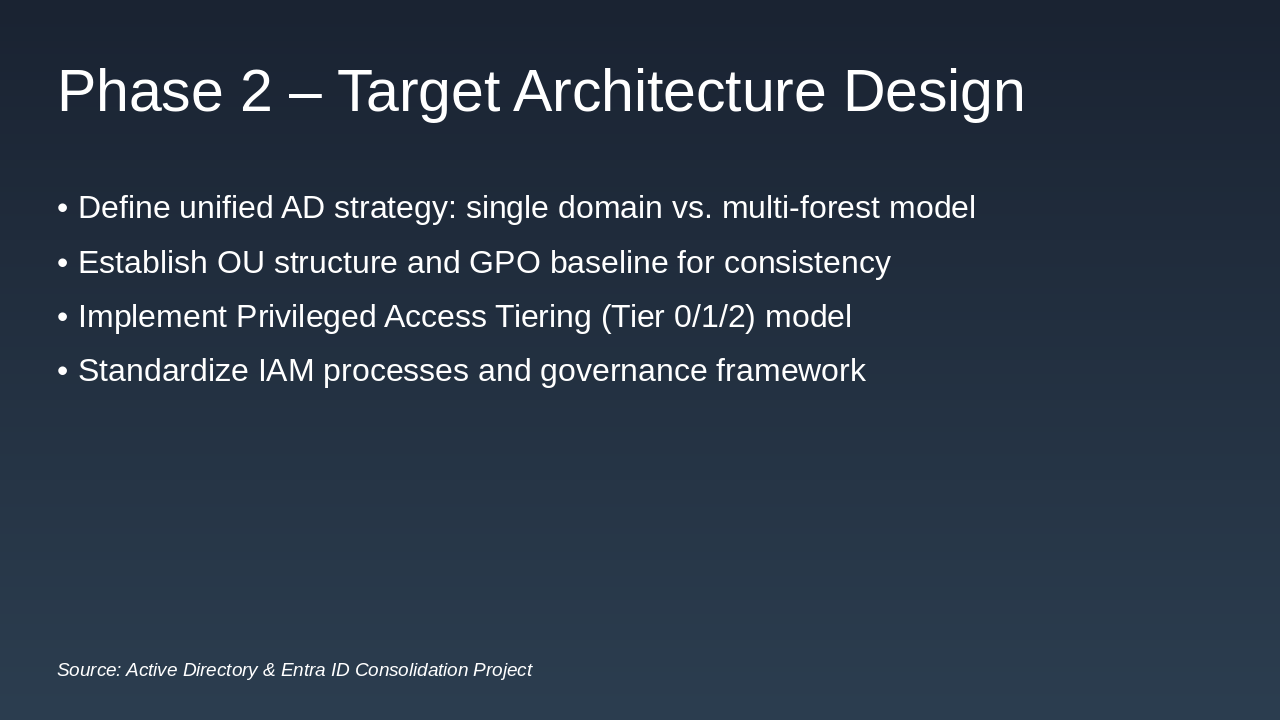
Phase 2 of the project focuses on designing the target architecture by defining a unified Active Directory strategy, such as choosing between a single domain or multi-forest model, and establishing a consistent OU structure with GPO baselines. It also involves implementing a Privileged Access Tiering model (Tier 0/1/2) and standardizing IAM processes along with a governance framework.

Phase 2 – Target Architecture Design

  • Define unified AD strategy: single domain vs. multi-forest model
  • Establish OU structure and GPO baseline for consistency
  • Implement Privileged Access Tiering (Tier 0/1/2) model
  • Standardize IAM processes and governance framework

Source: Active Directory & Entra ID Consolidation Project

Slide 5 - Phase 2 – Target Architecture Design
Slide 6 of 12

Slide 6 - Entra ID Modern Identity Architecture

The slide outlines Entra ID's modern identity architecture, focusing on lifecycle management for onboarding (Joiner), role changes (Mover), and offboarding (Leaver) with automated provisioning and immediate access revocation, alongside support for advanced authentication like FIDO2 keys, passkeys, and Microsoft Authenticator for MFA. It also covers Conditional Access policies with baseline protections and risk adaptations, plus Identity Protection features for detecting anomalies, enforcing MFA on risky sign-ins, and automatic remediation of compromised identities.

Entra ID Modern Identity Architecture

Lifecycle and Authentication DesignConditional Access and Identity Protection
Implement lifecycle management for Joiner (onboarding with automated provisioning), Mover (role changes via access reviews), and Leaver (deprovisioning with immediate access revocation). Support modern authentication methods including FIDO2 keys, passkeys for seamless sign-ins, and Microsoft Authenticator for multi-factor verification.Design Conditional Access policies with baseline protections for all users and high-risk adaptations for elevated threats. Enable Identity Protection using risk-based policies to detect anomalies, enforce MFA on risky sign-ins, and remediate compromised identities automatically.
Slide 6 - Entra ID Modern Identity Architecture
Slide 7 of 12

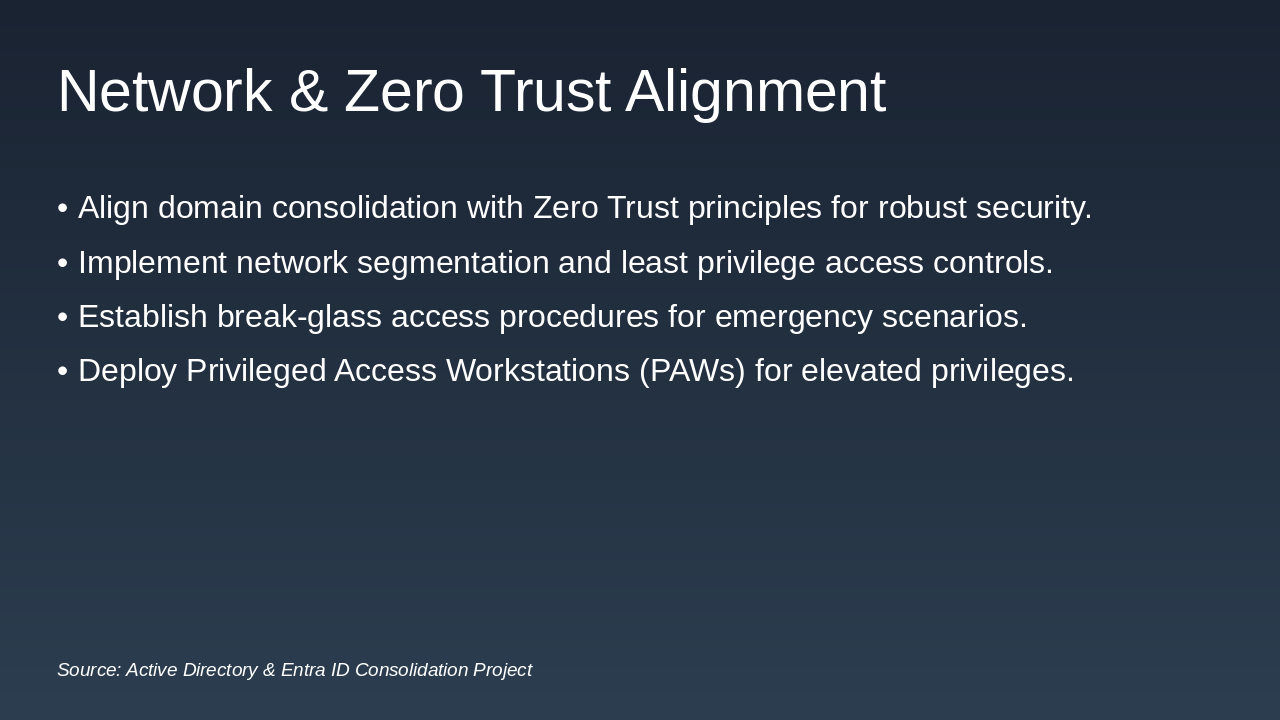
Slide 7 - Network & Zero Trust Alignment

The slide on Network & Zero Trust Alignment outlines strategies to enhance security by consolidating domains in line with Zero Trust principles, implementing network segmentation, and enforcing least privilege access controls. It also covers establishing break-glass procedures for emergencies and deploying Privileged Access Workstations (PAWs) for managing elevated privileges.

Network & Zero Trust Alignment

  • Align domain consolidation with Zero Trust principles for robust security.
  • Implement network segmentation and least privilege access controls.
  • Establish break-glass access procedures for emergency scenarios.
  • Deploy Privileged Access Workstations (PAWs) for elevated privileges.

Source: Active Directory & Entra ID Consolidation Project

Speaker Notes
Highlight integration of network security with Zero Trust for the 265 endpoints and 60 servers.
Slide 7 - Network & Zero Trust Alignment
Slide 8 of 12

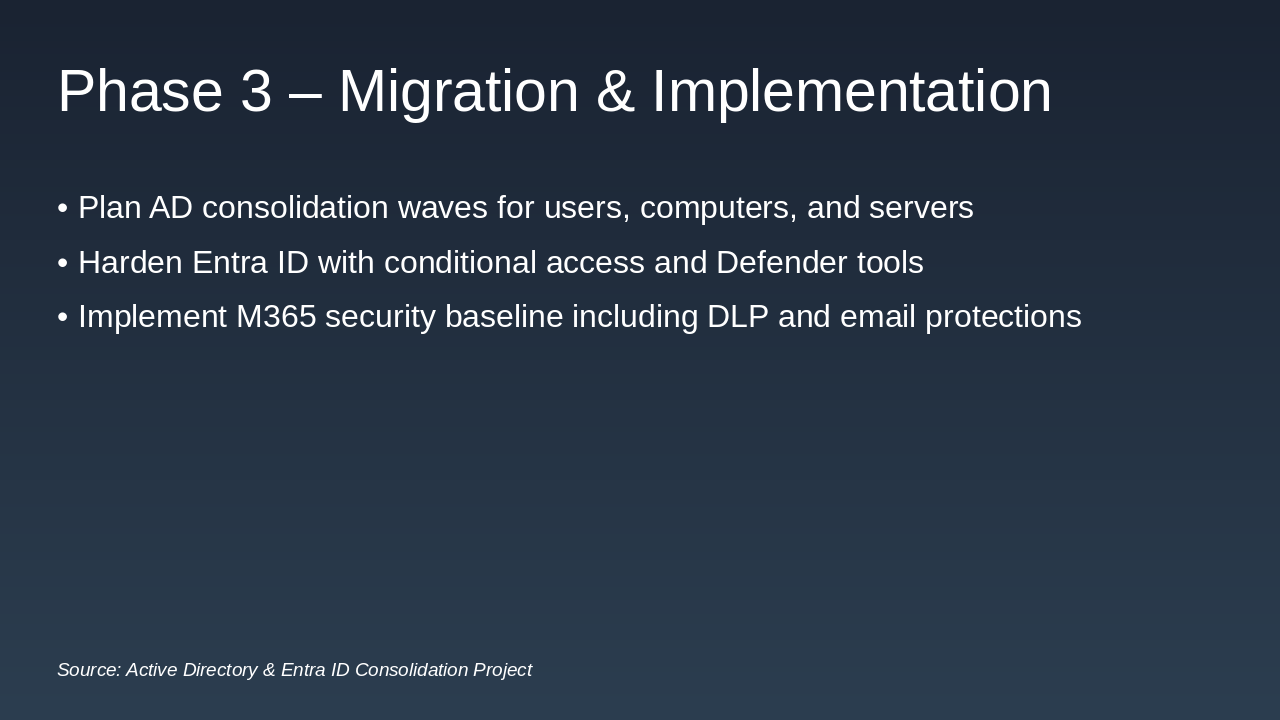
Slide 8 - Phase 3 – Migration & Implementation

Phase 3 of the project focuses on migration and implementation, starting with planning consolidation waves for users, computers, and servers in Active Directory. It also involves hardening Entra ID using conditional access and Defender tools, alongside implementing the Microsoft 365 security baseline that includes DLP and email protections.

Phase 3 – Migration & Implementation

  • Plan AD consolidation waves for users, computers, and servers
  • Harden Entra ID with conditional access and Defender tools
  • Implement M365 security baseline including DLP and email protections

Source: Active Directory & Entra ID Consolidation Project

Slide 8 - Phase 3 – Migration & Implementation
Slide 9 of 12

Slide 9 - Migration Planning Details

The Migration Planning Details timeline outlines a structured rollout starting in Q1 2024 with preparation and testing, including protocols, rollback procedures, and stakeholder communications. It progresses through Q2's Wave 1 user migration for 100 endpoints with training and monitoring, Q3's Wave 2 for remaining computers and 60 servers with contingencies, and Q4's completion with KPI evaluation and full programs.

Migration Planning Details

Q1 2024: Preparation and Testing Phase Develop testing protocols, rollback procedures, and initial communication plans for stakeholders. Q2 2024: Wave 1: User Migration Rollout Migrate first wave of users (100 endpoints), conduct training sessions, and monitor initial KPIs. Q3 2024: Wave 2: Computers and Servers Phased migration of remaining computers and 60 servers, with contingency rollback options. Q4 2024: Completion and KPI Evaluation Finalize rollout, evaluate success metrics, and implement full communication and training programs.

Slide 9 - Migration Planning Details
Slide 10 of 12

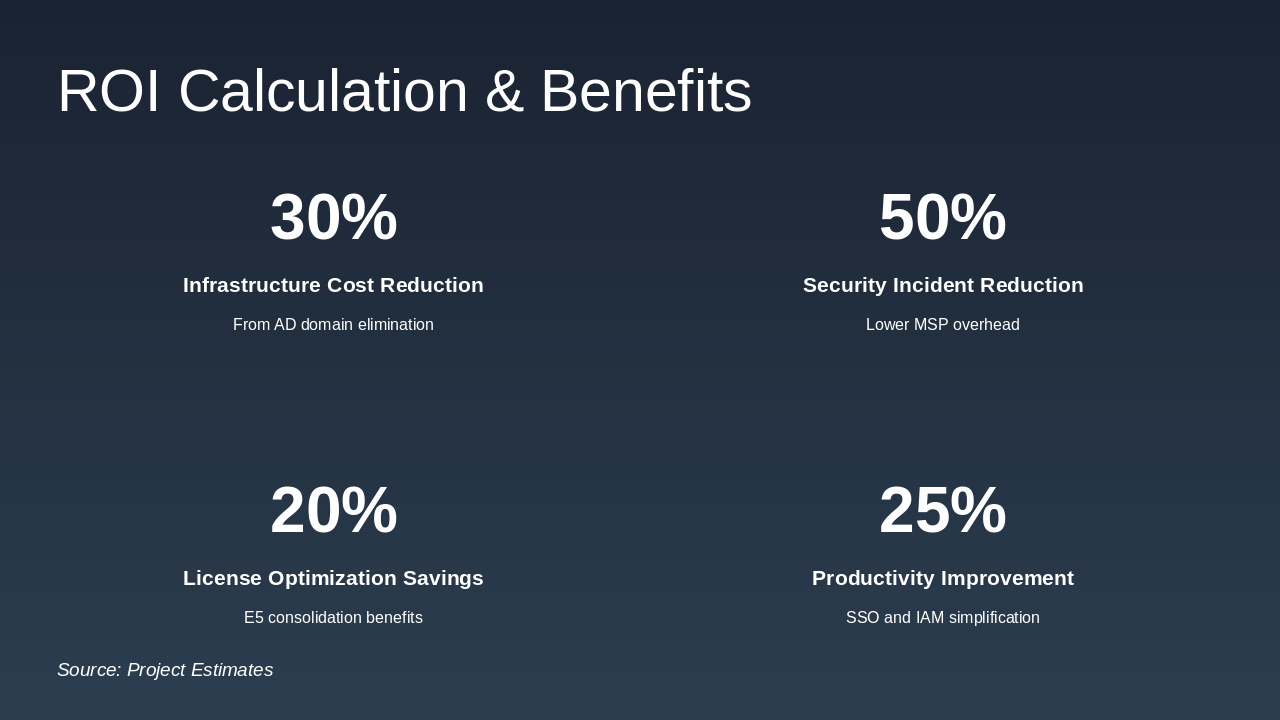
Slide 10 - ROI Calculation & Benefits

The slide outlines key ROI benefits from infrastructure optimizations, including a 30% reduction in costs by eliminating AD domains and a 50% drop in security incidents through lower MSP overhead. It also highlights 20% savings from E5 license consolidation and a 25% productivity boost via simplified SSO and IAM processes.

ROI Calculation & Benefits

  • 30%: Infrastructure Cost Reduction
  • From AD domain elimination

  • 50%: Security Incident Reduction
  • Lower MSP overhead

  • 20%: License Optimization Savings
  • E5 consolidation benefits

  • 25%: Productivity Improvement

SSO and IAM simplification Source: Project Estimates

Slide 10 - ROI Calculation & Benefits
Slide 11 of 12

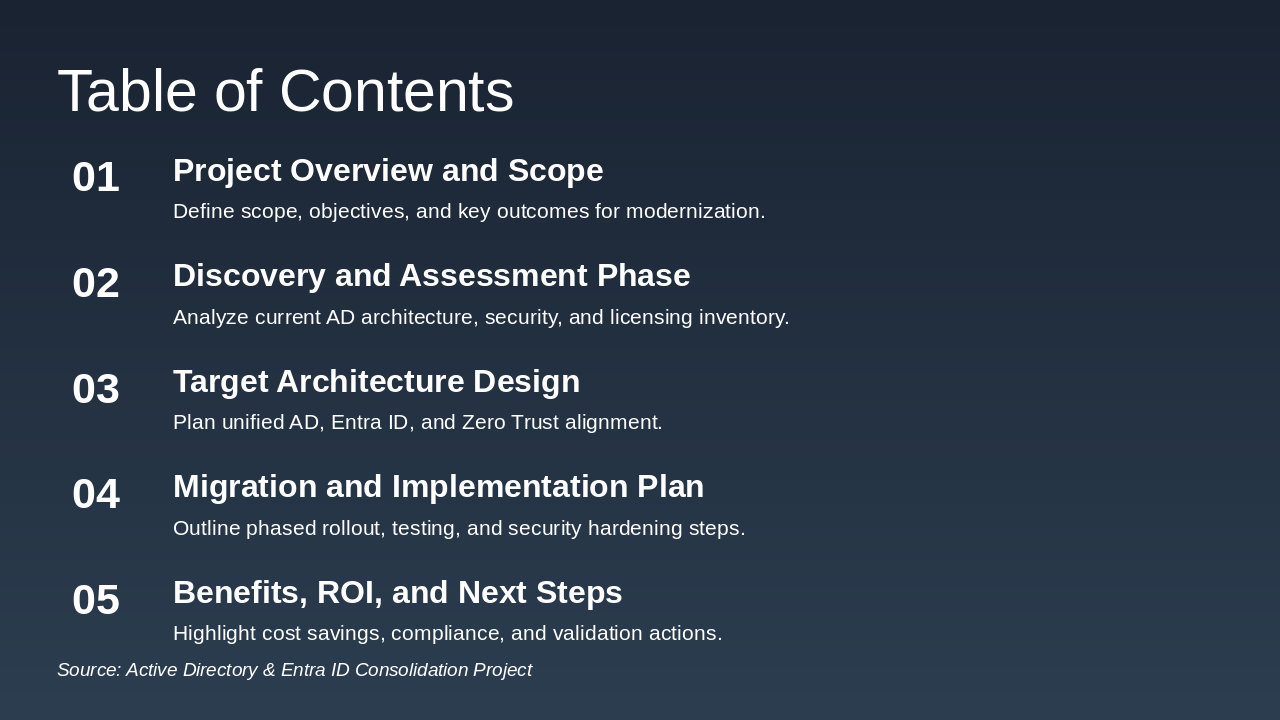
Slide 11 - Table of Contents

The slide presents a table of contents outlining the key sections of a project agenda focused on Active Directory modernization. It covers project overview and scope, discovery and assessment of current architecture, target architecture design with Entra ID and Zero Trust integration, migration and implementation planning, and benefits including ROI and next steps.

Table of Contents

  1. Project Overview and Scope
  2. Define scope, objectives, and key outcomes for modernization.

  3. Discovery and Assessment Phase
  4. Analyze current AD architecture, security, and licensing inventory.

  5. Target Architecture Design
  6. Plan unified AD, Entra ID, and Zero Trust alignment.

  7. Migration and Implementation Plan
  8. Outline phased rollout, testing, and security hardening steps.

  9. Benefits, ROI, and Next Steps

Highlight cost savings, compliance, and validation actions. Source: Active Directory & Entra ID Consolidation Project

Slide 11 - Table of Contents
Slide 12 of 12

Slide 12 - Summary

The slide summarizes a unified Active Directory and Entra ID ecosystem as a modern, secure identity framework that serves as the foundation for Zero Trust and cloud enablement. It closes with a message to secure the future through modern identity and a call-to-action to approve the modernization roadmap today.

Summary

Unified AD & Entra ID ecosystem. Modern, secure identity framework. Foundation for Zero Trust and cloud enablement.

Closing Message: Secure your future with modern identity.

Call-to-Action: Approve the roadmap to begin modernization today.

Speaker Notes
Emphasize the transformative impact on security and efficiency. Invite questions.
Slide 12 - Summary

Discover More Presentations

Explore thousands of AI-generated presentations for inspiration

Browse Presentations
Powered by AI

Create Your Own Presentation

Generate professional presentations in seconds with Karaf's AI. Customize this presentation or start from scratch.

Create New Presentation

Powered by Karaf.ai — AI-Powered Presentation Generator