L298N vs DRV8825: H-Bridge Showdown

Generated from prompt:

Create a 20-slide PowerPoint presentation titled 'Specialized Analysis of DC Motor Power Drivers: A Comparative Study of L298N and DRV8825 H-Bridge Architectures'. Use the Modern Tech Blue (engineering style, blue-gray) template. Slides should cover: 1) Title, 2) Introduction to Motor Drivers, 3) DC Motor Control, 4) H-Bridge Concept, 5) Characteristics of a Good H-Bridge, 6) L298N Overview, 7) L298N Pin Configuration, 8) L298N Working Principle, 9) L298N Performance, 10) DRV8825 Overview, 11) DRV8825 Pin Configuration, 12) DRV8825 Working Principle, 13) DRV8825 Performance, 14) Comparative Table, 15) H-Bridge Topology Comparison, 16) Thermal and Power Efficiency, 17) Application Examples, 18) Design Considerations, 19) Future Trends, 20) Conclusion. Include diagrams, charts, and visuals where suitable. Focus on technical depth and clarity.

Compares L298N and DRV8825 DC motor drivers: intros H-bridge concepts, pin configs, performance table, and trends. Highlights L298N's robustness vs DRV8825's efficiency.

December 20, 20256 slides
Slide 1 of 6

Slide 1 - Specialized Analysis of DC Motor Power Drivers: L298N vs DRV8825

This title slide introduces a specialized analysis of DC motor power drivers, comparing the L298N and DRV8825. It highlights a comparative study of their H-Bridge architectures, with a subtitle reinforcing "H-Bridge Architectures."

Specialized Analysis of DC Motor Power Drivers:

A Comparative Study of L298N and DRV8825 H-Bridge Architectures

H-Bridge Architectures

Speaker Notes
Engineering style title slide with Modern Tech Blue template. Subtitle: H-Bridge Architectures. Include motor icon visual.
Slide 1 - Specialized Analysis of DC Motor Power Drivers: L298N vs DRV8825
Slide 2 of 6

Slide 2 - Introduction to Motor Drivers & H-Bridge Concept

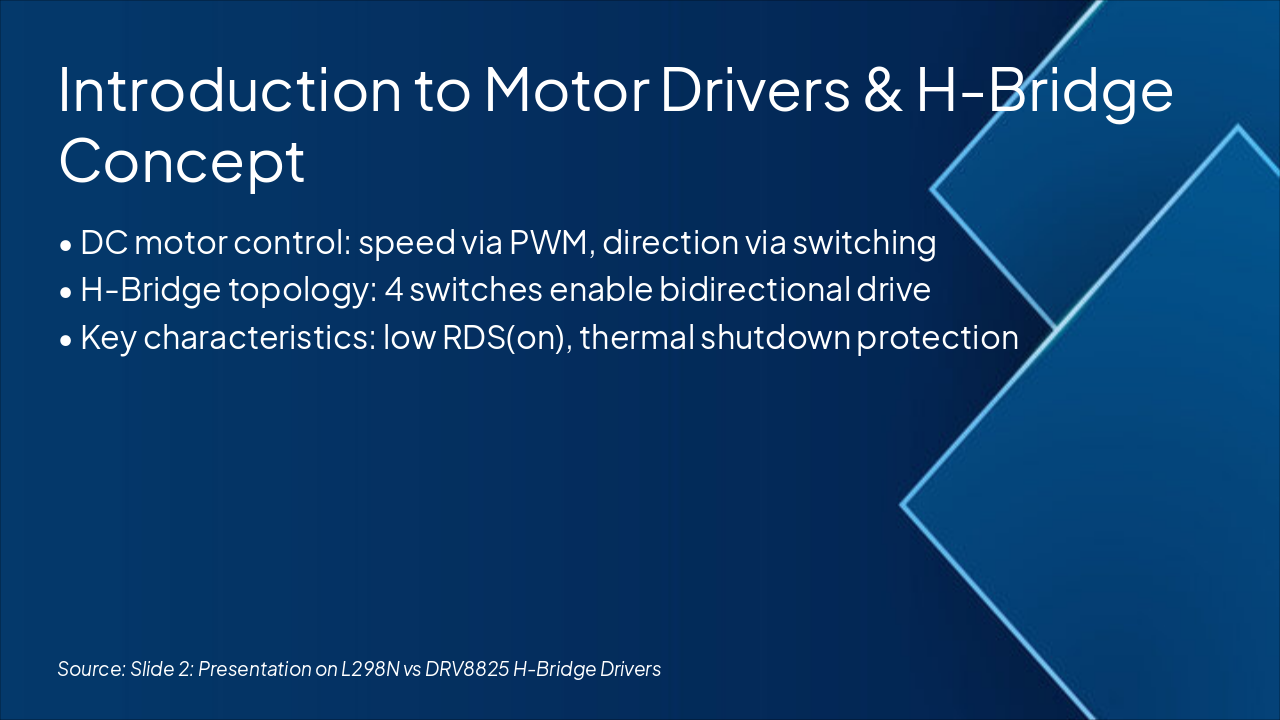
This slide introduces DC motor control using PWM for speed and switching for direction, along with the H-Bridge topology featuring 4 switches for bidirectional drive. It also highlights key characteristics like low RDS(on) and thermal shutdown protection.

Introduction to Motor Drivers & H-Bridge Concept

  • DC motor control: speed via PWM, direction via switching
  • H-Bridge topology: 4 switches enable bidirectional drive
  • Key characteristics: low RDS(on), thermal shutdown protection

Source: Slide 2: Presentation on L298N vs DRV8825 H-Bridge Drivers

Speaker Notes
Include basic H-Bridge schematic diagram. Highlight PWM control and bidirectional drive fundamentals.
Slide 2 - Introduction to Motor Drivers & H-Bridge Concept
Slide 3 of 6

Slide 3 - L298N Overview & Pin Configuration

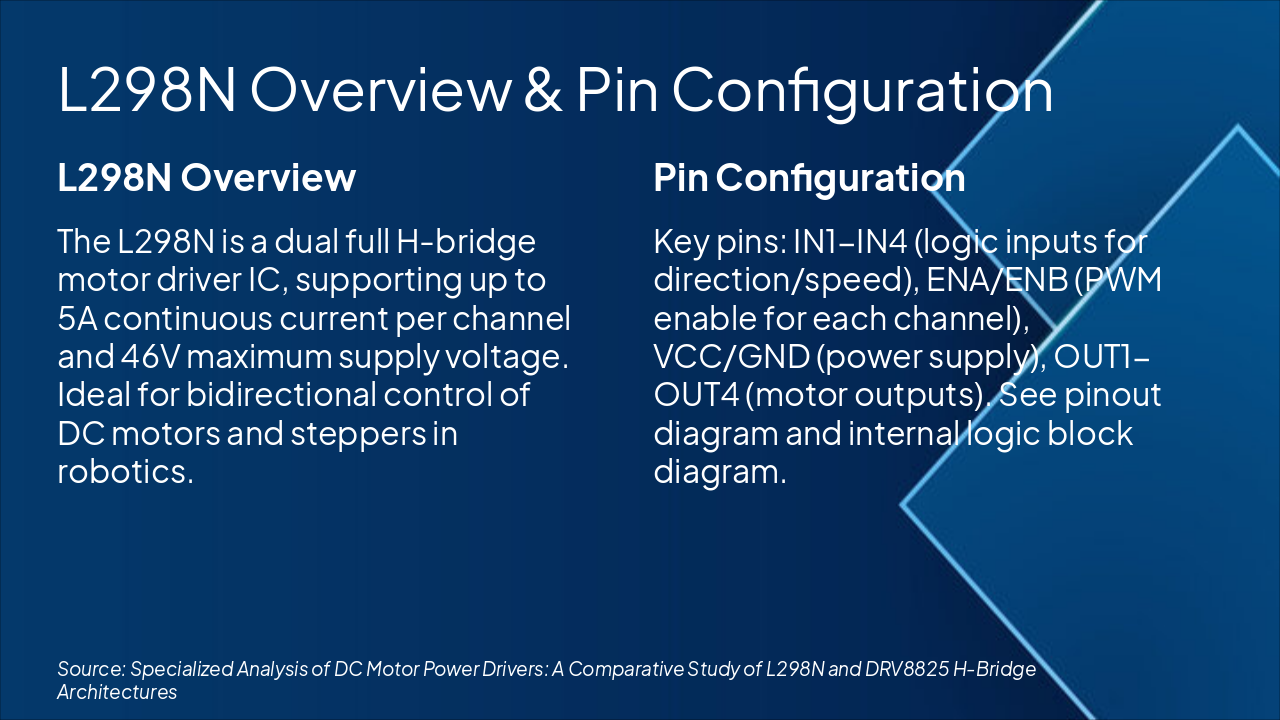
The L298N is a dual full H-bridge motor driver IC supporting up to 5A continuous current per channel and 46V max voltage, ideal for bidirectional control of DC motors and steppers in robotics. Key pins include IN1-IN4 (logic inputs for direction/speed), ENA/ENB (PWM enables), VCC/GND (power), and OUT1-OUT4 (motor outputs), as shown in the pinout and logic diagrams.

L298N Overview & Pin Configuration

L298N OverviewPin Configuration
The L298N is a dual full H-bridge motor driver IC, supporting up to 5A continuous current per channel and 46V maximum supply voltage. Ideal for bidirectional control of DC motors and steppers in robotics.Key pins: IN1-IN4 (logic inputs for direction/speed), ENA/ENB (PWM enable for each channel), VCC/GND (power supply), OUT1-OUT4 (motor outputs). See pinout diagram and internal logic block diagram.

Source: Specialized Analysis of DC Motor Power Drivers: A Comparative Study of L298N and DRV8825 H-Bridge Architectures

Speaker Notes
Emphasize L298N's dual H-bridge design for two motors. Point to pinout diagram (top-right) and internal block diagram (bottom) for visual reference during explanation.
Slide 3 - L298N Overview & Pin Configuration
Slide 4 of 6

Slide 4 - DRV8825 Overview & Pin Configuration

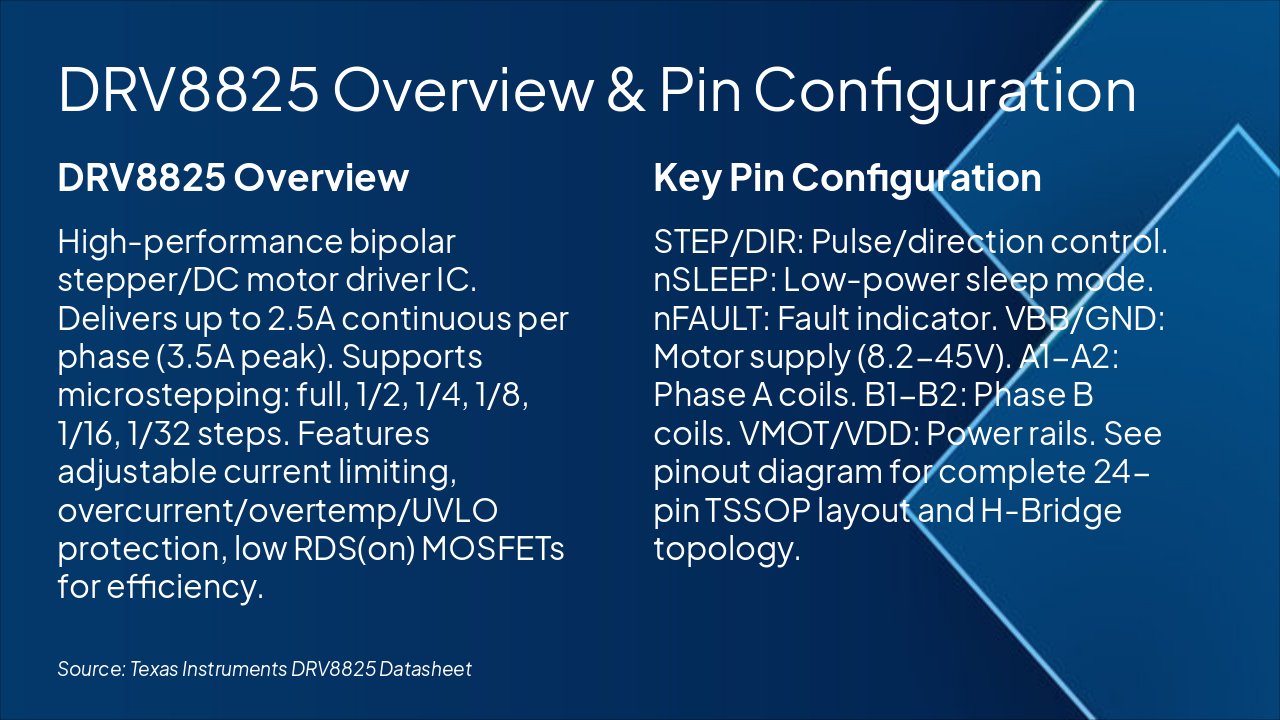
The DRV8825 is a high-performance bipolar stepper/DC motor driver IC that delivers up to 2.5A continuous (3.5A peak) per phase, supports microstepping up to 1/32, and includes protections like adjustable current limiting and overcurrent/overtemp. The slide's right column details key pins such as STEP/DIR for control, nSLEEP, nFAULT, motor supply (VBB/GND, 8.2-45V), phase coils (A1-A2, B1-B2), and power rails, referencing a 24-pin TSSOP pinout diagram.

DRV8825 Overview & Pin Configuration

DRV8825 OverviewKey Pin Configuration
High-performance bipolar stepper/DC motor driver IC. Delivers up to 2.5A continuous per phase (3.5A peak). Supports microstepping: full, 1/2, 1/4, 1/8, 1/16, 1/32 steps. Features adjustable current limiting, overcurrent/overtemp/UVLO protection, low RDS(on) MOSFETs for efficiency.STEP/DIR: Pulse/direction control. nSLEEP: Low-power sleep mode. nFAULT: Fault indicator. VBB/GND: Motor supply (8.2-45V). A1-A2: Phase A coils. B1-B2: Phase B coils. VMOT/VDD: Power rails. See pinout diagram for complete 24-pin TSSOP layout and H-Bridge topology.

Source: Texas Instruments DRV8825 Datasheet

Speaker Notes
Display DRV8825 pinout image under right column and H-Bridge topology diagram. Emphasize microstepping and protection features for technical audience.
Slide 4 - DRV8825 Overview & Pin Configuration
Slide 5 of 6

Slide 5 - Comparative Analysis: L298N vs DRV8825

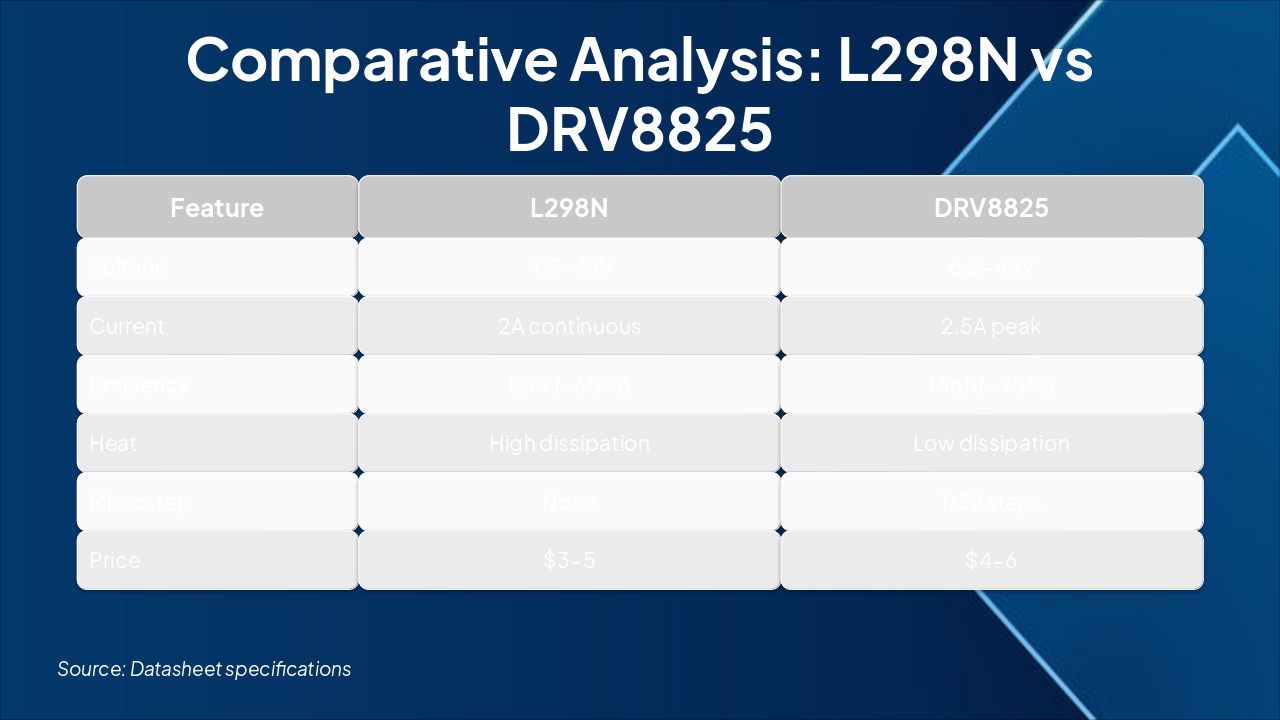
The table compares L298N and DRV8825 motor drivers on voltage (4.5-46V vs. 8.2-45V), current (2A continuous vs. 2.5A peak), efficiency (~60% vs. ~90%), heat (high vs. low), microstepping (none vs. 1/32), and price ($3-5 vs. $4-6). DRV8825 excels in efficiency, heat management, and microstepping, while L298N provides a wider voltage range at a slightly lower cost.

Comparative Analysis: L298N vs DRV8825

{ "headers": [ "Feature", "L298N", "DRV8825" ], "rows": [ [ "Voltage", "4.5-46V", "8.2-45V" ], [ "Current", "2A continuous", "2.5A peak" ], [ "Efficiency", "Low (~60%)", "High (~90%)" ], [ "Heat", "High dissipation", "Low dissipation" ], [ "Microstep", "None", "1/32 steps" ], [ "Price", "$3-5", "$4-6" ] ] }

Source: Datasheet specifications

Speaker Notes
Key features comparison. DRV8825 excels in efficiency and microstepping. Highlight performance metrics.
Slide 5 - Comparative Analysis: L298N vs DRV8825
Slide 6 of 6

Slide 6 - Conclusion & Future Trends

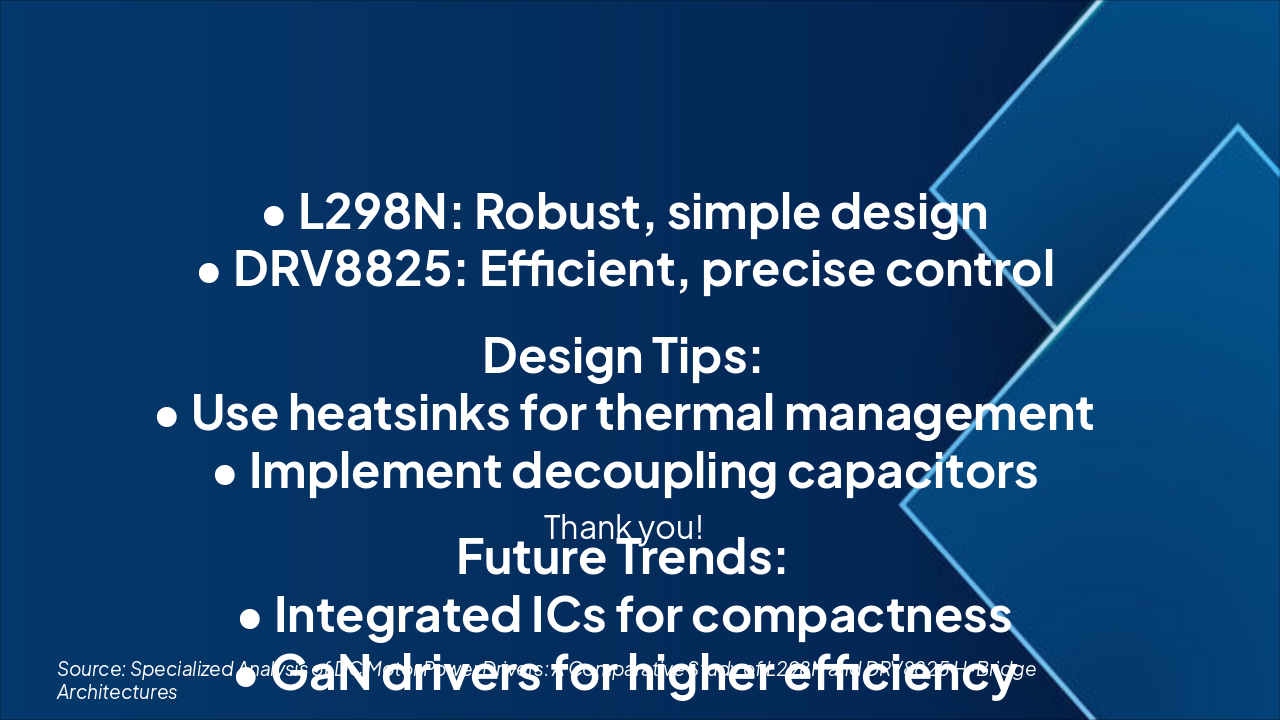
The slide summarizes L298N as robust and simple, DRV8825 as efficient and precise, with design tips like heatsinks and decoupling capacitors. It outlines future trends in integrated ICs and GaN drivers, advises choosing wisely for peak performance, and invites Q&A.

Conclusion & Future Trends

• L298N: Robust, simple design

  • DRV8825: Efficient, precise control

Design Tips:

  • Use heatsinks for thermal management
  • Implement decoupling capacitors

Future Trends:

  • Integrated ICs for compactness
  • GaN drivers for higher efficiency

Choose wisely for peak performance.

Open floor for Q&A!

Thank you!

Source: Specialized Analysis of DC Motor Power Drivers: A Comparative Study of L298N and DRV8825 H-Bridge Architectures

Speaker Notes
Closing message: Choose wisely for peak performance. (4 words) Call-to-action: Open floor for Q&A and discussion. (6 words) Emphasize key takeaways, design tips, and trends before inviting questions.
Slide 6 - Conclusion & Future Trends

Discover More Presentations

Explore thousands of AI-generated presentations for inspiration

Browse Presentations
Powered by AI

Create Your Own Presentation

Generate professional presentations in seconds with Karaf's AI. Customize this presentation or start from scratch.

Create New Presentation

Powered by Karaf.ai — AI-Powered Presentation Generator