Rectifiers: Principles, Types, and Applications in Power Electronics

Generated from prompt:

Report on rectifiers

This presentation provides a comprehensive overview of rectifiers, fundamental devices that convert alternating current (AC) to direct current (DC). It covers the introduction and definition, historical development from early vacuum tubes to modern silicon carbide diodes, classifications including half-wave, full-wave center-tap, bridge, and controlled rectifiers, key performance characteristics like efficiency and ripple factor, practical applications in chargers, motors, electroplating, and power transmission, along with advantages, disadvantages, and concluding insights.

May 6, 202616 slides
Slide 1 of 16

Slide 1 - Report on Rectifiers

Report on Rectifiers

Converting AC to DC in Power Electronics

---

Photo by Glenn Hansen on Unsplash

Slide 1 - Report on Rectifiers
Slide 2 of 16

Slide 2 - Presentation Agenda

  • Introduction to Rectifiers
  • History and Development
  • Types of Rectifiers
  • Working Principles
  • Key Characteristics
  • Applications
  • Conclusion

---

Photo by Umberto on Unsplash

Slide 2 - Presentation Agenda
Slide 3 of 16

Slide 3 - Introduction to Rectifiers

1

Introduction

Fundamentals of AC to DC Conversion

---

Photo by Doug Baney on Unsplash
Slide 3 - Introduction to Rectifiers
Slide 4 of 16

Slide 4 - What is a Rectifier?

  • Converts alternating current (AC) to direct current (DC)
  • Uses diodes for unidirectional conduction
  • Essential component in power supplies
  • Processes only one polarity of AC waveform
Slide 4 - What is a Rectifier?
Slide 5 of 16

Slide 5 - History of Rectifiers

2

History

Key Milestones in Rectification

---

Photo by Tawshif Khan on Unsplash

Slide 5 - History of Rectifiers
Slide 6 of 16

Slide 6 - Development Timeline

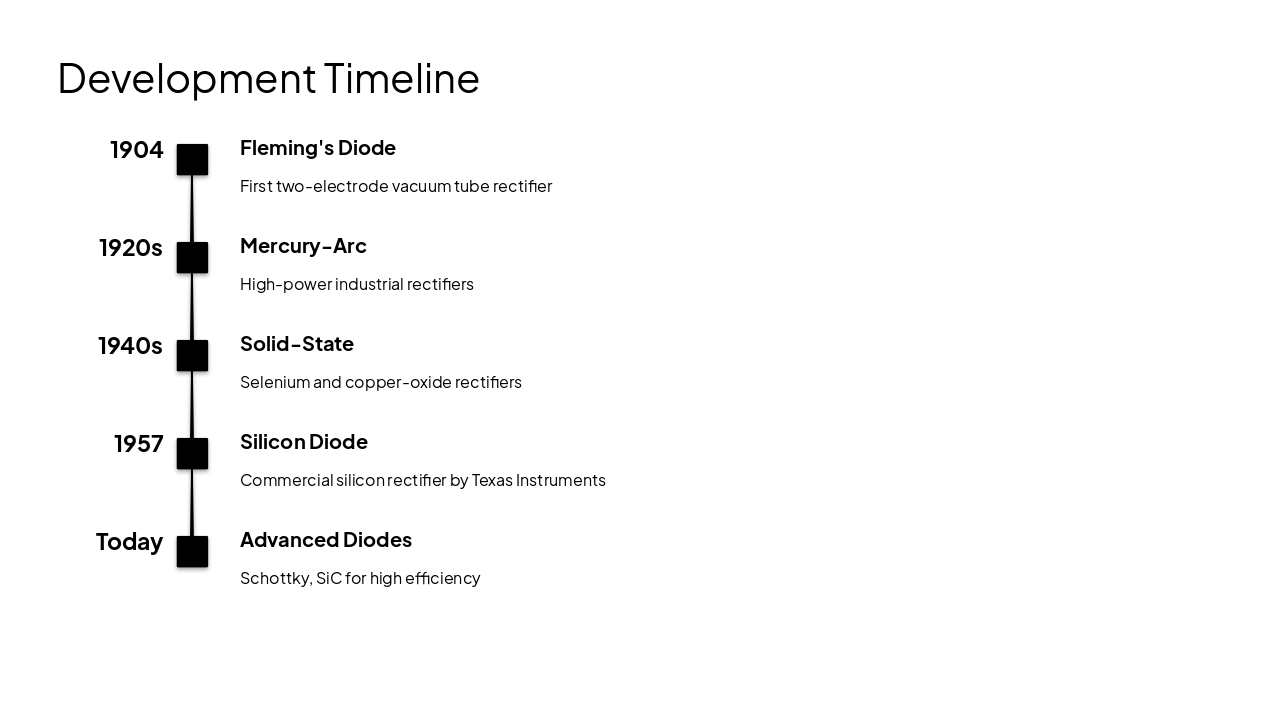
1904: Fleming's Diode First two-electrode vacuum tube rectifier 1920s: Mercury-Arc High-power industrial rectifiers 1940s: Solid-State Selenium and copper-oxide rectifiers 1957: Silicon Diode Commercial silicon rectifier by Texas Instruments Today: Advanced Diodes Schottky, SiC for high efficiency

Slide 6 - Development Timeline
Slide 7 of 16

Slide 7 - Types of Rectifiers

3

Types

Classifications by Operation and Configuration

---

Photo by Hanna Morris on Unsplash

Slide 7 - Types of Rectifiers
Slide 8 of 16

Slide 8 - Classification of Rectifiers

  • Half-Wave Rectifier: Single diode, utilizes half AC cycle
  • Full-Wave Center-Tap: Two diodes, transformer with center tap
  • Bridge Rectifier: Four diodes, no center tap needed
  • Controlled Rectifiers: Use thyristors (SCRs) for phase control
Slide 8 - Classification of Rectifiers
Slide 9 of 16

Slide 9 - Half-Wave Rectifier

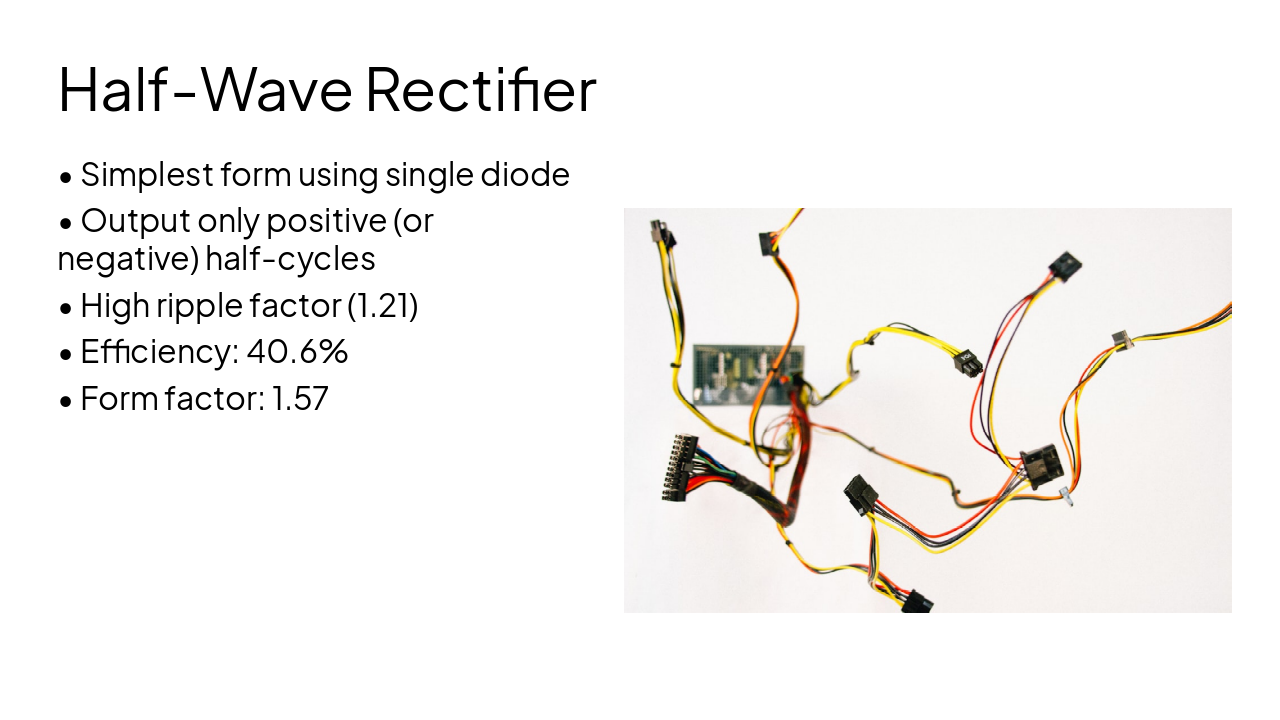
  • Simplest form using single diode
  • Output only positive (or negative) half-cycles
  • High ripple factor (1.21)
  • Efficiency: 40.6%
  • Form factor: 1.57

---

Photo by Randall Bruder on Unsplash
Slide 9 - Half-Wave Rectifier
Slide 10 of 16

Slide 10 - Bridge Rectifier

  • Uses four diodes in bridge configuration
  • No special transformer required
  • Both half-cycles utilized
  • Ripple factor: 0.48
  • Efficiency: 81.2%

---

Photo by Randall Bruder on Unsplash
Slide 10 - Bridge Rectifier
Slide 11 of 16

Slide 11 - Key Performance Stats

  • 40.6%: Half-Wave Efficiency
  • 81.2%: Full-Wave Efficiency
  • 1.21: Half-Wave Ripple
  • 0.48: Full-Wave Ripple

---

Photo by Luke Chesser on Unsplash

Slide 11 - Key Performance Stats
Slide 12 of 16

Slide 12 - Applications of Rectifiers

4

Applications

From Consumer Electronics to Industry

---

Photo by Umberto on Unsplash

Slide 12 - Applications of Rectifiers
Slide 13 of 16

Slide 13 - Practical Applications

  • AC-DC adapters and phone chargers
  • Battery charging circuits
  • DC motor speed control
  • High-voltage DC transmission
  • Electrowinning and electroplating
  • RFID and signal demodulation
Slide 13 - Practical Applications
Slide 14 of 16

Slide 14 - Advantages vs Disadvantages

Advantages

  • High efficiency in full-wave designs
  • Simple and cost-effective
  • Reliable solid-state components
  • Essential for all DC-powered devices

Disadvantages

  • Output ripple requires filtering
  • Half-wave low efficiency
  • Harmonic distortion in AC supply
  • Heat generation in high power
Slide 14 - Advantages vs Disadvantages
Slide 15 of 16

Slide 15 - Key Insight

> 'The rectifier is the cornerstone of all DC power systems, transforming the alternating world into direct usability.'

— Power Electronics Expert

---

Photo by Axel Richter on Unsplash

Slide 15 - Key Insight
Slide 16 of 16

Slide 16 - Conclusion

Rectifiers enable the powering of our digital world From simple diodes to advanced SiC devices, efficiency and applications expand

Thank you for your attention! Questions?

---

Photo by Gabriel Castles on Unsplash

Slide 16 - Conclusion

Discover More Presentations

Explore thousands of AI-generated presentations for inspiration

Browse Presentations
Powered by AI

Create Your Own Presentation

Generate professional presentations in seconds with Karaf's AI. Customize this presentation or start from scratch.

Create New Presentation

Powered by Karaf.ai — AI-Powered Presentation Generator