Printing Press: Igniting Renaissance Critical Thinking

Generated from prompt:

L'imprimerie au XVIe siècle: Comment l'imprimerie contribue-t-elle à la diffusion de l'esprit critique à la Renaissance ?

This presentation explores the 16th-century printing press's invention by Gutenberg, its rapid European expansion, and role in spreading ancient texts, translations, and ideas. Featuring history, time

November 28, 202511 slides
Slide 1 of 11

Slide 1 - L'Imprimerie au XVIe Siècle

The slide is titled "L'Imprimerie au XVIe Siècle," which translates to "Printing in the 16th Century." Its subtitle highlights the influence of printing on critical thinking during the Renaissance.

L'Imprimerie au XVIe Siècle

Influence sur l'Esprit Critique à la Renaissance

Slide 1 - L'Imprimerie au XVIe Siècle
Slide 2 of 11

Slide 2 - Plan de la présentation

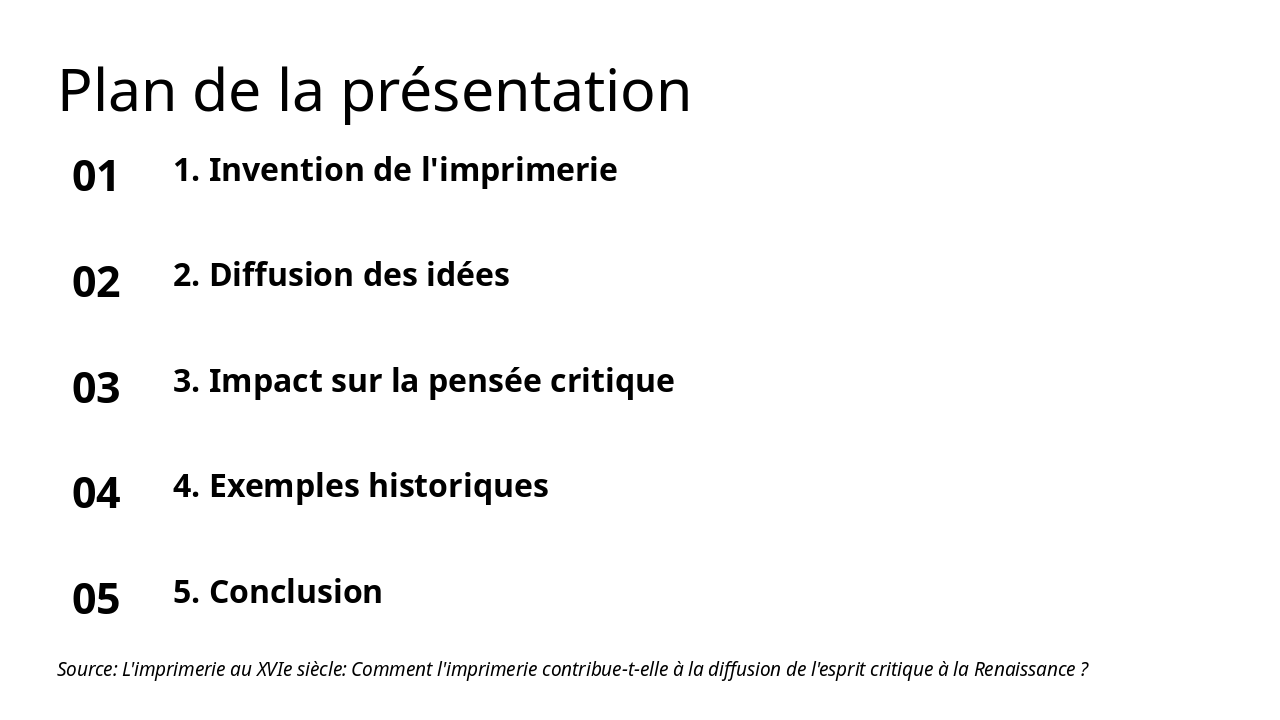
This agenda slide outlines the structure of a presentation on the printing press and its influences. It covers the invention of printing, the spread of ideas, its impact on critical thinking, historical examples, and a conclusion.

Plan de la présentation

  1. 1. Invention de l'imprimerie
  2. 2. Diffusion des idées
  3. 3. Impact sur la pensée critique
  4. 4. Exemples historiques
  5. 5. Conclusion

Source: L'imprimerie au XVIe siècle: Comment l'imprimerie contribue-t-elle à la diffusion de l'esprit critique à la Renaissance ?

Slide 2 - Plan de la présentation
Slide 3 of 11

Slide 3 - L'invention de l'imprimerie

This section header slide is titled "L'invention de l'imprimerie," focusing on the invention of printing. Its subtitle highlights a review of Johannes Gutenberg and the early developments in the 15th century, leading to the printing boom in the 16th century.

L'invention de l'imprimerie

Retour sur Gutenberg et les débuts au XVe siècle, menant au boom du XVIe

Slide 3 - L'invention de l'imprimerie
Slide 4 of 11

Slide 4 - Histoire de l'imprimerie au XVIe

The printing press was invented by Gutenberg around 1440, leading to its rapid expansion across Europe in the 16th century. This enabled massive production of books in Latin, Greek, and vernacular languages, significantly boosting the spread of critical ideas during the Renaissance.

Histoire de l'imprimerie au XVIe

  • Invention par Gutenberg vers 1440
  • Expansion rapide en Europe au XVIe siècle
  • Production massive de livres en latin, grec et vernaculaire
  • Diffusion accrue des idées critiques à la Renaissance
Speaker Notes
L'imprimerie au XVIe siècle: Comment l'imprimerie contribue-t-elle à la diffusion de l'esprit critique à la Renaissance ?
Slide 4 - Histoire de l'imprimerie au XVIe
Slide 5 of 11

Slide 5 - La presse de Gutenberg

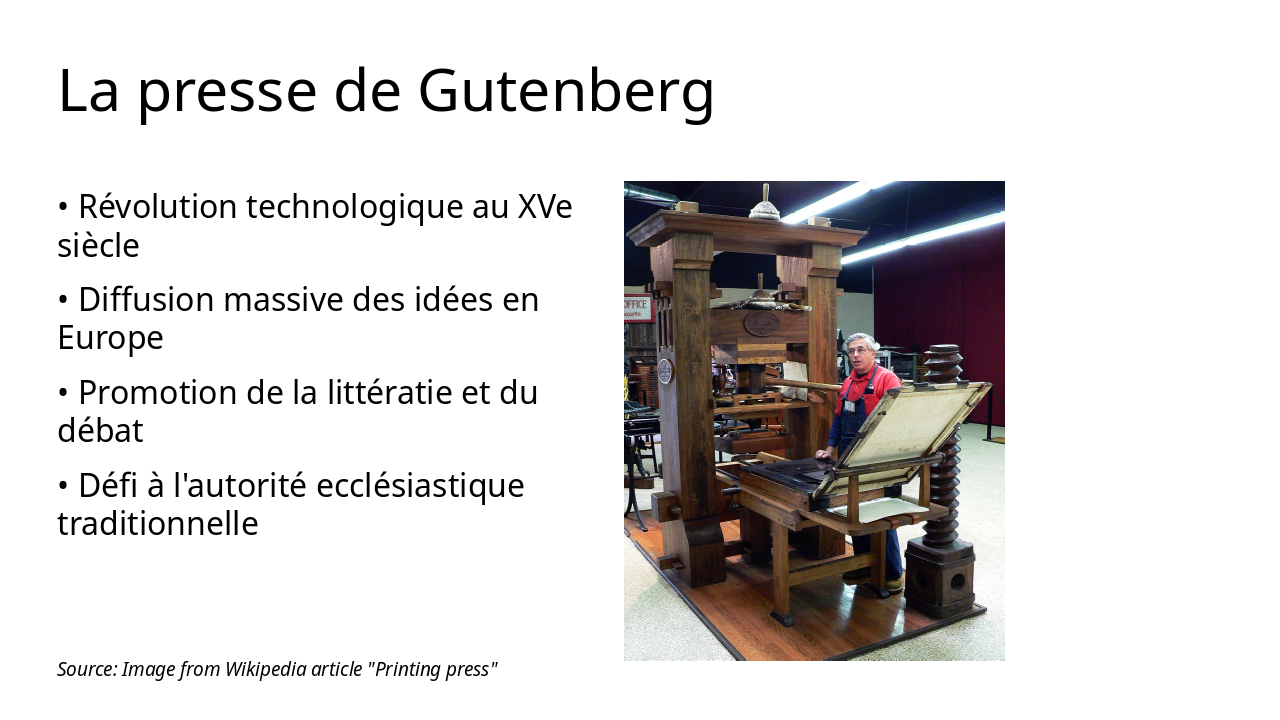
The slide titled "La presse de Gutenberg" highlights the 15th-century technological revolution introduced by the printing press. It emphasizes its role in enabling the massive diffusion of ideas across Europe, promoting literacy and debate while challenging traditional ecclesiastical authority.

La presse de Gutenberg

!Image

  • Révolution technologique au XVe siècle
  • Diffusion massive des idées en Europe
  • Promotion de la littératie et du débat
  • Défi à l'autorité ecclésiastique traditionnelle

Source: Image from Wikipedia article "Printing press"

Slide 5 - La presse de Gutenberg
Slide 6 of 11

Slide 6 - Événements clés du XVIe siècle

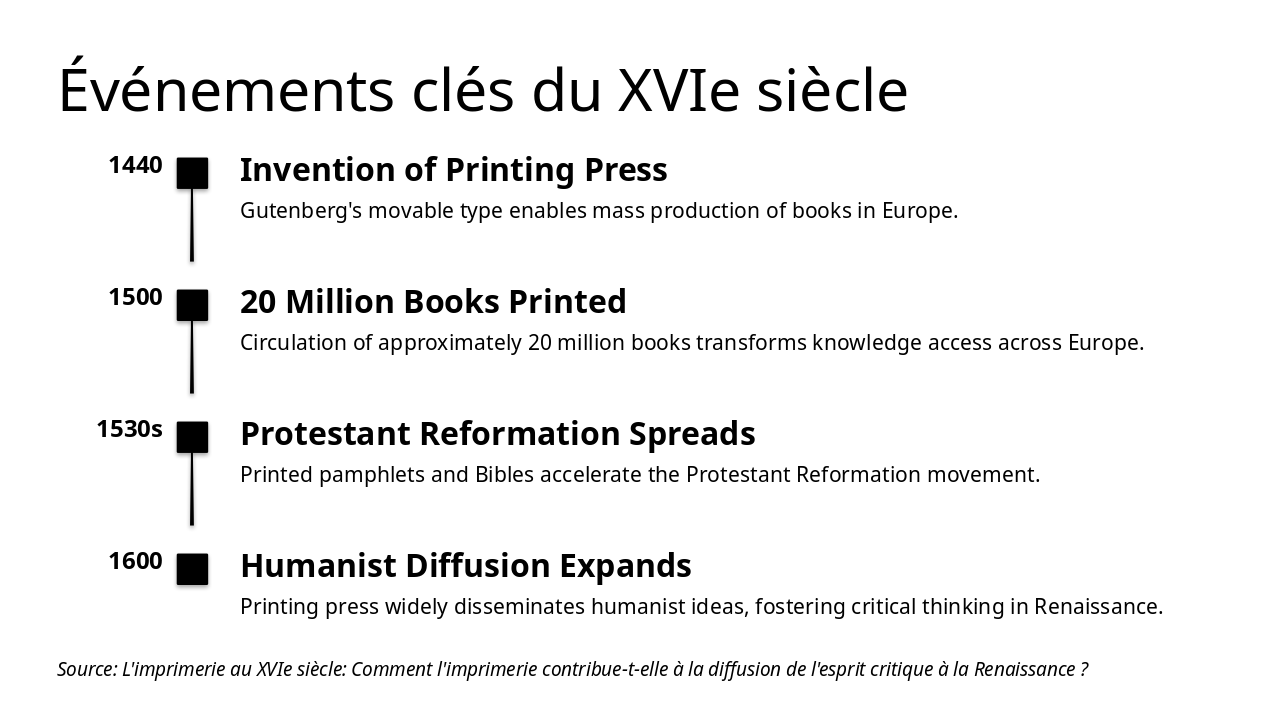
The timeline slide "Événements clés du XVIe siècle" highlights key events in printing and knowledge dissemination during the 16th century. It begins with Gutenberg's 1440 invention of the movable type printing press, which enabled mass book production, leading to about 20 million books printed by 1500, the spread of the Protestant Reformation via pamphlets and Bibles in the 1530s, and the widespread diffusion of humanist ideas by 1600 to promote Renaissance critical thinking.

Événements clés du XVIe siècle

1440: Invention of Printing Press Gutenberg's movable type enables mass production of books in Europe. 1500: 20 Million Books Printed Circulation of approximately 20 million books transforms knowledge access across Europe. 1530s: Protestant Reformation Spreads Printed pamphlets and Bibles accelerate the Protestant Reformation movement. 1600: Humanist Diffusion Expands Printing press widely disseminates humanist ideas, fostering critical thinking in Renaissance.

Source: L'imprimerie au XVIe siècle: Comment l'imprimerie contribue-t-elle à la diffusion de l'esprit critique à la Renaissance ?

Slide 6 - Événements clés du XVIe siècle
Slide 7 of 11

Slide 7 - Diffusion des connaissances

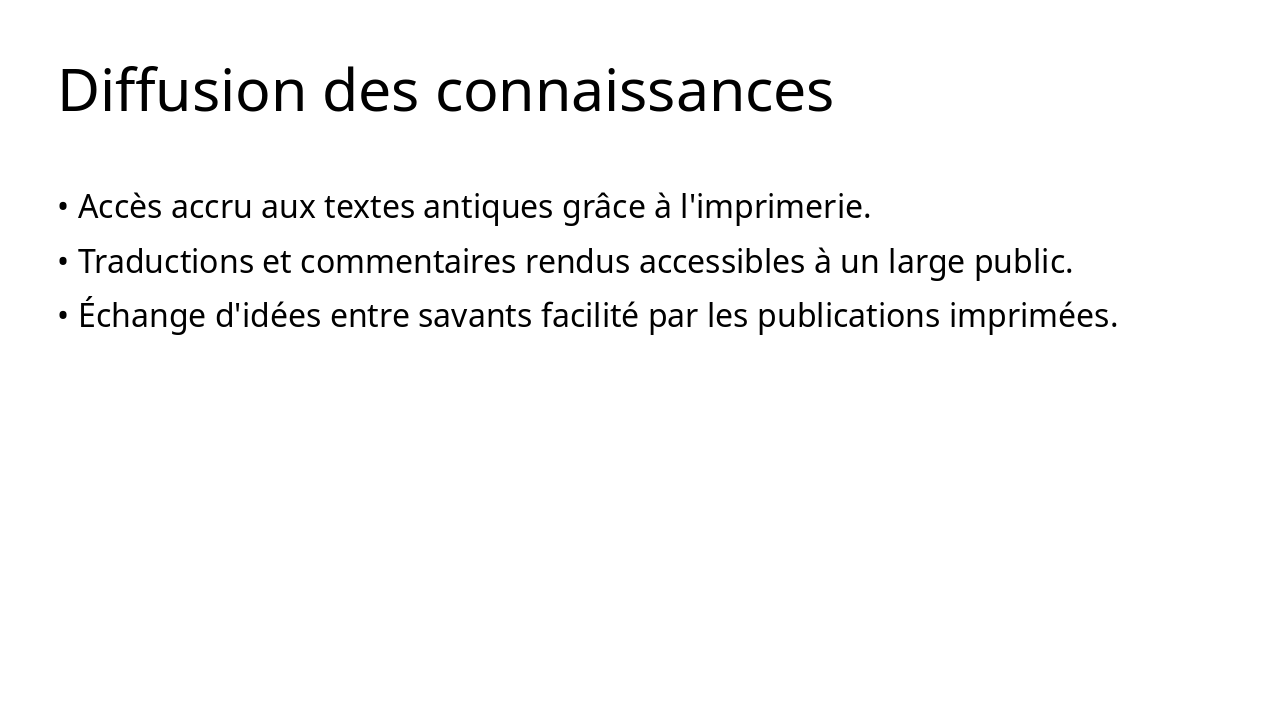
The slide titled "Diffusion des connaissances" highlights how the invention of printing greatly increased access to ancient texts. It also emphasizes that translations and commentaries became available to a broad audience, while printed publications facilitated idea exchanges among scholars.

Diffusion des connaissances

  • Accès accru aux textes antiques grâce à l'imprimerie.
  • Traductions et commentaires rendus accessibles à un large public.
  • Échange d'idées entre savants facilité par les publications imprimées.
Slide 7 - Diffusion des connaissances
Slide 8 of 11

Slide 8 - Citation d'Érasme

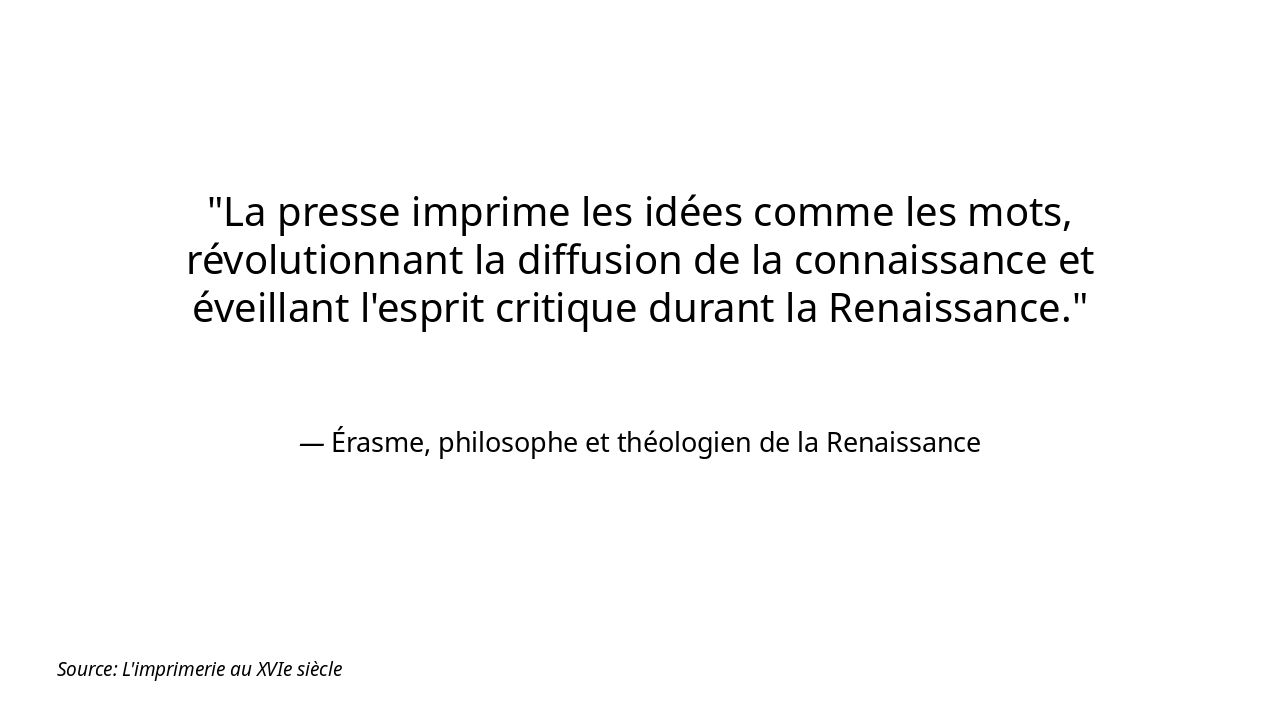
The slide, titled "Citation d'Érasme," features a quote from Renaissance philosopher and theologian Erasmus. It states that the printing press imprints ideas like words, revolutionizing the spread of knowledge and awakening critical thinking during the Renaissance.

Citation d'Érasme

> La presse imprime les idées comme les mots, révolutionnant la diffusion de la connaissance et éveillant l'esprit critique durant la Renaissance.

— Érasme, philosophe et théologien de la Renaissance

Source: L'imprimerie au XVIe siècle

Speaker Notes
Comment l'imprimerie contribue-t-elle à la diffusion de l'esprit critique à la Renaissance ?
Slide 8 - Citation d'Érasme
Slide 9 of 11

Slide 9 - Esprit critique avant et après

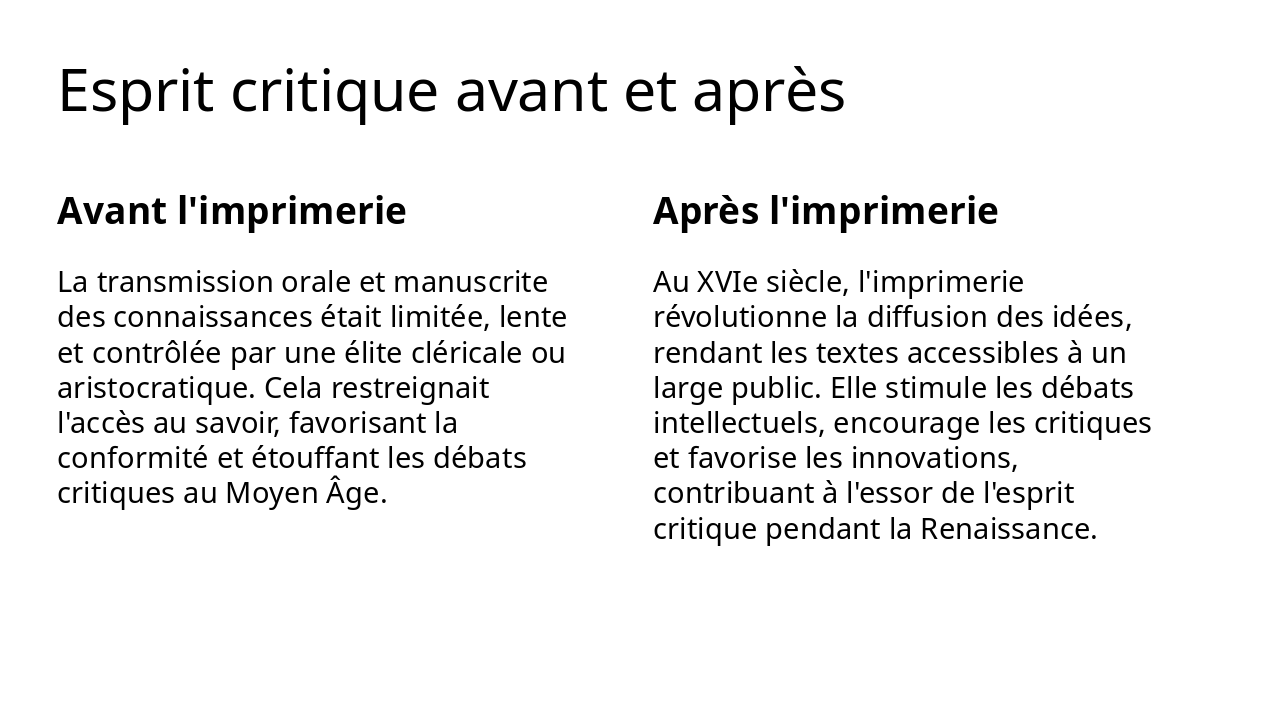
Before the invention of the printing press, knowledge transmission through oral and manuscript methods was limited, slow, and controlled by clerical or aristocratic elites, which restricted access to information and suppressed critical debates during the Middle Ages. After the printing press emerged in the 16th century, it revolutionized idea dissemination by making texts widely accessible, sparking intellectual debates, encouraging criticism, and fostering innovations that propelled the rise of critical thinking during the Renaissance.

Esprit critique avant et après

Avant l'imprimerieAprès l'imprimerie
La transmission orale et manuscrite des connaissances était limitée, lente et contrôlée par une élite cléricale ou aristocratique. Cela restreignait l'accès au savoir, favorisant la conformité et étouffant les débats critiques au Moyen Âge.Au XVIe siècle, l'imprimerie révolutionne la diffusion des idées, rendant les textes accessibles à un large public. Elle stimule les débats intellectuels, encourage les critiques et favorise les innovations, contribuant à l'essor de l'esprit critique pendant la Renaissance.
Slide 9 - Esprit critique avant et après
Slide 10 of 11

Slide 10 - Statistiques sur l'impression

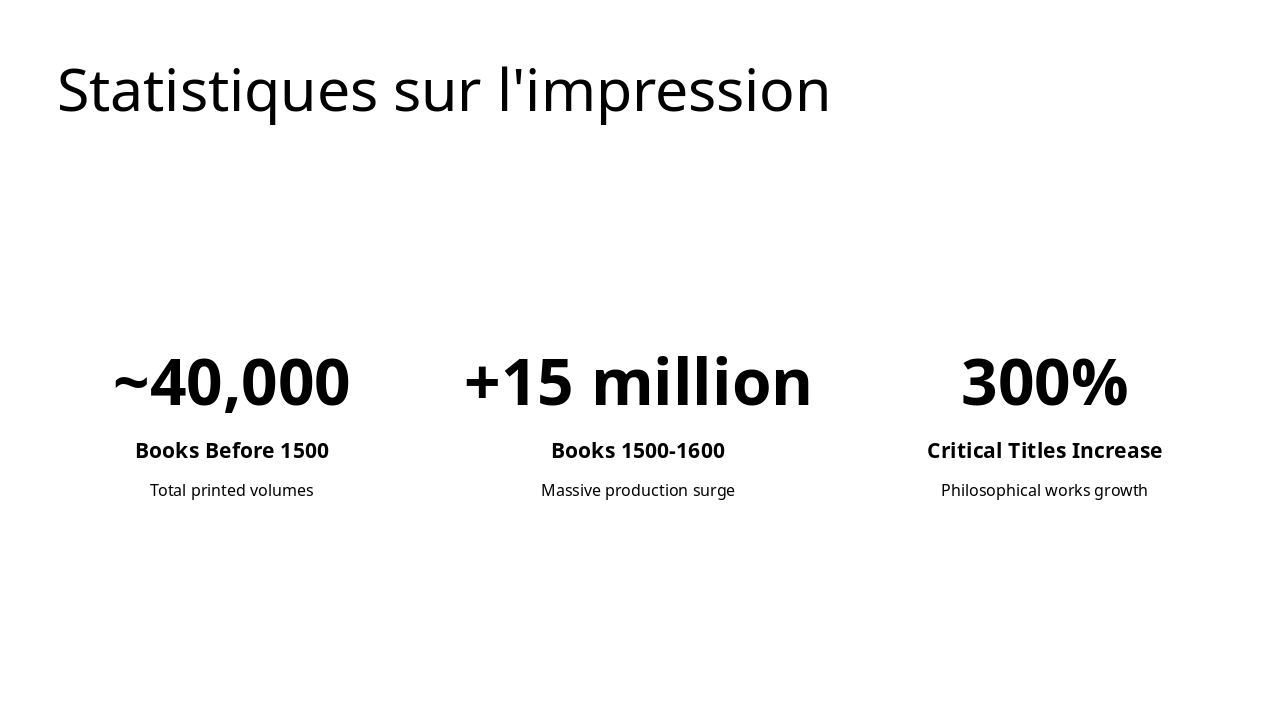
The slide on printing statistics highlights that approximately 40,000 books were printed before 1500, representing the total printed volumes from that era. It then notes a massive surge to over 15 million books between 1500 and 1600, alongside a 300% increase in critical titles, particularly philosophical works.

Statistiques sur l'impression

  • ~40,000: Books Before 1500
  • Total printed volumes

  • +15 million: Books 1500-1600
  • Massive production surge

  • 300%: Critical Titles Increase
  • Philosophical works growth

Slide 10 - Statistiques sur l'impression
Slide 11 of 11

Slide 11 - Conclusion

The printing press democratized knowledge, fostering critical thinking and laying the foundations of modernity. It left a lasting impact on society, as highlighted by its enduring legacy.

Conclusion

L'imprimerie a démocratisé le savoir, stimulant l'esprit critique et posant les bases de la modernité. Impact durable sur la société.

Héritage durable de l'imprimerie.

Source: L'imprimerie au XVIe siècle: Comment l'imprimerie contribue-t-elle à la diffusion de l'esprit critique à la Renaissance ?

Speaker Notes
L'imprimerie a démocratisé le savoir, stimulant l'esprit critique et posant les bases de la modernité. Impact durable sur la société. Closing message: Héritage durable de l'imprimerie. (4 mots). Call-to-action: Explorez l'impact des innovations numériques actuelles. (6 mots).
Slide 11 - Conclusion
Powered by AI

Create Your Own Presentation

Generate professional presentations in seconds with Karaf's AI. Customize this presentation or start from scratch.

Create New Presentation

Powered by Karaf.ai — AI-Powered Presentation Generator