COI in Research & Publication Ethics

Generated from prompt:

Create a 15-slide PowerPoint presentation titled 'Conflict of Interest in Research and Publication Ethics' for 15 PhD scholars (20-minute seminar). Each slide represents one participant. Include key content, flowcharts, and diagrams. Slides: 1) Title slide 2) Introduction to Research Ethics 3) Definition of Conflict of Interest 4) Types of COI (financial, personal, academic, institutional) 5) Examples of COI in research 6) COI in publication 7) Disclosure and Transparency 8) Ethical Guidelines (COPE, ICMJE, etc.) 9) Managing COI in research 10) Managing COI in publication 11) Flowchart: COI Disclosure Process 12) Diagram: Ethical Decision-Making Model 13) Institutional Responsibilities 14) Consequences of Non-disclosure 15) Conclusion & Takeaway. Use a blue and white academic theme with clear visuals and concise text.

15-slide seminar for PhD scholars on conflicts of interest (COI): definitions, types/examples, disclosure processes, ethical guidelines (COPE/ICMJE), management strategies, institutional roles, conseq

December 6, 202515 slides
Slide 1 of 15

Slide 1 - Title Slide

This title slide displays the main topic "Conflict of Interest in Research and Publication Ethics." The subtitle notes it is a 20-minute seminar for 15 PhD scholars, presented by Presenter Name on Date from Affiliation.

Conflict of Interest in Research and Publication Ethics

20-Minute Seminar for 15 PhD Scholars Presenter Name | Date | Affiliation

Slide 1 - Title Slide
Slide 2 of 15

Slide 2 - Introduction to Research Ethics

This slide introduces research ethics by emphasizing core principles of integrity, honesty, and objectivity. It explains how ethics safeguards public trust, ensures reliable and reproducible knowledge, and drives academia and societal progress.

Introduction to Research Ethics

  • Emphasizes core principles: integrity, honesty, objectivity.
  • Safeguards public trust in scientific research.
  • Ensures reliable, reproducible knowledge production.
  • Essential for academia and societal progress.
Slide 2 - Introduction to Research Ethics
Slide 3 of 15

Slide 3 - Definition of Conflict of Interest

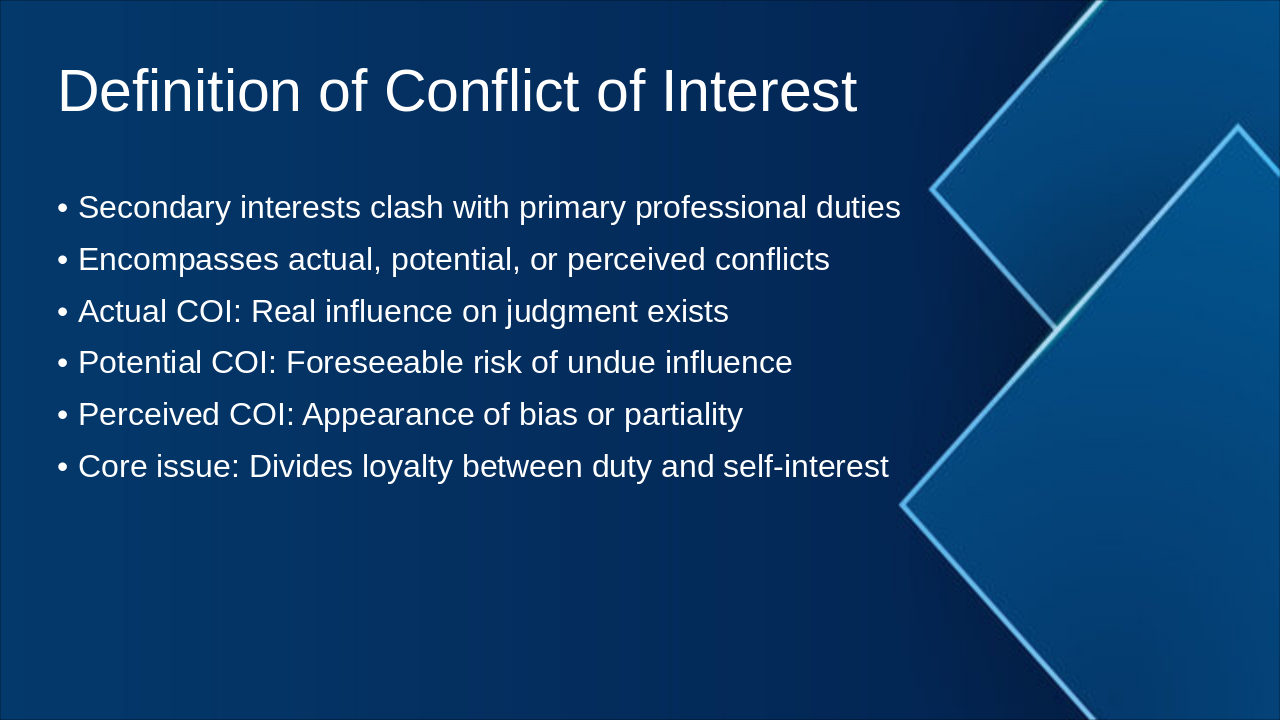
A conflict of interest arises when secondary interests clash with primary professional duties, encompassing actual, potential, or perceived conflicts. Actual COIs involve real influence on judgment, potential ones a foreseeable risk of undue influence, and perceived ones an appearance of bias, dividing loyalty between duty and self-interest.

Definition of Conflict of Interest

  • Secondary interests clash with primary professional duties
  • Encompasses actual, potential, or perceived conflicts
  • Actual COI: Real influence on judgment exists
  • Potential COI: Foreseeable risk of undue influence
  • Perceived COI: Appearance of bias or partiality
  • Core issue: Divides loyalty between duty and self-interest
Speaker Notes
Highlight that COI undermines trust; even perceived conflicts require management to preserve research integrity.
Slide 3 - Definition of Conflict of Interest
Slide 4 of 15

Slide 4 - Types of COI

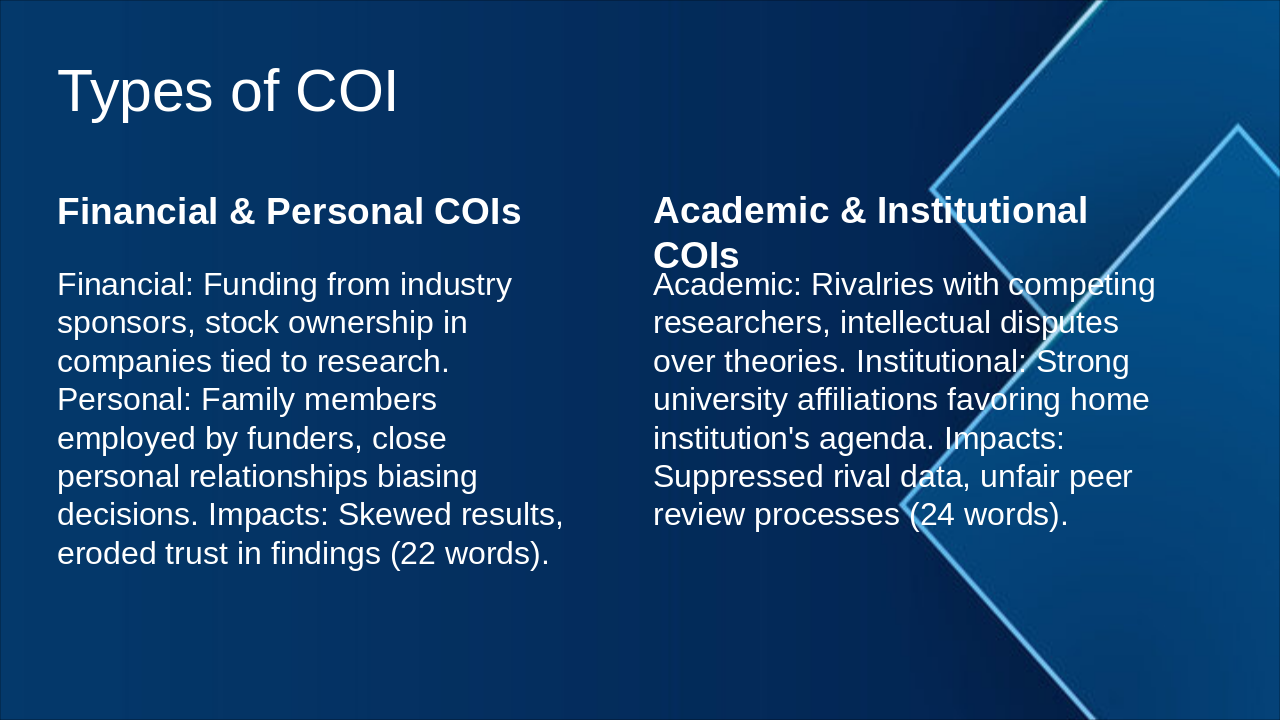
The slide "Types of COI" divides conflicts of interest into two columns. The left covers Financial & Personal COIs (e.g., industry funding, stock ownership, family ties), which skew results and erode trust; the right details Academic & Institutional COIs (e.g., researcher rivalries, university biases), causing suppressed data and unfair peer review.

Types of COI

Financial & Personal COIsAcademic & Institutional COIs
Financial: Funding from industry sponsors, stock ownership in companies tied to research. Personal: Family members employed by funders, close personal relationships biasing decisions. Impacts: Skewed results, eroded trust in findings (22 words).Academic: Rivalries with competing researchers, intellectual disputes over theories. Institutional: Strong university affiliations favoring home institution's agenda. Impacts: Suppressed rival data, unfair peer review processes (24 words).
Slide 4 - Types of COI
Slide 5 of 15

Slide 5 - Examples of COI in Research

This slide lists examples of conflicts of interest (COI) in research under the title "Examples of COI in Research." Key points include pharma funding biasing drug trials, researchers owning patents on interventions, undisclosed collaborator ties, and the Vioxx scandal hiding cardiac risks for profit.

Examples of COI in Research

  • Pharma funding biases drug trial outcomes
  • Researcher owns patent on studied intervention
  • Undisclosed ties with collaborators
  • Vioxx scandal: hidden cardiac risks for profit
Speaker Notes
Highlight financial and personal COIs; use Vioxx scandal to show real consequences like patient harm.
Slide 5 - Examples of COI in Research
Slide 6 of 15

Slide 6 - COI in Publication

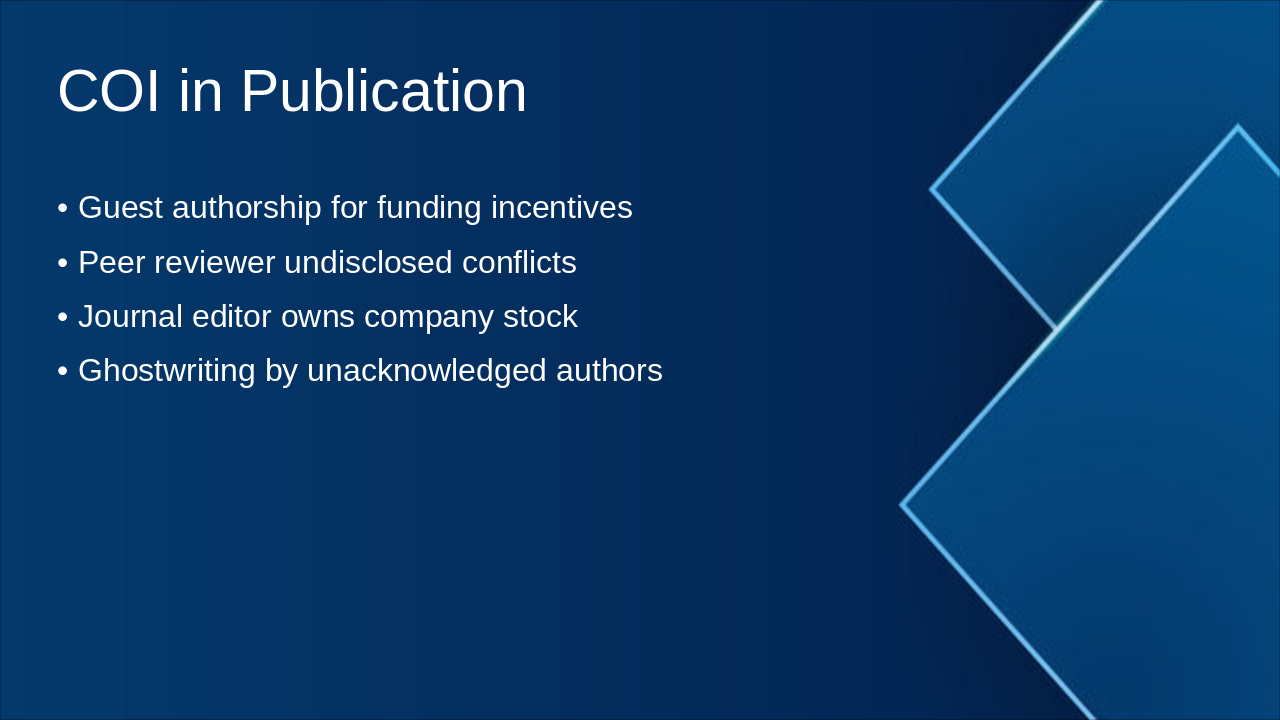
The slide "COI in Publication" highlights common conflicts of interest in academic publishing. Examples include guest authorship for funding incentives, undisclosed peer reviewer conflicts, journal editors owning company stock, and ghostwriting by unacknowledged authors.

COI in Publication

  • Guest authorship for funding incentives
  • Peer reviewer undisclosed conflicts
  • Journal editor owns company stock
  • Ghostwriting by unacknowledged authors
Slide 6 - COI in Publication
Slide 7 of 15

Slide 7 - Disclosure and Transparency

The slide mandates full disclosure in papers and grants using standardized forms and statements, required prior to submission. This builds trust and enables bias assessment.

Disclosure and Transparency

  • Mandatory full disclosure in papers and grants.
  • Use standardized forms and statements.
  • Builds trust and enables bias assessment.
  • Required prior to submission.
Speaker Notes
Mandatory full disclosure in papers/grants. Use forms/statements. Benefits: Builds trust, allows assessment. Timing: Pre-submission.
Slide 7 - Disclosure and Transparency
Slide 8 of 15

Slide 8 - Ethical Guidelines

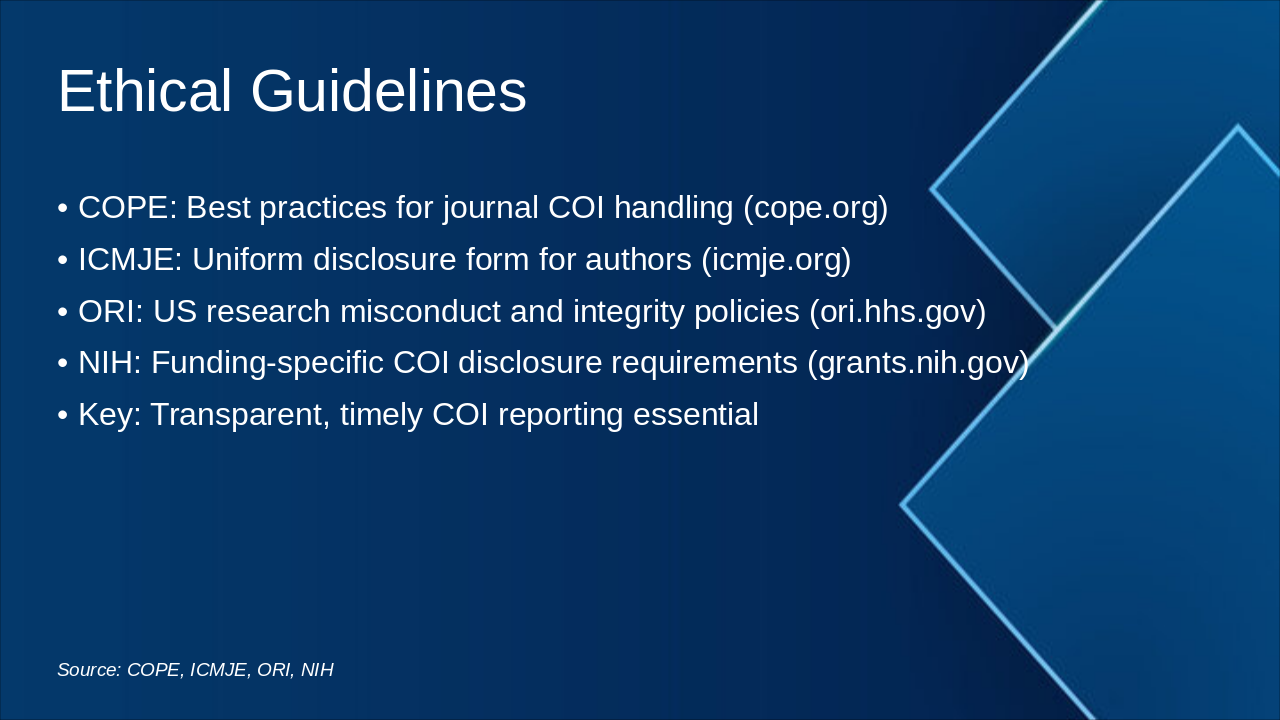
The Ethical Guidelines slide lists key resources for handling conflicts of interest (COI), including COPE best practices for journals, ICMJE author disclosure forms, ORI research integrity policies, and NIH funding requirements. It stresses that transparent, timely COI reporting is essential.

Ethical Guidelines

  • COPE: Best practices for journal COI handling (cope.org)
  • ICMJE: Uniform disclosure form for authors (icmje.org)
  • ORI: US research misconduct and integrity policies (ori.hhs.gov)
  • NIH: Funding-specific COI disclosure requirements (grants.nih.gov)
  • Key: Transparent, timely COI reporting essential

Source: COPE, ICMJE, ORI, NIH

Speaker Notes
Highlight key organizations, their roles in COI, and direct scholars to websites for resources.
Slide 8 - Ethical Guidelines
Slide 9 of 15

Slide 9 - Managing COI in Research

This slide on Managing COI in Research emphasizes early identification, transparent disclosure, and recusal if conflicts can't be mitigated. It also advocates for independent oversight, established mitigation protocols, and regular institutional reviews.

Managing COI in Research

  • Identify potential COIs early in the process
  • Disclose all conflicts transparently and promptly
  • Recuse if mitigation is not feasible
  • Implement independent oversight mechanisms
  • Establish protocols for COI mitigation
  • Conduct institutional reviews regularly
Slide 9 - Managing COI in Research
Slide 10 of 15

Slide 10 - Managing COI in Publication

Authors must declare conflicts of interest (COI) during manuscript submission, allowing editors to assess impacts on research integrity and consider options like removing authors or declining review. Policies also permit post-publication COI updates to ensure ongoing transparency and accountability.

Managing COI in Publication

  • Declare COI in manuscript submission.
  • Editors assess impact on research integrity.
  • Alternatives: remove authors or decline review.
  • Allow post-publication COI updates.
  • Promote ongoing transparency and accountability.

Source: COPE and ICMJE Guidelines

Speaker Notes
Emphasize proactive declaration and editor's role; highlight alternatives to maintain integrity.
Slide 10 - Managing COI in Publication
Slide 11 of 15

Slide 11 - Flowchart: COI Disclosure Process

The slide features a flowchart titled "COI Disclosure Process." It outlines steps to identify potential conflicts of interest, assess their significance, disclose them in the required form, and reach a decision via journal review.

Flowchart: COI Disclosure Process

!Image

  • Identify potential conflicts of interest (COI)
  • Assess significance of the COI
  • Disclose COI in required form
  • Journal review leads to decision

Source: Wikipedia

Speaker Notes
Visual flowchart: Identify COI → Assess significance → Disclose in form → Journal review → Decision (proceed/recuse). Arrows, steps, icons.
Slide 11 - Flowchart: COI Disclosure Process
Slide 12 of 15

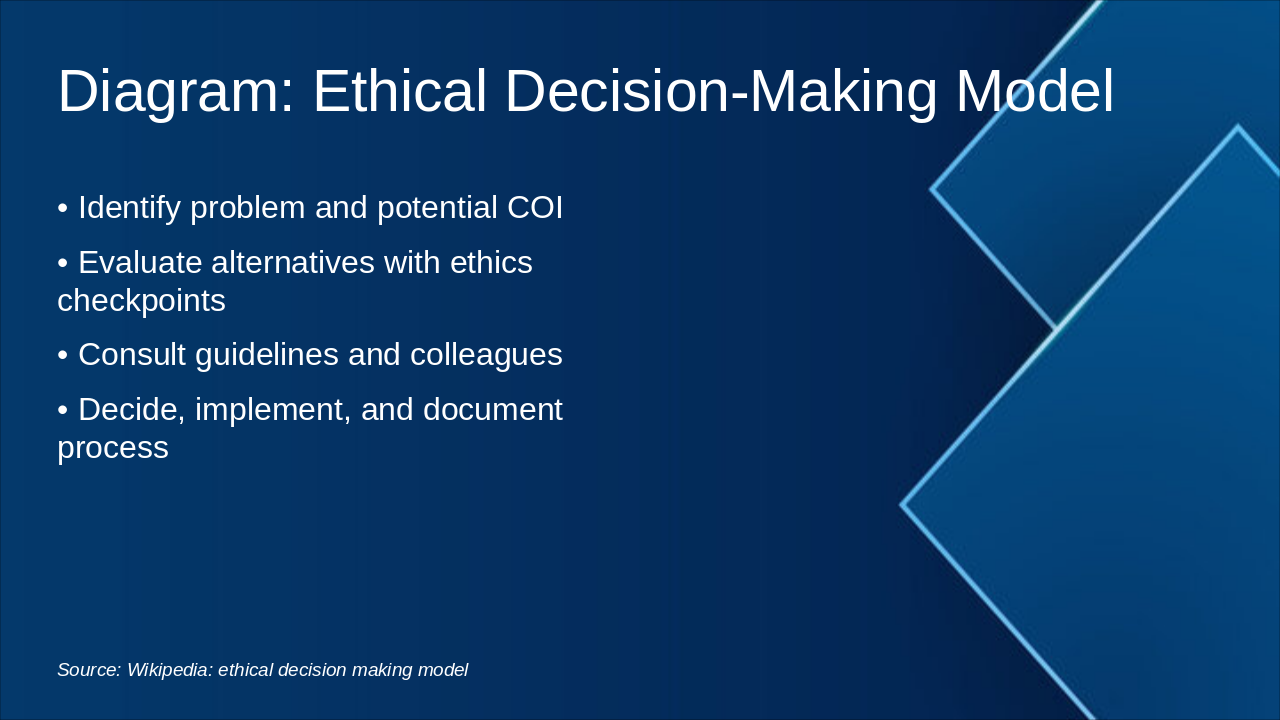
Slide 12 - Diagram: Ethical Decision-Making Model

The slide features a diagram titled "Ethical Decision-Making Model" with four key steps. These steps are: identify the problem and potential COI, evaluate alternatives with ethics checkpoints, consult guidelines and colleagues, and decide, implement, and document the process.

Diagram: Ethical Decision-Making Model

!Image

  • Identify problem and potential COI
  • Evaluate alternatives with ethics checkpoints
  • Consult guidelines and colleagues
  • Decide, implement, and document process

Source: Wikipedia: ethical decision making model

Speaker Notes
Explain the circular model: starts with problem identification, loops through steps with ethics checkpoints, emphasizes documentation for research integrity.
Slide 12 - Diagram: Ethical Decision-Making Model
Slide 13 of 15

Slide 13 - Institutional Responsibilities

This slide outlines institutional responsibilities for managing conflicts of interest (COI). Key actions include developing COI policies and training, establishing oversight committees, monitoring disclosure compliance, and providing researcher support resources.

Institutional Responsibilities

  • Develop comprehensive COI policies and training programs
  • Establish dedicated COI committees for oversight
  • Implement monitoring for disclosure compliance
  • Provide support resources for researcher disclosures
Slide 13 - Institutional Responsibilities
Slide 14 of 15

Slide 14 - Consequences of Non-disclosure

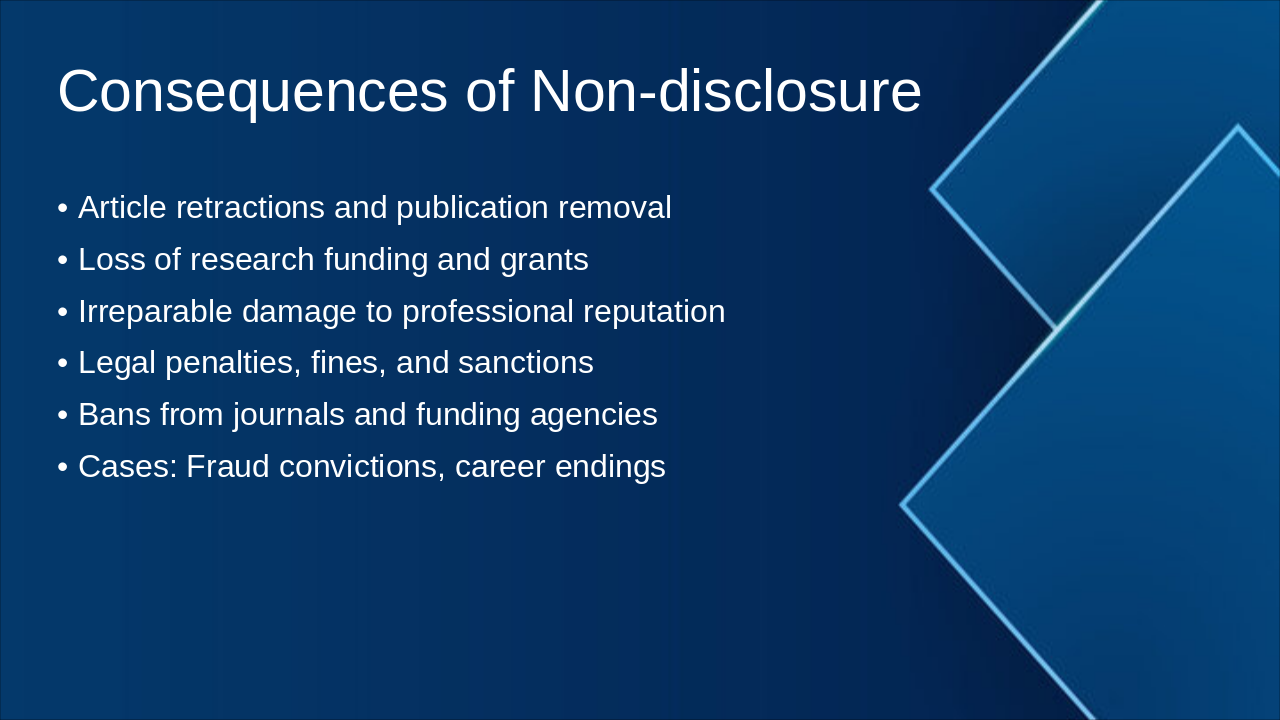
Non-disclosure in research leads to severe consequences like article retractions, loss of funding, reputational damage, legal penalties, and bans from journals and agencies. Real-world cases include fraud convictions that end careers.

Consequences of Non-disclosure

  • Article retractions and publication removal
  • Loss of research funding and grants
  • Irreparable damage to professional reputation
  • Legal penalties, fines, and sanctions
  • Bans from journals and funding agencies
  • Cases: Fraud convictions, career endings
Speaker Notes
Highlight real-world cases; emphasize prevention through transparency.
Slide 14 - Consequences of Non-disclosure
Slide 15 of 15

Slide 15 - Conclusion & Takeaway

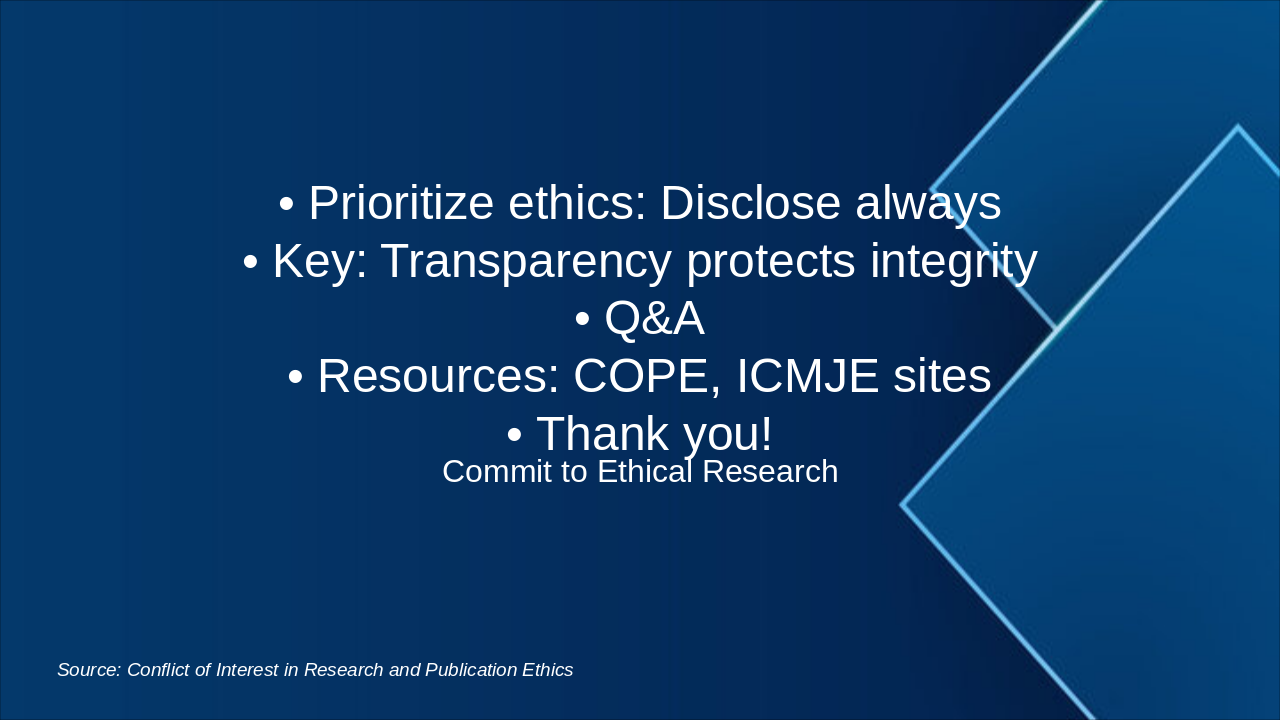
The slide's conclusion emphasizes prioritizing ethics by always disclosing information, with transparency as key to protecting integrity, under the subtitle "Commit to Ethical Research." It invites Q&A, lists resources like COPE and ICMJE sites, and ends with "Thank you!"

Conclusion & Takeaway

• Prioritize ethics: Disclose always

  • Key: Transparency protects integrity
  • Q&A
  • Resources: COPE, ICMJE sites
  • Thank you!

Commit to Ethical Research

Source: Conflict of Interest in Research and Publication Ethics

Speaker Notes
Closing message: Thank you for your attention! (4 words) Call-to-action: Always prioritize ethics and disclose conflicts to protect research integrity. (9 words) Invite Q&A and direct to COPE/ICMJE resources.
Slide 15 - Conclusion & Takeaway

Discover More Presentations

Explore thousands of AI-generated presentations for inspiration

Browse Presentations
Powered by AI

Create Your Own Presentation

Generate professional presentations in seconds with Karaf's AI. Customize this presentation or start from scratch.

Create New Presentation

Powered by Karaf.ai — AI-Powered Presentation Generator