Intelligent Governance Revolution

Generated from prompt:

Appendix A: Presentation Framework Note: The following section outlines the structure and content for the accompanying presentation deck required by the assignment. Slide 1: Title Slide Title: Intelligent Governance: A Scientific Approach to Service Strategy Subtitle: Synthesizing Adaptation Economics, Stochastic Dynamics, and Holistic Design for the Public Sector Visual: A stylized diagram showing the convergence of Sourcing, Operations, and Design. Slide 2: The Strategic Imperative The Problem: The NPM model (Outsource everything, Treat citizens like customers, Optimize for average) is failing in a volatile world. The Solution: A shift to "Intelligent Governance." Dynamic Sourcing (Adaptation Cost Theory). Co-Production Operations (Hawkes Processes). Variance-Aware Design (Holistic Coupling). Slide 3: Sourcing Strategy - When to Insource? Theory: Wernerfelt et al. (2021) - Adaptation Cost Theory. Key Concept: The trade-off between Functional Specialization (Market) and Firm-Specific Specialization (Internal). The Pivot Point: Adjustment Frequency. As volatility rises, the transaction costs of contracting explode. Visual: A graph showing the "Cost of Governance" vs. "Volatility." The Outsourcing curve rises sharply; the Insourcing curve remains flat. Slide 4: Operations - The Myth of "Lightest Load" Theory: Daw et al. (2025) - Hawkes Processes in Service. The Insight: Service is "Bursty," not linear. It is Co-Produced. The Failure: "Lightest Load" routing assigns work to agents who are administratively free but cognitively overloaded by bursting cases. Data Point: LL routing increases wait times by >10% compared to predictive routing. Visual: A "Heat Map" of an agent's day, showing intense bursts vs. administrative case counts. Slide 5: Designing the Journey - Routine vs. Nonroutine Theory: Bellos & Kavadias (2021) - Process Framework. Typology: Routine: Effort $\uparrow$ = Value $\uparrow$, Variance $\downarrow$ (e.g., ID Check). Nonroutine: Effort $\uparrow$ = Value $\uparrow$, Variance $\uparrow$ (e.g., Crisis Assessment). Strategy: You cannot treat them the same. Invest in Routine steps to "bank" consistency. Slide 6: The "Impact Zone" and Holistic Coupling Concept: Service steps interact. A bad start amplifies a bad middle. The Rule: Design steps in modules. The optimal effort for Step $N$ depends on the variance of Step $N-1$ and $N+1$. Application: Don't design the "Digital Portal" in isolation from the "Physical Interview." They are coupled. Slide 7: Moving Beyond False Premises Theme: Integrating Baron (Omnichannel) and Rai (Relational). The False Premise: Adding channels (Chatbots, Apps) fixes service. The Reality: If the process is high-variance and the sourcing is rigid, new channels just scale the failure. The Goal: Relational Value. Trust is the currency. Slide 8: The Roadmap Audit: Identify High-Volatility functions $\rightarrow$ Repatriate to Civil Service. Map: Tag Routine vs. Nonroutine steps $\rightarrow$ Automate Routine, Enable Nonroutine. Route: Switch to Predictive Activity Routing $\rightarrow$ Balance Cognitive Load. Measure: Track Variance, not just Averages. Slide 9: Conclusion "Government service is not a factory line. It is a dynamic, co-produced relationship. Our strategy must reflect the physics of that relationship." use this structure to design slides

This presentation critiques the failing NPM model in volatile environments, proposing Intelligent Governance via adaptation economics, stochastic operations, and holistic design. It covers sourcing pi

November 29, 20259 slides
Slide 1 of 9

Slide 1 - Intelligent Governance: A Scientific Approach to Service Strategy

The title slide is titled "Intelligent Governance: A Scientific Approach to Service Strategy," presenting a framework for public sector service planning. Its subtitle elaborates on synthesizing adaptation economics, stochastic dynamics, and holistic design to achieve this approach.

Intelligent Governance: A Scientific Approach to Service Strategy

Synthesizing Adaptation Economics, Stochastic Dynamics, and Holistic Design for the Public Sector

Source: Appendix A: Presentation Framework

Speaker Notes
Visual: Stylized diagram showing the convergence of Sourcing, Operations, and Design.
Slide 1 - Intelligent Governance: A Scientific Approach to Service Strategy
Slide 2 of 9

Slide 2 - The Strategic Imperative

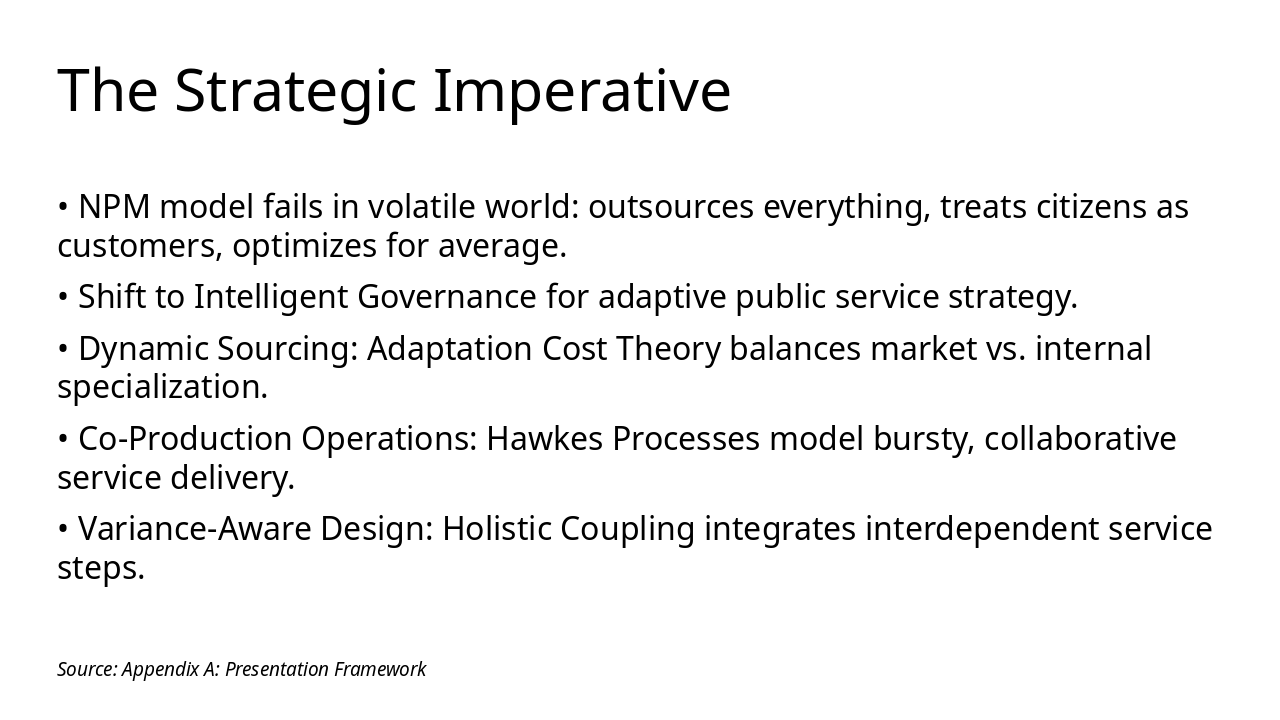
The slide critiques the NPM model for failing in volatile environments by outsourcing everything, treating citizens as customers, and optimizing for averages, advocating a shift to Intelligent Governance for adaptive public service strategies. It introduces key concepts like Dynamic Sourcing via Adaptation Cost Theory to balance market and internal options, Co-Production Operations using Hawkes Processes for bursty collaboration, and Variance-Aware Design through Holistic Coupling for integrating interdependent service steps.

The Strategic Imperative

  • NPM model fails in volatile world: outsources everything, treats citizens as customers, optimizes for average.
  • Shift to Intelligent Governance for adaptive public service strategy.
  • Dynamic Sourcing: Adaptation Cost Theory balances market vs. internal specialization.
  • Co-Production Operations: Hawkes Processes model bursty, collaborative service delivery.
  • Variance-Aware Design: Holistic Coupling integrates interdependent service steps.

Source: Appendix A: Presentation Framework

Slide 2 - The Strategic Imperative
Slide 3 of 9

Slide 3 - Sourcing Strategy - When to Insource?

The slide explores the Adaptation Cost Theory, which weighs the trade-off between market-based functional specialization for general efficiency and internal firm-specific specialization for tailored adaptation, balancing external expertise with internal control in dynamic settings. It pivots to adjustment frequency, noting that high volatility exponentially raises contracting costs from frequent renegotiations, making insourcing preferable for stable internal governance in uncertain environments.

Sourcing Strategy - When to Insource?

Theory: Adaptation Cost TheoryPivot: Adjustment Frequency
Trade-off between Functional Specialization (Market) for general efficiency and Firm-Specific Specialization (Internal) for tailored adaptation. Balances external expertise against internal control in dynamic environments.Volatility increases contracting costs exponentially due to frequent adjustments. Insourcing remains stable as internal governance avoids renegotiation expenses in high-uncertainty scenarios.

Source: Wernerfelt et al. (2021)

Speaker Notes
Discuss trade-off in volatile public sector; highlight graph showing outsourcing costs rising with volatility.
Slide 3 - Sourcing Strategy - When to Insource?
Slide 4 of 9

Slide 4 - Operations - The Myth of 'Lightest Load'

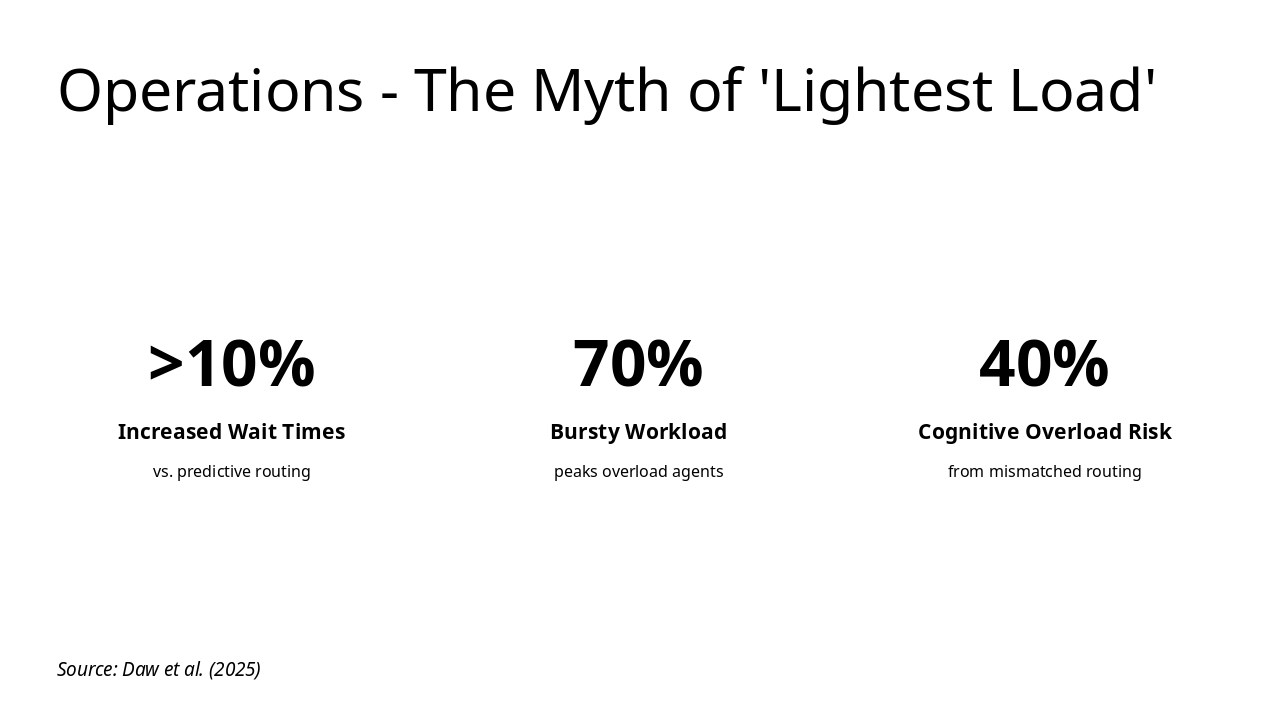
The slide "Operations - The Myth of 'Lightest Load'" debunks the idea of routing work to the least busy agents, highlighting key stats from operations data. It shows increased wait times over 10% compared to predictive routing, 70% of workloads being bursty and overloading agents, and a 40% risk of cognitive overload from mismatched assignments.

Operations - The Myth of 'Lightest Load'

  • >10%: Increased Wait Times
  • vs. predictive routing

  • 70%: Bursty Workload
  • peaks overload agents

  • 40%: Cognitive Overload Risk

from mismatched routing Source: Daw et al. (2025)

Speaker Notes
Highlight bursty service nature and failure of LL routing; reference heat map visual.
Slide 4 - Operations - The Myth of 'Lightest Load'
Slide 5 of 9

Slide 5 - Designing the Journey - Routine vs. Nonroutine

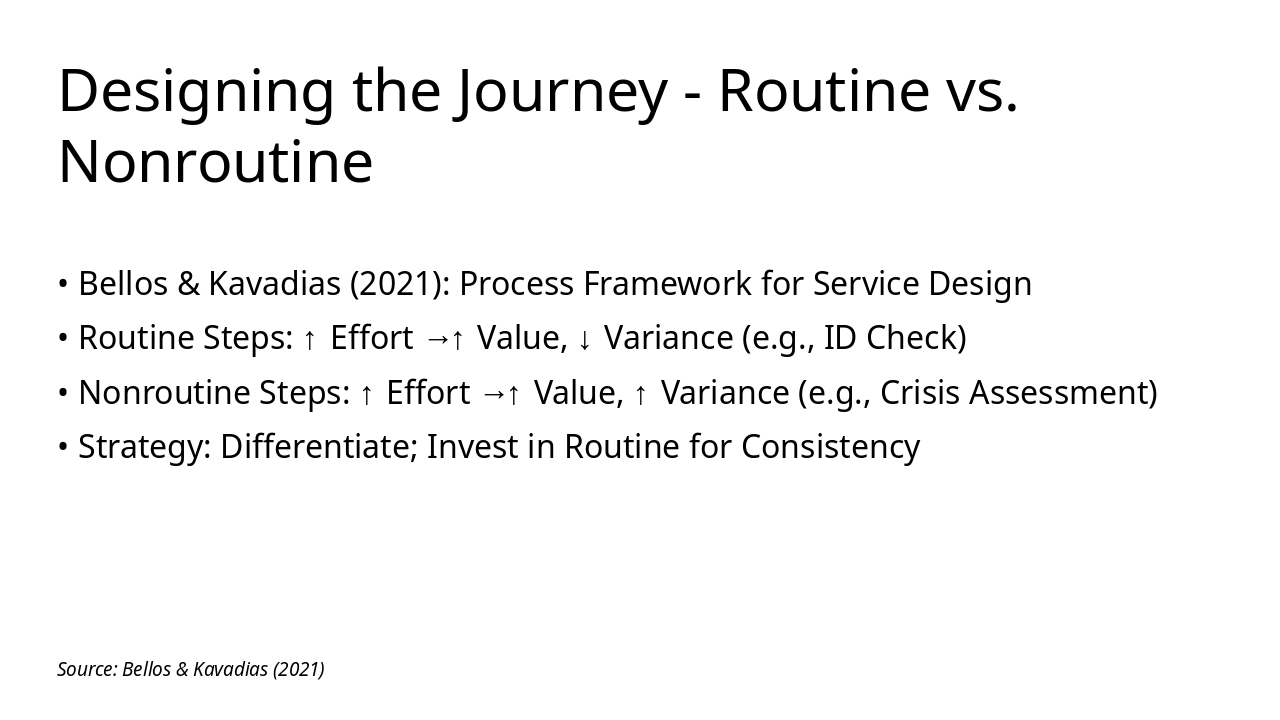
Bellos and Kavadias (2021) outline a process framework for service design that contrasts routine steps, where increased effort boosts value while reducing variance (e.g., ID checks), with nonroutine steps, where effort enhances value but increases variance (e.g., crisis assessments). The recommended strategy is to differentiate processes by investing in routine steps to achieve greater consistency.

Designing the Journey - Routine vs. Nonroutine

  • Bellos & Kavadias (2021): Process Framework for Service Design
  • Routine Steps: ↑ Effort → ↑ Value, ↓ Variance (e.g., ID Check)
  • Nonroutine Steps: ↑ Effort → ↑ Value, ↑ Variance (e.g., Crisis Assessment)
  • Strategy: Differentiate; Invest in Routine for Consistency

Source: Bellos & Kavadias (2021)

Speaker Notes
Theory: Bellos & Kavadias (2021). Typology: Routine (Effort ↑ = Value ↑, Variance ↓ e.g., ID Check); Nonroutine (Effort ↑ = Value ↑, Variance ↑ e.g., Crisis Assessment). Strategy: Differentiate; invest in Routine for consistency.
Slide 5 - Designing the Journey - Routine vs. Nonroutine
Slide 6 of 9

Slide 6 - The 'Impact Zone' and Holistic Coupling

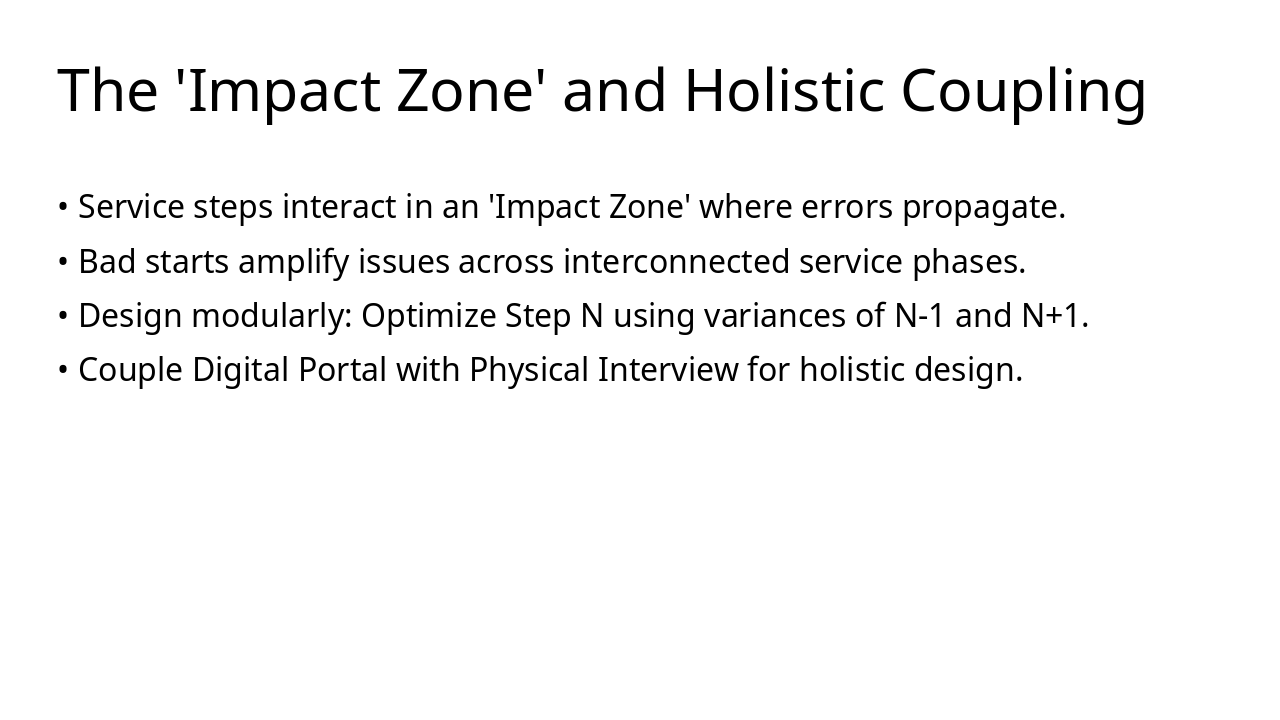
In the 'Impact Zone,' service steps interconnect such that errors propagate and bad starts amplify issues across phases. To address this, designs should be modular, optimizing each step based on variances from adjacent ones, while holistically coupling elements like the Digital Portal and Physical Interview.

The 'Impact Zone' and Holistic Coupling

  • Service steps interact in an 'Impact Zone' where errors propagate.
  • Bad starts amplify issues across interconnected service phases.
  • Design modularly: Optimize Step N using variances of N-1 and N+1.
  • Couple Digital Portal with Physical Interview for holistic design.
Slide 6 - The 'Impact Zone' and Holistic Coupling
Slide 7 of 9

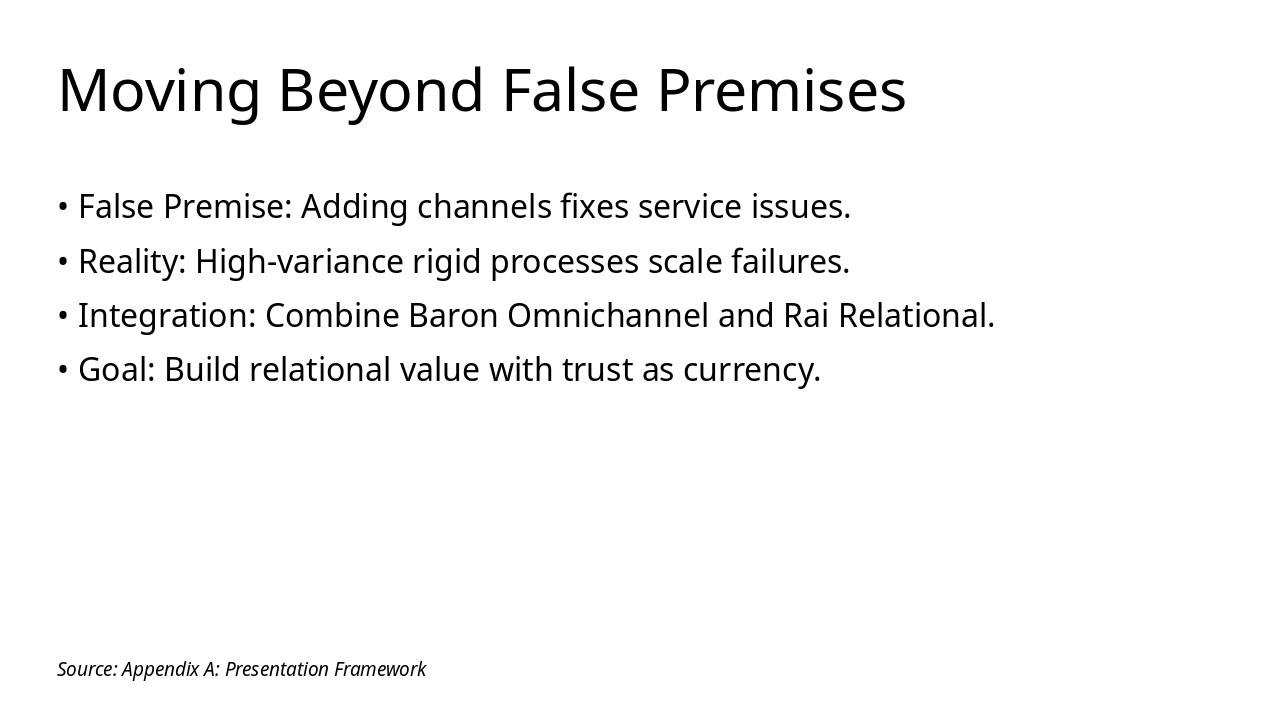
Slide 7 - Moving Beyond False Premises

The slide challenges the false premise that simply adding more channels resolves service issues, emphasizing instead that high-variance, rigid processes amplify failures during scaling. It advocates integrating Baron Omnichannel and Rai Relational solutions to build relational value, using trust as the key currency.

Moving Beyond False Premises

  • False Premise: Adding channels fixes service issues.
  • Reality: High-variance rigid processes scale failures.
  • Integration: Combine Baron Omnichannel and Rai Relational.
  • Goal: Build relational value with trust as currency.

Source: Appendix A: Presentation Framework

Slide 7 - Moving Beyond False Premises
Slide 8 of 9

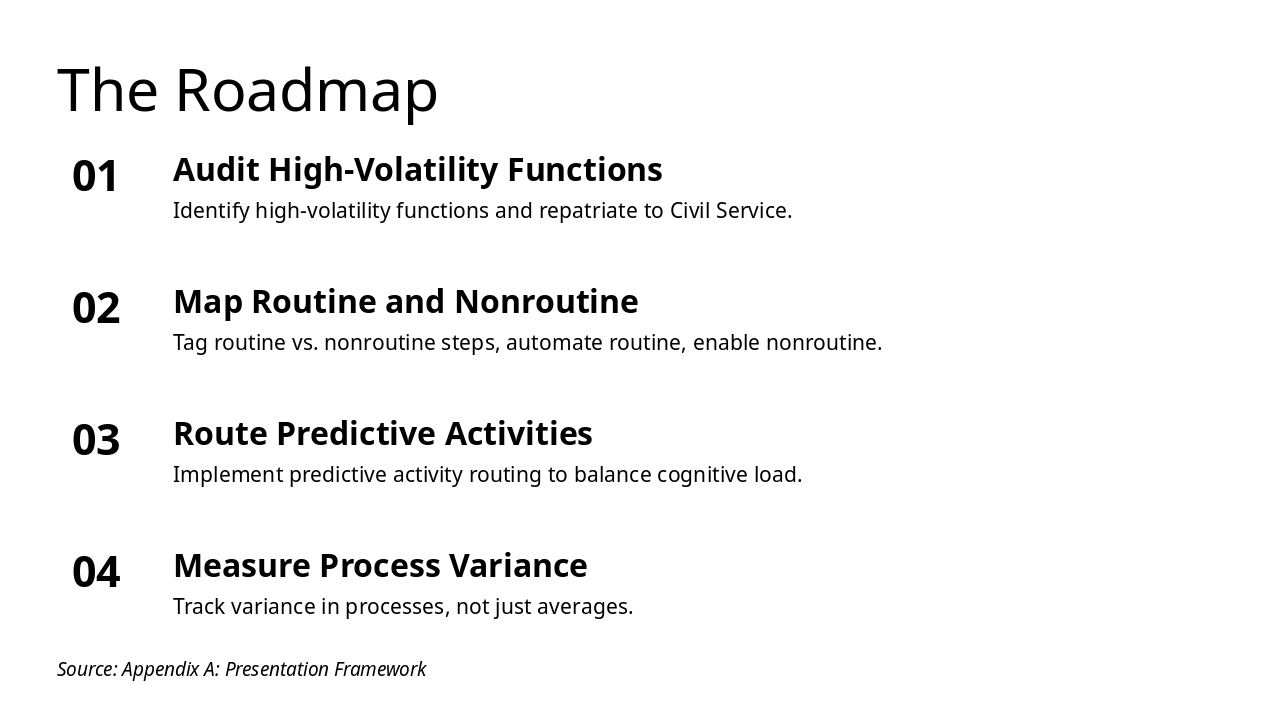
Slide 8 - The Roadmap

The Roadmap agenda outlines a four-step plan to optimize processes in a civil service context. It includes auditing high-volatility functions for repatriation, mapping and automating routine versus nonroutine steps, routing predictive activities to balance cognitive load, and measuring process variance beyond averages.

The Roadmap

  1. Audit High-Volatility Functions
  2. Identify high-volatility functions and repatriate to Civil Service.

  3. Map Routine and Nonroutine
  4. Tag routine vs. nonroutine steps, automate routine, enable nonroutine.

  5. Route Predictive Activities
  6. Implement predictive activity routing to balance cognitive load.

  7. Measure Process Variance

Track variance in processes, not just averages. Source: Appendix A: Presentation Framework

Slide 8 - The Roadmap
Slide 9 of 9

Slide 9 - Conclusion

Government service is portrayed as a dynamic, co-produced relationship rather than a rigid factory line, requiring strategies that align with its inherent physics. The slide advocates embracing intelligent governance through adaptive strategies to transform public service.

Conclusion

Government service is not a factory line. It is a dynamic, co-produced relationship. Our strategy must reflect the physics of that relationship.

Embrace Intelligent Governance. Implement adaptive strategies to transform public service.

Source: Appendix A: Presentation Framework

Slide 9 - Conclusion
Powered by AI

Create Your Own Presentation

Generate professional presentations in seconds with Karaf's AI. Customize this presentation or start from scratch.

Create New Presentation

Powered by Karaf.ai — AI-Powered Presentation Generator