Renewable Energy: Powering a Sustainable Future

Generated from prompt:

Create a presentation about renewable energy

This presentation explores renewable energy sources like solar, wind, hydro, bioenergy, and geothermal. It highlights their role in combating climate change, benefits and growth stats, challenges such

November 4, 202511 slides
Slide 1 of 11

Slide 1 - Renewable Energy: Sustainable Power for the Future

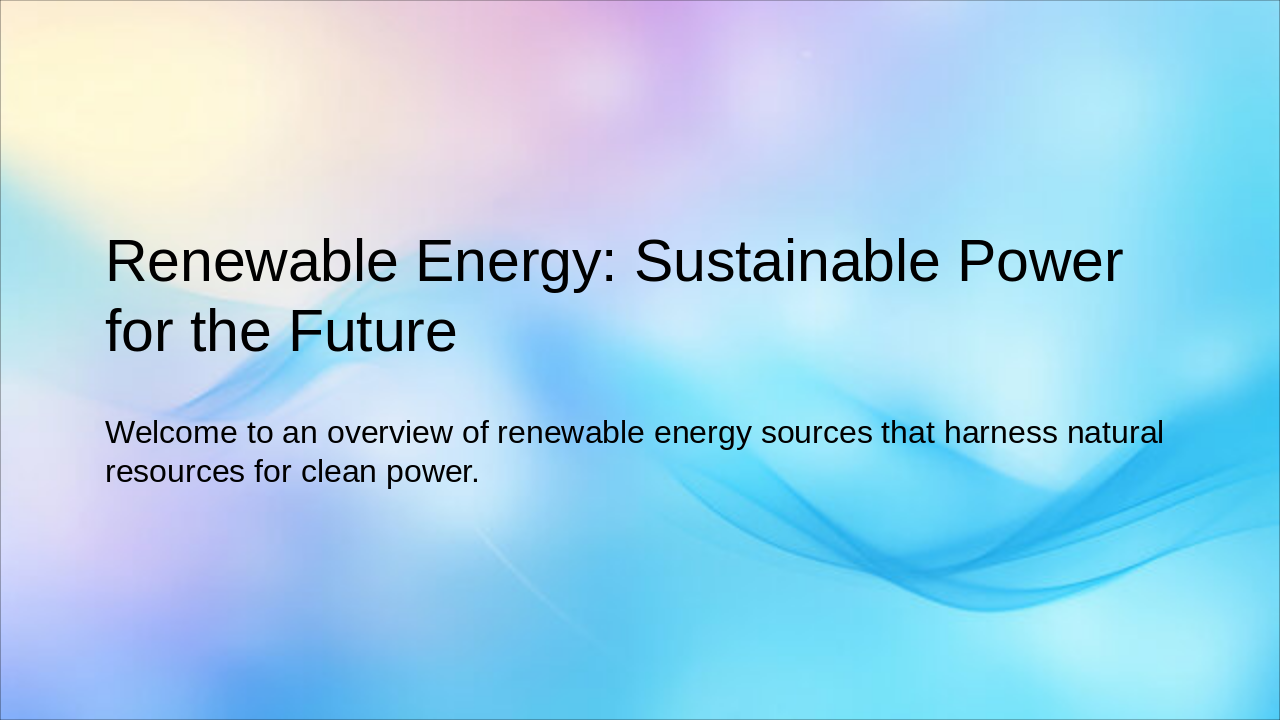
The slide's title, "Renewable Energy: Sustainable Power for the Future," introduces the topic as a key to clean and enduring energy solutions. Its subtitle welcomes viewers to an overview of renewable sources that tap into natural resources for generating power.

Renewable Energy: Sustainable Power for the Future

Welcome to an overview of renewable energy sources that harness natural resources for clean power.
Slide 1
Slide 2 of 11

Slide 2 - Presentation Agenda

The presentation agenda outlines key topics on renewable energy, starting with its definition and basic principles, followed by an exploration of types such as solar, wind, hydro, and others. It then covers the role of renewables in mitigating climate change and emissions, benefits and challenges of adoption, and concludes with a summary and future outlook on the energy transition.

Presentation Agenda

  1. Definition of Renewable Energy

Understanding what renewable energy means and its basic principles.

  1. Types of Renewable Energy

Exploring solar, wind, hydro, and other renewable sources.

  1. Role in Climate Change

How renewables help mitigate global warming and emissions.

  1. Benefits and Challenges

Advantages like sustainability versus obstacles in adoption.

  1. Conclusion and Future Outlook

Summarizing key points and looking ahead to energy transition.

Slide 2
Slide 3 of 11

Slide 3 - What is Renewable Energy?

Renewable energy is derived from natural resources that replenish on human timescales, including sources like solar, wind, hydro, bioenergy, and geothermal. It offers a sustainable alternative to finite fossil fuels by reducing greenhouse gas emissions and minimizing environmental impact.

What is Renewable Energy?

  • Derived from natural resources replenished on human timescales.
  • Includes solar, wind, hydro, bioenergy, and geothermal sources.
  • Provides sustainable alternative to finite fossil fuels.
  • Reduces greenhouse gas emissions and environmental impact.
Slide 3
Slide 4 of 11

Slide 4 - Renewable Energy

This section header slide introduces "Major Types of Renewable Energy" as the third main topic in the presentation. It features a subtitle that highlights an exploration of the most common renewable sources and their global usage.

Renewable Energy

03

Major Types of Renewable Energy

Exploring the most common renewable sources and their global usage.

Slide 4
Slide 5 of 11

Slide 5 - Solar and Wind Power

Solar power harnesses sunlight through photovoltaic panels to produce clean, abundant electricity, offering low operating costs and scalability for homes and large-scale farms in the renewable energy revolution. Wind power converts kinetic wind energy via large turbines into emission-free electricity, though intermittent and weather-dependent, it scales effectively in windy areas for national grids and offshore use.

Solar and Wind Power

Solar PowerWind Power
Solar energy captures sunlight using photovoltaic panels to generate clean electricity. It is widely used globally due to its abundance, low operating costs, and scalability for homes and large farms, driving the renewable energy revolution.Wind power utilizes large turbines to convert kinetic wind energy into electricity. Though intermittent and dependent on weather, it scales effectively in windy regions, providing a reliable, emission-free source for national grids and offshore installations.
Slide 5
Slide 6 of 11

Slide 6 - Hydropower and Geothermal

Hydropower harnesses energy from water controlled by dams, providing a reliable renewable source. Geothermal energy draws from the Earth's internal heat to generate steady baseload power, making both options dependable renewables.

Hydropower and Geothermal

!Image

  • Hydropower uses dams for controllable water-based energy.
  • Geothermal taps Earth's heat for steady baseload power.
  • Both are reliable renewable sources.

Source: Hydropower and geothermal energy

--- Speaker Notes: Visual of dams for hydropower and geothermal plants. Hydropower is controllable; geothermal provides steady baseload from Earth's heat.

Slide 6
Slide 7 of 11

Slide 7 - Role in Addressing Climate Change

Renewables play a pivotal role in addressing climate change by drastically reducing worldwide greenhouse gas emissions and advancing the Paris Agreement's global targets. They also enable efficient electrification in heat and transport sectors while driving rapid deployment to reach net-zero emissions by 2050.

Role in Addressing Climate Change

  • Renewables drastically reduce greenhouse gas emissions worldwide.
  • Advance Paris Agreement goals for global climate targets.
  • Enable efficient electrification of heat and transport sectors.
  • Drive rapid deployment to achieve net-zero by 2050.
Slide 7
Slide 8 of 11

Slide 8 - Benefits and Growth Stats

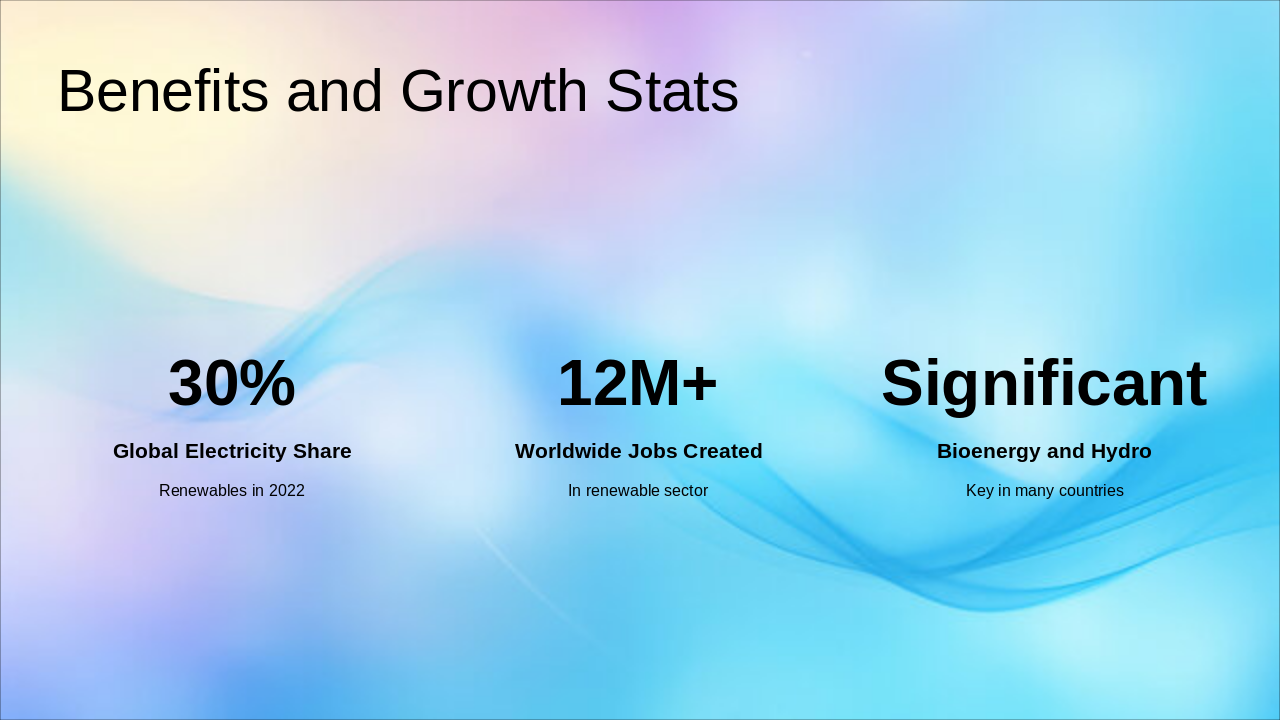
In 2022, renewable energy accounted for 30% of global electricity share while creating over 12 million jobs worldwide in the sector. Bioenergy and hydro remain significant contributors to renewable energy in many countries.

Benefits and Growth Stats

  • 30%: Global Electricity Share

Renewables in 2022

  • 12M+: Worldwide Jobs Created

In renewable sector

  • Significant: Bioenergy and Hydro

Key in many countries

Slide 8
Slide 9 of 11

Slide 9 - A Quote on Renewables

This slide features a quote emphasizing the sustainability and necessity of renewable energy for the planet's future, while calling for urgent global efforts to address climate change. The quote is attributed to António Guterres, the United Nations Secretary-General.

A Quote on Renewables

> Renewable energy is not only sustainable but essential for our planet's future, demanding urgent global action to combat climate change.

— António Guterres, United Nations Secretary-General

Source: United Nations

--- Speaker Notes: Highlights the urgency of transition in renewable energy adoption.

Slide 9
Slide 10 of 11

Slide 10 - Challenges: Intermittency

Renewable energy sources like solar and wind face intermittency challenges due to unpredictable weather patterns, leading to supply variability and grid reliability issues. Solutions include energy storage batteries to smooth fluctuations, grid upgrades for better integration, and hybrid systems that pair these sources with controllable hydro power.

Challenges: Intermittency

  • Solar and wind fluctuate with unpredictable weather patterns.
  • Intermittency causes supply variability and grid reliability issues.
  • Energy storage batteries smooth out renewable power fluctuations.
  • Grid upgrades enhance integration of intermittent sources.
  • Hybrid systems pair variable renewables with controllable hydro.

Source: Renewable Energy Presentation

--- Speaker Notes: Variable sources like solar/wind fluctuate with weather. Solutions: Energy storage, grid improvements, and hybrid systems with controllable renewables like hydro.

Slide 10
Slide 11 of 11

Slide 11 - Conclusion: Embrace Renewables

The slide, titled "Conclusion: Embrace Renewables," highlights how renewable energy provides a sustainable solution to combat climate change through clean and efficient power sources. It urges immediate investment in renewables to ensure a greener future, with the subtitle "Secure Our Planet's Future Today."

Conclusion: Embrace Renewables

Renewable energy offers a path to sustainability, combating climate change with clean, efficient power. Invest now for a greener tomorrow!

Secure Our Planet's Future Today.

Slide 11
Powered by AI

Create Your Own Presentation

Generate professional presentations in seconds with Karaf's AI. Customize this presentation or start from scratch.

Create New Presentation

Powered by Karaf.ai — AI-Powered Presentation Generator