Chemical Space Coverage in Liquid Chromatography

Generated from prompt:

Make a presenation about this file

This MSc Chemistry thesis presentation explores the chemical space coverage of LC techniques using the RepoRT repository. It examines selectivity-measurability bias in NTA for exposome analysis, presents key findings on compound coverage trends (RPLC

April 18, 202617 slides
Slide 1 of 17

Slide 1 - Chemical Space Coverage in Liquid Chromatography

Chemical Space Coverage in Liquid Chromatography

Investigating chemical space coverage of liquid chromatographic techniques (Literature Thesis - MSc Chemistry)

---

Photo by Trnava University on Unsplash
Slide 1 - Chemical Space Coverage in Liquid Chromatography
Slide 2 of 17

Slide 2 - MSc Chemistry - Jens Heemskerk

Analytical Sciences: Literature Thesis

Investigating the Chemical Space Coverage of Liquid Chromatographic Techniques: How Selectivity Drives Measurability

---

Photo by Ryan Zazueta on Unsplash

Slide 2 - MSc Chemistry - Jens Heemskerk
Slide 3 of 17

Slide 3 - Presentation Outline

  • Introduction and NTA Context: Introduction to exposome and analytical challenges.
  • Methodology: Methodological approach using RepoRT repository.
  • Analysis of Chemical Coverage: Analysis of LC setups and chemical space coverage.
  • Conclusions and Future Outlook: Summary of findings and perspectives.

---

Photo by Elimende Inagella on Unsplash

Slide 3 - Presentation Outline
Slide 4 of 17

Slide 4 - Presentation Agenda

  • Introduction to Exposome and Chemical Space
  • The Selectivity-Measurability Bias
  • Methodology: RepoRT Repository Analysis
  • Key Findings and Chemical Coverage Trends
  • Conclusions and Perspectives

---

Photo by Drew Beamer on Unsplash

Slide 4 - Presentation Agenda
Slide 5 of 17

Slide 5 - Section 1

1

Introduction and Methodology

Understanding Exposome analysis through RepoRT repository

---

Photo by Ryan Zazueta on Unsplash

Slide 5 - Section 1
Slide 6 of 17

Slide 6 - The Challenge: Exposome and NTA

  • The exposome covers all chemical and non-chemical exposures throughout a lifetime.
  • Non-targeted analysis (NTA) with LC-HRMS is essential for identifying thousands of unknown compounds.
  • Comprehensive measurability is limited by analytical methods (sample prep, separation, detection).
  • "Selectivity-measurability bias": only compounds interacting with the chosen system are retained and detected.
Slide 6 - The Challenge: Exposome and NTA
Slide 7 of 17

Slide 7 - Context and Methodology

  • Exposome includes all lifetime chemical and non-chemical exposures related to health.
  • Non-targeted analysis (NTA) combined with LC-HRMS is crucial for identifying unknown compounds.
  • Selectivity-measurability bias: Only analytes interacting with LC phases are effectively measured.
  • RepoRT repository: Used for data-driven assessment of 236 curated LC methods.
Slide 7 - Context and Methodology
Slide 8 of 17

Slide 8 - The Selectivity-Measurability Bias

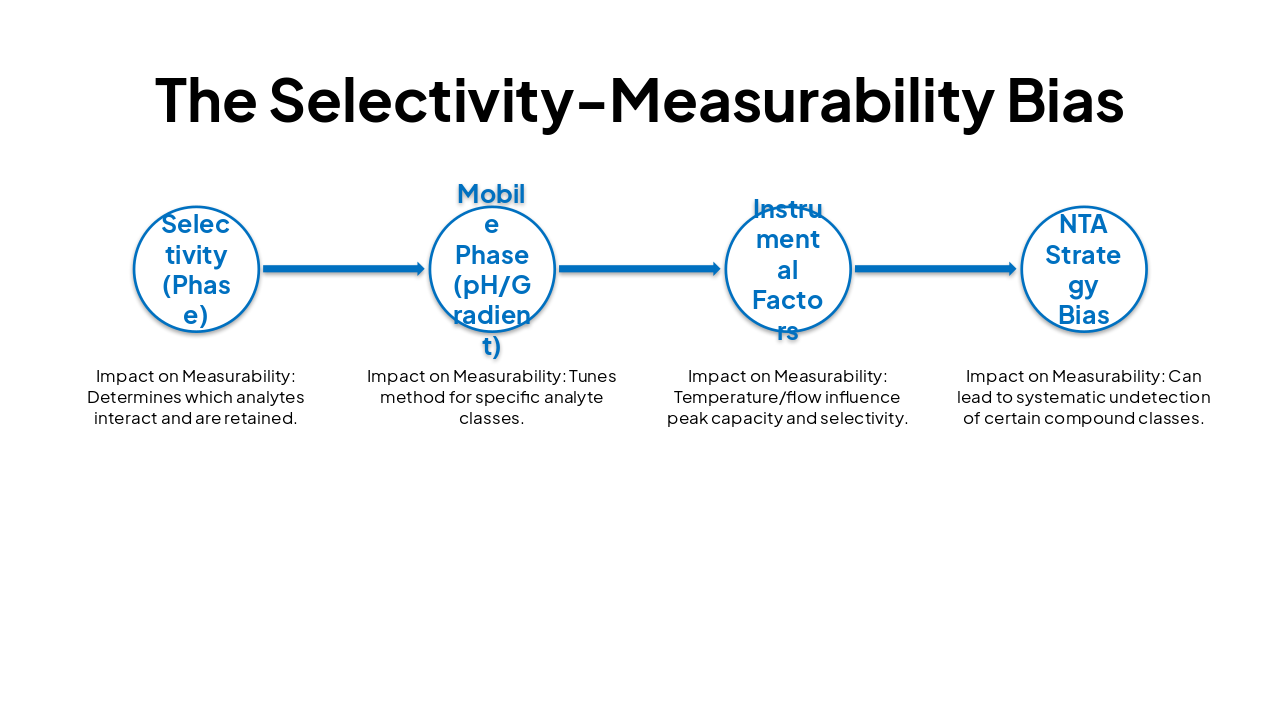
Analysis ParameterImpact on Measurability
Selectivity (Phase)Determines which analytes interact and are retained.
Mobile Phase (pH/Gradient)Tunes method for specific analyte classes.
Instrumental FactorsTemperature/flow influence peak capacity and selectivity.
NTA Strategy BiasCan lead to systematic undetection of certain compound classes.
Slide 8 - The Selectivity-Measurability Bias
Slide 9 of 17

Slide 9 - Methodology: RepoRT Analysis

  • Dataset: 236 curated LC methods from the RepoRT repository.
  • Focus: 75,797 reported compounds across 8 USP-classified column types.
  • Data Processing: Julia programming language used to handle setup metadata and chemical descriptors.
  • Chemical Descriptors: Exact mass, predicted log-P, TPSA, H-bond donors/acceptors retrieved from PubChem.
Slide 9 - Methodology: RepoRT Analysis
Slide 10 of 17

Slide 10 - Section 2

2

Key Findings and Analysis

Evaluating chemical space coverage of current LC methods

---

Photo by Deng Xiang on Unsplash

Slide 10 - Section 2
Slide 11 of 17

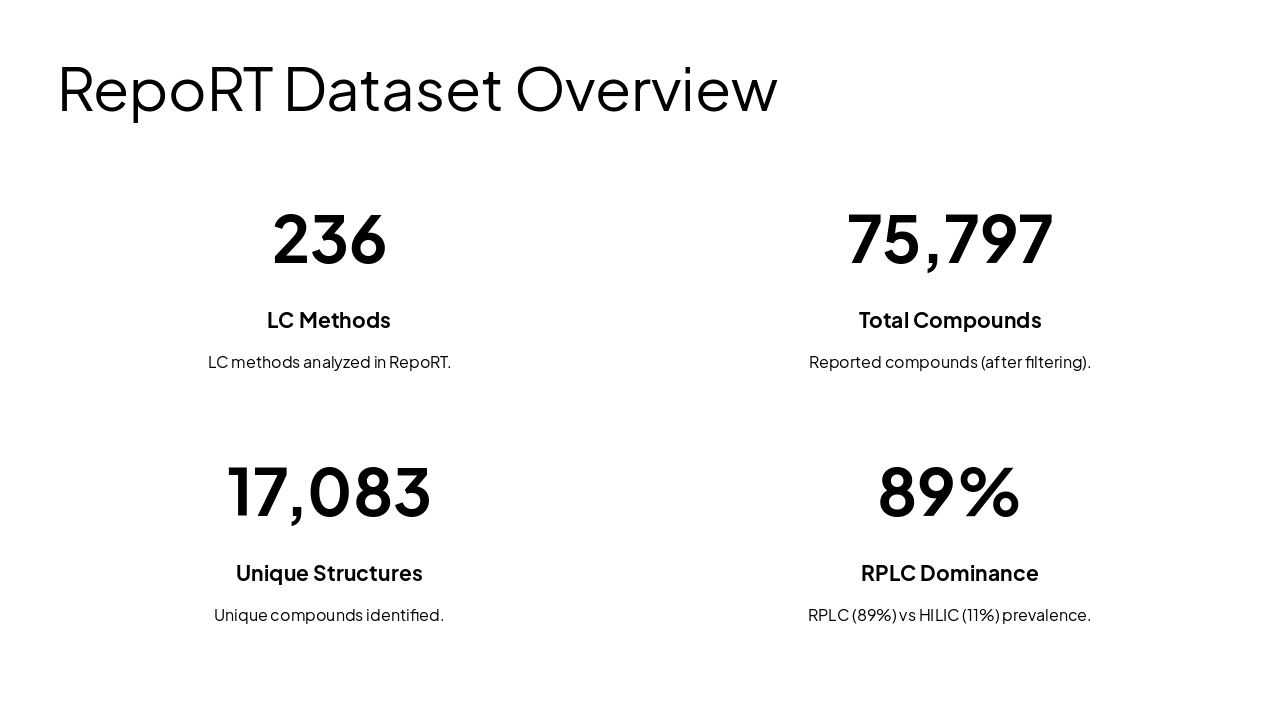
Slide 11 - RepoRT Dataset Overview

  • 236: LC Methods
  • 75,797: Total Compounds
  • 17,083: Unique Structures
  • 89%: RPLC Dominance
Slide 11 - RepoRT Dataset Overview
Slide 12 of 17

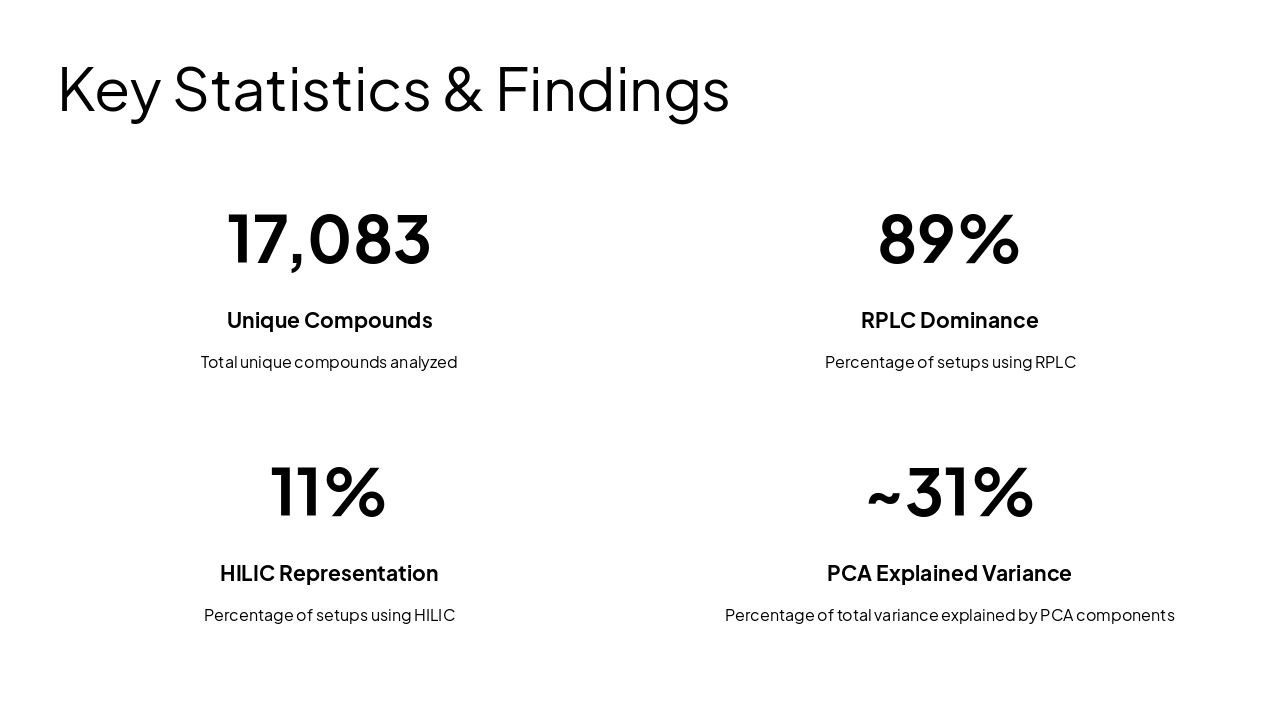
Slide 12 - Key Statistics & Findings

  • 17,083: Unique Compounds
  • 89%: RPLC Dominance
  • 11%: HILIC Representation
  • ~31%: PCA Explained Variance
Slide 12 - Key Statistics & Findings
Slide 13 of 17

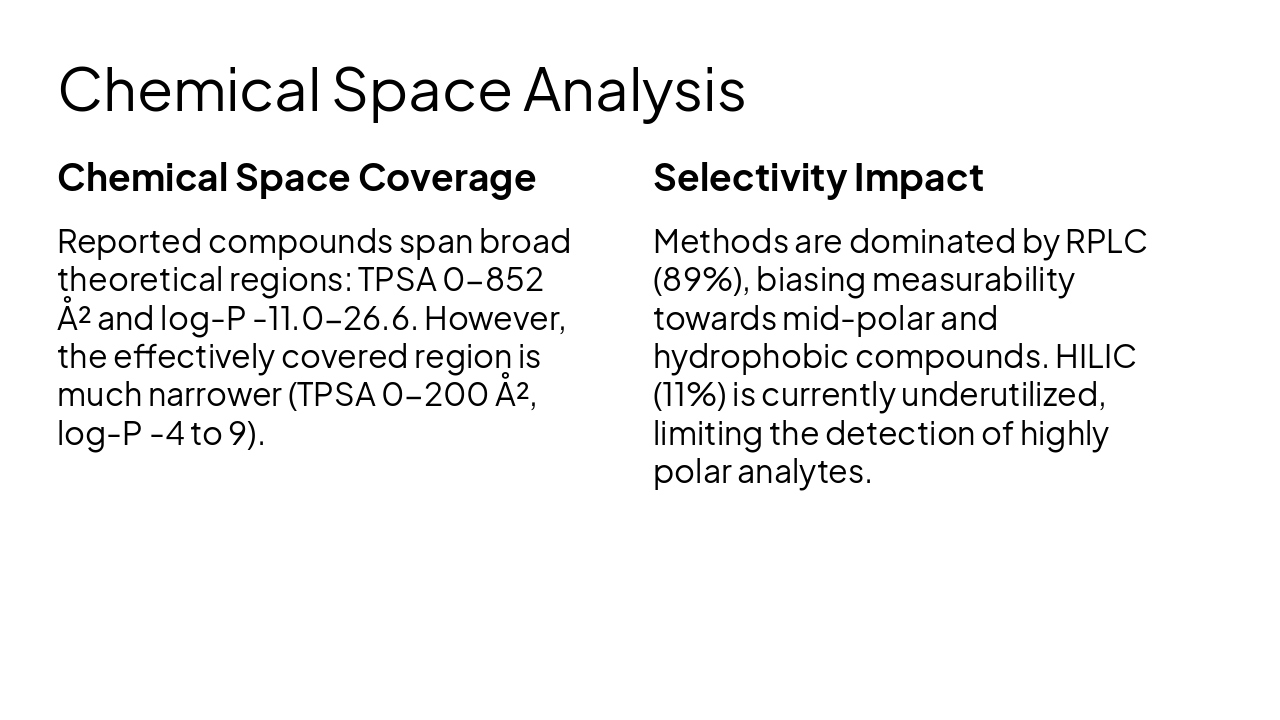
Slide 13 - Chemical Space Analysis

Chemical Space Coverage Reported compounds span broad theoretical regions: TPSA 0-852 Ų and log-P -11.0-26.6. However, the effectively covered region is much narrower (TPSA 0-200 Ų, log-P -4 to 9).

Selectivity Impact Methods are dominated by RPLC (89%), biasing measurability towards mid-polar and hydrophobic compounds. HILIC (11%) is currently underutilized, limiting the detection of highly polar analytes.

Slide 13 - Chemical Space Analysis
Slide 14 of 17

Slide 14 - Constraints on Chemical Coverage

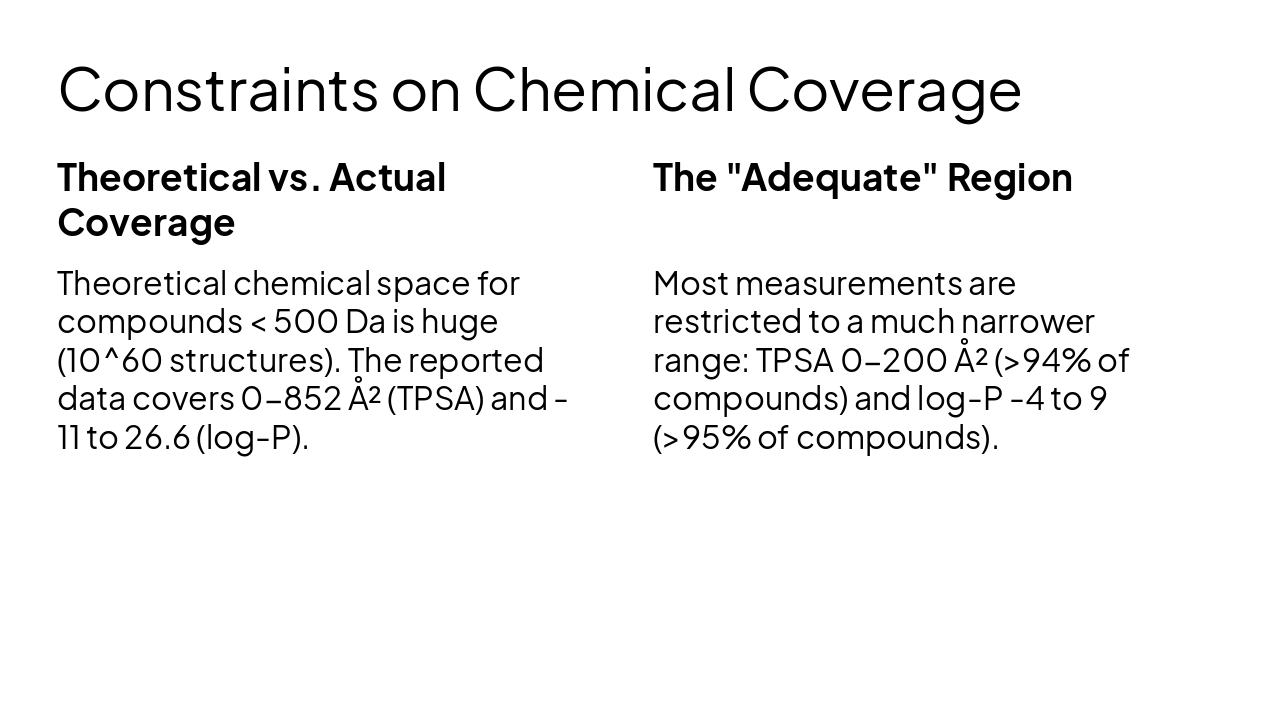
Theoretical vs. Actual Coverage Theoretical chemical space for compounds < 500 Da is huge (10^60 structures). The reported data covers 0-852 Ų (TPSA) and -11 to 26.6 (log-P).

The "Adequate" Region Most measurements are restricted to a much narrower range: TPSA 0-200 Ų (>94% of compounds) and log-P -4 to 9 (>95% of compounds).

Slide 14 - Constraints on Chemical Coverage
Slide 15 of 17

Slide 15 - Conclusions

Current LC workflows are effective but insufficient for complete chemical space characterization; orthogonal techniques are essential.

Future perspectives for exposome research

---

Photo by Conny Schneider on Unsplash

Slide 15 - Conclusions
Slide 16 of 17

Slide 16 - Conclusions and Future Perspectives

Current LC methods are substantial but limited; complete coverage of chemical space remains unachievable with current chromatographic strategies alone.

Addressing future analytical needs in exposome research.

---

Photo by Conny Schneider on Unsplash

Slide 16 - Conclusions and Future Perspectives
Slide 17 of 17

Slide 17 - Perspectives for Future Research

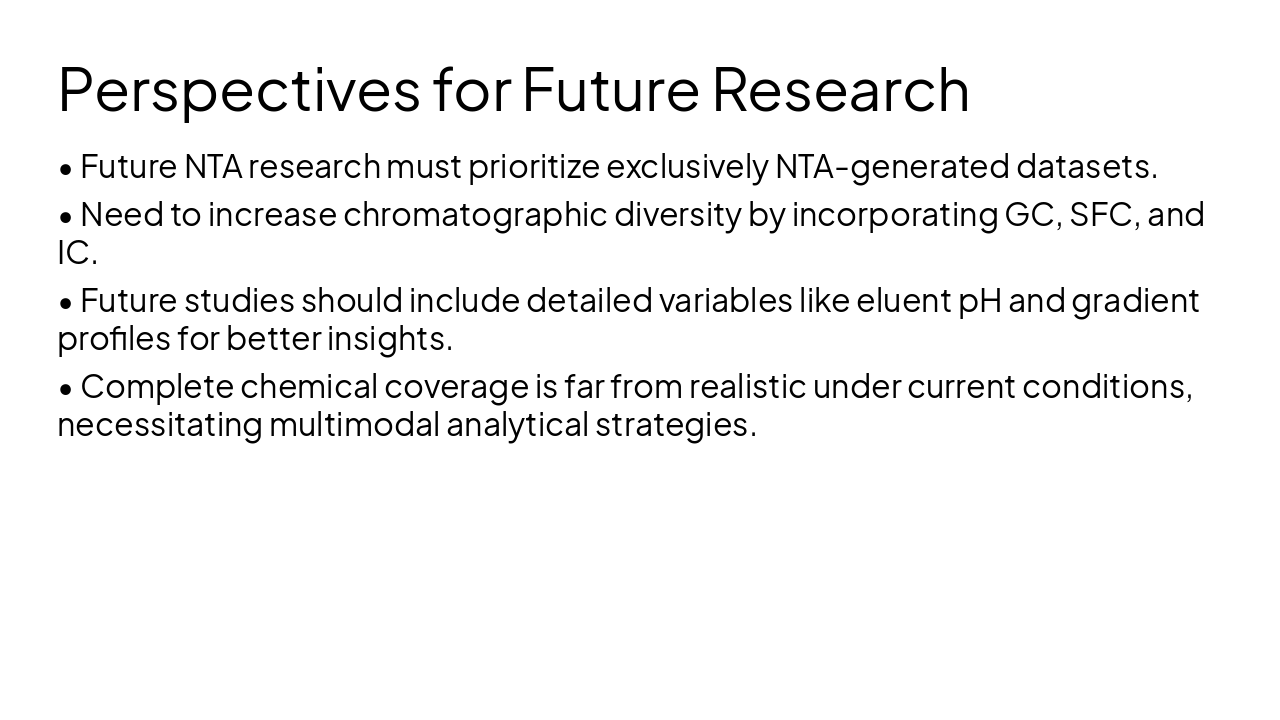
  • Future NTA research must prioritize exclusively NTA-generated datasets.
  • Need to increase chromatographic diversity by incorporating GC, SFC, and IC.
  • Future studies should include detailed variables like eluent pH and gradient profiles for better insights.
  • Complete chemical coverage is far from realistic under current conditions, necessitating multimodal analytical strategies.
Slide 17 - Perspectives for Future Research

Discover More Presentations

Explore thousands of AI-generated presentations for inspiration

Browse Presentations
Powered by AI

Create Your Own Presentation

Generate professional presentations in seconds with Karaf's AI. Customize this presentation or start from scratch.

Create New Presentation

Powered by Karaf.ai — AI-Powered Presentation Generator