Mural Art: Caves to Kerala Creations (35 chars)

Generated from prompt:

Create a 16-slide presentation titled 'MURAL ART' presented by Grade 8A – Ryan, Aaron & Mahijith. Slide 1: Title — MURAL ART, Presented by Ryan, Aaron, Mahijith, Grade 8A. Slide 2: What is Mural Art? — Art created directly on walls, ceilings, or large surfaces; one of the oldest forms of expression; tells stories, traditions & culture. Visual: simple wall painting or abstract mural. Slide 3: Early History of Murals — Prehistoric origins; Lascaux cave paintings; natural pigments & basic tools. Visual: cave mural. Slide 4: Murals Around the World — Mexico (Diego Rivera), Europe (Michelangelo), Africa (Ndebele art). Visual: Rivera mural, Sistine Chapel, Ndebele houses. Slide 5: Murals in India — Ajanta & Ellora caves, temple murals, earthy colors, detailed figures. Visual: Ajanta mural. Slide 6: Kerala Mural Art — 9th–12th century origin, themes of gods/goddesses, found in temples & palaces. Visual: Kerala temple mural. Slide 7: Kerala Mural Style — Red, yellow, green, black; intricate lines; natural dyes. Visual: Kerala mural close-up. Slide 8: Techniques Used — Lime plaster, charcoal sketching, pigment layering, fine detailing. Visual: mural painting steps. Slide 9: Famous Kerala Mural Locations — Mattancherry Palace, Guruvayur Temple, Poonjar Palace, Padmanabhaswamy Temple. Visual: landmark murals. Slide 10: Modern Murals — Street art, awareness messages, digital + traditional techniques. Visual: colorful street mural. Slide 11: Importance of Murals — Preserve history, beautify spaces, promote creativity. Visual: community mural project. Slide 12: Tools & Materials — Brushes, pigments, sponges, walls/panels. Visual: painting tools. Slide 13: Our Mural Activity — Theme selection, sketching, teamwork. Visual: rough sketch. Slide 14: 2 HOURS PROGRESS — Placeholder for student images. Slide 15: FINAL RESULT — Placeholder for final mural images. Slide 16: THANK YOU — Presented by Grade 8A, Ryan, Aaron, Mahijith. Visual: Thank You design.

Explores mural art's history from prehistoric caves to global examples, focusing on Indian/Kerala styles, techniques, famous sites, modern uses, and importance. Features students' collaborative mural

December 10, 202516 slides
Slide 1 of 16

Slide 1 - MURAL ART

This is a title slide for a presentation titled "MURAL ART." It credits the presenters as Ryan, Aaron, and Mahijith from Grade 8A.

MURAL ART

Presented by Ryan, Aaron, Mahijith, Grade 8A.

Speaker Notes
Presented by Ryan, Aaron, Mahijith, Grade 8A.
Slide 1 - MURAL ART
Slide 2 of 16

Slide 2 - What is Mural Art?

Mural art is artwork painted directly on walls, ceilings, or large surfaces, ranging from simple paintings to abstract designs. As one of the oldest forms of human expression, it conveys stories, traditions, and cultural narratives.

What is Mural Art?

  • Art painted directly on walls, ceilings, or large surfaces
  • One of the oldest forms of human expression
  • Conveys stories, traditions, and cultural narratives
  • Ranges from simple paintings to abstract designs
Slide 2 - What is Mural Art?
Slide 3 of 16

Slide 3 - Early History of Murals

Murals originated in prehistoric times within ancient caves, exemplified by the Lascaux cave paintings from 17,000 BCE. They were made using natural pigments from minerals and plants, applied with basic tools like animal-hair brushes and fingers.

Early History of Murals

  • Prehistoric origins in ancient caves
  • Lascaux cave paintings from 17,000 BCE
  • Used natural pigments from minerals and plants
  • Basic tools like animal-hair brushes and fingers
Slide 3 - Early History of Murals
Slide 4 of 16

Slide 4 - Murals Around the World

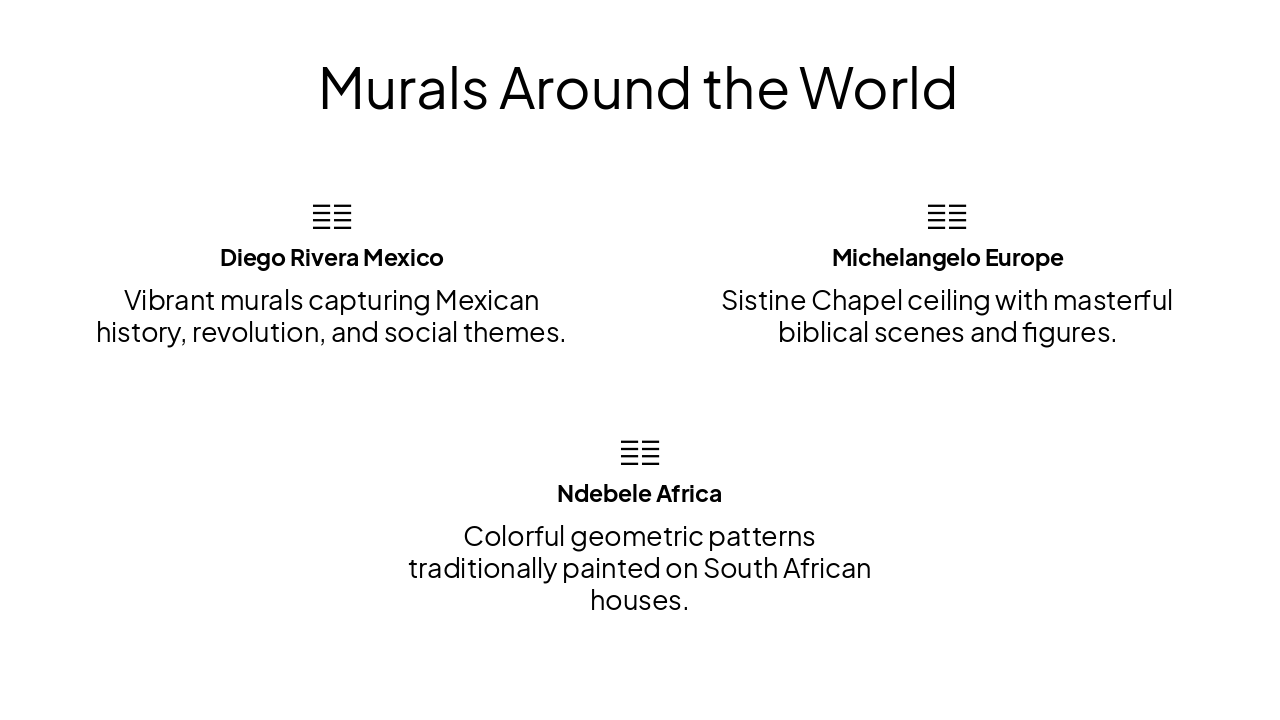
The "Murals Around the World" feature grid showcases three iconic examples from different regions. It highlights Diego Rivera's vibrant Mexican murals on history and revolution, Michelangelo's Sistine Chapel ceiling with biblical scenes in Europe, and Ndebele's colorful geometric house patterns in South Africa.

Murals Around the World

{ "features": [ { "icon": "🇲🇽", "heading": "Diego Rivera Mexico", "description": "Vibrant murals capturing Mexican history, revolution, and social themes." }, { "icon": "🇮🇹", "heading": "Michelangelo Europe", "description": "Sistine Chapel ceiling with masterful biblical scenes and figures." }, { "icon": "🇿🇦", "heading": "Ndebele Africa", "description": "Colorful geometric patterns traditionally painted on South African houses." } ] }

Slide 4 - Murals Around the World
Slide 5 of 16

Slide 5 - Murals in India

India's murals are showcased in the Ajanta Caves' ancient Buddhist art and Ellora Caves' rock-cut temple paintings. Temple murals depict gods and epics using earthy colors and detailed figures.

Murals in India

  • Ajanta Caves: ancient Buddhist murals
  • Ellora Caves: rock-cut temple paintings
  • Temple murals depict gods and epics
  • Earthy colors with detailed figures
Slide 5 - Murals in India
Slide 6 of 16

Slide 6 - Kerala Mural Art

Kerala Mural Art originated between the 9th and 12th centuries. It depicts themes of gods and goddesses and is found in temples and palaces.

Kerala Mural Art

  • 9th–12th century origins
  • Themes of gods and goddesses
  • Found in temples and palaces
Slide 6 - Kerala Mural Art
Slide 7 of 16

Slide 7 - Kerala Mural Style

Kerala Mural Style showcases vibrant colors like red, yellow, green, and black, paired with intricate, flowing line work. It employs natural dyes from plants and minerals to render detailed mythical figures and motifs.

Kerala Mural Style

  • Vibrant colors: red, yellow, green, black
  • Intricate, flowing line work
  • Natural dyes from plants, minerals
  • Detailed mythical figures and motifs
Slide 7 - Kerala Mural Style
Slide 8 of 16

Slide 8 - Techniques Used

This workflow slide outlines four phases of a painting technique: surface preparation with lime plaster, sketching with charcoal, pigment layering using natural pigments, and fine detailing with brushes. Each phase lists specific materials and concise process steps for building a mural.

Techniques Used

{ "headers": [ "Phase", "Materials", "Process" ], "rows": [ [ "1. Surface Preparation", "Lime Plaster", "Apply lime plaster to create a smooth, absorbent base on the wall." ], [ "2. Sketching", "Charcoal", "Outline the composition and figures with light charcoal sketches." ], [ "3. Pigment Layering", "Natural Pigments", "Build up colors in thin layers using plant-based dyes for depth." ], [ "4. Fine Detailing", "Fine Brushes", "Add intricate lines, patterns, and highlights for precision." ] ] }

Source: Traditional Kerala Mural Painting

Speaker Notes
These are the key steps in creating Kerala murals: from preparation to detailing.
Slide 8 - Techniques Used
Slide 9 of 16

Slide 9 - Famous Kerala Mural Locations

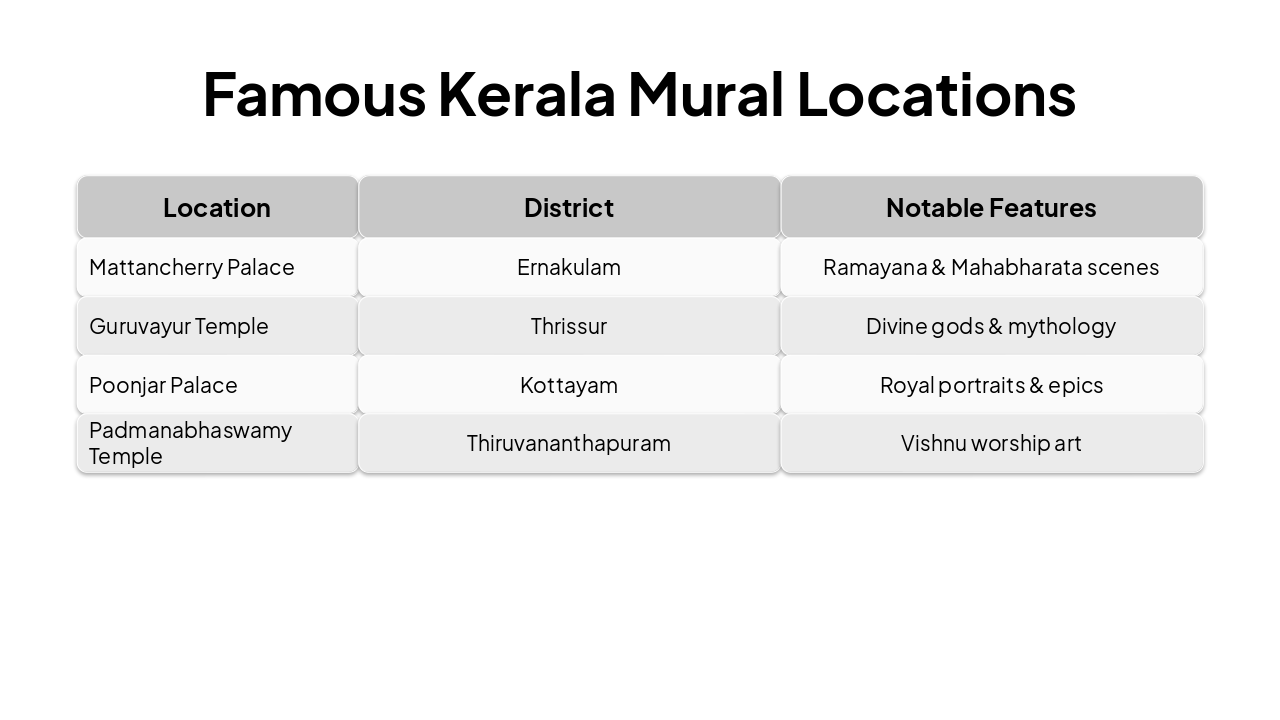
The slide table lists famous Kerala mural locations, including Mattancherry Palace (Ernakulam) with Ramayana and Mahabharata scenes, Guruvayur Temple (Thrissur) featuring divine gods and mythology, Poonjar Palace (Kottayam) with royal portraits and epics, and Padmanabhaswamy Temple (Thiruvananthapuram) depicting Vishnu worship art. It organizes this information by location, district, and notable features.

Famous Kerala Mural Locations

{ "headers": [ "Location", "District", "Notable Features" ], "rows": [ [ "Mattancherry Palace", "Ernakulam", "Ramayana & Mahabharata scenes" ], [ "Guruvayur Temple", "Thrissur", "Divine gods & mythology" ], [ "Poonjar Palace", "Kottayam", "Royal portraits & epics" ], [ "Padmanabhaswamy Temple", "Thiruvananthapuram", "Vishnu worship art" ] ] }

Slide 9 - Famous Kerala Mural Locations
Slide 10 of 16

Slide 10 - Modern Murals

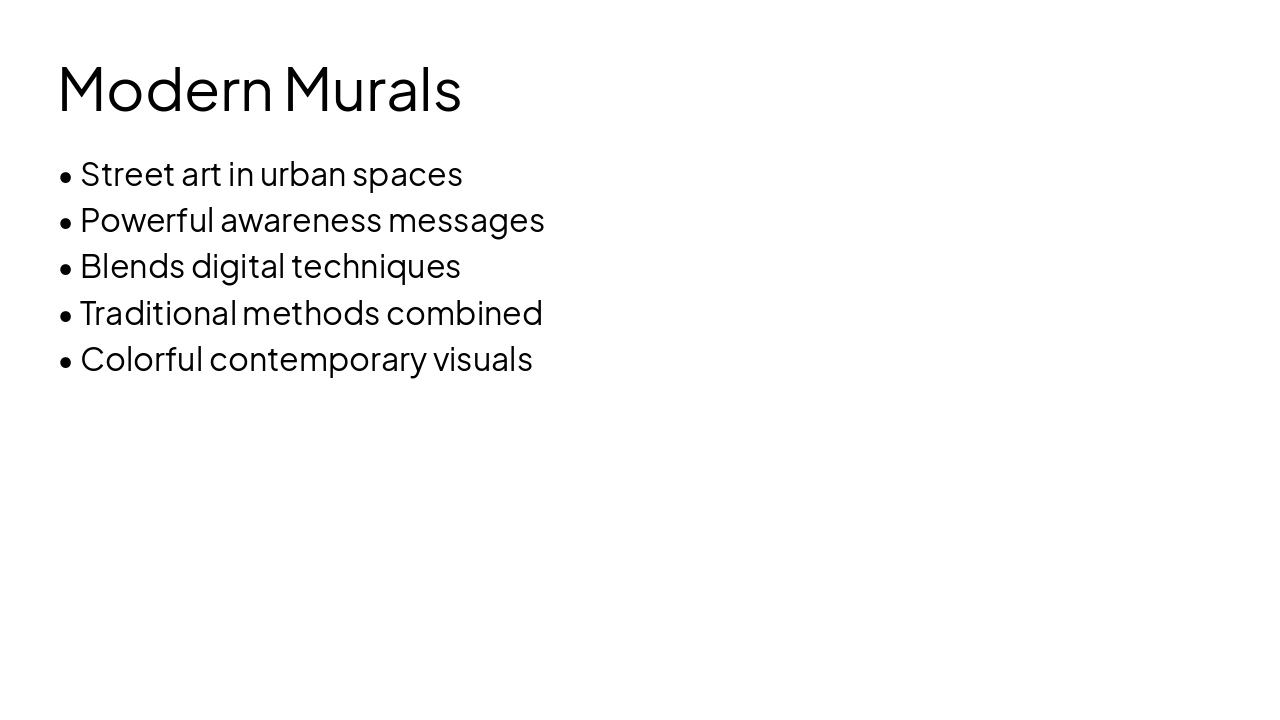
Modern Murals feature street art in urban spaces that deliver powerful awareness messages. They blend traditional methods with digital techniques for colorful, contemporary visuals.

Modern Murals

  • Street art in urban spaces
  • Powerful awareness messages
  • Blends digital techniques
  • Traditional methods combined
  • Colorful contemporary visuals
Slide 10 - Modern Murals
Slide 11 of 16

Slide 11 - Importance of Murals

This slide, titled "Importance of Murals," outlines their key benefits in bullet points. Murals preserve cultural history, beautify urban spaces, promote artistic expression, and foster community collaboration.

Importance of Murals

  • Preserves cultural history and traditions.
  • Beautifies public and urban spaces.
  • Promotes creativity and artistic expression.
  • Fosters community engagement and collaboration.
Slide 11 - Importance of Murals
Slide 12 of 16

Slide 12 - Tools & Materials

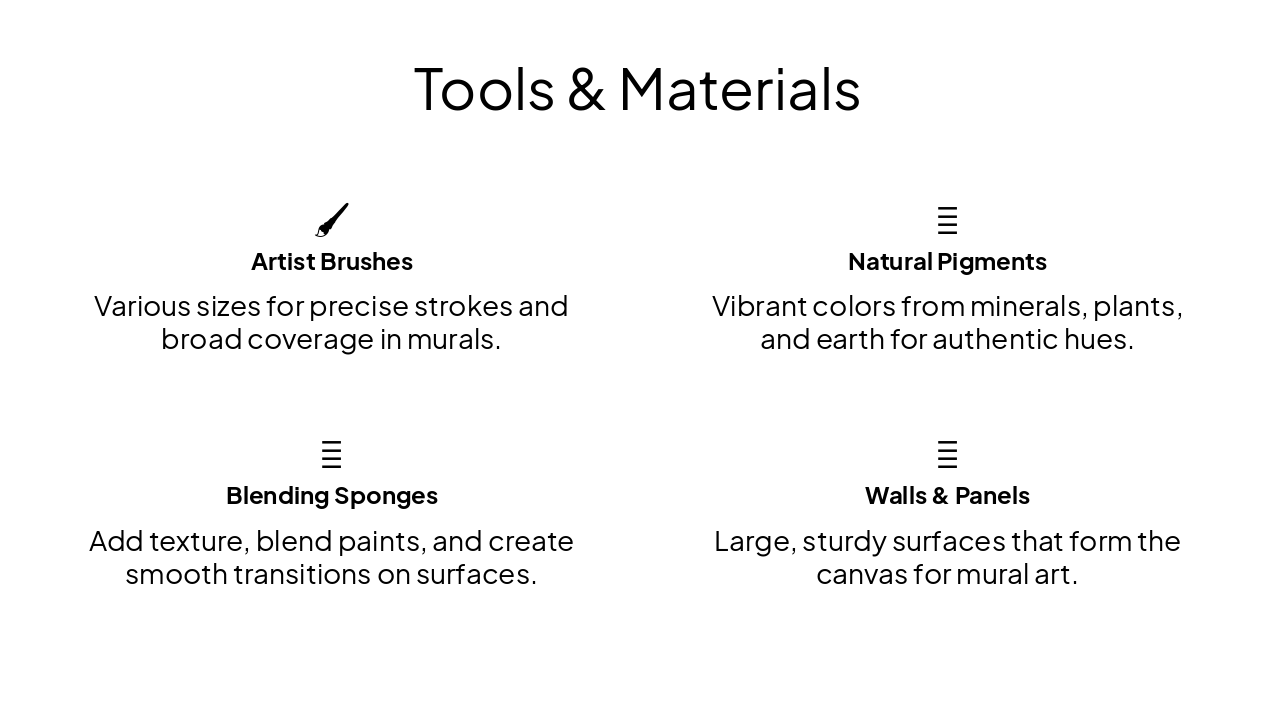
The "Tools & Materials" feature grid slide lists essential mural art supplies with icons: artist brushes for precise strokes, natural pigments for authentic vibrant colors, blending sponges for texture and smooth transitions, and walls & panels as sturdy canvases. Each feature includes a concise description of its purpose.

Tools & Materials

{ "features": [ { "icon": "🖌️", "heading": "Artist Brushes", "description": "Various sizes for precise strokes and broad coverage in murals." }, { "icon": "🎨", "heading": "Natural Pigments", "description": "Vibrant colors from minerals, plants, and earth for authentic hues." }, { "icon": "🧽", "heading": "Blending Sponges", "description": "Add texture, blend paints, and create smooth transitions on surfaces." }, { "icon": "🧱", "heading": "Walls & Panels", "description": "Large, sturdy surfaces that form the canvas for mural art." } ] }

Slide 12 - Tools & Materials
Slide 13 of 16

Slide 13 - Our Mural Activity

In the "Our Mural Activity" slide, participants collaboratively selected an inspiring theme and sketched rough preliminary designs. The activity fostered effective teamwork while combining creativity and collaboration.

Our Mural Activity

  • Collaboratively selected inspiring theme
  • Sketched rough preliminary designs
  • Fostered effective teamwork spirit
  • Combined creativity and collaboration
Slide 13 - Our Mural Activity
Slide 14 of 16

Slide 14 - 2 HOURS PROGRESS

This slide, titled "2 HOURS PROGRESS," outlines main figures and borders while applying base colors to the background. The team coordinated sections effectively, with intricate details now in progress.

2 HOURS PROGRESS

!Image

  • Outlined main figures and borders.
  • Applied base colors to background.
  • Team coordinated sections effectively.
  • Intricate details in progress.

Source: Wikipedia

Speaker Notes
Placeholder for student images.
Slide 14 - 2 HOURS PROGRESS
Slide 15 of 16

Slide 15 - FINAL RESULT

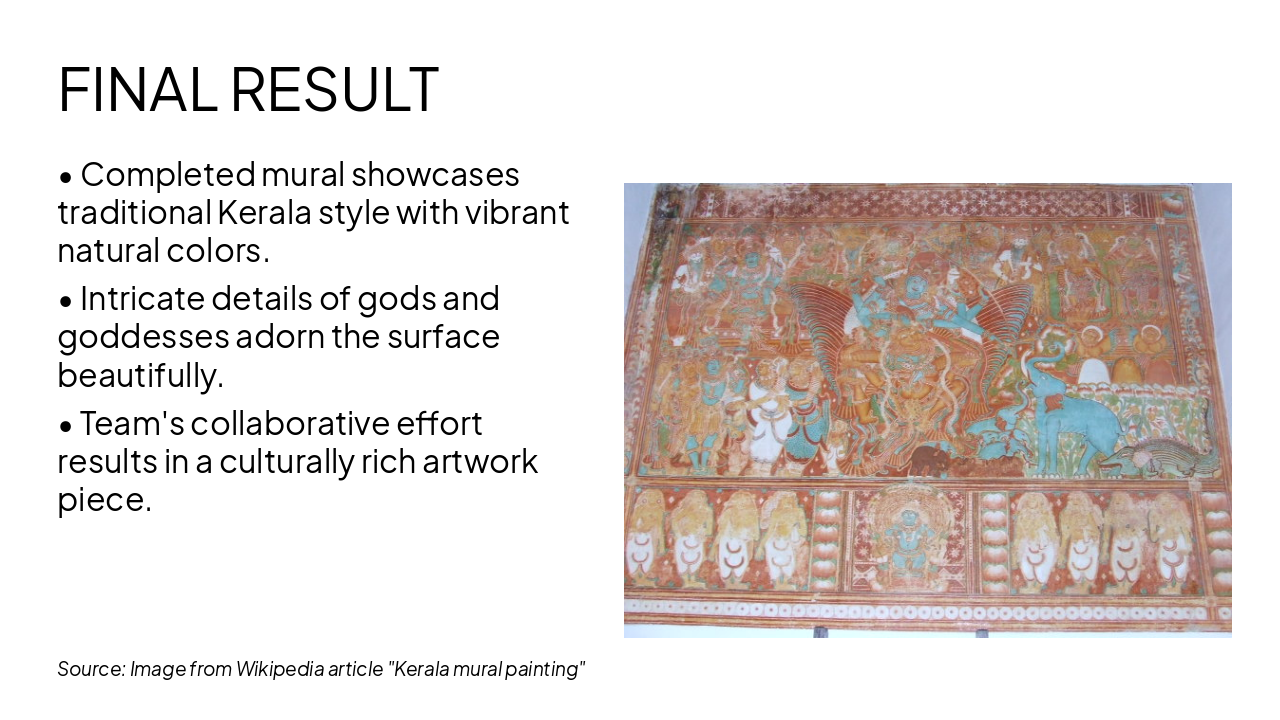
The "FINAL RESULT" slide showcases a completed mural in traditional Kerala style, featuring vibrant natural colors and intricate details of gods and goddesses. This culturally rich artwork is the result of the team's collaborative effort.

FINAL RESULT

!Image

  • Completed mural showcases traditional Kerala style with vibrant natural colors.
  • Intricate details of gods and goddesses adorn the surface beautifully.
  • Team's collaborative effort results in a culturally rich artwork piece.

Source: Image from Wikipedia article "Kerala mural painting"

Slide 15 - FINAL RESULT
Slide 16 of 16

Slide 16 - THANK YOU

This conclusion slide, titled "THANK YOU", displays the message "Thank you for your kind attention!". The subtitle credits the presentation to Ryan, Aaron, and Mahijith from Grade 8A.

THANK YOU

Thank you for your kind attention!

Presented by Ryan, Aaron, Mahijith – Grade 8A

Source: MURAL ART Presentation by Grade 8A

Speaker Notes
Smile, bow, and invite questions.
Slide 16 - THANK YOU

Discover More Presentations

Explore thousands of AI-generated presentations for inspiration

Browse Presentations
Powered by AI

Create Your Own Presentation

Generate professional presentations in seconds with Karaf's AI. Customize this presentation or start from scratch.

Create New Presentation

Powered by Karaf.ai — AI-Powered Presentation Generator