XXE & Known Vulns: Risks and Fixes (32 chars)

Generated from prompt:

Create a presentation with 4 slides titled 'XML External Entities (XXE) & Known Vulnerabilities'. SLIDE 1 — XML External Entities (XXE): What It Is - XXE is a security weakness in systems that process XML input. - Hackers insert external entities into XML to make the system load files or URLs. - This can expose sensitive data, crash the system, or allow internal network access. - Happens when XML parsers are not configured securely. - Simple explanation: The system trusts XML too much, so hackers hide commands inside XML files. SLIDE 2 — XXE: How Hackers Use It & How to Prevent It How Hackers Use XXE: - Send/upload malicious XML with hidden external entities. - Force the server to open private files (e.g., /etc/passwd). - Attack internal systems or cause denial-of-service. How to Prevent XXE: - Disable external entities in XML parsers. - Use secure XML libraries that block XXE by default. - Validate all XML input. - Use JSON instead of XML when possible. - Keep all XML-related software updated. SLIDE 3 — Using Components With Known Vulnerabilities: What It Is - Happens when apps use outdated or insecure software libraries, plugins, or frameworks. - Hackers already know how to attack these weaknesses because they are public. - Example components: old JavaScript libraries, outdated PHP versions, old WordPress plugins, Log4j. - This is one of the most common OWASP Top 10 risks. - Simple explanation: If you use old software, hackers already know how to break it. SLIDE 4 — Known Vulnerabilities: How Hackers Use Them & How to Prevent Them How Hackers Exploit These Weak Components: - Scan for old versions of software with known weaknesses. - Use public tools to attack them (Metasploit, scanners). - Steal data, install malware, or take over servers. - Real Example: Log4j 'Log4Shell' let hackers run code on thousands of systems. How to Prevent It: - Update and patch all software regularly. - Remove unused or outdated components. - Use tools like Snyk, OWASP Dependency Check, NPM Audit. - Keep an inventory of all software used (SBOM). - Monitor vendor security alerts.

Explores XML External Entities (XXE) flaws allowing file access/DoS, hacker exploits, and prevention via secure parsers/JSON. Covers using outdated components (e.g., Log4Shell), scanning/exploitation

December 10, 20257 slides
Slide 1 of 7

Slide 1 - XML External Entities (XXE): What It Is

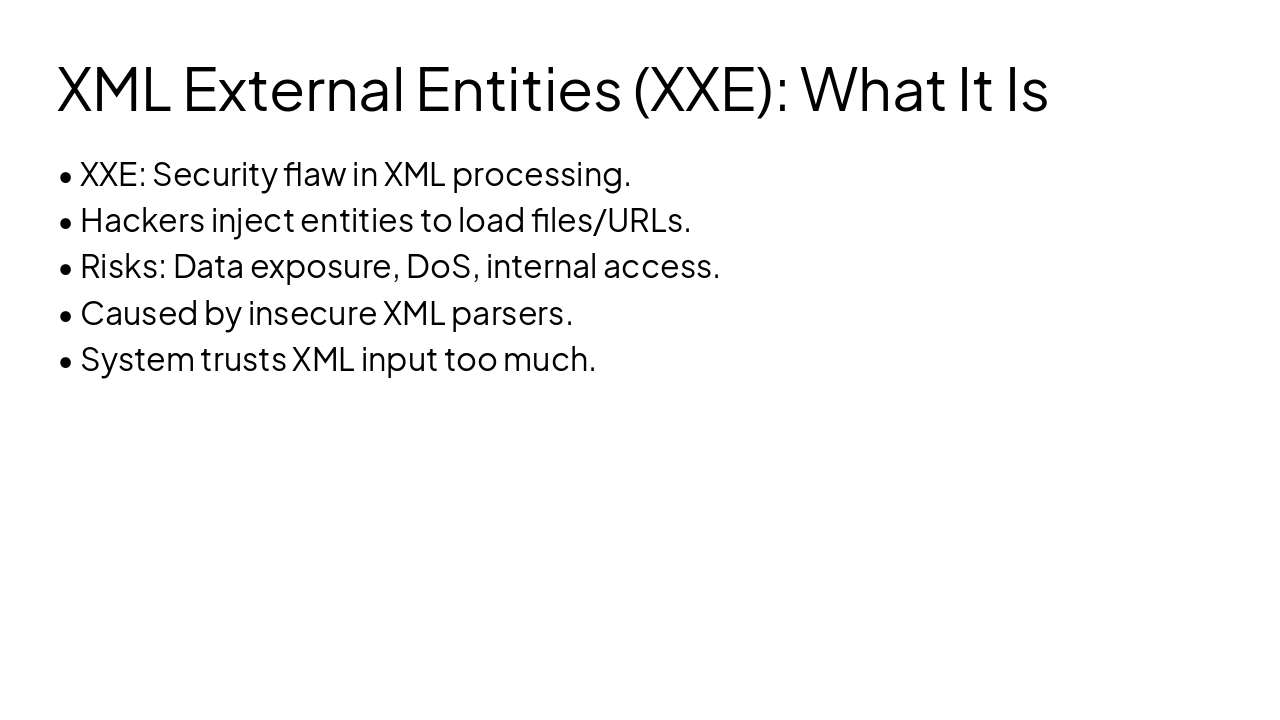
XXE is a security flaw in XML processing where attackers inject malicious entities to load files or external URLs. It causes risks like data exposure, denial of service, and internal system access due to insecure parsers overly trusting XML input.

XML External Entities (XXE): What It Is

  • XXE: Security flaw in XML processing.
  • Hackers inject entities to load files/URLs.
  • Risks: Data exposure, DoS, internal access.
  • Caused by insecure XML parsers.
  • System trusts XML input too much.
Slide 1 - XML External Entities (XXE): What It Is
Slide 2 of 7

Slide 2 - Diagram illustrating XXE attack: malicious XML entity injection leading to file disclosure like /etc/passwd

  • Malicious XML defines external entity
  • Parser expands entity reading files
  • Discloses sensitive data like /etc/passwd
Slide 2 - Diagram illustrating XXE attack: malicious XML entity injection leading to file disclosure like /etc/passwd
Slide 3 of 7

Slide 3 - XXE: How Hackers Use It & How to Prevent It

Hackers exploit XXE by sending malicious XML with external entities to read files like /etc/passwd, attack internal systems, or cause DoS attacks. Prevention involves disabling external entities in parsers, using secure XML libraries, validating inputs, preferring JSON over XML, and keeping software updated.

XXE: How Hackers Use It & How to Prevent It

How Hackers Use XXEHow to Prevent XXE
Hackers send malicious XML with external entities to force servers to read files like /etc/passwd, attack internal systems, or cause denial-of-service (DoS).Disable external entities in parsers, use secure XML libraries, validate all input, prefer JSON over XML, and keep software updated.
Slide 3 - XXE: How Hackers Use It & How to Prevent It
Slide 4 of 7

Slide 4 - Using Components With Known Vulnerabilities: What It Is

This slide defines "Using Components With Known Vulnerabilities" as applications incorporating outdated or insecure libraries, plugins, or frameworks that hackers exploit via publicly known weaknesses. Examples include old JavaScript libraries, outdated PHP, WordPress plugins, and Log4j, marking it as one of the most common OWASP Top 10 risks since old software is already known to be breakable.

Using Components With Known Vulnerabilities: What It Is

  • Applications use outdated or insecure software libraries, plugins, frameworks.
  • Hackers exploit publicly known weaknesses in these components.
  • Examples: old JavaScript libraries, outdated PHP, WordPress plugins, Log4j.
  • One of the most common OWASP Top 10 risks.
  • Simple: Old software means hackers already know how to break it.
Slide 4 - Using Components With Known Vulnerabilities: What It Is
Slide 5 of 7

Slide 5 - Exploiting Log4Shell Vulnerability

  • Log4Shell enables remote code execution via malicious input
  • Attackers exploit JNDI lookups in Log4j libraries
  • Leads to full server compromise if unpatched
Slide 5 - Exploiting Log4Shell Vulnerability
Slide 6 of 7

Slide 6

Generating slide...

Slide 7 of 7

Slide 7 - Known Vulnerabilities: How Hackers Use Them & How to Prevent

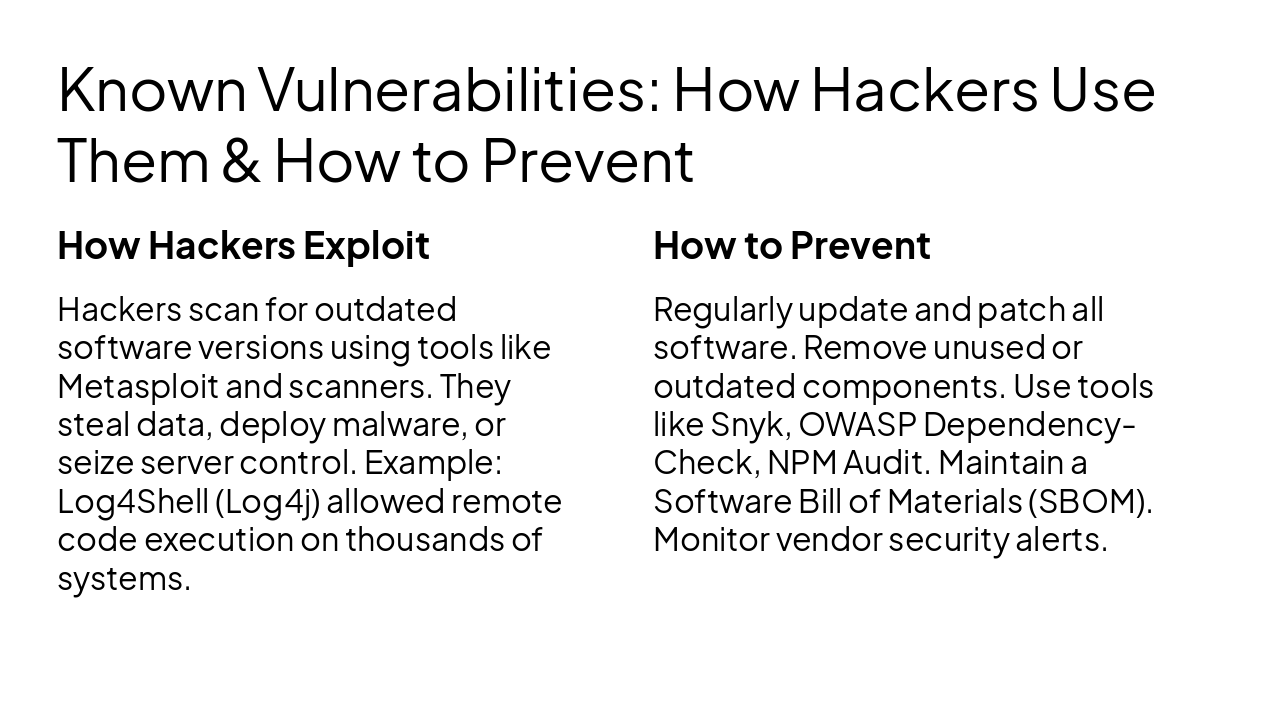
Hackers exploit known vulnerabilities by scanning for outdated software with tools like Metasploit, enabling data theft, malware deployment, or server control, as seen in the Log4Shell Log4j flaw. Prevention involves regular patching, removing unused components, using tools like Snyk and OWASP Dependency-Check, maintaining an SBOM, and monitoring vendor alerts.

Known Vulnerabilities: How Hackers Use Them & How to Prevent

How Hackers ExploitHow to Prevent
Hackers scan for outdated software versions using tools like Metasploit and scanners. They steal data, deploy malware, or seize server control. Example: Log4Shell (Log4j) allowed remote code execution on thousands of systems.Regularly update and patch all software. Remove unused or outdated components. Use tools like Snyk, OWASP Dependency-Check, NPM Audit. Maintain a Software Bill of Materials (SBOM). Monitor vendor security alerts.
Slide 7 - Known Vulnerabilities: How Hackers Use Them & How to Prevent

Discover More Presentations

Explore thousands of AI-generated presentations for inspiration

Browse Presentations
Powered by AI

Create Your Own Presentation

Generate professional presentations in seconds with Karaf's AI. Customize this presentation or start from scratch.

Create New Presentation

Powered by Karaf.ai — AI-Powered Presentation Generator