The Power of Computer Engineering

Generated from prompt:

Make PowerPoint more aesthetically pleasing while keeping the theme of computers and programming. Add at least 5 pictures. Fill in the text box about how mathematics can be utilized in that career. Fix grammar. Change information if some of it is incorrect

This presentation provides an in-depth exploration of computer engineering, highlighting its foundational concepts, academic pathways, and the critical role of mathematics in various career opportunities. It covers key courses, university cost comparisons, and specialized fields such as software engineering, cybersecurity, and artificial intelligence/machine learning.

May 15, 202613 slides
Slide 1 of 13

Slide 1 - The Power of Computer Engineering

The Power of Computer Engineering

Exploring the Intersection of Hardware, Software, and Mathematics

---

Photo by kevin laminto on Unsplash
Slide 1 - The Power of Computer Engineering
Slide 2 of 13

Slide 2

Introduction to Computer Engineering

Bridging Hardware and Software Innovation

---

Photo by Pawel Czerwinski on Unsplash
Slide 2
Slide 3 of 13

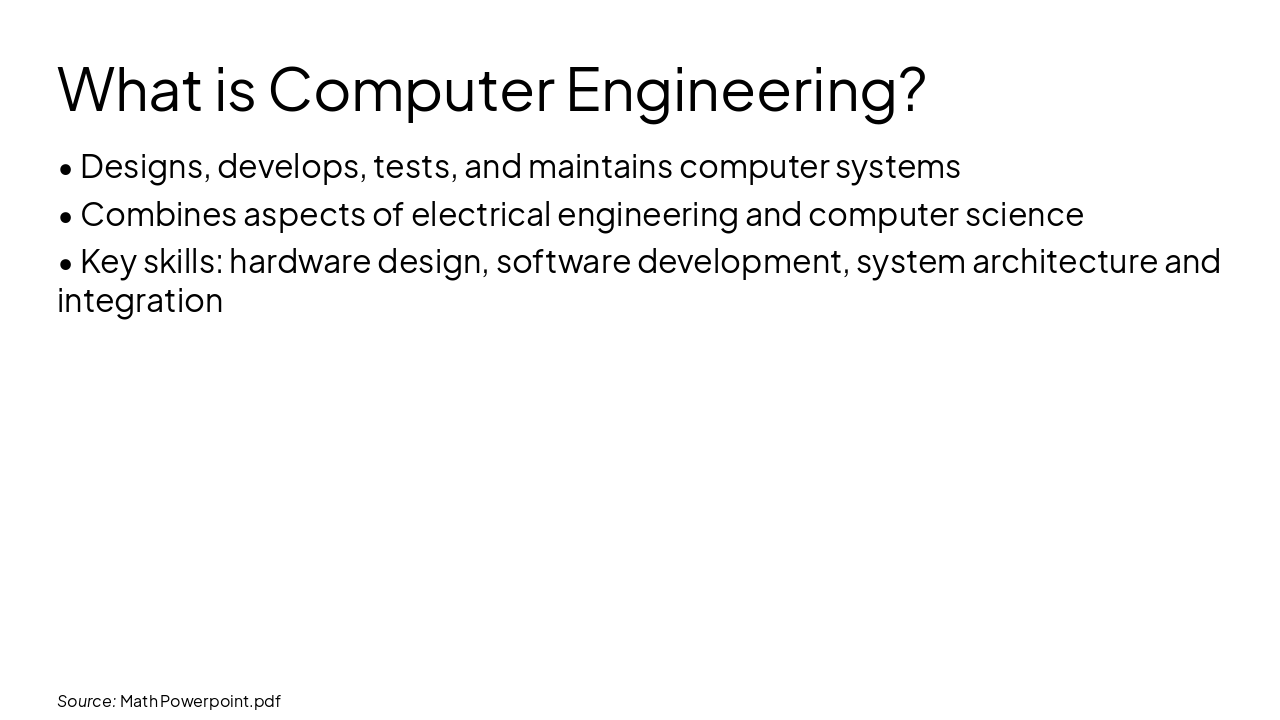
Slide 3 - What is Computer Engineering?

  • Designs, develops, tests, and maintains computer systems
  • Combines aspects of electrical engineering and computer science
  • Key skills: hardware design, software development, system architecture and integration

Source: Math Powerpoint.pdf

Slide 3 - What is Computer Engineering?
Slide 4 of 13

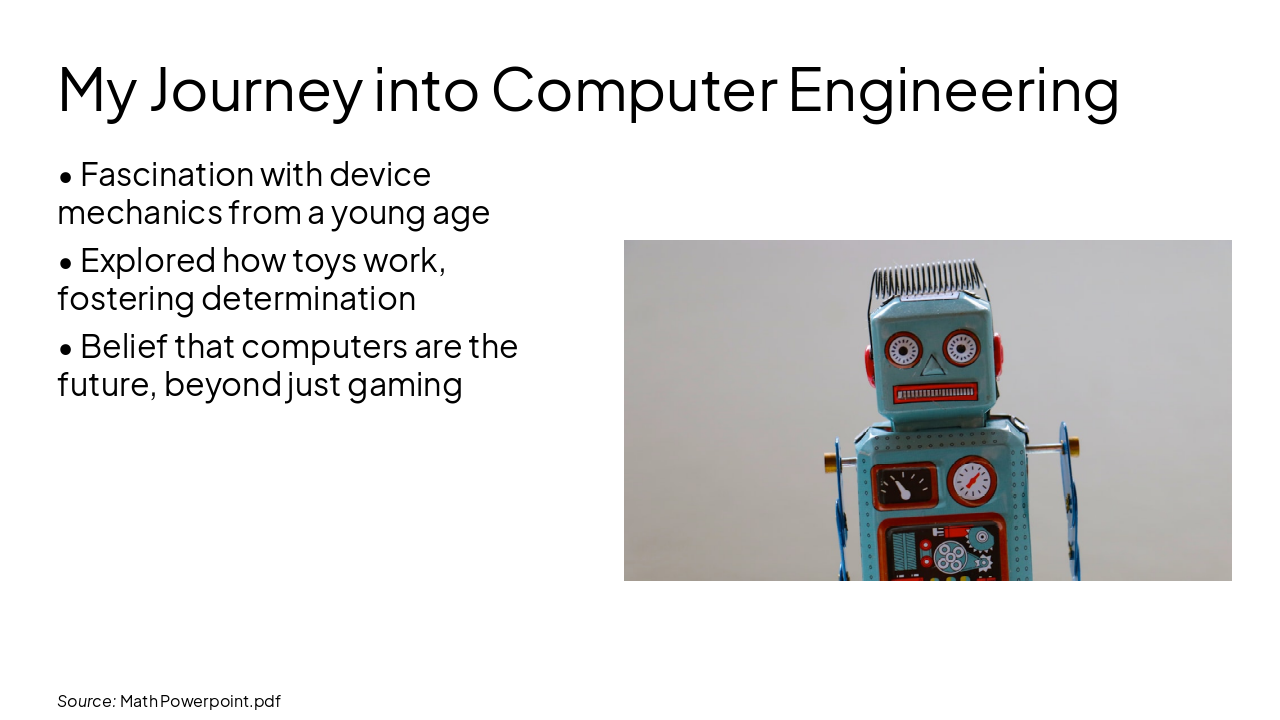
Slide 4 - My Journey into Computer Engineering

  • Fascination with device mechanics from a young age
  • Explored how toys work, fostering determination
  • Belief that computers are the future, beyond just gaming

---

Photo by Emilipothèse on Unsplash

Source: Math Powerpoint.pdf
Slide 4 - My Journey into Computer Engineering
Slide 5 of 13

Slide 5

Academic Path

Foundational Courses and Institutions

---

Photo by GV Chana on Unsplash

Slide 5
Slide 6 of 13

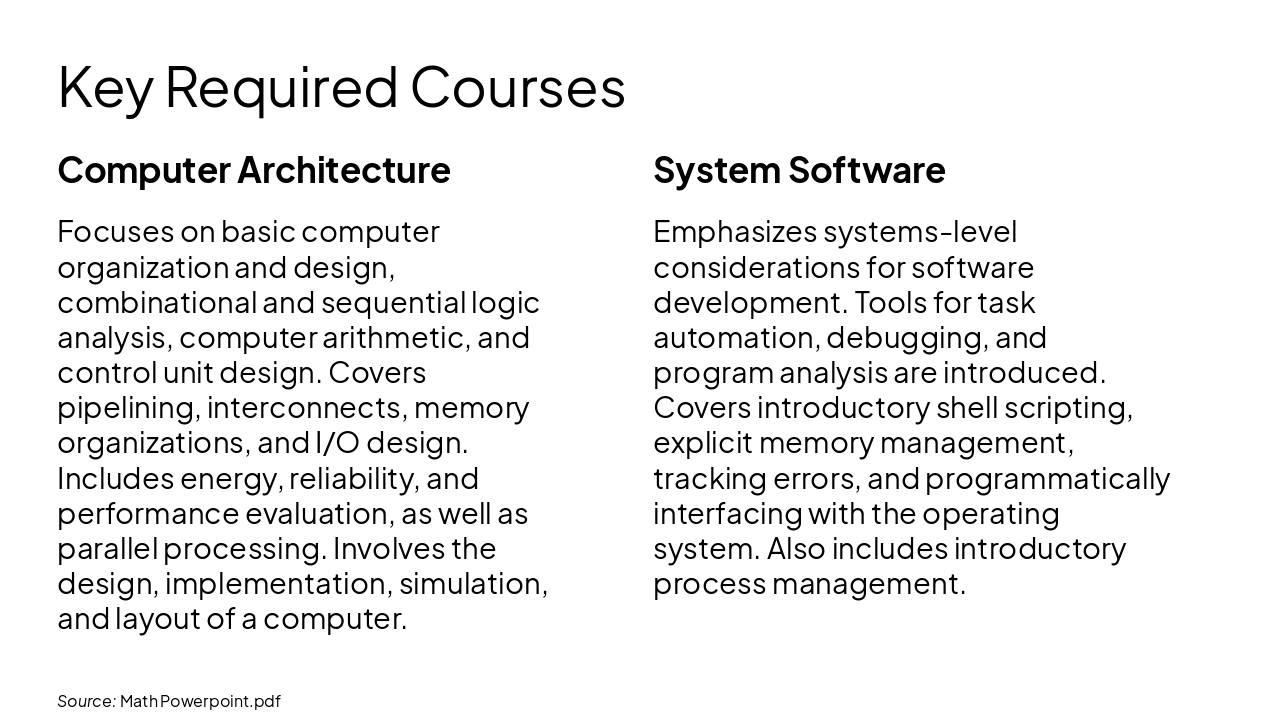
Slide 6 - Key Required Courses

Computer Architecture Focuses on basic computer organization and design, combinational and sequential logic analysis, computer arithmetic, and control unit design. Covers pipelining, interconnects, memory organizations, and I/O design. Includes energy, reliability, and performance evaluation, as well as parallel processing. Involves the design, implementation, simulation, and layout of a computer.

System Software Emphasizes systems-level considerations for software development. Tools for task automation, debugging, and program analysis are introduced. Covers introductory shell scripting, explicit memory management, tracking errors, and programmatically interfacing with the operating system. Also includes introductory process management.

Source: Math Powerpoint.pdf
Slide 6 - Key Required Courses
Slide 7 of 13

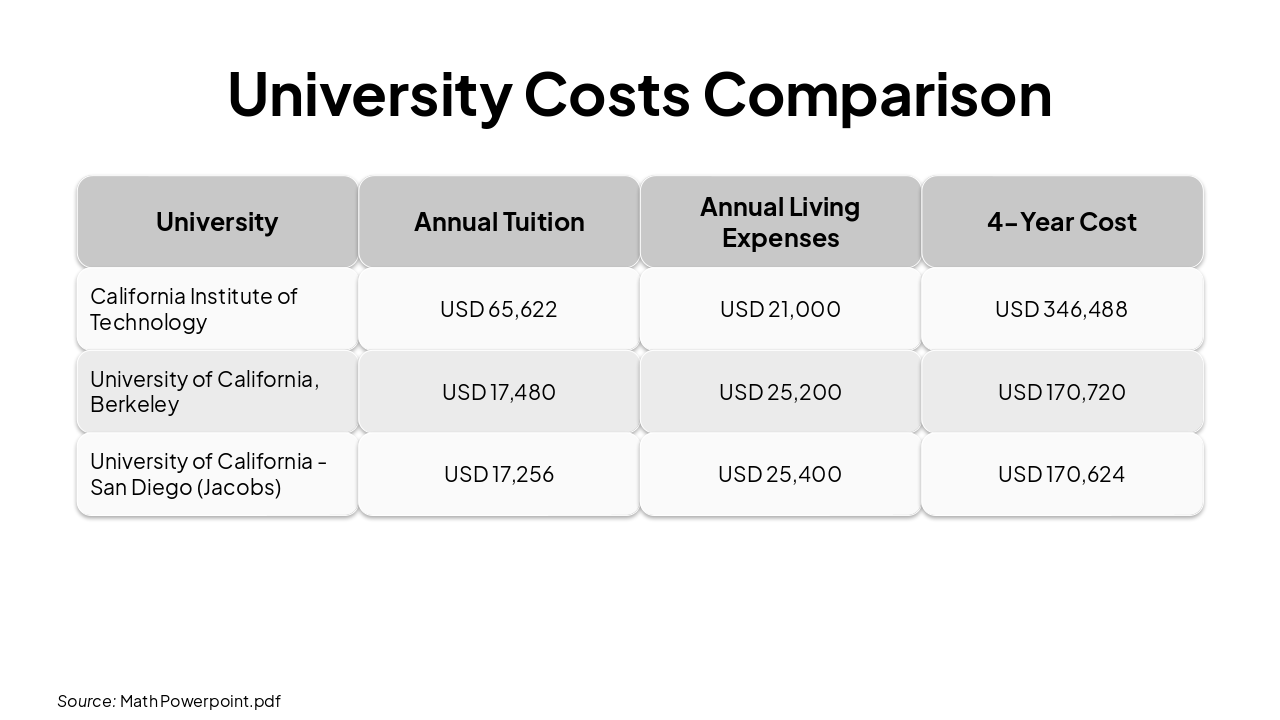
Slide 7 - University Costs Comparison

UniversityAnnual TuitionAnnual Living Expenses4-Year Cost
California Institute of TechnologyUSD 65,622USD 21,000USD 346,488
University of California, BerkeleyUSD 17,480USD 25,200USD 170,720
University of California - San Diego (Jacobs)USD 17,256USD 25,400USD 170,624

Source: Math Powerpoint.pdf

Slide 7 - University Costs Comparison
Slide 8 of 13

Slide 8

Career Opportunities & Mathematics

Shaping the Future with Quantitative Skills

---

Photo by Albert Stoynov on Unsplash

Slide 8
Slide 9 of 13

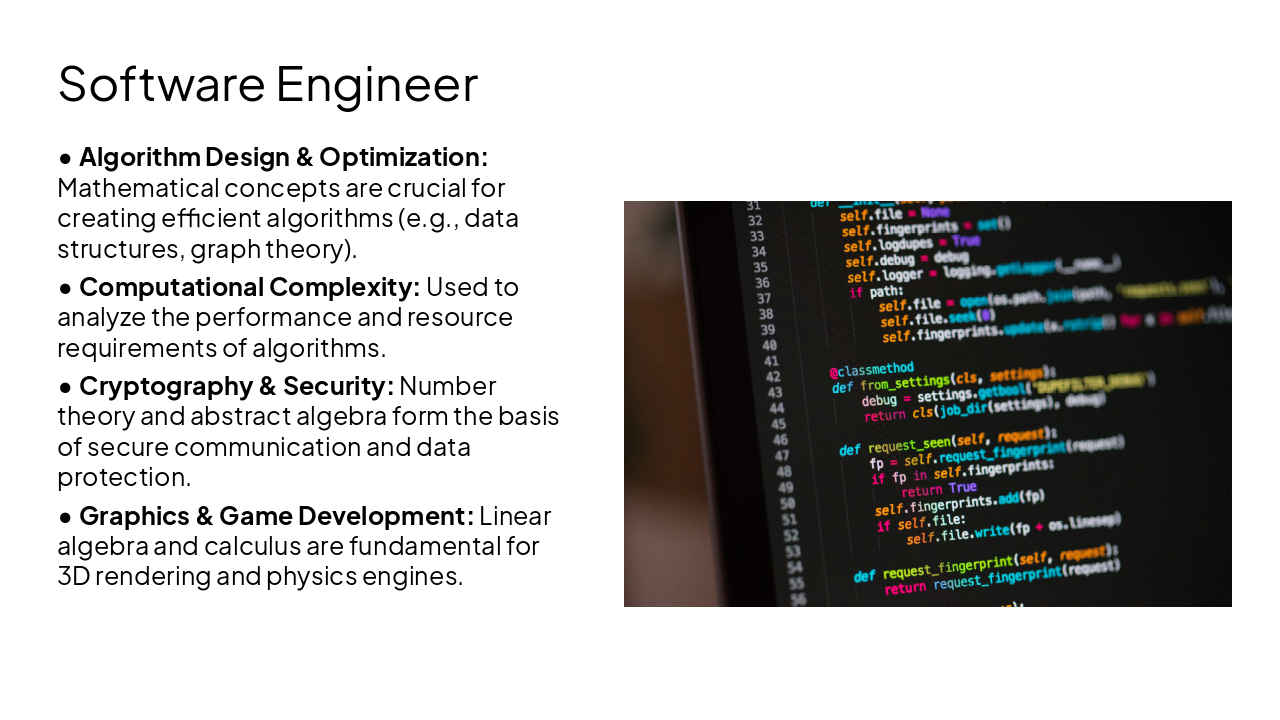
Slide 9 - Software Engineer

  • Algorithm Design & Optimization: Mathematical concepts are crucial for creating efficient algorithms (e.g., data structures, graph theory).
  • Computational Complexity: Used to analyze the performance and resource requirements of algorithms.
  • Cryptography & Security: Number theory and abstract algebra form the basis of secure communication and data protection.
  • Graphics & Game Development: Linear algebra and calculus are fundamental for 3D rendering and physics engines.

---

Photo by Chris Ried on Unsplash

Slide 9 - Software Engineer
Slide 10 of 13

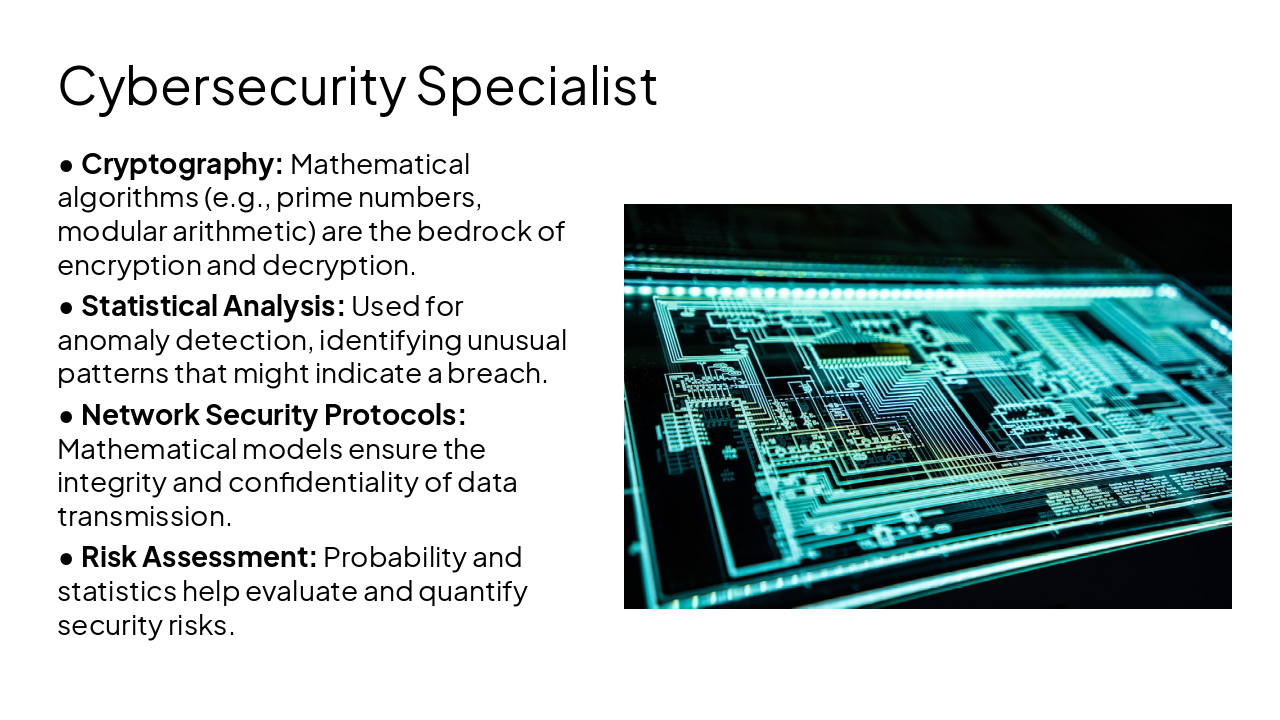
Slide 10 - Cybersecurity Specialist

  • Cryptography: Mathematical algorithms (e.g., prime numbers, modular arithmetic) are the bedrock of encryption and decryption.
  • Statistical Analysis: Used for anomaly detection, identifying unusual patterns that might indicate a breach.
  • Network Security Protocols: Mathematical models ensure the integrity and confidentiality of data transmission.
  • Risk Assessment: Probability and statistics help evaluate and quantify security risks.

---

Photo by Adi Goldstein on Unsplash
Slide 10 - Cybersecurity Specialist
Slide 11 of 13

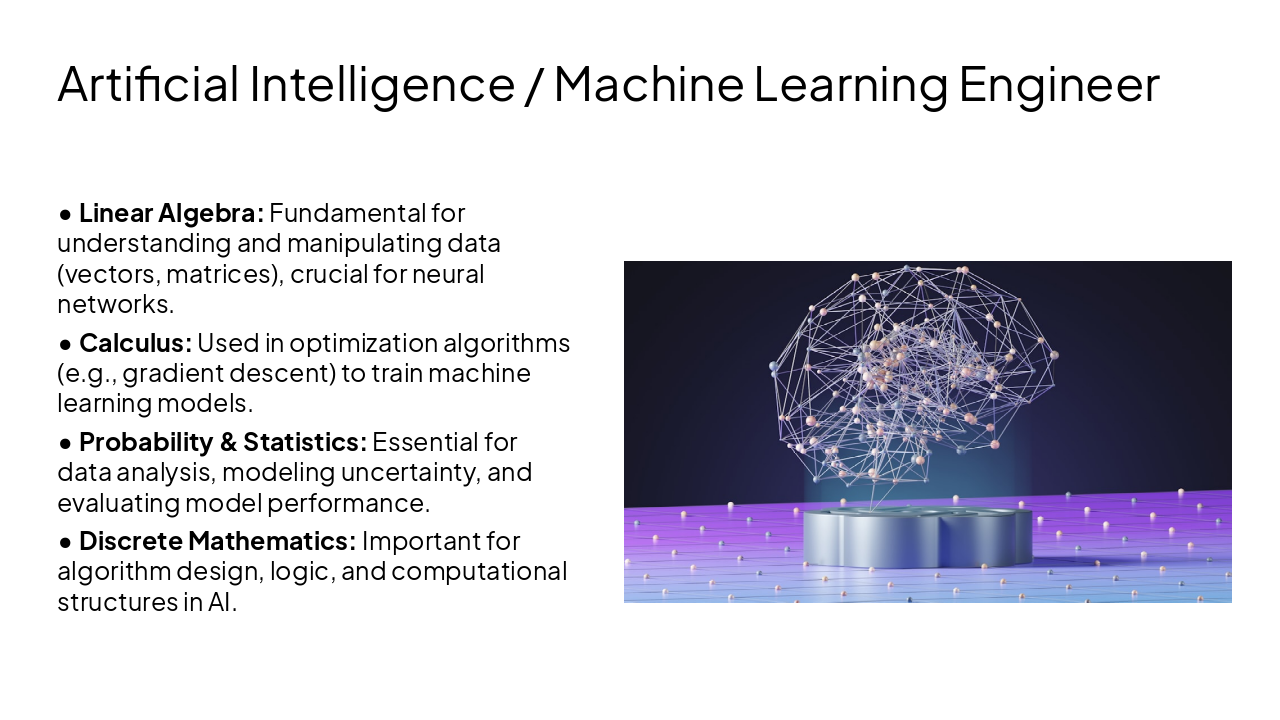
Slide 11 - Artificial Intelligence / Machine Learning Engineer

  • Linear Algebra: Fundamental for understanding and manipulating data (vectors, matrices), crucial for neural networks.
  • Calculus: Used in optimization algorithms (e.g., gradient descent) to train machine learning models.
  • Probability & Statistics: Essential for data analysis, modeling uncertainty, and evaluating model performance.
  • Discrete Mathematics: Important for algorithm design, logic, and computational structures in AI.

---

Photo by Growtika on Unsplash

Slide 11 - Artificial Intelligence / Machine Learning Engineer
Slide 12 of 13

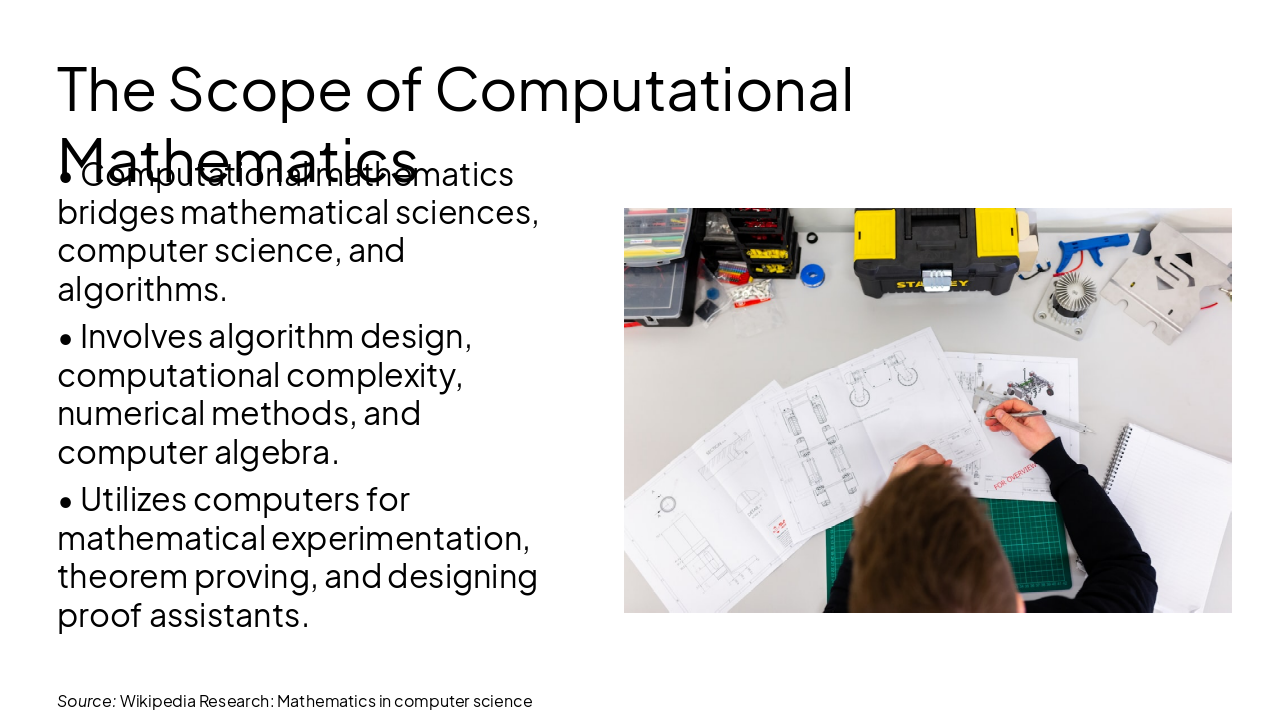
Slide 12 - The Scope of Computational Mathematics

  • Computational mathematics bridges mathematical sciences, computer science, and algorithms.
  • Involves algorithm design, computational complexity, numerical methods, and computer algebra.
  • Utilizes computers for mathematical experimentation, theorem proving, and designing proof assistants.

---

Photo by ThisisEngineering on Unsplash

Source: Wikipedia Research: Mathematics in computer science
Slide 12 - The Scope of Computational Mathematics
Slide 13 of 13

Slide 13 - Conclusion

Computer Engineering: Where Innovation Meets Mathematical Precision

A rewarding career at the forefront of technological advancement

---

Photo by MJH SHIKDER on Unsplash
Slide 13 - Conclusion

Discover More Presentations

Explore thousands of AI-generated presentations for inspiration

Browse Presentations
Powered by AI

Create Your Own Presentation

Generate professional presentations in seconds with Karaf's AI. Customize this presentation or start from scratch.

Create New Presentation

Powered by Karaf.ai — AI-Powered Presentation Generator