Mastering BCP for Business Resilience

Generated from prompt:

Make a presentation about BCP

This presentation explores Business Continuity Planning (BCP), covering its definition, differences from disaster recovery, development timeline, impact stats, expert insights, implementation steps, a

November 20, 202510 slides
Slide 1 of 10

Slide 1 - Business Continuity Planning (BCP)

The slide features the title "Business Continuity Planning (BCP)" as its main heading. Its subtitle emphasizes "Ensuring Organizational Resilience Against Disruptions," highlighting the focus on maintaining operations during unexpected challenges.

Business Continuity Planning (BCP)

Ensuring Organizational Resilience Against Disruptions

--- Speaker Notes: Introduction to BCP: Ensuring organizational resilience against disruptions. Key elements and importance in modern business.

Slide 1
Slide 2 of 10

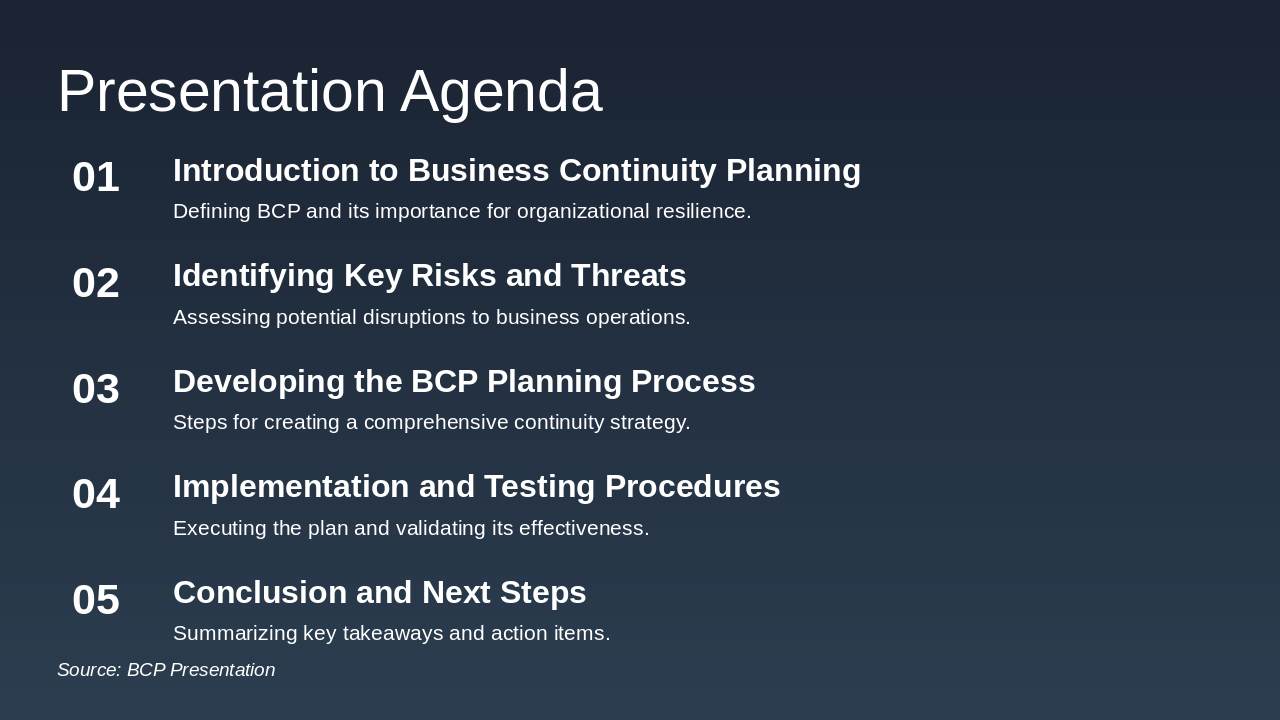
Slide 2 - Presentation Agenda

The presentation agenda outlines a structured overview of Business Continuity Planning (BCP), starting with an introduction that defines BCP and its role in enhancing organizational resilience. It then covers identifying key risks and threats, developing the BCP process, implementation and testing procedures, and concludes with key takeaways and next steps.

Presentation Agenda

  1. Introduction to Business Continuity Planning

Defining BCP and its importance for organizational resilience.

  1. Identifying Key Risks and Threats

Assessing potential disruptions to business operations.

  1. Developing the BCP Planning Process

Steps for creating a comprehensive continuity strategy.

  1. Implementation and Testing Procedures

Executing the plan and validating its effectiveness.

  1. Conclusion and Next Steps

Summarizing key takeaways and action items.

Source: BCP Presentation

Slide 2
Slide 3 of 10

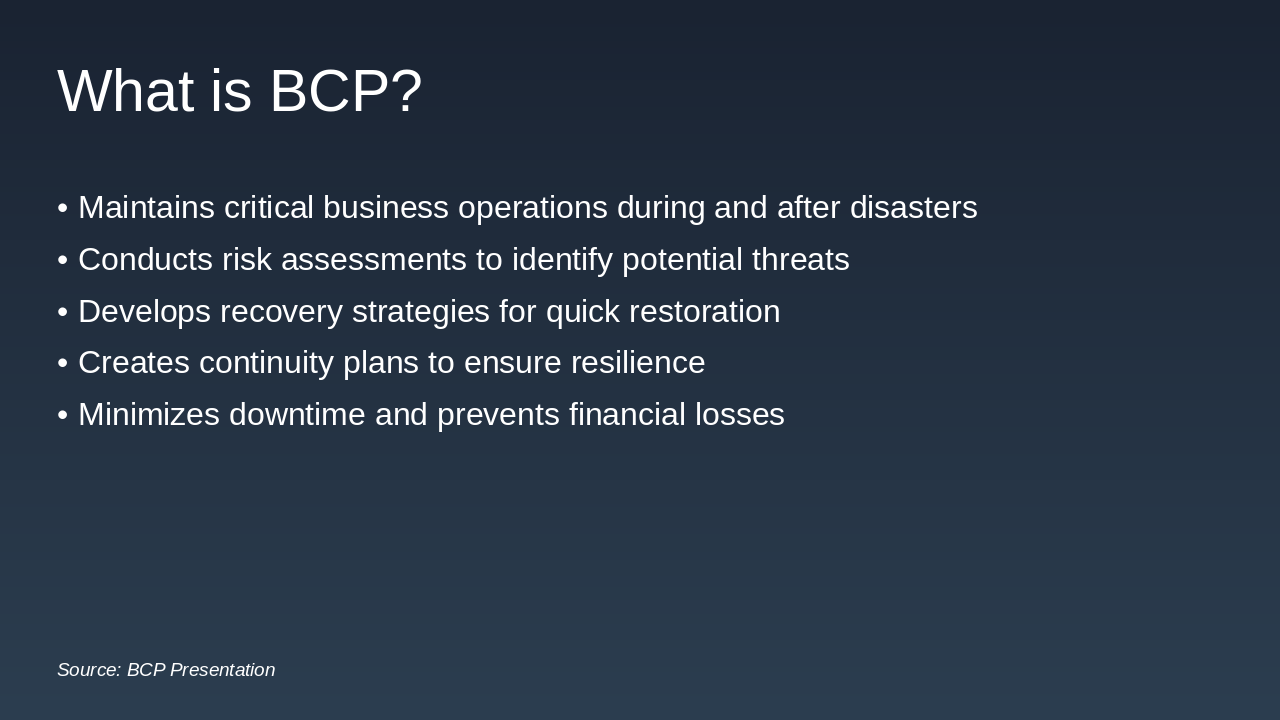
Slide 3 - What is BCP?

Business Continuity Planning (BCP) is a framework that maintains critical business operations during and after disasters by conducting risk assessments to identify threats and developing recovery strategies for quick restoration. It creates comprehensive continuity plans to ensure organizational resilience, minimizing downtime and preventing financial losses.

What is BCP?

  • Maintains critical business operations during and after disasters
  • Conducts risk assessments to identify potential threats
  • Develops recovery strategies for quick restoration
  • Creates continuity plans to ensure resilience
  • Minimizes downtime and prevents financial losses

Source: BCP Presentation

--- Speaker Notes: BCP is a strategy to maintain critical operations during and after a disaster. Covers risk assessment, recovery strategies, and continuity plans. Essential for minimizing downtime and financial loss.

Slide 3
Slide 4 of 10

Slide 4 - Business Continuity Planning

This section header slide introduces "Identifying Risks" as the third part of Business Continuity Planning. It focuses on assessing natural disasters, cyberattacks, and supply chain failures based on their impact and likelihood.

Business Continuity Planning

03

Identifying Risks

Assessing natural disasters, cyberattacks, and supply chain failures by impact and likelihood.

Slide 4
Slide 5 of 10

Slide 5 - BCP vs. Disaster Recovery

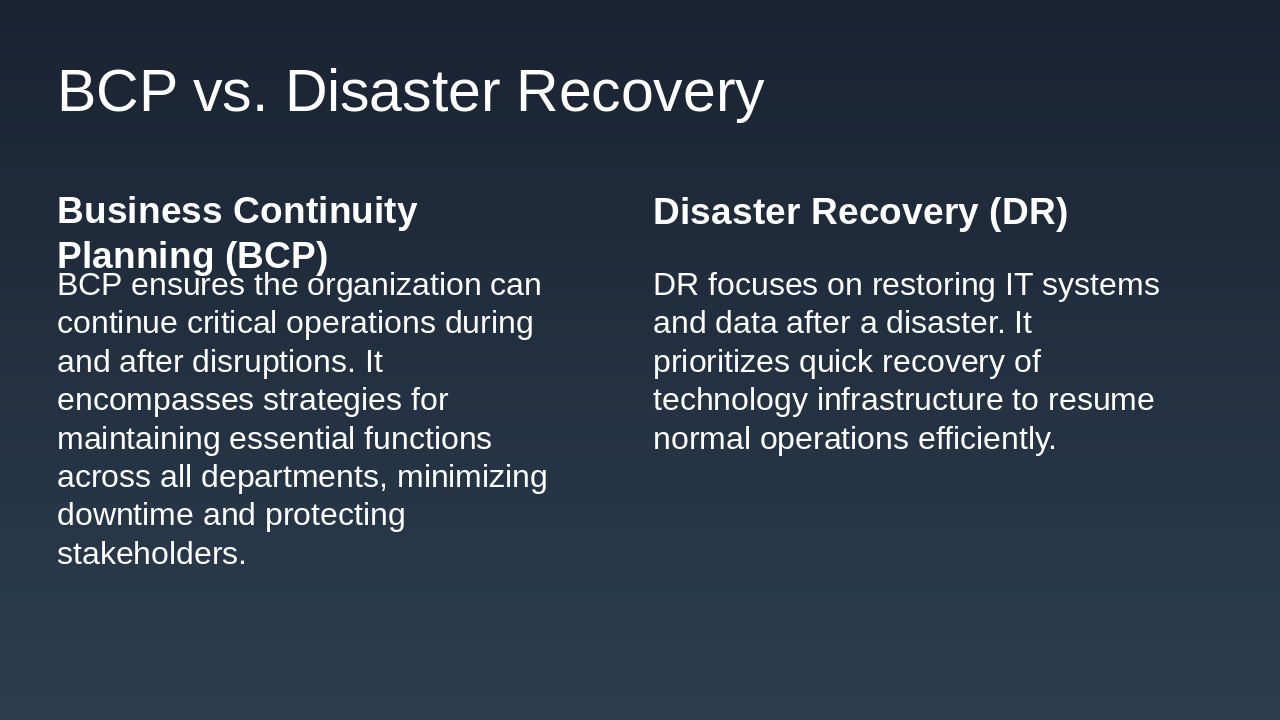
Business Continuity Planning (BCP) ensures an organization can maintain critical operations across all departments during and after disruptions, minimizing downtime and protecting stakeholders. In contrast, Disaster Recovery (DR) focuses on quickly restoring IT systems and data following a disaster to efficiently resume normal operations.

BCP vs. Disaster Recovery

Business Continuity Planning (BCP)Disaster Recovery (DR)
BCP ensures the organization can continue critical operations during and after disruptions. It encompasses strategies for maintaining essential functions across all departments, minimizing downtime and protecting stakeholders.DR focuses on restoring IT systems and data after a disaster. It prioritizes quick recovery of technology infrastructure to resume normal operations efficiently.
Slide 5
Slide 6 of 10

Slide 6 - BCP Development Timeline

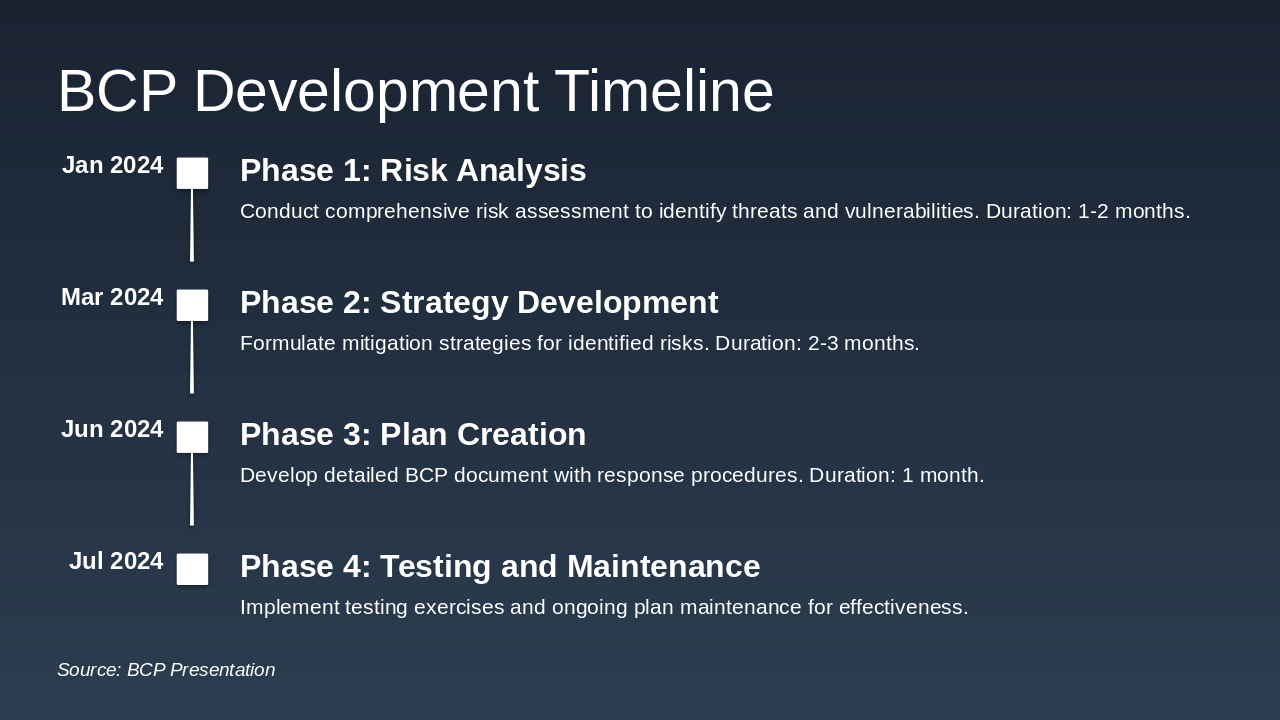
The BCP Development Timeline outlines a four-phase process starting in January 2024 with Phase 1: Risk Analysis, involving a 1-2 month comprehensive assessment of threats and vulnerabilities. It progresses to Phase 2: Strategy Development in March (2-3 months for mitigation formulation), Phase 3: Plan Creation in June (1 month for detailed BCP documentation), and Phase 4: Testing and Maintenance in July for implementation and ongoing effectiveness.

BCP Development Timeline

Jan 2024: Phase 1: Risk Analysis Conduct comprehensive risk assessment to identify threats and vulnerabilities. Duration: 1-2 months. Mar 2024: Phase 2: Strategy Development Formulate mitigation strategies for identified risks. Duration: 2-3 months. Jun 2024: Phase 3: Plan Creation Develop detailed BCP document with response procedures. Duration: 1 month. Jul 2024: Phase 4: Testing and Maintenance Implement testing exercises and ongoing plan maintenance for effectiveness.

Source: BCP Presentation

Slide 6
Slide 7 of 10

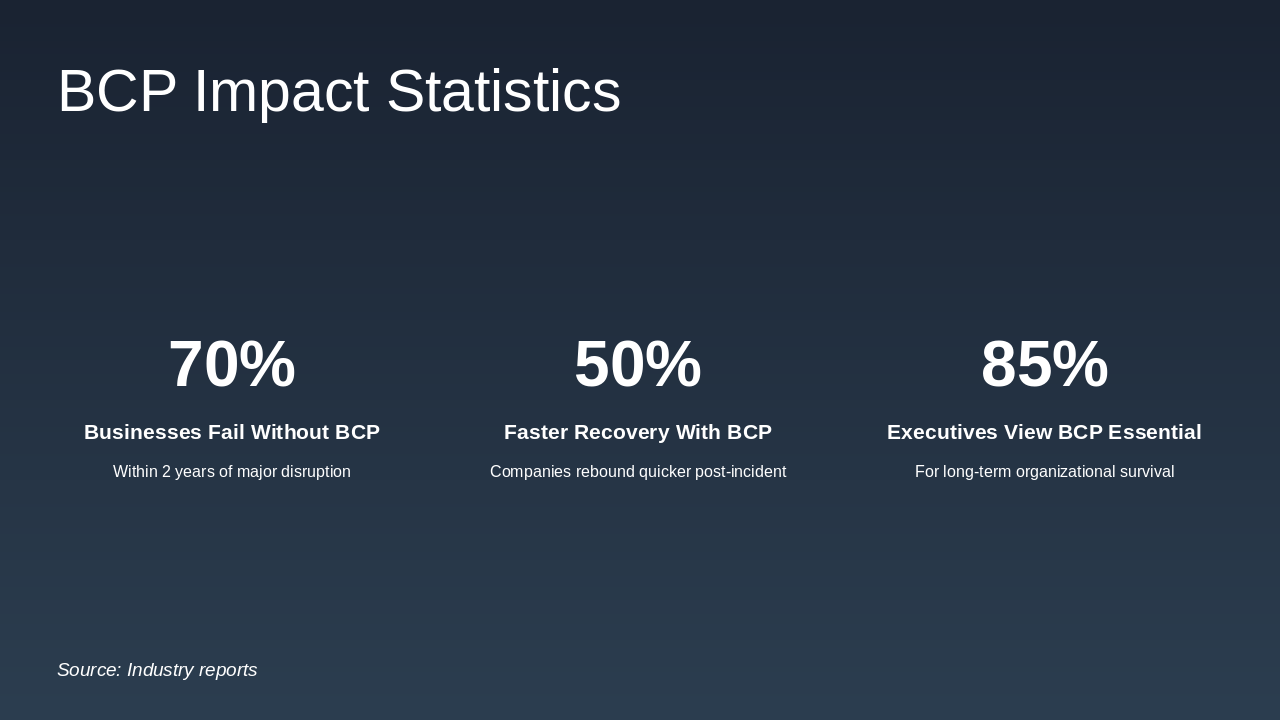
Slide 7 - BCP Impact Statistics

The BCP Impact Statistics slide highlights that 70% of businesses fail within two years of a major disruption without a Business Continuity Plan (BCP). It also notes that companies with a BCP recover 50% faster post-incident, while 85% of executives consider it essential for long-term organizational survival.

BCP Impact Statistics

  • 70%: Businesses Fail Without BCP

Within 2 years of major disruption

  • 50%: Faster Recovery With BCP

Companies rebound quicker post-incident

  • 85%: Executives View BCP Essential

For long-term organizational survival

Source: Industry reports

--- Speaker Notes: Emphasize the critical role of BCP in business resilience during disruptions.

Slide 7
Slide 8 of 10

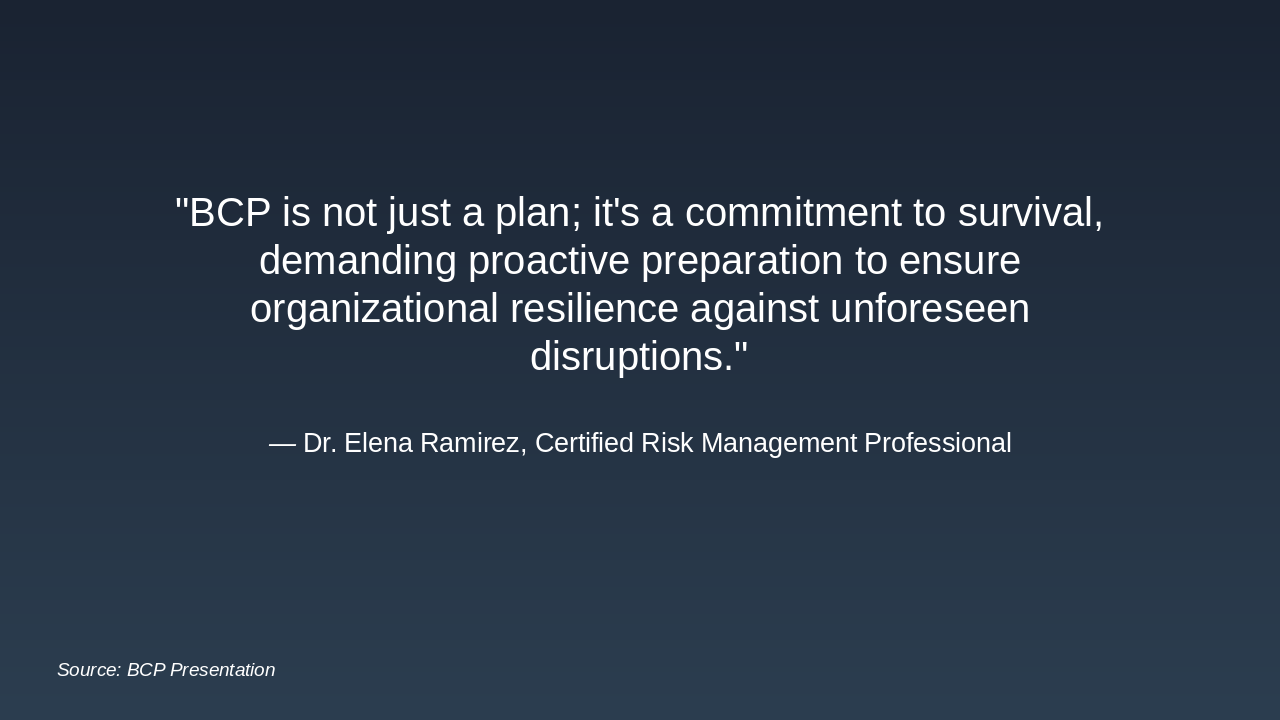
Slide 8 - Expert Insight

The slide, titled "Expert Insight," features a quote emphasizing that Business Continuity Planning (BCP) goes beyond a mere document to represent a vital commitment to an organization's survival. It stresses the need for proactive preparation to build resilience against unexpected disruptions, attributed to Dr. Elena Ramirez, a Certified Risk Management Professional.

Expert Insight

> BCP is not just a plan; it's a commitment to survival, demanding proactive preparation to ensure organizational resilience against unforeseen disruptions.

— Dr. Elena Ramirez, Certified Risk Management Professional

Source: BCP Presentation

--- Speaker Notes: Emphasizes proactive preparation.

Slide 8
Slide 9 of 10

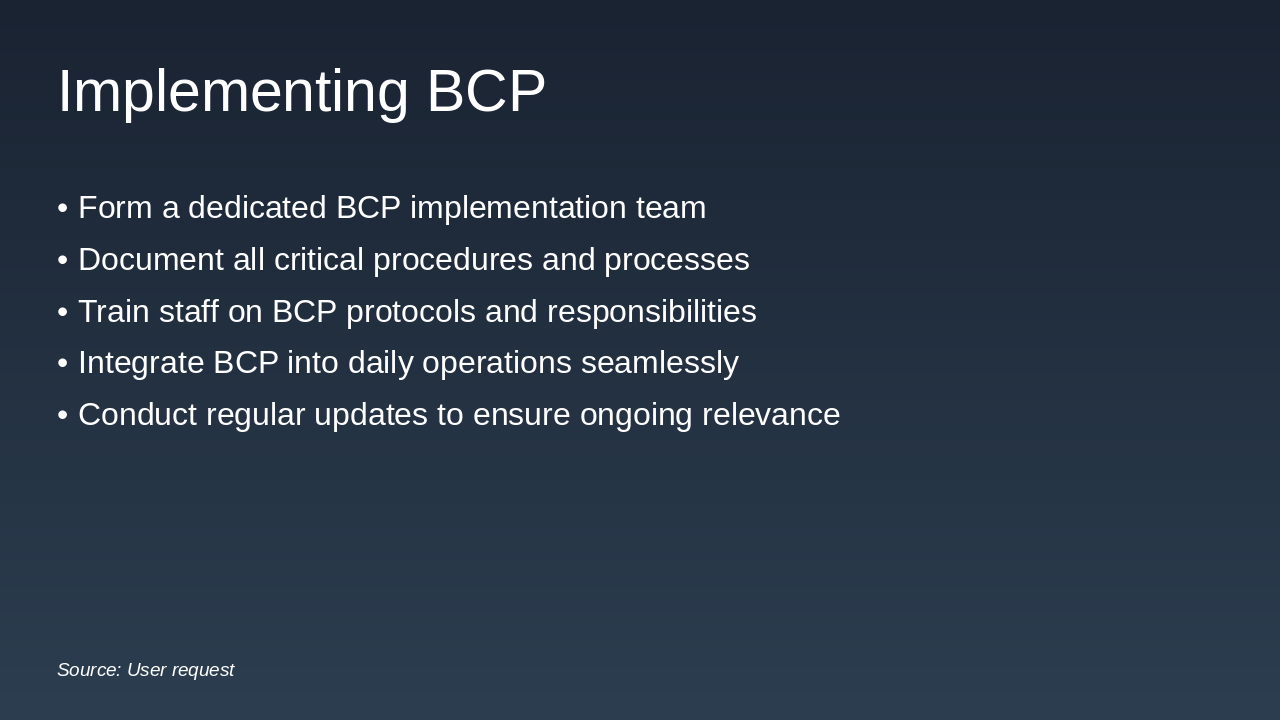
Slide 9 - Implementing BCP

To implement a Business Continuity Plan (BCP), start by forming a dedicated team and documenting all critical procedures and processes. Then, train staff on protocols and responsibilities, integrate BCP into daily operations, and conduct regular updates for ongoing relevance.

Implementing BCP

  • Form a dedicated BCP implementation team
  • Document all critical procedures and processes
  • Train staff on BCP protocols and responsibilities
  • Integrate BCP into daily operations seamlessly
  • Conduct regular updates to ensure ongoing relevance

Source: User request

--- Speaker Notes: Steps for implementing Business Continuity Planning: form team, document procedures, train staff, integrate operations, regular updates.

Slide 9
Slide 10 of 10

Slide 10 - Key Takeaways

The slide's main message urges businesses to adopt a Business Continuity Plan (BCP) to protect against disruptions. It encourages starting an assessment immediately and invites discussion for any questions.

Key Takeaways

Adopt BCP to Safeguard Your Business

Start your assessment today. Questions? Let's discuss!

Source: BCP Presentation

--- Speaker Notes: Adopt BCP to safeguard your business. Start with assessment today. Questions? Let's discuss!

Slide 10
Powered by AI

Create Your Own Presentation

Generate professional presentations in seconds with Karaf's AI. Customize this presentation or start from scratch.

Create New Presentation

Powered by Karaf.ai — AI-Powered Presentation Generator