Neural Networks: Foundations & Applications

Generated from prompt:

Create an 8-slide PowerPoint presentation on the topic of neural networks. The presentation should introduce what neural networks are, explain how they work, and cover their main components and applications. Include explanations of the key terms such as nodes, layers, weights, activation functions, and training process. Discuss the importance of neural networks in modern AI and machine learning. Include a slide summarizing the major types of neural networks like feedforward, convolutional, and recurrent networks.

An 8-slide intro to neural networks: definitions, components (nodes, layers, weights, activations), training, types (feedforward, CNNs, RNNs), applications in AI/ML, and their revolutionary impact. (1

December 23, 20258 slides
Slide 1 of 8

Slide 1 - Neural Networks: Foundations and Applications

This title slide introduces "Neural Networks: Foundations and Applications." The subtitle emphasizes understanding the core of modern AI and machine learning.

Neural Networks: Foundations and Applications

Understanding the Core of Modern AI and Machine Learning

Source: PowerPoint presentation on neural networks

Speaker Notes
Welcome the audience and outline the presentation structure covering foundations, components, training, types, and applications.
Slide 1 - Neural Networks: Foundations and Applications
Slide 2 of 8

Slide 2 - What are Neural Networks?

Neural networks are computational models inspired by the human brain. They excel at pattern recognition and prediction tasks, forming the foundation of deep learning in artificial intelligence.

What are Neural Networks?

  • Computational models inspired by the human brain
  • Excel at pattern recognition and prediction tasks
  • Foundation of deep learning in artificial intelligence

Source: Neural Networks Presentation Slide 1

Speaker Notes
Neural networks mimic the brain's structure for intelligent tasks. They excel in recognizing patterns from data, forming the backbone of deep learning techniques in AI.
Slide 2 - What are Neural Networks?
Slide 3 of 8

Slide 3 - How Neural Networks Work

This section header slide, titled "How Neural Networks Work" (section 03), introduces the topic. It features a subtitle providing an overview of neural network structure, data flow, and learning process.

How Neural Networks Work

03

How Neural Networks Work

Overview of structure, data flow, and learning process

Source: Neural Networks Presentation

Speaker Notes
Overview slide explaining the core structure, data flow through layers, and the learning process via backpropagation.
Slide 3 - How Neural Networks Work
Slide 4 of 8

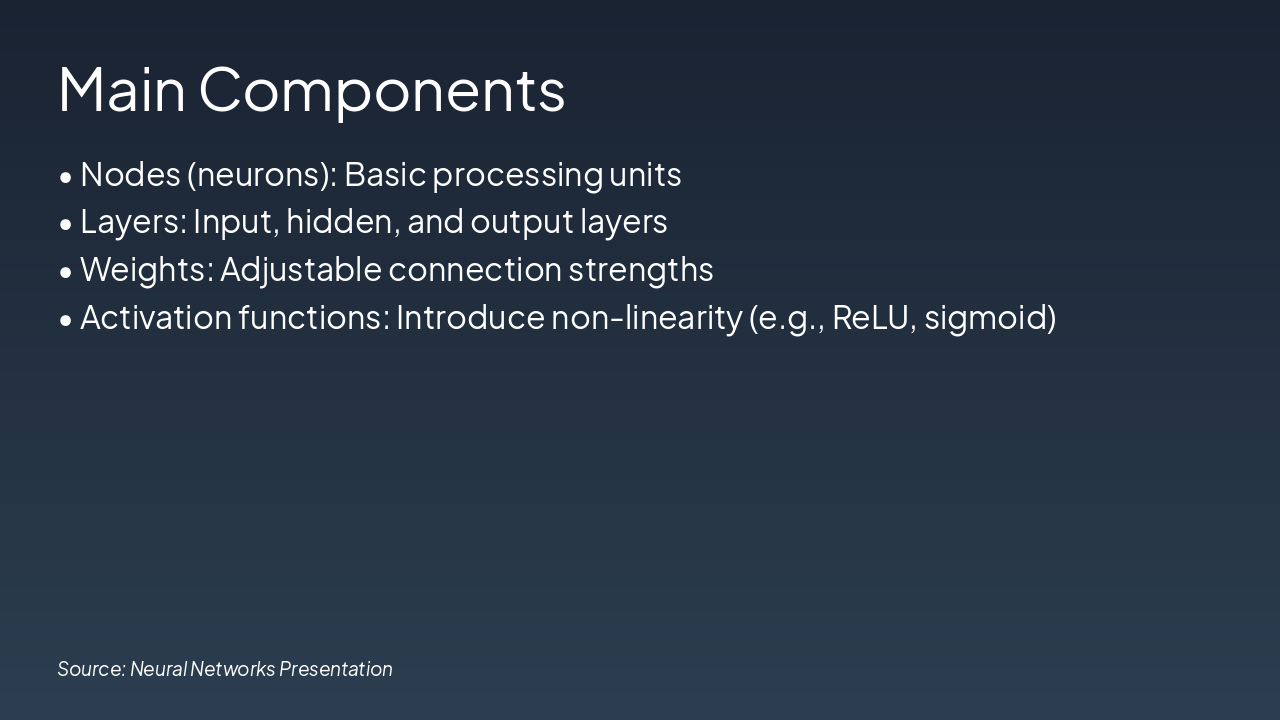
Slide 4 - Main Components

The slide outlines the main components of neural networks: nodes (neurons) as basic processing units, layers including input, hidden, and output, weights as adjustable connection strengths, and activation functions like ReLU or sigmoid that introduce non-linearity. These elements form the foundational structure for processing data in such models.

Main Components

  • Nodes (neurons): Basic processing units
  • Layers: Input, hidden, and output layers
  • Weights: Adjustable connection strengths
  • Activation functions: Introduce non-linearity (e.g., ReLU, sigmoid)

Source: Neural Networks Presentation

Slide 4 - Main Components
Slide 5 of 8

Slide 5 - Training Process

The training process workflow consists of four phases: forward propagation to compute predicted output from input data, calculating loss by comparing predictions to actual values, backpropagation to compute gradients, and updating weights via an optimizer repeated over epochs until convergence. This structured sequence enables the model to learn and minimize errors effectively.

Training Process

Source: Neural Networks Presentation - Slide 4

Slide 5 - Training Process
Slide 6 of 8

Slide 6 - Major Types of Neural Networks

The slide outlines five major types of neural networks in a feature grid: Feedforward Networks for basic classification, Convolutional Networks for image processing, Recurrent Networks for sequential data, Generative Networks like GANs for data creation, and Transformer Networks for parallel sequence processing in NLP. Each type includes an icon, heading, and concise description of its key strengths and mechanisms.

Major Types of Neural Networks

Speaker Notes
This slide summarizes the primary architectures of neural networks, each optimized for specific data types and tasks.
Slide 6 - Major Types of Neural Networks
Slide 7 of 8

Slide 7 - Applications and Importance

Neural networks power key AI applications like image/speech recognition, NLP, autonomous vehicles, robotics, GPT models, and recommendation systems. They enable complex pattern learning beyond traditional ML and transform modern AI and machine learning.

Applications and Importance

  • Powers image/speech recognition and NLP
  • Drives autonomous vehicles and robotics
  • Underpins GPT models and recommendation systems
  • Enables complex pattern learning beyond traditional ML
  • Transforms modern AI and machine learning
Speaker Notes
Highlight real-world impact and why neural networks are foundational to AI advancements.
Slide 7 - Applications and Importance
Slide 8 of 8

Slide 8 - Conclusion

Neural networks have revolutionized AI; mastering their components and types enables innovation. Embrace the neural revolution and build your first neural network today!

Conclusion

Neural networks revolutionized AI. Master components & types to innovate. Future: Deeper architectures ahead!

Closing: Embrace the neural revolution. Action: Build your first neural network today!

Thank you!

Speaker Notes
Summarize key takeaways and inspire action on neural networks.
Slide 8 - Conclusion

Discover More Presentations

Explore thousands of AI-generated presentations for inspiration

Browse Presentations
Powered by AI

Create Your Own Presentation

Generate professional presentations in seconds with Karaf's AI. Customize this presentation or start from scratch.

Create New Presentation

Powered by Karaf.ai — AI-Powered Presentation Generator