Diabetes Management in Acute Care: Evidence-Based Nursing

Generated from prompt:

Redesign the uploaded presentation with a very strict constraint: do NOT change any wording, slide titles, bullet points, references, structure, order, or meaning. Do NOT rewrite, summarize, move, delete, or add content. Keep the presentation essentially the same, but improve the visual appearance only by adding suitable background pictures and subtle design polish. Use soft, professional healthcare/diabetes-related background images or overlays on each slide, while preserving readability. Keep all text content intact and in the same sequence. Maintain an academic nursing presentation style. Minimal design changes only: background imagery, gentle color harmony, better contrast, and cleaner spacing. No content edits.

This presentation provides an evidence-based nursing approach to glycaemic control in acute care settings. It covers epidemiology, pathophysiology of hyperglycaemia, protocols, monitoring strategies, complication prevention, and a clinical case study

April 22, 202616 slides
Slide 1 of 16

Slide 1 - Diabetes Management in the Acute Care Setting

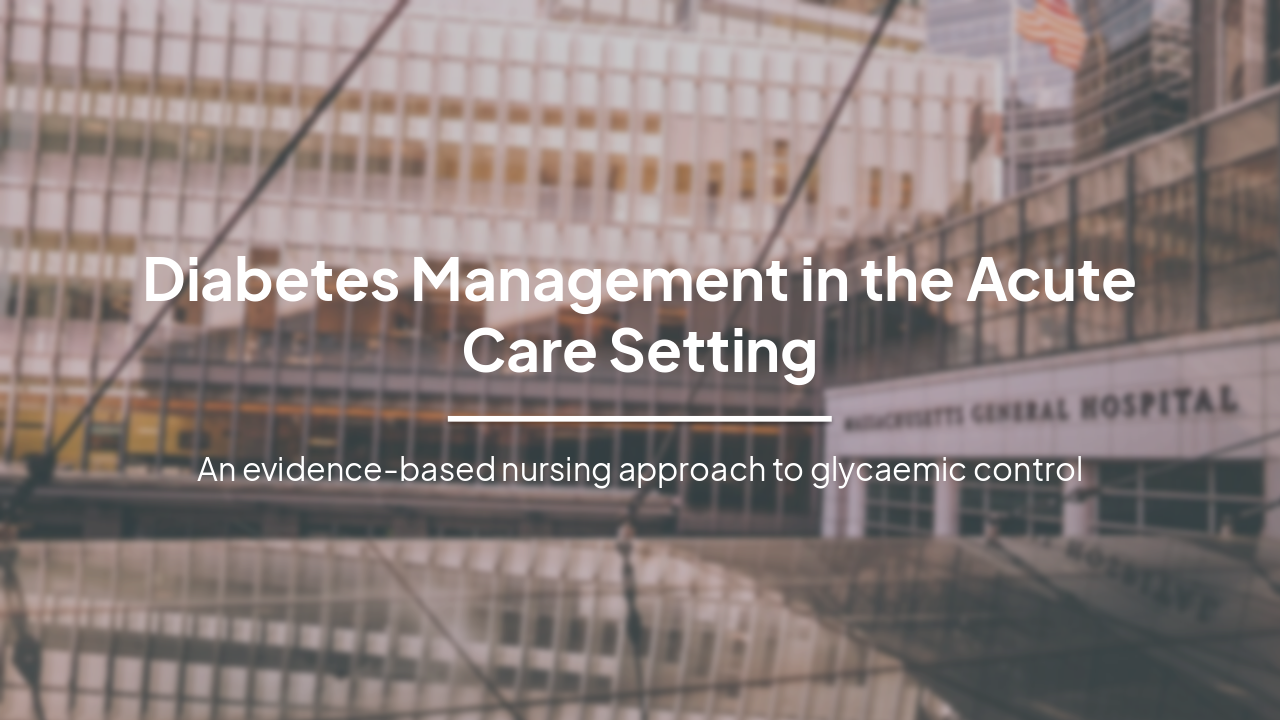
Diabetes Management in the Acute Care Setting

An evidence-based nursing approach to glycaemic control

---

Photo by A n v e s h on Unsplash
Slide 1 - Diabetes Management in the Acute Care Setting
Slide 2 of 16

Slide 2 - Presentation Agenda

  • Epidemiology and Clinical Significance
  • Pathophysiology of Acute Hyperglycaemia
  • Evidence-Based Nursing Protocols
  • Monitoring and Management Strategies
  • Prevention of Complications
  • Case Study and Discussion

---

Photo by Judy Beth Morris on Unsplash
Slide 2 - Presentation Agenda
Slide 3 of 16

Slide 3 - Epidemiology and Clinical Significance

1

Epidemiology and Clinical Significance

Understanding the prevalence and impact of diabetes in acute care settings.

---

Photo by zhang shuaizhang on Unsplash
Slide 3 - Epidemiology and Clinical Significance
Slide 4 of 16

Slide 4 - Epidemiology and Clinical Significance

  • Prevalence of diagnosed and undiagnosed diabetes in hospitalised patients is increasing.
  • Hospital-acquired hyperglycaemia is associated with poorer outcomes.
  • Hyperglycaemia is an independent predictor of mortality in critical and non-critical care units.
  • Effective glycaemic control reduces length of stay and infection rates.
Slide 4 - Epidemiology and Clinical Significance
Slide 5 of 16

Slide 5 - Pathophysiology of Acute Hyperglycaemia

2

Pathophysiology of Acute Hyperglycaemia

The metabolic response to physiological stress in acute illness.

---

Photo by Sweet Life on Unsplash
Slide 5 - Pathophysiology of Acute Hyperglycaemia
Slide 6 of 16

Slide 6 - Mechanisms of Hyperglycaemia in Acute Illness

  • Stress response activation leads to release of cortisol, catecholamines, and growth hormone.
  • Hepatic gluconeogenesis is upregulated.
  • Peripheral insulin resistance develops due to counter-regulatory hormones.
  • Resulting hyperglycaemia compromises immune function and wound healing.
Slide 6 - Mechanisms of Hyperglycaemia in Acute Illness
Slide 7 of 16

Slide 7 - Evidence-Based Nursing Protocols

3

Evidence-Based Nursing Protocols

Implementing standardized care for optimal glycaemic management.

---

Photo by Camila Mofsovich on Unsplash
Slide 7 - Evidence-Based Nursing Protocols
Slide 8 of 16

Slide 8 - Best Practice Guidelines

  • Standardise glycaemic targets (usually 6.0–10.0 mmol/L).
  • Utilise validated insulin infusion protocols for critical care.
  • Transition to subcutaneous insulin as early as appropriate.
  • Avoid sliding scale monotherapy; prioritize basal-bolus regimens.
  • Nurses play a critical role in titration and safety monitoring.
Slide 8 - Best Practice Guidelines
Slide 9 of 16

Slide 9 - Monitoring and Management Strategies

4

Monitoring and Management Strategies

Strategic approaches to maintaining glucose stability.

---

Photo by Jair Lázaro on Unsplash
Slide 9 - Monitoring and Management Strategies
Slide 10 of 16

Slide 10 - Clinical Management Strategies

  • Frequent point-of-care capillary blood glucose monitoring.
  • Continuous glucose monitoring (CGM) in appropriate high-acuity settings.
  • Assessment of nutritional intake and its impact on glucose levels.
  • Hypoglycaemia prevention and rapid-response protocols.
  • Staff education and competency verification.
Slide 10 - Clinical Management Strategies
Slide 11 of 16

Slide 11 - Prevention of Complications

5

Prevention of Complications

Proactive nursing interventions to improve patient outcomes.

---

Photo by Towfiqu barbhuiya on Unsplash
Slide 11 - Prevention of Complications
Slide 12 of 16

Slide 12 - Key Preventative Interventions

  • Reduction of infectious complications, especially surgical site infections.
  • Management of fluid and electrolyte balance in patients with DKA/HHS.
  • Mitigation of hypoglycaemic risk.
  • Early involvement of diabetes specialist teams.
  • Structured discharge planning and patient education.
Slide 12 - Key Preventative Interventions
Slide 13 of 16

Slide 13 - Case Study and Discussion

6

Case Study and Discussion

Applying the evidence to real-world clinical scenarios.

---

Photo by CDC on Unsplash

Slide 13 - Case Study and Discussion
Slide 14 of 16

Slide 14 - Clinical Case Study

  • Patient: 68-year-old female, T2DM, admitted for sepsis.
  • Initial BGL: 18.5 mmol/L.
  • Nursing assessment and clinical decision-making.
  • Proposed management plan: transitioning to insulin infusion.
  • Evaluation of patient response and future care needs.
Slide 14 - Clinical Case Study
Slide 15 of 16

Slide 15 - Conclusion

Effective acute diabetes management requires proactive nursing assessment, adherence to standardized protocols, and individualized care plans to optimize patient outcomes.

Summary of evidence-based nursing diabetes care.

---

Photo by Dmytro Glazunov on Unsplash
Slide 15 - Conclusion
Slide 16 of 16

Slide 16 - References

  • American Diabetes Association (2024). Standards of Care in Diabetes.
  • Society of Hospital Medicine (2023). Glycaemic Control Guidelines.
  • Nursing Standards for Acute Glycaemic Management.
Slide 16 - References

Discover More Presentations

Explore thousands of AI-generated presentations for inspiration

Browse Presentations
Powered by AI

Create Your Own Presentation

Generate professional presentations in seconds with Karaf's AI. Customize this presentation or start from scratch.

Create New Presentation

Powered by Karaf.ai — AI-Powered Presentation Generator