3 Models of Muscle Hypertrophy Explained

Generated from prompt:

Deecribe and explain the 3 models of the hypertrophi

This presentation defines muscle hypertrophy as training-induced size gains via protein synthesis. It explores three models: Mechanical Tension (heavy lifting activates mTOR), Metabolic Stress (high-r

November 26, 202512 slides
Slide 1 of 12

Slide 1 - The 3 Models of Muscle Hypertrophy

The slide titled "The 3 Models of Muscle Hypertrophy" serves as an introduction to the key mechanisms behind muscle growth in fitness and physiology. It highlights three distinct models that explain how muscles enlarge and adapt during training.

The 3 Models of Muscle Hypertrophy

Introduction to Muscle Growth Mechanisms in Fitness and Physiology

Slide 1 - The 3 Models of Muscle Hypertrophy
Slide 2 of 12

Slide 2 - What is Muscle Hypertrophy?

Muscle hypertrophy refers to the increase in muscle size driven by training-induced adaptations, primarily through three mechanisms: mechanical tension that applies force to stimulate protein synthesis, metabolic stress that builds metabolites and promotes growth factors, and muscle damage from micro-tears that triggers repair processes. Collectively, these factors enhance protein synthesis and overall muscle growth.

What is Muscle Hypertrophy?

  • Muscle hypertrophy increases size through training-induced adaptations.
  • Mechanical tension applies force, stimulating protein synthesis.
  • Metabolic stress builds metabolites, promoting growth factors.
  • Muscle damage causes micro-tears, triggering repair processes.
  • These models drive protein synthesis and muscle growth.
Slide 2 - What is Muscle Hypertrophy?
Slide 3 of 12

Slide 3 - Model 1: Mechanical Tension

This section header slide introduces Model 1: Mechanical Tension as the first topic in a series. It describes mechanical tension as the primary driver of muscle hypertrophy, achieved through heavy loads and muscle stretch.

Model 1: Mechanical Tension

01

Model 1: Mechanical Tension

The primary driver of hypertrophy via heavy loads and stretch.

Speaker Notes
Describe and explain the 3 models of hypertrophy.
Slide 3 - Model 1: Mechanical Tension
Slide 4 of 12

Slide 4 - Mechanical Tension Explained

Mechanical tension in weightlifting occurs when heavy loads create force on muscle fibers, activating the mTOR pathway to promote muscle growth. This effect is optimally achieved through sets of 6-12 reps combined with progressive overload.

Mechanical Tension Explained

  • Lifting heavy weights generates force on muscle fibers.
  • This force activates the mTOR pathway for muscle growth.
  • Best achieved with 6-12 reps and progressive overload.
Slide 4 - Mechanical Tension Explained
Slide 5 of 12

Slide 5 - Visualizing Mechanical Tension

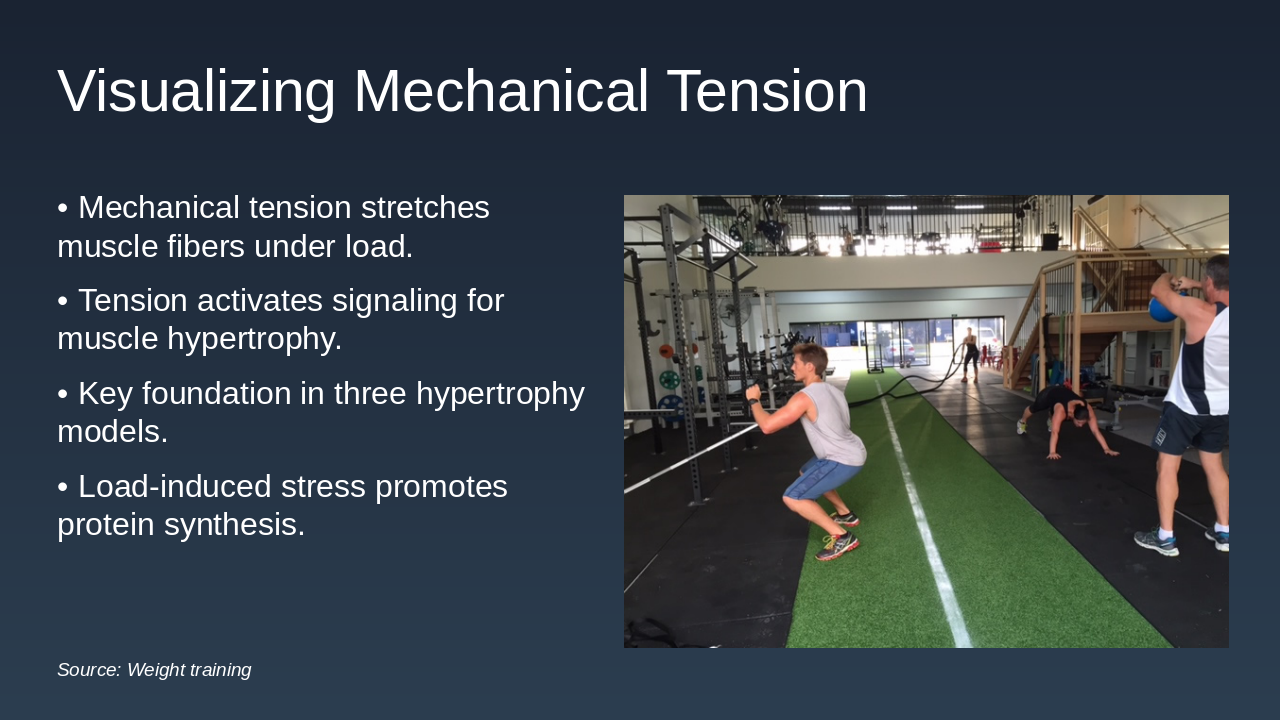
The slide, titled "Visualizing Mechanical Tension," illustrates how mechanical tension stretches muscle fibers under load, activating signaling pathways that promote muscle hypertrophy and serving as a key foundation in three hypertrophy models. It also highlights how load-induced stress drives protein synthesis for muscle growth.

Visualizing Mechanical Tension

!Image

  • Mechanical tension stretches muscle fibers under load.
  • Tension activates signaling for muscle hypertrophy.
  • Key foundation in three hypertrophy models.
  • Load-induced stress promotes protein synthesis.

Source: Weight training

Speaker Notes
Image of weightlifting showing muscle stretch under load. Emphasizes tension as the foundation of hypertrophy. Describe and explain the 3 models of hypertrophy.
Slide 5 - Visualizing Mechanical Tension
Slide 6 of 12

Slide 6 - Model 2: Metabolic Stress

This slide introduces Model 2: Metabolic Stress as the second section in the presentation. It explains that hypertrophy is driven by the buildup of metabolites, such as lactate, resulting from high-repetition training.

Model 2: Metabolic Stress

02

Model 2: Metabolic Stress

Buildup of metabolites like lactate from high-repetition training drives hypertrophy.

Slide 6 - Model 2: Metabolic Stress
Slide 7 of 12

Slide 7 - Metabolic Stress Explained

Metabolic stress happens during pump workouts using moderate weights and high reps (12 or more), leading to cell swelling from the buildup of metabolites like lactate. It boosts hormones and growth factors for anabolic benefits, ultimately driving muscle hypertrophy through key cellular signaling pathways.

Metabolic Stress Explained

  • Occurs during pump workouts with moderate weights and high reps (12+).
  • Causes cell swelling from metabolite accumulation like lactate.
  • Elevates hormones and growth factors for anabolic effects.
  • Contributes to muscle hypertrophy via cellular signaling pathways.
Slide 7 - Metabolic Stress Explained
Slide 8 of 12

Slide 8 - Benefits of Metabolic Stress

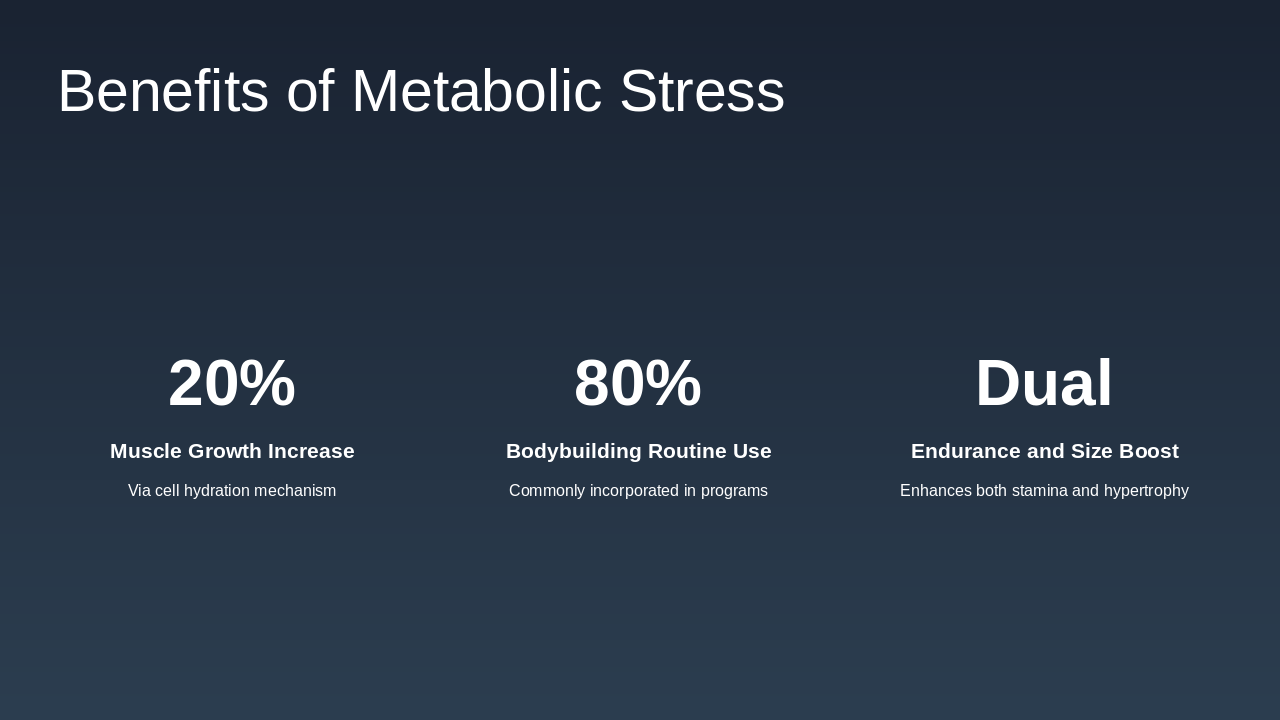
Metabolic stress boosts muscle growth by 20% through cell hydration mechanisms and enhances both endurance and hypertrophy simultaneously. It is commonly incorporated into 80% of bodybuilding routines for these dual benefits.

Benefits of Metabolic Stress

  • 20%: Muscle Growth Increase
  • Via cell hydration mechanism

  • 80%: Bodybuilding Routine Use
  • Commonly incorporated in programs

  • Dual: Endurance and Size Boost
  • Enhances both stamina and hypertrophy

Speaker Notes
Describe and explain the 3 models of hypertrophy
Slide 8 - Benefits of Metabolic Stress
Slide 9 of 12

Slide 9 - Model 3: Muscle Damage

This section header slide introduces Model 3, focusing on muscle damage as the third key concept. It subtitles the topic as micro-tears caused by eccentric contractions, which are subsequently repaired to make muscles stronger.

3

Model 3: Muscle Damage

Micro-tears from eccentric contractions repaired stronger.

Slide 9 - Model 3: Muscle Damage
Slide 10 of 12

Slide 10 - Muscle Damage Explained

Muscle damage during the eccentric phase of lifts creates micro-tears in muscle fibers, triggering inflammation and satellite cell activation to initiate repair. This repair process rebuilds fibers stronger and larger to promote hypertrophy, so routines should include eccentric movements while prioritizing recovery for optimal growth.

Muscle Damage Explained

  • Eccentric phase of lifts causes micro-tears in muscle fibers.
  • Inflammation triggers satellite cell activation for repair process.
  • Repair rebuilds fibers stronger and larger, driving hypertrophy.
  • Incorporate eccentric movements in routines to induce damage.
  • Prioritize recovery periods to support muscle repair and growth.
Slide 10 - Muscle Damage Explained
Slide 11 of 12

Slide 11 - Comparing the Models

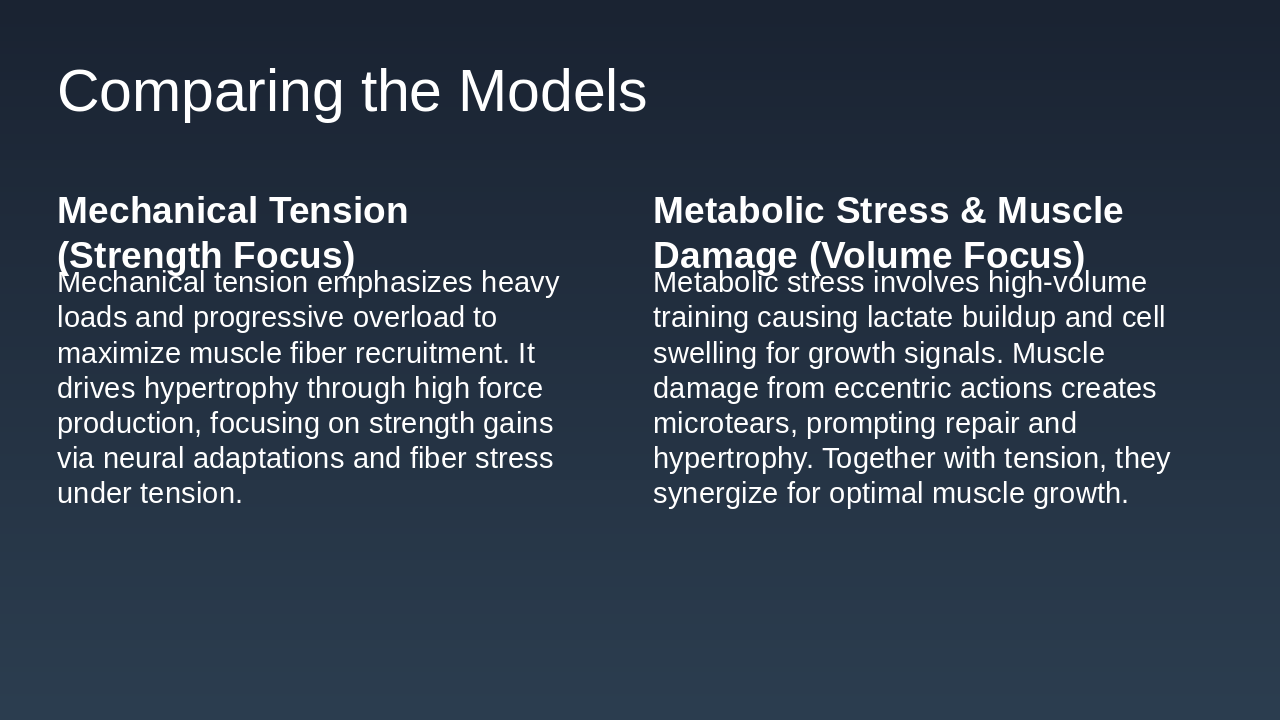
The slide compares two key drivers of muscle hypertrophy: mechanical tension, which uses heavy loads and progressive overload to recruit muscle fibers and build strength through neural adaptations and high force, and metabolic stress paired with muscle damage, which involves high-volume training to induce lactate buildup, cell swelling, and microtears for repair and growth signals. Together, these mechanisms synergize to optimize overall muscle development.

Comparing the Models

Mechanical Tension (Strength Focus)Metabolic Stress & Muscle Damage (Volume Focus)
Mechanical tension emphasizes heavy loads and progressive overload to maximize muscle fiber recruitment. It drives hypertrophy through high force production, focusing on strength gains via neural adaptations and fiber stress under tension.Metabolic stress involves high-volume training causing lactate buildup and cell swelling for growth signals. Muscle damage from eccentric actions creates microtears, prompting repair and hypertrophy. Together with tension, they synergize for optimal muscle growth.
Slide 11 - Comparing the Models
Slide 12 of 12

Slide 12 - Key Takeaways

The Key Takeaways slide recommends combining all three hypertrophy models for balanced training, while emphasizing the importance of tracking progress and prioritizing recovery. It advises consulting a trainer for personalized plans, with the subtitle urging viewers to achieve balanced growth and start today with expert guidance.

Key Takeaways

- Combine all 3 hypertrophy models for balanced training.

  • Track progress and prioritize recovery.
  • Consult a trainer for personalized plans.

Achieve balanced growth. Start today with expert guidance.

Speaker Notes
Combine all 3 models for balanced training. Track progress and recover well. Consult a trainer for personalized plans! Context: Describe and explain the 3 models of hypertrophy.
Slide 12 - Key Takeaways
Powered by AI

Create Your Own Presentation

Generate professional presentations in seconds with Karaf's AI. Customize this presentation or start from scratch.

Create New Presentation

Powered by Karaf.ai — AI-Powered Presentation Generator