The Reign of the Justinian Dynasty

Generated from prompt:

The reign of the Justinian dynasty

This presentation explores the rise of Emperor Justinian I, his legal reforms with the Corpus Juris Civilis, architectural marvels like Hagia Sophia, political crises including the Nika Riots, military reconquests, and the enduring legacy of the Just

April 23, 202613 slides
Slide 1 of 13

Slide 1 - The Reign of the Justinian Dynasty

The Reign of the Justinian Dynasty

A legacy of expansion, legal reform, and architectural grandeur in the Byzantine Empire
Slide 1 - The Reign of the Justinian Dynasty
Slide 2 of 13

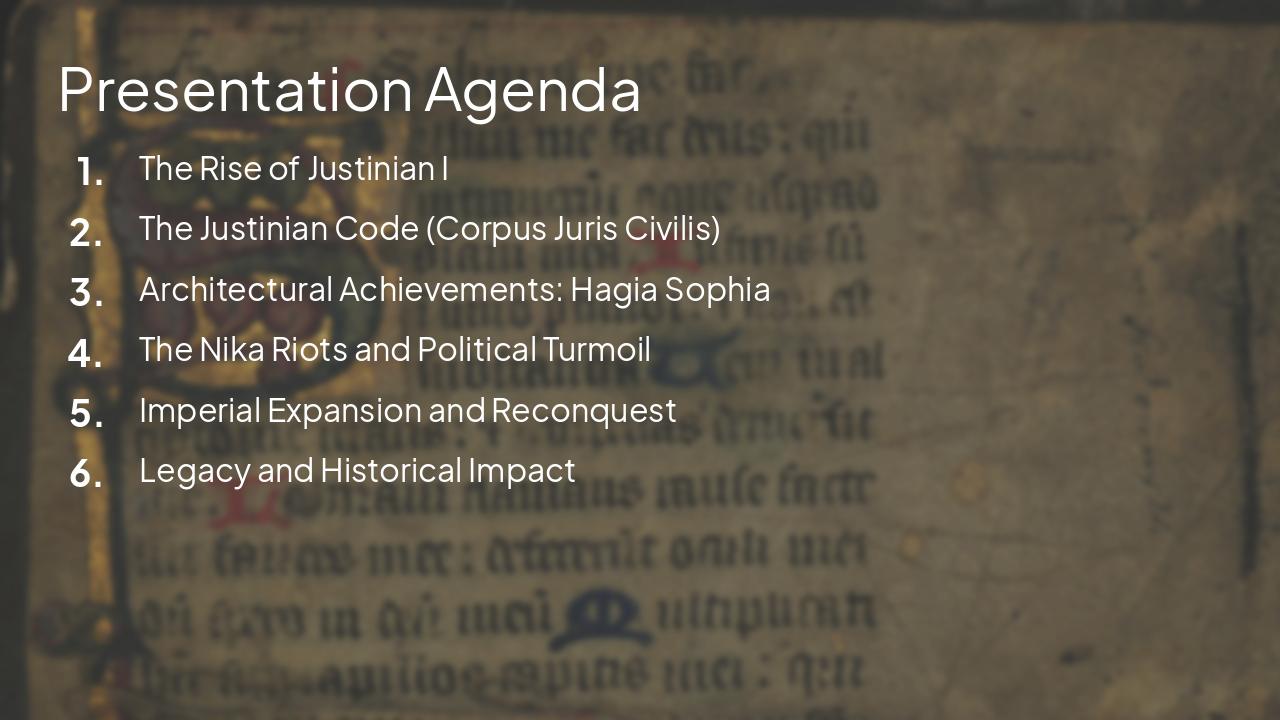
Slide 2 - Presentation Agenda

  • The Rise of Justinian I
  • The Justinian Code (Corpus Juris Civilis)
  • Architectural Achievements: Hagia Sophia
  • The Nika Riots and Political Turmoil
  • Imperial Expansion and Reconquest
  • Legacy and Historical Impact

---

Photo by Boudewijn Huysmans on Unsplash
Slide 2 - Presentation Agenda
Slide 3 of 13

Slide 3 - Rise of Justinian

1

The Rise of Justinian I

From peasant origins to the heights of imperial power
Slide 3 - Rise of Justinian
Slide 4 of 13

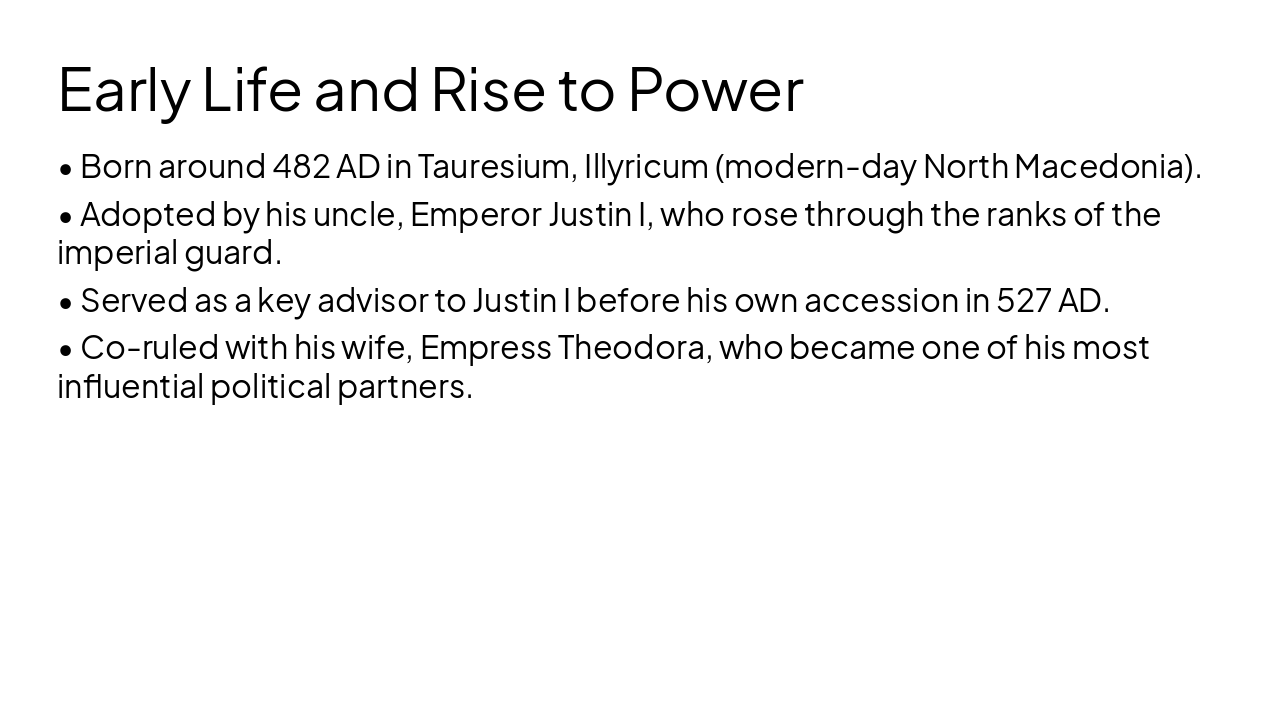
Slide 4 - Early Life and Rise to Power

  • Born around 482 AD in Tauresium, Illyricum (modern-day North Macedonia).
  • Adopted by his uncle, Emperor Justin I, who rose through the ranks of the imperial guard.
  • Served as a key advisor to Justin I before his own accession in 527 AD.
  • Co-ruled with his wife, Empress Theodora, who became one of his most influential political partners.
Slide 4 - Early Life and Rise to Power
Slide 5 of 13

Slide 5 - Legal and Architectural Legacy

2

Legal and Architectural Legacy

Defining the foundations of modern civil law and enduring art

---

Photo by Alex Boyd on Unsplash
Slide 5 - Legal and Architectural Legacy
Slide 6 of 13

Slide 6 - Key Accomplishments

The Justinian Code Justinian commissioned a massive codification of Roman law, known as the 'Corpus Juris Civilis'. This work organized centuries of legal precedents, forming the basis for modern civil law systems in many parts of the world today.

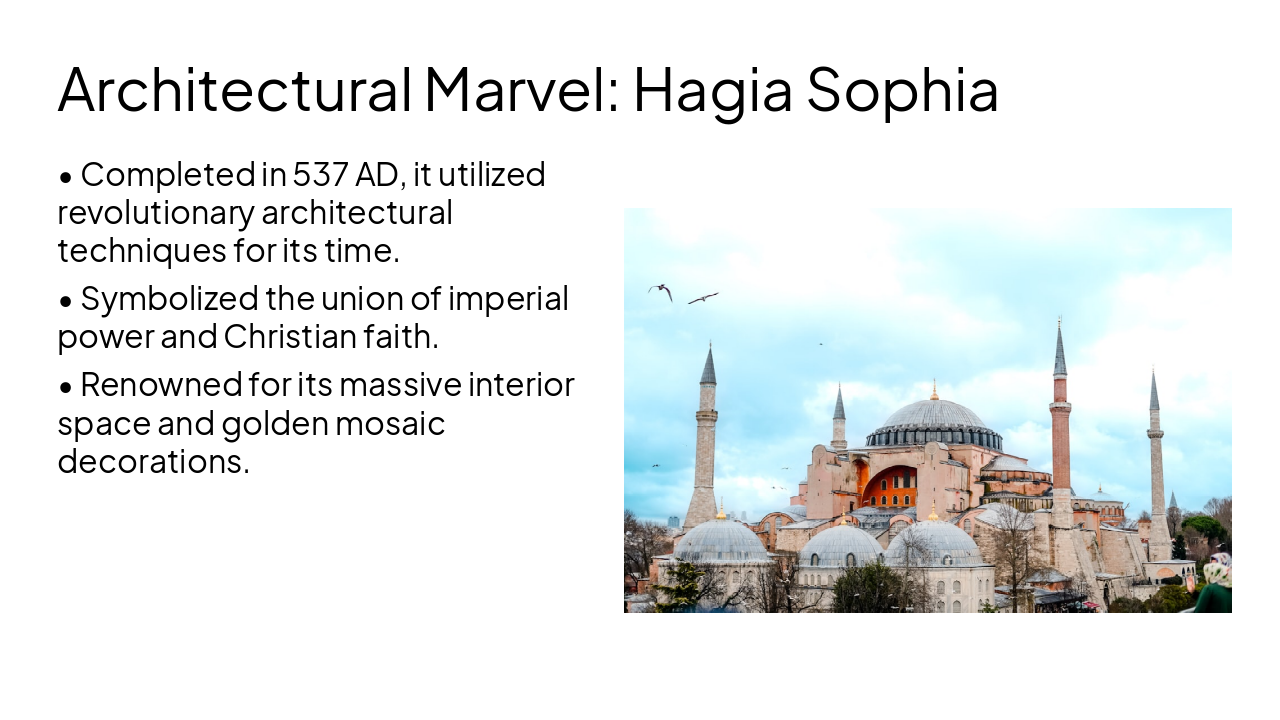
Hagia Sophia The crowning achievement of his architectural program. Built in Constantinople in just five years, it stood as the world's largest cathedral for nearly a thousand years, demonstrating the empire's immense wealth and technical skill.
Slide 6 - Key Accomplishments
Slide 7 of 13

Slide 7 - Architectural Marvel: Hagia Sophia

  • Completed in 537 AD, it utilized revolutionary architectural techniques for its time.
  • Symbolized the union of imperial power and Christian faith.
  • Renowned for its massive interior space and golden mosaic decorations.

---

Photo by Nabil Adham on Unsplash
Slide 7 - Architectural Marvel: Hagia Sophia
Slide 8 of 13

Slide 8 - Crisis and Expansion

3

Crisis and Expansion

Challenges to the throne and territorial ambitions

---

Photo by Benjamin Cheng on Unsplash
Slide 8 - Crisis and Expansion
Slide 9 of 13

Slide 9 - Crisis and Expansion

3

Crisis and Expansion

Challenges to the throne and territorial ambitions

---

Photo by Europeana on Unsplash
Slide 9 - Crisis and Expansion
Slide 10 of 13

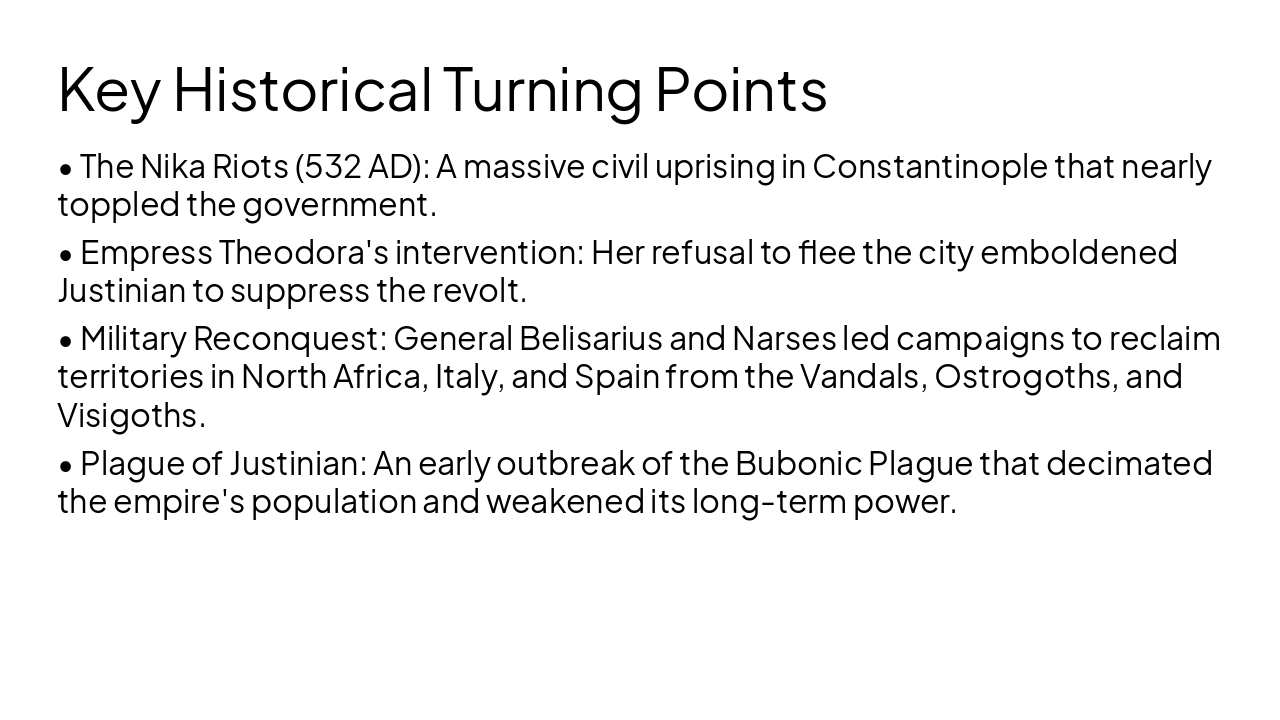
Slide 10 - Key Historical Turning Points

  • The Nika Riots (532 AD): A massive civil uprising in Constantinople that nearly toppled the government.
  • Empress Theodora's intervention: Her refusal to flee the city emboldened Justinian to suppress the revolt.
  • Military Reconquest: General Belisarius and Narses led campaigns to reclaim territories in North Africa, Italy, and Spain from the Vandals, Ostrogoths, and Visigoths.
  • Plague of Justinian: An early outbreak of the Bubonic Plague that decimated the empire's population and weakened its long-term power.
Slide 10 - Key Historical Turning Points
Slide 11 of 13

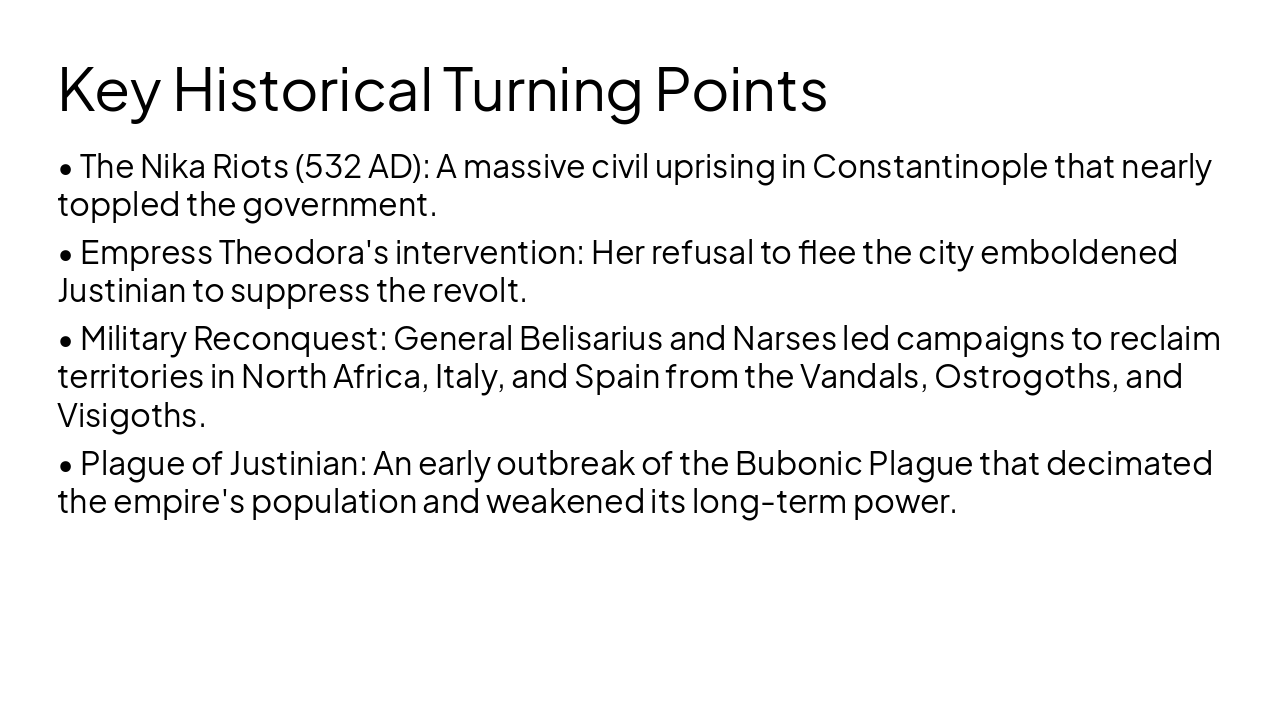
Slide 11 - Key Historical Turning Points

  • The Nika Riots (532 AD): A massive civil uprising in Constantinople that nearly toppled the government.
  • Empress Theodora's intervention: Her refusal to flee the city emboldened Justinian to suppress the revolt.
  • Military Reconquest: General Belisarius and Narses led campaigns to reclaim territories in North Africa, Italy, and Spain from the Vandals, Ostrogoths, and Visigoths.
  • Plague of Justinian: An early outbreak of the Bubonic Plague that decimated the empire's population and weakened its long-term power.
Slide 11 - Key Historical Turning Points
Slide 12 of 13

Slide 12 - Conclusion

A Legacy that Reshaped the World

Justinian's reign remains a pivotal era that bridged late antiquity and the Byzantine Middle Ages.

---

Photo by Erik Fabian on Unsplash
Slide 12 - Conclusion
Slide 13 of 13

Slide 13 - Conclusion

A Legacy that Reshaped the World

Justinian's reign remains a pivotal era that bridged late antiquity and the Byzantine Middle Ages.

---

Photo by Quan-You Zhang on Unsplash
Slide 13 - Conclusion

Discover More Presentations

Explore thousands of AI-generated presentations for inspiration

Browse Presentations
Powered by AI

Create Your Own Presentation

Generate professional presentations in seconds with Karaf's AI. Customize this presentation or start from scratch.

Create New Presentation

Powered by Karaf.ai — AI-Powered Presentation Generator