Turtles: Habitats, Diet, Types & Conservation (41 chars)

Generated from prompt:

Create a Google Slides presentation about turtles, covering their habitat, diet, types of turtles, life cycle, and conservation efforts.

This presentation covers turtles' diverse ocean/freshwater habitats, omnivorous/herbivorous diets, types via table, life cycle timeline, conservation stats, and their ecosystem importance. (162 chars)

December 10, 20259 slides
Slide 1 of 9

Slide 1 - All About Turtles

This is a title slide titled "All About Turtles." Its subtitle highlights key topics like habitat, diet, types, life cycle, and conservation efforts.

All About Turtles

Discover the fascinating world of turtles: habitat, diet, types, life cycle, and conservation efforts.
Slide 1 - All About Turtles
Slide 2 of 9

Slide 2 - Presentation Agenda

This slide outlines the agenda for a presentation on turtles. It covers Habitat, Diet, Types of Turtles, Life Cycle, Conservation Efforts, and Conclusion.

Presentation Agenda

  1. Habitat
  2. Diet
  3. Types of Turtles
  4. Life Cycle
  5. Conservation Efforts
  6. Conclusion
Slide 2 - Presentation Agenda
Slide 3 of 9

Slide 3 - Turtle Habitats

This slide serves as a section header titled "Turtle Habitats." Its subtitle reads: "Where turtles live around the world."

Turtle Habitats

Turtle Habitats

Where turtles live around the world.

Slide 3 - Turtle Habitats
Slide 4 of 9

Slide 4 - Diverse Habitats

These organisms thrive in diverse aquatic habitats, including oceans where they migrate thousands of miles, as well as freshwater rivers, lakes, and ponds. They also occupy terrestrial environments like forests, deserts, and beaches while adapting to various global climates.

Diverse Habitats

  • Thrive in oceans, migrating thousands of miles.
  • Inhabit freshwater rivers, lakes, and ponds.
  • Occupy terrestrial forests, deserts, and beaches.
  • Adapt to various global climates.
Slide 4 - Diverse Habitats
Slide 5 of 9

Slide 5 - Turtle Diet

Turtle diets vary by type: omnivorous turtles eat plants, insects, and fish; herbivorous ones consume sea grass and algae; and carnivorous ones prey on jellyfish and crabs. Overall diet differs by species and age.

Turtle Diet

  • Omnivorous turtles eat plants, insects, and fish.
  • Herbivorous turtles consume sea grass and algae.
  • Carnivorous turtles prey on jellyfish and crabs.
  • Diet varies by species and age.
Slide 5 - Turtle Diet
Slide 6 of 9

Slide 6 - Types of Turtles

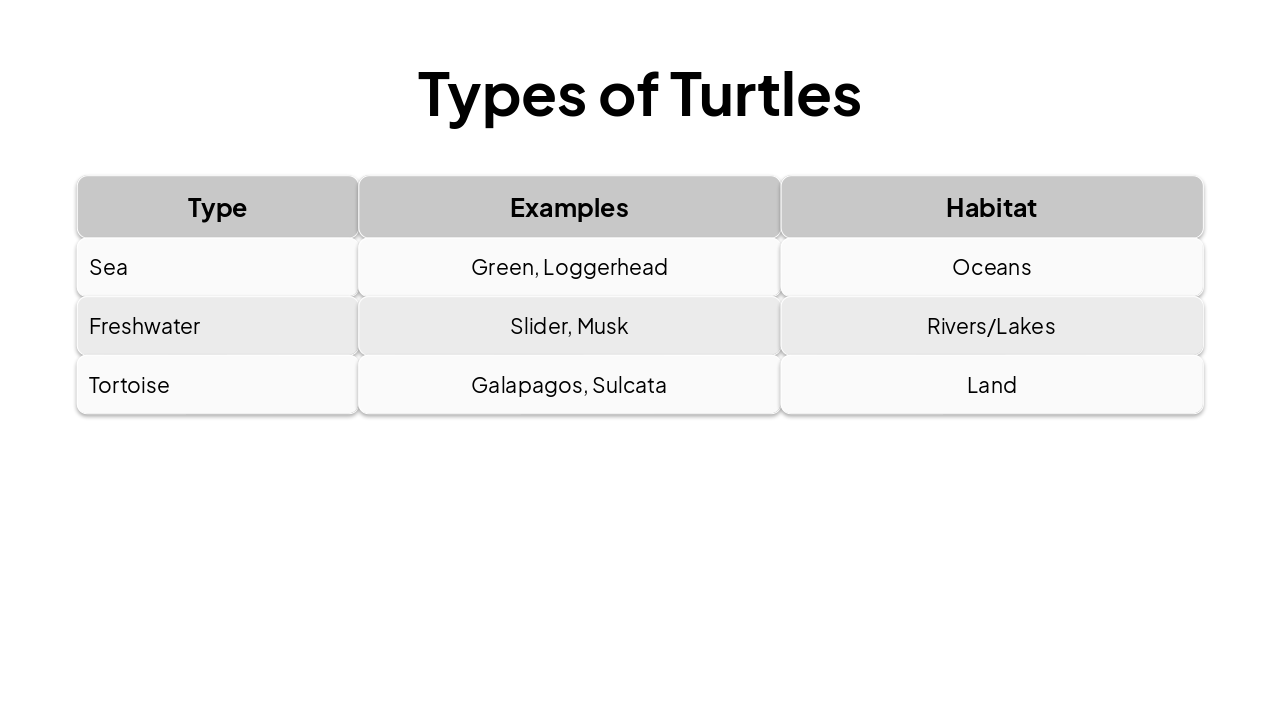
The slide "Types of Turtles" features a table categorizing turtles by type, examples, and habitat. It covers sea turtles (e.g., Green, Loggerhead) in oceans, freshwater turtles (e.g., Slider, Musk) in rivers/lakes, and tortoises (e.g., Galapagos, Sulcata) on land.

Types of Turtles

{ "headers": [ "Type", "Examples", "Habitat" ], "rows": [ [ "Sea", "Green, Loggerhead", "Oceans" ], [ "Freshwater", "Slider, Musk", "Rivers/Lakes" ], [ "Tortoise", "Galapagos, Sulcata", "Land" ] ] }

Slide 6 - Types of Turtles
Slide 7 of 9

Slide 7 - Turtle Life Cycle

The Turtle Life Cycle timeline starts with eggs laid on Day 0, hatching after 60 days as hatchlings race to the ocean. Juveniles grow rapidly over 1-10 years, reach maturity in 10-50 years, and live over 100 years while reproducing multiple times.

Turtle Life Cycle

Day 0: Egg Laid Female turtles lay eggs in sandy nests, incubating for about 60 days until hatching. 60 Days: Hatchling Emerges Hatchlings break free from eggs and instinctively race to the ocean for safety. 1-10 Years: Juvenile Growth Phase Juveniles undergo rapid growth spurts, feeding on jellyfish and other small prey. 10-50 Years: Adult Maturity Reached Turtles reach sexual maturity and begin reproduction after 10 to 50 years. 50+ Years: Longevity Achieved Adults live over 100 years, reproducing multiple times throughout their long lives.

Slide 7 - Turtle Life Cycle
Slide 8 of 9

Slide 8 - Conservation Efforts

Conservation efforts have successfully protected 50% of key species. The slide targets a 50% extinction prevention goal for endangered species while safeguarding 100+ nesting beaches through global initiatives.

Conservation Efforts

  • 50%: Species Protected
  • Key conservation success

  • 50%: Extinction Prevention Goal
  • Target for endangered species

  • 100+: Nesting Beaches Protected
  • Global initiatives underway

Slide 8 - Conservation Efforts
Slide 9 of 9

Slide 9 - Protect Our Turtles

The conclusion slide, titled "Protect Our Turtles," states that turtles are vital to ecosystems. Its subtitle calls for supporting conservation today, with globe and turtle emojis.

Protect Our Turtles

Turtles are vital to ecosystems.

Support conservation today! 🌍🐢

Speaker Notes
Questions? Thank you.
Slide 9 - Protect Our Turtles

Discover More Presentations

Explore thousands of AI-generated presentations for inspiration

Browse Presentations
Powered by AI

Create Your Own Presentation

Generate professional presentations in seconds with Karaf's AI. Customize this presentation or start from scratch.

Create New Presentation

Powered by Karaf.ai — AI-Powered Presentation Generator