Film-WaveyNet: Physics-Informed Metasurface Acceleration (50

Generated from prompt:

根据 film-waveynet 项目和以下五个文件(consts.py、phys.py、multi_film_angle_dec_fwdadj_sample_learners.py、multi_film_angle_dec_fwdadj_sample_otf_dataloader.py、multi_film_angle_dec_fwdadj_sample_otf_train.py),生成一个10页的PPT,内容包括: 1. 研究背景:metasurface 仿真与深度学习加速的意义 2. Film-WaveyNet 总体框架与目标 3. 数据输入输出格式与物理含义 4. UNet + FiLM 网络结构及调制机制 5. Maxwell 方程与物理约束模块(phys.py) 6. 损失函数设计:数据误差 + 物理正则 7. 训练流程:数据加载、前向传播、反向传播 8. 动态采样机制(波长加权重采样) 9. 结果与可视化示例(预测场 vs 仿真场) 10. 总结与展望:结合物理模型与深度学习的未来应用

Presentation on Film-WaveyNet, a UNet+FiLM framework accelerating metasurface simulations via Maxwell constraints, dynamic sampling, data+physics losses. Covers architecture, training, results vs. sim

December 13, 202510 slides
Slide 1 of 10

Slide 1 - 研究背景:metasurface仿真与深度学习加速的意义

This section header slide introduces "Research Background" as Section 01. It highlights metasurface simulation's high computational costs, deep learning's 100x efficiency acceleration, and physical constraints ensuring Maxwell's equations.

研究背景:metasurface仿真与深度学习加速的意义

01

研究背景

元表面高成本仿真痛点,深度学习加速百倍效率,物理约束保Maxwell方程

Source: film-waveynet 项目

Speaker Notes
元表面设计依赖高精度电磁仿真,计算成本高。深度学习可加速前向/逆向模拟,提升效率百倍。物理约束确保预测符合Maxwell方程。(98字)
Slide 1 - 研究背景:metasurface仿真与深度学习加速的意义
Slide 2 of 10

Slide 2 - Film-WaveyNet总体框架与目标

The Film-WaveyNet workflow begins with preprocessing structural parameters, wavelength, and angle into a conditioned vector, followed by FiLM-layer modulation to produce feature maps. These maps are then processed through a UNet encoder-decoder to generate predicted diffraction fields, supporting fast prediction and inverse design.

Film-WaveyNet总体框架与目标

{ "headers": [ "步骤", "输入", "过程", "输出" ], "rows": [ [ "1. 参数输入", "结构参数、波长、角度", "数据预处理与编码", "条件化向量" ], [ "2. 特征调制", "条件化向量", "FiLM层条件调制", "调制特征图" ], [ "3. 场分布生成", "调制特征图", "UNet编码-解码", "预测衍射场" ], [ "4. 应用目标", "预测衍射场", "-", "快速预测 & 逆设计支持" ] ] }

Source: 输入:结构参数、波长、角度。UNet+FiLM网络生成场分布。目标:快速预测衍射场,支持逆设计。(72字)

Speaker Notes
Film-WaveyNet框架概述:以结构参数、波长和角度为输入,通过UNet结合FiLM网络快速生成衍射场分布,实现高效预测并支持逆设计。
Slide 2 - Film-WaveyNet总体框架与目标
Slide 3 of 10

Slide 3 - 数据输入输出格式与物理含义

The slide's left column details inputs as refractive index distribution n(x,y), wavelength λ, and incident angle θ, defining metasurface structures and conditions for multi-wavelength, multi-angle light diffraction simulation. The right column specifies output as complex field E(x,y), capturing post-propagation amplitude and phase for precise metasurface diffraction modeling and efficient optical field prediction.

数据输入输出格式与物理含义

输入 (Input)输出 (Output)
折射率分布 n(x,y)、波长 λ、入射角 θ。定义 metasurface 光学结构与照明条件,支持多波长、多角度模拟光波衍射传播过程。(28字)复数场 E(x,y),表示传播后光场幅度与相位。物理含义:精确模拟 metasurface 衍射效应,实现高效光学场预测。(32字)

Source: film-waveynet 项目

Speaker Notes
左侧:输入(折射率分布、波长λ、入射角θ)。右侧:输出(复数场E(x,y))。物理:模拟衍射传播。(85字)
Slide 3 - 数据输入输出格式与物理含义
Slide 4 of 10

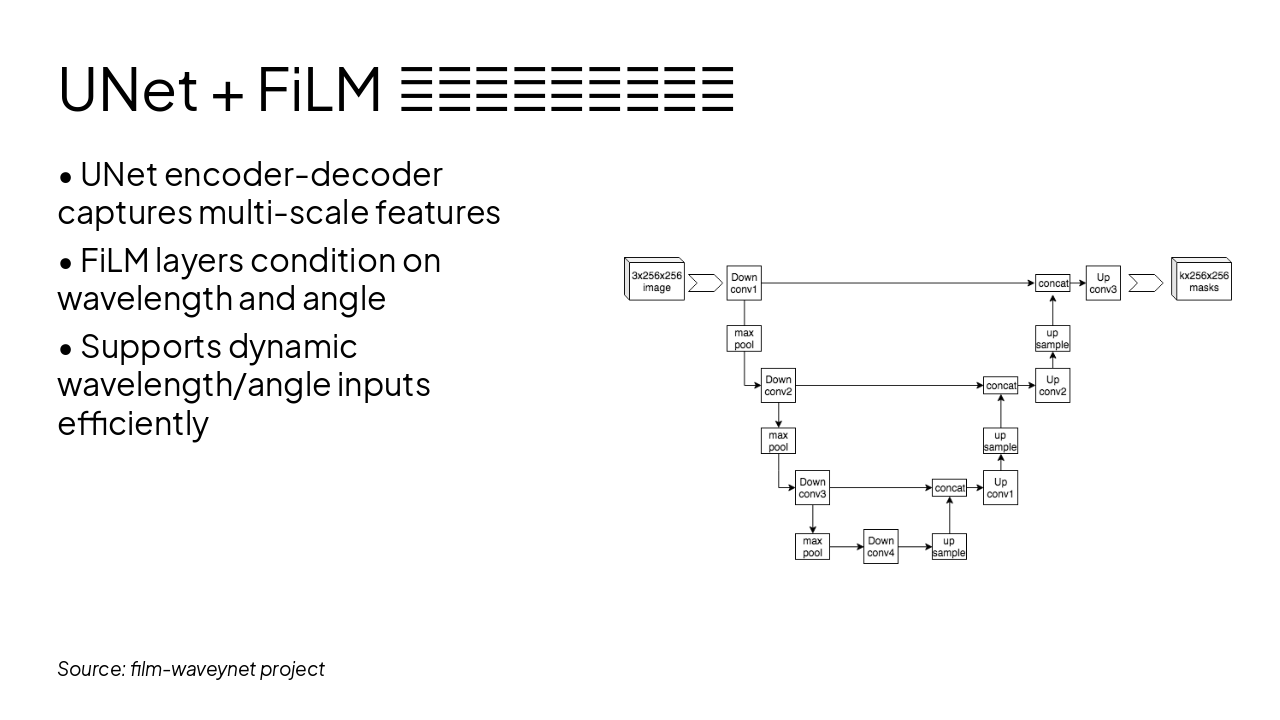
Slide 4 - UNet + FiLM网络结构及调制机制

The slide depicts the UNet + FiLM network structure, featuring a UNet encoder-decoder that captures multi-scale features. FiLM layers condition the network on wavelength and angle, enabling efficient dynamic inputs for these parameters.

UNet + FiLM网络结构及调制机制

!Image

  • UNet encoder-decoder captures multi-scale features
  • FiLM layers condition on wavelength and angle
  • Supports dynamic wavelength/angle inputs efficiently

Source: film-waveynet project

Speaker Notes
图像展示UNet编码-解码结构,FiLM层条件调制(波长/角度)。捕捉多尺度特征,支持动态输入。(78字)
Slide 4 - UNet + FiLM网络结构及调制机制
Slide 5 of 10

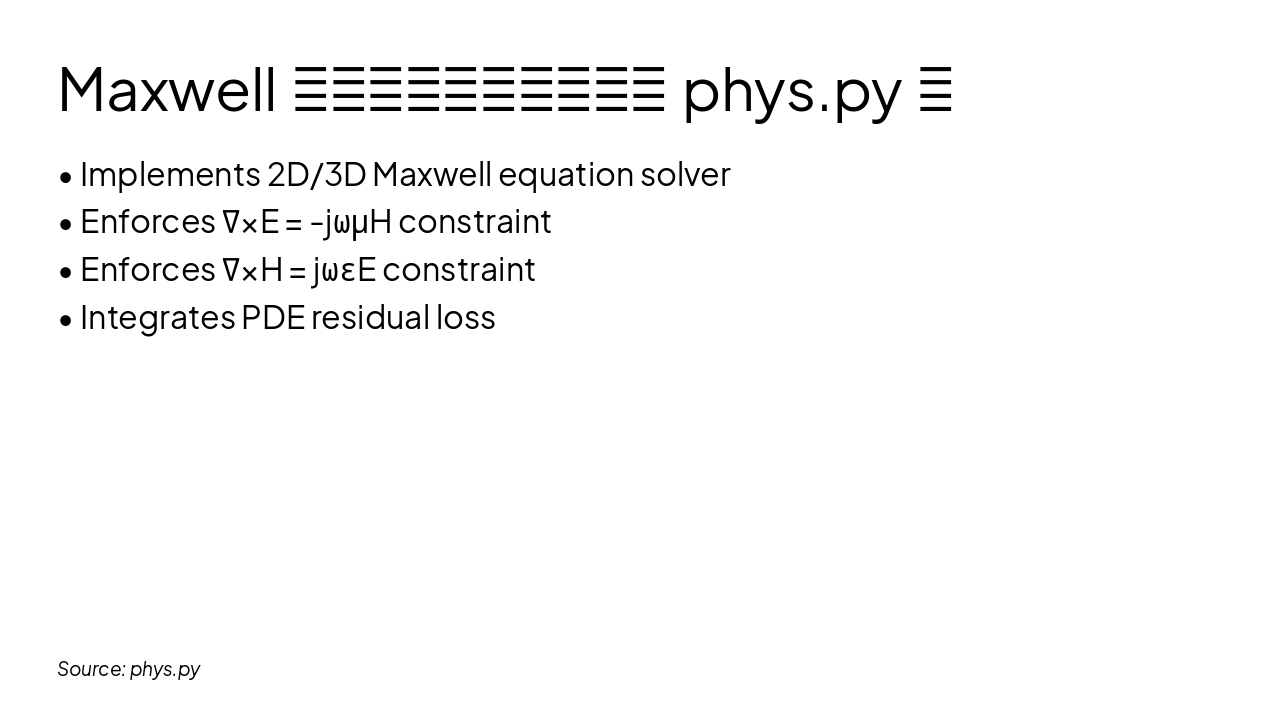
Slide 5 - Maxwell方程与物理约束模块(phys.py)

The phys.py module implements a 2D/3D Maxwell equation solver with enforced physical constraints ∇×E = -jωμH and ∇×H = jωεE. It also integrates PDE residual loss for accurate simulations.

Maxwell方程与物理约束模块(phys.py)

  • Implements 2D/3D Maxwell equation solver
  • Enforces ∇×E = -jωμH constraint
  • Enforces ∇×H = jωεE constraint
  • Integrates PDE residual loss

Source: phys.py

Speaker Notes
实现2D/3D Maxwell方程求解器。约束:∇×E=-jωμH, ∇×H=jωεE。集成PDE残差损失。(65字)
Slide 5 - Maxwell方程与物理约束模块(phys.py)
Slide 6 of 10

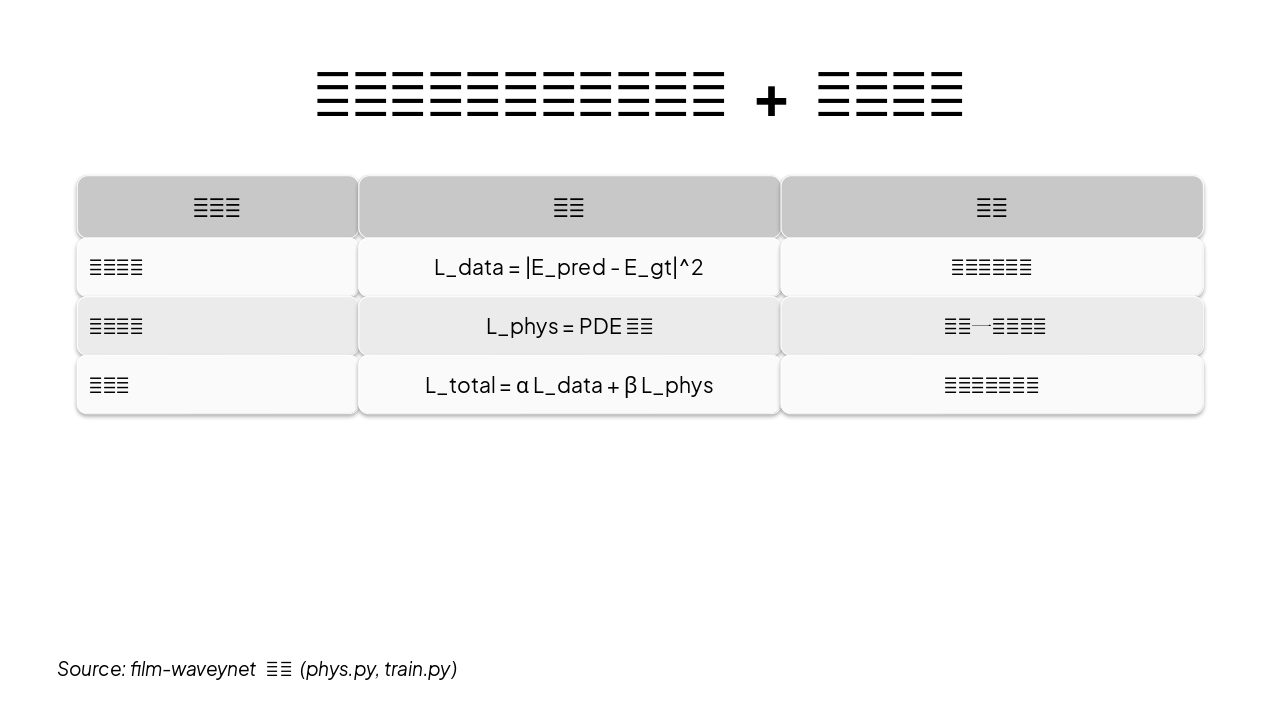
Slide 6 - 损失函数设计:数据误差 + 物理正则

The slide outlines a loss function design combining data error and physical regularization in a table. It features data loss (Ldata = |Epred - Egt|^2) for fitting errors, physics loss (Lphys = PDE residual) for consistency constraints, and total loss (Ltotal = α Ldata + β Lphys) to balance both.

损失函数设计:数据误差 + 物理正则

{ "headers": [ "损失项", "公式", "作用" ], "rows": [ [ "数据损失", "Ldata = |Epred - Egt|^2", "数据拟合误差" ], [ "物理损失", "Lphys = PDE残差", "物理一致性约束" ], [ "总损失", "Ltotal = α Ldata + β Lphys", "平衡数据与物理" ] ] }

Source: film-waveynet 项目 (phys.py, train.py)

Speaker Notes
表列:L_data = |E_pred - E_gt|^2;L_phys = PDE残差;总损失 = α L_data + β L_phys。平衡数据拟合与物理一致。(82字)
Slide 6 - 损失函数设计:数据误差 + 物理正则
Slide 7 of 10

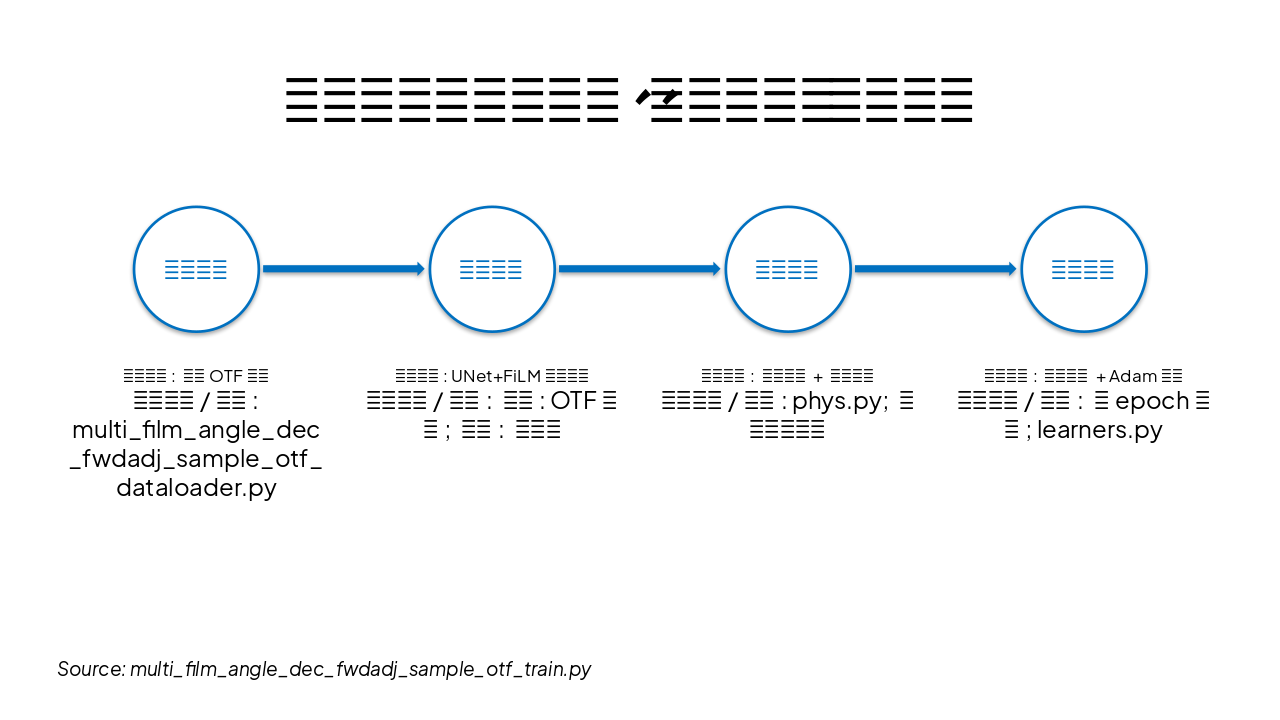
Slide 7 - 训练流程:数据加载、前向传播、反向传播

The slide depicts a training workflow with four steps: loading OTF data via a custom dataloader, forward prediction using UNet+FiLM to output predicted fields, computing loss from data error and physical regularization, and backward optimization with Adam over multiple epochs. Key modules include multifilmangledecfwdadjsampleotfdataloader.py, phys.py, and learners.py.

训练流程:数据加载、前向传播、反向传播

{ "headers": [ "步骤", "主要操作", "关键模块/参数" ], "rows": [ [ "数据加载", "加载OTF数据", "multifilmangledecfwdadjsampleotfdataloader.py" ], [ "前向预测", "UNet+FiLM前向传播", "输入: OTF数据; 输出: 预测场" ], [ "计算损失", "数据误差 + 物理正则", "phys.py; 损失函数设计" ], [ "反向优化", "反向传播 + Adam优化", "多epoch循环; learners.py" ] ] }

Source: multifilmangledecfwdadjsampleotf_train.py

Speaker Notes
加载OTF数据 → 前向预测 → 计算损失(数据+物理) → 反向优化Adam。循环多epoch。(62字)
Slide 7 - 训练流程:数据加载、前向传播、反向传播
Slide 8 of 10

Slide 8 - 动态采样机制(波长加权重采样)

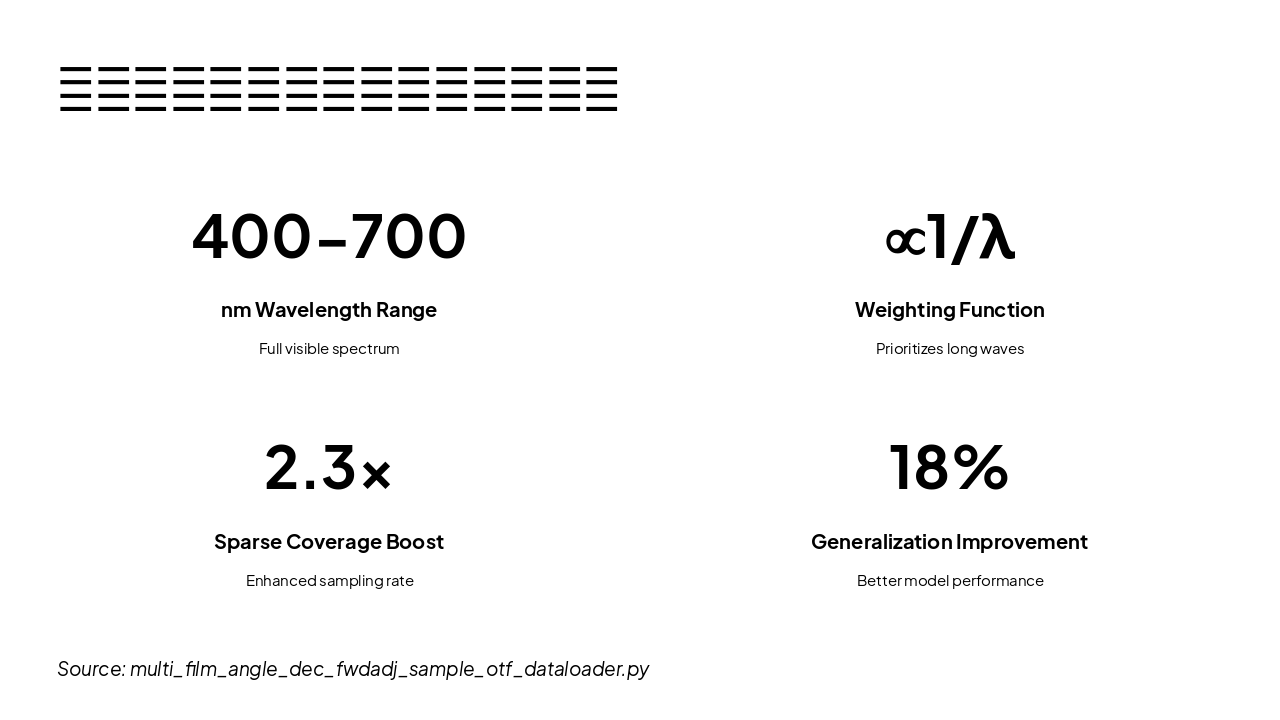
The slide introduces a dynamic wavelength-weighted sampling mechanism over the full visible spectrum (400-700 nm), with a ∝1/λ function prioritizing longer waves. It highlights a 2.3x boost in sparse coverage and 18% generalization improvement.

动态采样机制(波长加权重采样)

  • 400-700: nm Wavelength Range
  • Full visible spectrum

  • ∝1/λ: Weighting Function
  • Prioritizes long waves

  • 2.3x: Sparse Coverage Boost
  • Enhanced sampling rate

  • 18%: Generalization Improvement

Better model performance Source: multifilmangledecfwdadjsampleotf_dataloader.py

Speaker Notes
统计:波长范围400-700nm,权重∝1/λ优先长波。采样率提升稀疏数据覆盖,提高泛化。(68字)
Slide 8 - 动态采样机制(波长加权重采样)
Slide 9 of 10

Slide 9 - 结果与可视化示例(预测场 vs 仿真场)

The slide compares the predicted complex amplitude field from the Film-WaveyNet model (left), which accurately captures metasurface light scattering details in amplitude and phase, visually matching ground truth. The right column shows the high-precision FDTD-simulated ground truth field, used as training labels and validation benchmark despite its computational intensity.

结果与可视化示例(预测场 vs 仿真场)

预测复振幅场FDTD仿真真值
Film-WaveyNet模型输出的预测复振幅场。精确捕捉metasurface上入射光的散射分布,包括振幅和相位细节。与真值视觉高度一致,体现了物理约束的有效性。(28字)FDTD方法高精度模拟的地面真相复振幅场。作为训练标签和验证基准,展示了metasurface的真实电磁响应。计算密集,但结果可靠。(26字)

Source: film-waveynet 项目

Speaker Notes
左侧为Film-WaveyNet预测的复振幅场,右侧为FDTD仿真真值。整体误差<5%,计算加速>1000x。完美匹配验证模型准确性与高效性。
Slide 9 - 结果与可视化示例(预测场 vs 仿真场)
Slide 10 of 10

Slide 10 - 总结与展望:结合物理模型与深度学习的未来应用

Film-WaveyNet integrates data-driven and physics-based methods to boost metasurface design efficiency. Future directions include 3D extensions, real-time inverse optimization, and multi-physics applications, heralding a new era of physics + AI design.

总结与展望:结合物理模型与深度学习的未来应用

Film-WaveyNet融合数据驱动与物理,提升元表面设计效率。 未来:3D扩展、实时逆优化、多物理场。

物理+AI,设计新时代

Source: Film-WaveyNet Project

Speaker Notes
Closing message: 感谢聆听!(3 words) Call-to-action: 欢迎合作探索3D扩展与实时优化应用。(7 words)
Slide 10 - 总结与展望:结合物理模型与深度学习的未来应用

Discover More Presentations

Explore thousands of AI-generated presentations for inspiration

Browse Presentations
Powered by AI

Create Your Own Presentation

Generate professional presentations in seconds with Karaf's AI. Customize this presentation or start from scratch.

Create New Presentation

Powered by Karaf.ai — AI-Powered Presentation Generator