Supporting Teens 14-19: Parent Guide (34 chars)

Generated from prompt:

Create a 25-slide vibrant, engaging PowerPoint presentation titled 'Understanding & Supporting Teenagers (14–19 years)' for parents of school children. Use colorful, dynamic designs with illustrations and icons (not real photos). The tone should be warm, positive, and practical. Slide outline: 1. Title – Understanding & Supporting Teenagers (14–19 Years) 2. Goals – communication, reduce conflict, emotional wellbeing 3. Why Teenage Stage is Challenging – physical, emotional, social changes 4. Teenage Brain Basics – development, impulse control, peer influence 5. Common Teen Behaviors – mood swings, privacy, risk-taking 6. What Teens Really Need – respect, boundaries, emotional safety 7. Knowing Today’s Teen World – social media, comparison culture 8. Common Teen Challenges – anger, lying, low confidence 9. Parenting Styles – strict, lenient, balanced 10. Effective Communication – dos and don’ts 11. Teen Perspective Activity – understanding emotions 12. Setting Healthy Boundaries – examples & tips 13. Case Study 1 – Teen Lying 14. Case Study 2 – Phone Addiction 15. Case Study 3 – Angry/Isolated Teen 16. Understanding Temperaments – types & parent responses 17. Handling Conflicts – calm discussion & resolution 18. Academic Pressure & Motivation – focus on effort, reduce comparison 19. Emotional Health & Warning Signs – when to seek help 20. Digital Parenting – screen time & safety rules 21. Building Strong Bonds – trust, time together, appreciation 22. When to Seek Help – emotional red flags 23. Key Takeaways – calm, connection, clear rules 24. Parent Reflection Activity – empathy & understanding 25. Closing Message – 'Teenagers don’t need perfect parents, they need present ones.'

Vibrant 25-slide presentation for parents on teen brain/behaviors, challenges (e.g., mood swings, social media), communication tips, boundaries, case studies (lying, phone addiction), conflict resolut

December 14, 202525 slides
Slide 1 of 25

Slide 1 - Understanding & Supporting Teenagers (14–19 Years)

This title slide is named "Understanding & Supporting Teenagers (14–19 Years)." Its subtitle describes it as a practical guide to better communication and support.

Understanding & Supporting Teenagers (14–19 Years)

Practical guide to better communication and support.

Source: Welcoming title slide for parents of school children. Vibrant icons of happy teens and families.

Speaker Notes
Introduce the presentation warmly, emphasizing practical support for parents.
Slide 1 - Understanding & Supporting Teenagers (14–19 Years)
Slide 2 of 25

Slide 2 - Presentation Goals

This agenda slide outlines the presentation's five key goals for parenting teens. Topics include understanding teen development, effective communication, navigating challenges like lying and phones, handling conflicts to build bonds, and key takeaways with support resources.

Presentation Goals

  1. Understanding Teen Development 💡
  2. Brain basics, behaviors, needs, and today's social world.

  3. Effective Communication Strategies 💬
  4. Parenting styles, dos/don’ts, and healthy boundaries.

  5. Navigating Common Challenges 🚀
  6. Case studies on lying, phones, anger, academics, digital safety.

  7. Handling Conflicts & Bonds ❤️
  8. Temperaments, calm resolutions, trust, time, appreciation.

  9. Key Takeaways & Support ✌️

Emotional signs, when to seek help, reflection activity. Source: Understanding & Supporting Teenagers (14–19 Years)

Speaker Notes
Improve communication 💬, reduce conflicts ✌️, boost emotional wellbeing ❤️. Outline key topics ahead for easy navigation.
Slide 2 - Presentation Goals
Slide 3 of 25

Slide 3 - Why Teenage Stage is Challenging

The teenage stage is challenging due to rapid physical changes like growth spurts and surging hormones, plus emotional rollercoasters from mood swings and identity searches. Social shifts involving peer pressure and independence quests, alongside brain rewiring that impairs impulse control and decisions, further intensify the difficulties.

Why Teenage Stage is Challenging

  • Rapid physical changes: growth spurts and surging hormones
  • Emotional rollercoaster: mood swings and identity search
  • Social shifts: peer pressure and quest for independence
  • Brain rewiring: impacts impulse control and decisions
Slide 3 - Why Teenage Stage is Challenging
Slide 4 of 25

Slide 4 - Teenage Brain Basics

The "Teenage Brain Basics" slide highlights that the prefrontal cortex, key for impulse control, matures last in teens. It also notes the limbic system drives emotions and peer influence.

Teenage Brain Basics

!Image

  • Prefrontal cortex matures last: impulse control
  • Limbic system drives emotions, peer influence

Source: adolescent brain development

Slide 4 - Teenage Brain Basics
Slide 5 of 25

Slide 5 - Common Teen Behaviors

Common Teen Behaviors slide highlights normal traits like mood swings from hormonal changes, need for privacy to build independence, and safe risk-taking to test boundaries. It advises understanding these to support positive growth.

Common Teen Behaviors

  • Mood swings: Hormonal rollercoasters are normal 🌪️
  • Need for privacy: Fosters independence 🔒
  • Risk-taking adventures: Testing boundaries safely 🚀
  • Understand these: Support growth positively!
Speaker Notes
Normal part of growth—understand to support better!
Slide 5 - Common Teen Behaviors
Slide 6 of 25

Slide 6 - What Teens Really Need

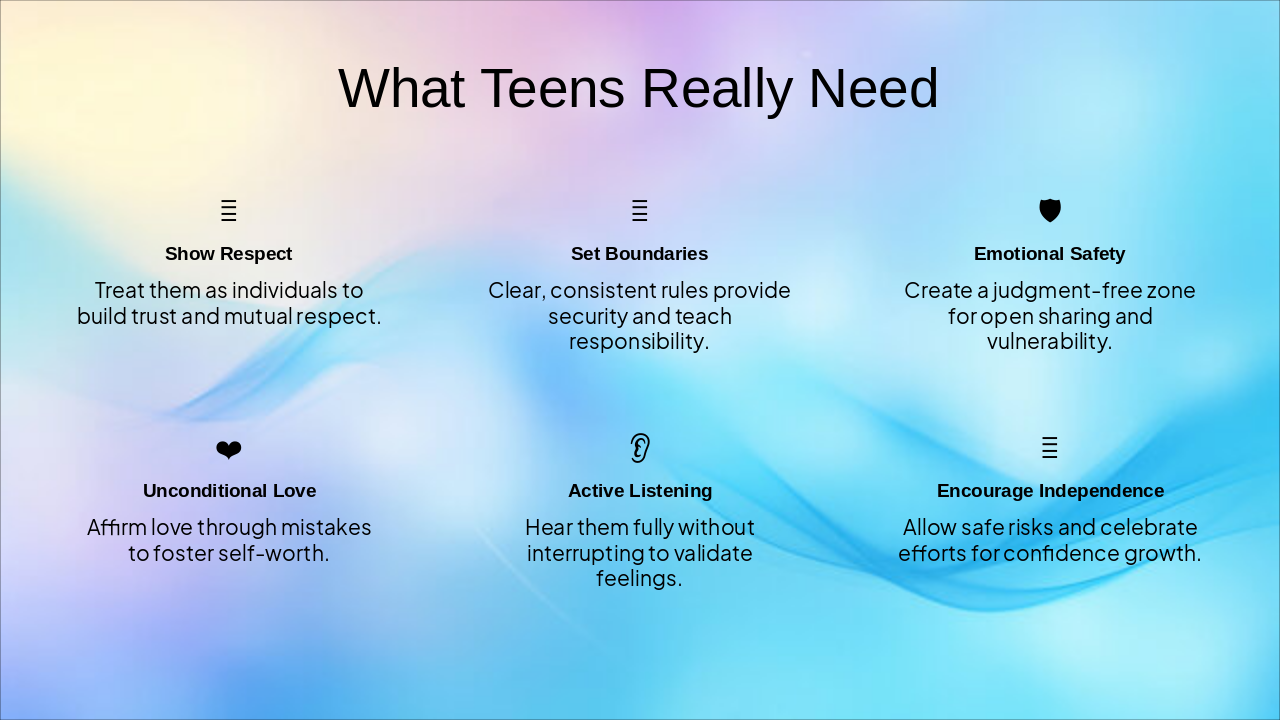
The slide "What Teens Really Need" features a grid of six key elements for supporting teens, illustrated with icons. It emphasizes showing respect, setting boundaries, emotional safety, unconditional love, active listening, and encouraging independence.

What Teens Really Need

{ "features": [ { "icon": "👏", "heading": "Show Respect", "description": "Treat them as individuals to build trust and mutual respect." }, { "icon": "📏", "heading": "Set Boundaries", "description": "Clear, consistent rules provide security and teach responsibility." }, { "icon": "🛡️", "heading": "Emotional Safety", "description": "Create a judgment-free zone for open sharing and vulnerability." }, { "icon": "❤️", "heading": "Unconditional Love", "description": "Affirm love through mistakes to foster self-worth." }, { "icon": "👂", "heading": "Active Listening", "description": "Hear them fully without interrupting to validate feelings." }, { "icon": "🚀", "heading": "Encourage Independence", "description": "Allow safe risks and celebrate efforts for confidence growth." } ] }

Speaker Notes
Highlight these essentials with real-life examples to engage parents.
Slide 6 - What Teens Really Need
Slide 7 of 25

Slide 7 - Knowing Today’s Teen World

The slide "Knowing Today’s Teen World" explains how social media apps like Instagram and TikTok dominate teens' lives, shaping trends, friendships, and self-image while fueling validation from likes alongside pressure and FOMO. It warns of the "comparison culture trap" from curated feeds, which sparks anxiety, low self-esteem, and unrealistic standards of looks, lives, and success.

Knowing Today’s Teen World

Social Media Influence 📱Comparison Culture Trap 😔
Teens live online, where apps like Instagram and TikTok shape trends, friendships, and self-image. Instant likes fuel validation, but also pressure and FOMO in a 24/7 digital world.Curated feeds spark endless comparisons of looks, lives, and success. This breeds anxiety, low self-esteem, and unrealistic standards, trapping teens in a cycle of inadequacy.
Speaker Notes
Encourage real connections over likes.
Slide 7 - Knowing Today’s Teen World
Slide 8 of 25

Slide 8 - Common Teen Challenges

The "Common Teen Challenges" slide highlights anger outbursts, occasional lying, and low confidence dips as typical issues teens face. It advises spotting patterns early for intervention and responding with empathy instead of judgment.

Common Teen Challenges

  • Anger outbursts 😠 – sudden emotional flares
  • Occasional lying 🤫 – testing boundaries
  • Low confidence dips 😢 – self-doubt moments
  • Spot patterns early for intervention
  • Respond with empathy, not judgment

Source: Understanding & Supporting Teenagers (14–19 Years)

Speaker Notes
Spot patterns, respond with empathy.
Slide 8 - Common Teen Challenges
Slide 9 of 25

Slide 9 - Parenting Styles

The slide features a table comparing three parenting styles—Strict, Lenient, and Balanced—with their key pros and cons. Strict provides clear rules but risks rebellion; Lenient fosters creativity yet lacks boundaries; Balanced builds trust and responsibility but demands consistent effort.

Parenting Styles

{ "headers": [ "Style", "Pros ✅", "Cons ❌" ], "rows": [ [ "Strict 👮", "Clear rules & structure<br>Discipline", "Rebellion risk<br>Stifles independence" ], [ "Lenient 😎", "Fosters creativity<br>Flexibility", "Lacks boundaries<br>Irresponsibility" ], [ "Balanced ❤️", "Builds trust<br>Responsibility & security", "Requires consistency<br>Effort to balance" ] ] }

Slide 9 - Parenting Styles
Slide 10 of 25

Slide 10 - Effective Communication

The "Effective Communication" slide outlines Do's like active listening without interrupting, validating feelings, asking open-ended questions, and staying calm and empathetic. It contrasts these with Don'ts such as lecturing, dismissing emotions, interrupting, and making assumptions.

Effective Communication

Do's ✅Don'ts ❌
Listen actively without interrupting. Validate feelings: 'I see you're upset.' Ask open-ended questions. Stay calm and empathetic for better connection.Avoid lecturing or preaching. Don't dismiss emotions: 'You're overreacting.' Never interrupt. Skip assumptions—listen first to build trust.

Source: Understanding & Supporting Teenagers

Speaker Notes
Highlight icons for quick visual recall. Encourage parents to role-play these dos and don'ts during the session.
Slide 10 - Effective Communication
Slide 11 of 25

Slide 11 - Teen Perspective Activity

The "Teen Perspective Activity" slide presents an interactive emotions wheel image for exploring teen feelings. It outlines activities like guessing emotions in scenarios, matching emoji faces to situations, and building empathy through discussion.

Teen Perspective Activity

!Image

  • Explore emotions wheel interactively
  • Guess teen feelings in scenarios
  • Match emoji faces to situations
  • Build empathy through discussion

Source: Plutchik wheel of emotions

Speaker Notes
Use this interactive emotions wheel to discuss how teens might feel in various situations, fostering parental empathy.
Slide 11 - Teen Perspective Activity
Slide 12 of 25

Slide 12 - Setting Healthy Boundaries

The slide "Setting Healthy Boundaries" outlines key steps: set clear expectations, enforce consistent consequences, and flex as trust grows. Examples include age-appropriate chores and reasonable curfews.

Setting Healthy Boundaries

  • Set clear expectations 📋
  • Enforce consistent consequences ⚖️
  • Flex as trust grows 🌱
  • Example: Age-appropriate chores 🧹
  • Example: Reasonable curfews 🕐
Slide 12 - Setting Healthy Boundaries
Slide 13 of 25

Slide 13 - Case Study 1: Teen Lying

The slide describes a case study of a 16-year-old lying about poor math grades, leading to shame, withdrawal, and family tension when discovered. It provides response tips like staying calm, asking curious questions, focusing on support over blame, and rebuilding trust with honest talks, clear expectations, and praise for truthfulness.

Case Study 1: Teen Lying

What HappenedResponse Tips
Your 16-year-old hides poor math grades, lying about homework to avoid disappointment. When discovered, he feels ashamed, withdraws, and tensions rise at home.Stay calm; ask curious questions like 'What made math tough?' Focus on support, not blame. Rebuild trust with honest talks, clear expectations, and praise for truthfulness.

Source: Understanding & Supporting Teenagers (14–19 Years)

Speaker Notes
Share the scenario, pause for audience reflection. Emphasize curiosity over confrontation to foster openness and trust.
Slide 13 - Case Study 1: Teen Lying
Slide 14 of 25

Slide 14 - Case Study 2: Phone Addiction

The slide "Case Study 2: Phone Addiction" lists signs on the left, including endless late-night scrolling, constant notification checks, irritability without access, neglected responsibilities, social withdrawal, and blue light-induced sleep issues. On the right, it recommends family rules like tech-free dinners, overnight phone charging in common areas, screen time limits, game nights, and modeling balanced use.

Case Study 2: Phone Addiction

Signs of Phone AddictionHelpful Family Rules
Endless scrolling late at night, constant notification checks, irritability without phone access, neglecting homework or chores, social withdrawal, and disrupted sleep patterns from blue light exposure.Tech-free dinners to chat and connect 🍲, charge phones in a common area overnight, set daily screen time limits, schedule family game nights, and model balanced phone use yourself.

Source: Understanding & Supporting Teenagers (14–19 Years)

Speaker Notes
Issue: Endless scrolling. Left: Signs of phone addiction like constant checking and sleep disruption. Right: Practical family rules such as tech-free dinners 🍲 and screen limits.
Slide 14 - Case Study 2: Phone Addiction
Slide 15 of 25

Slide 15 - Case Study 3: Angry/Isolated Teen

Case Study 3: Angry/Isolated Teen highlights signs like withdrawal from family/friends, frequent angry outbursts, irritability, and excessive isolation signaling deeper emotional distress. It advises creating a safe space for empathetic listening without judgment, gradual trust-building, and seeking professional counseling if behaviors persist.

Case Study 3: Angry/Isolated Teen

Signs & SymptomsSupportive Approach
Withdrawal from family/friends, frequent angry outbursts, irritability, excessive time alone. Teen may lash out unexpectedly or retreat into isolation, signaling deeper emotional distress.Create safe space for empathetic talks ❤️. Listen without judgment. Encourage gradual trust-building. Seek professional help like counseling if behaviors persist or worsen.

Source: Understanding & Supporting Teenagers (14–19 Years)

Speaker Notes
Discuss signs and approaches; encourage parent sharing.
Slide 15 - Case Study 3: Angry/Isolated Teen
Slide 16 of 25

Slide 16 - Understanding Temperaments

The slide "Understanding Temperaments" features a table outlining four personality types—Choleric (bold, ambitious leaders), Sanguine (outgoing, sociable), Melancholic (thoughtful, perfectionists), and Phlegmatic (calm, reliable peacemakers)—with their key traits. It provides tailored parent tips, such as channeling energy for Cholerics, adding structure for Sanguines, reassuring Melancholics, and encouraging Phlegmatics.

Understanding Temperaments

{ "headers": [ "Type", "Traits", "Parent Tips" ], "rows": [ [ "Choleric", "Bold, ambitious, leader", "Channel energy, set challenges" ], [ "Sanguine", "Outgoing, fun-loving, sociable", "Add structure, teach focus" ], [ "Melancholic", "Thoughtful, perfectionist, sensitive", "Reassure value, affirm efforts" ], [ "Phlegmatic", "Calm, reliable, peacemaker", "Encourage participation, draw out" ] ] }

Slide 16 - Understanding Temperaments
Slide 17 of 25

Slide 17 - Handling Conflicts

The "Handling Conflicts" workflow provides four steps for parents: Stay Calm by pausing and breathing, Listen Actively by validating teen feelings, Collaborate on solutions, and Follow Up to reinforce progress. Key tips emphasize building trust, mutual respect, and stronger relationships through composure and dialogue.

Handling Conflicts

{ "headers": [ "Step", "Action", "Key Tips" ], "rows": [ [ "1. Stay Calm 🧘", "Take deep breaths and pause before responding", "Maintain composure to model emotional control and create space for dialogue" ], [ "2. Listen Actively 👂", "Let your teen speak without interruption; validate their feelings", "Builds trust by showing you value their perspective" ], [ "3. Collaborate 🤝", "Brainstorm solutions together; find common ground", "Fosters mutual respect and ownership of resolutions" ], [ "4. Follow Up ✅", "Check in later to reinforce the agreement and progress", "Strengthens the relationship and prevents future issues" ] ] }

Source: Step 1: Stay calm 🧘 → 2: Listen → 3: Collaborate → 4: Follow up. Flowchart with icons.

Speaker Notes
Present as a flowchart with colorful icons (e.g., meditation for calm, ear for listen, hands shaking for collaborate, checkmark for follow up). Emphasize warm, positive tone: 'Conflicts are opportunities to connect!' Use dynamic animations for steps.
Slide 17 - Handling Conflicts
Slide 18 of 25

Slide 18 - Academic Pressure & Motivation

This slide on Academic Pressure & Motivation recommends praising effort over grades, avoiding peer comparisons, and setting growth mindset goals. It emphasizes celebrating progress and persistence to foster intrinsic motivation.

Academic Pressure & Motivation

  • Praise effort, not just grades 🏆
  • Avoid comparisons with peers
  • Set growth mindset goals 📈
  • Celebrate progress and persistence
  • Foster intrinsic motivation

Source: Understanding & Supporting Teenagers (14–19 Years)

Speaker Notes
Key strategies: Praise effort over grades 🏆, avoid comparisons, set growth goals 📈. Focus on building intrinsic motivation and resilience.
Slide 18 - Academic Pressure & Motivation
Slide 19 of 25

Slide 19 - Emotional Health & Warning Signs

The slide on Emotional Health & Warning Signs lists key indicators like persistent sadness, changes in sleep or eating, and social withdrawal. It advises regular open check-ins and normalizing professional help as a strength.

Emotional Health & Warning Signs

  • Watch for persistent sadness or hopelessness 😔 lasting weeks
  • Notice major changes in sleep or eating patterns
  • Observe withdrawal from family, friends, and activities
  • Hold regular open check-ins to foster sharing
  • Normalize seeking professional help as strength
Speaker Notes
Watch for: Persistent sadness 😔, sleep changes, withdrawal. Tips: Open check-ins, normalize seeking help.
Slide 19 - Emotional Health & Warning Signs
Slide 20 of 25

Slide 20 - Digital Parenting

The "Digital Parenting" slide outlines three key rules for managing kids' screen time: limits to promote balance and sleep, safety icons enabled to protect from risks, and no screens at dinner to build family bonds. It explains implementation via family media contracts, parental controls/filters, and device-free zones.

Digital Parenting

{ "headers": [ "Rule", "Why", "How" ], "rows": [ [ "Screen time limits", "Promotes balance & sleep", "Family media contracts" ], [ "Safety icons enabled", "Protects from risks", "Parental controls & filters" ], [ "No screens at dinner", "Builds family bonds", "Device-free zones" ] ] }

Source: Screen time & safety rules

Speaker Notes
Discuss practical rules for healthy digital habits.
Slide 20 - Digital Parenting
Slide 21 of 25

Slide 21 - Building Strong Bonds

The "Building Strong Bonds" slide outlines six key strategies for parents to strengthen relationships with teens. These include fostering trust with consistency, dedicating quality time, using words of appreciation, practicing active listening, enjoying shared activities, and offering unconditional support.

Building Strong Bonds

{ "features": [ { "icon": "🔐", "heading": "Foster Trust", "description": "Be consistent and honest to build lasting confidence in your teen." }, { "icon": "⏰", "heading": "Quality Time", "description": "Dedicate distraction-free moments for meaningful conversations and connection." }, { "icon": "💕", "heading": "Words of Appreciation", "description": "Verbally celebrate their efforts and unique qualities daily." }, { "icon": "👂", "heading": "Active Listening", "description": "Hear their thoughts without judgment to deepen emotional bonds." }, { "icon": "🎉", "heading": "Shared Activities", "description": "Join fun hobbies together for joyful, natural bonding experiences." }, { "icon": "🤗", "heading": "Unconditional Support", "description": "Stand by them through challenges with love and presence." } ] }

Slide 21 - Building Strong Bonds
Slide 22 of 25

Slide 22 - When to Seek Help

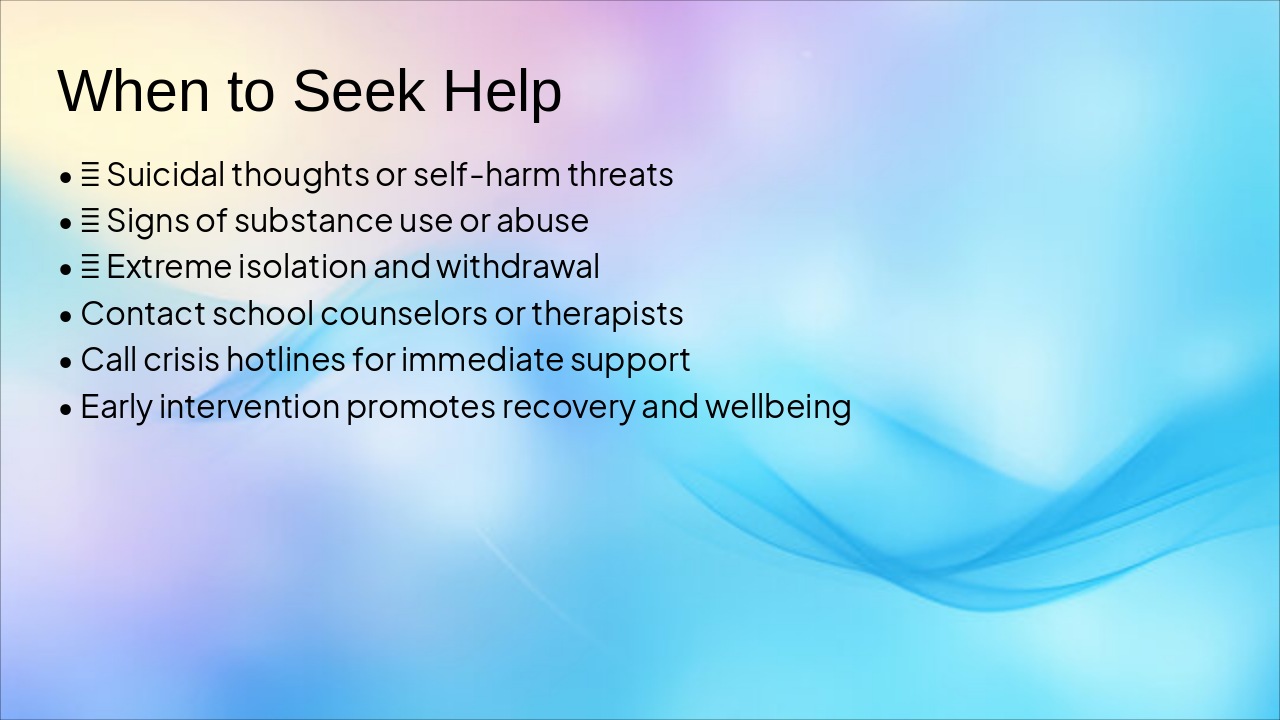
Seek help immediately for suicidal thoughts, self-harm threats, substance abuse signs, or extreme isolation. Contact school counselors, therapists, or crisis hotlines, as early intervention supports recovery and wellbeing.

When to Seek Help

  • 🚨 Suicidal thoughts or self-harm threats
  • 🚨 Signs of substance use or abuse
  • 🚨 Extreme isolation and withdrawal
  • Contact school counselors or therapists
  • Call crisis hotlines for immediate support
  • Early intervention promotes recovery and wellbeing
Slide 22 - When to Seek Help
Slide 23 of 25

Slide 23 - Key Takeaways

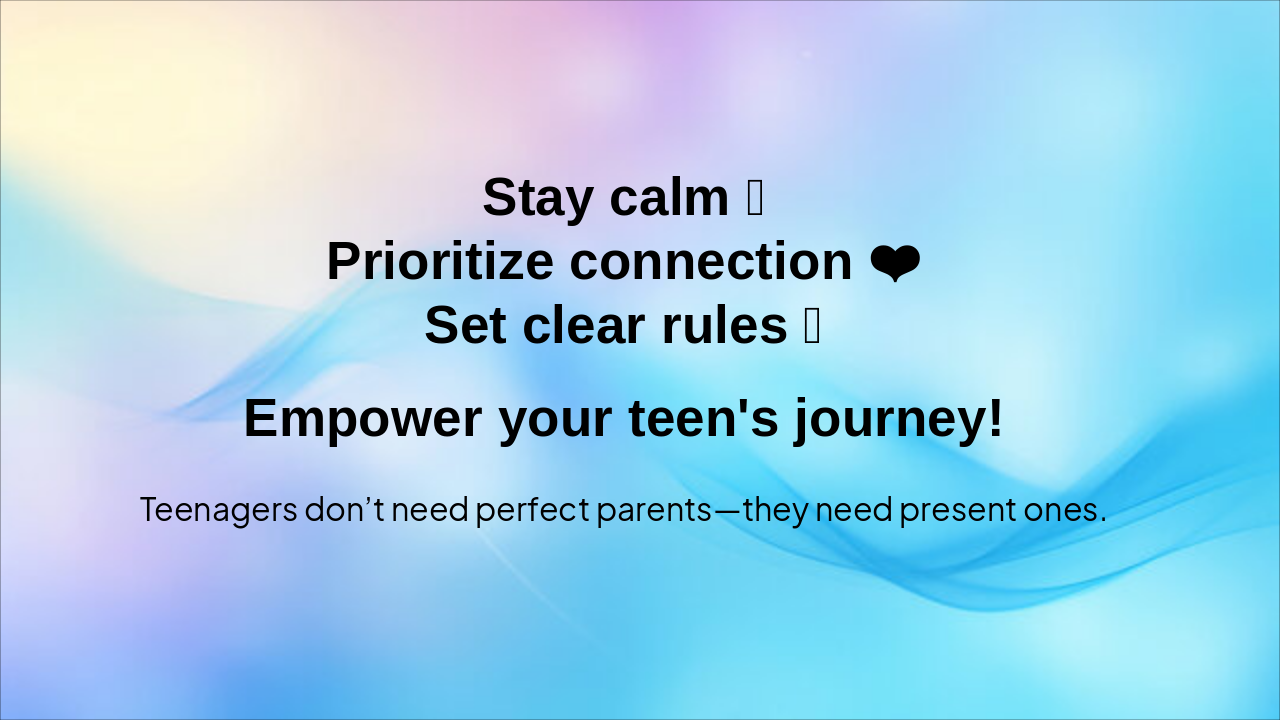
The Key Takeaways slide advises staying calm, prioritizing connection, setting clear rules, and empowering your teen's journey. Its subtitle notes that teenagers need present parents, not perfect ones.

Key Takeaways

Stay calm 😌 Prioritize connection ❤️ Set clear rules 📏

Empower your teen's journey!

Teenagers don’t need perfect parents—they need present ones.

Slide 23 - Key Takeaways
Slide 24 of 25

Slide 24 - Parent Reflection Activity

The "Parent Reflection Activity" slide features an image with prompts for parents to build empathy toward their teens. It asks: "What empathy can I show today?", to reflect on the teen's unique perspective, identify one understanding action, and journal thoughts with an open heart.

Parent Reflection Activity

!Image

  • What empathy can I show today?
  • Reflect on your teen's unique perspective.
  • Identify one understanding action to take.
  • Journal your thoughts with an open heart.

Source: Image from Wikipedia article "Mirror"

Slide 24 - Parent Reflection Activity
Slide 25 of 25

Slide 25 - Closing Message

The slide, titled "Closing Message," is a quote type. It features the anonymous quote: "Teenagers don’t need perfect parents, they need present ones."

Closing Message

> Teenagers don’t need perfect parents, they need present ones.

— Anonymous

Source: Understanding & Supporting Teenagers (14–19 years)

Speaker Notes
Heart icon & thank you!
Slide 25 - Closing Message

Discover More Presentations

Explore thousands of AI-generated presentations for inspiration

Browse Presentations
Powered by AI

Create Your Own Presentation

Generate professional presentations in seconds with Karaf's AI. Customize this presentation or start from scratch.

Create New Presentation

Powered by Karaf.ai — AI-Powered Presentation Generator