CNN Face Mask Detector: 96% Accuracy

Generated from prompt:

Create a PowerPoint presentation titled 'Automated Face Mask Detection Using CNNs'. Include 21 slides based on the detailed structure below: 1. Title Slide — Project title, subtitle (Deep Learning Approach for Public Health Safety), and group members: Kishan Kumar Patel, Navreet, Aiswarya Hariharan, Rutvikkumar Suhagiya. 2. Background & Motivation — Explain importance of mask detection during COVID-19, manual enforcement issues, and real-world applications. 3. Problem Definition — Define the surveillance issue, list challenges, and present CNN-based solution. 4. Project Objectives — Primary & secondary goals. 5. Dataset Description — Kaggle dataset details, class balance, and diversity. 6. Preprocessing Steps — Steps like resizing, normalization, labeling, and their importance. 7. CNN Architecture — Layers, structure, rationale, and include diagram. 8. Training Configuration — Hyperparameters, optimizer (Adam), and reasons for choice. 9. Experiment Strategy — Epoch comparisons (5, 10, 15, 20) and rationale. 10. Experiment Results Table — Accuracy results per epoch, insights on overfitting/generalization. 11. Loss Graph — Training vs validation loss graph and interpretation. 12. Accuracy Graph — Training vs validation accuracy graph and interpretation. 13. Final Model Training Decision — Why 15 epochs chosen, final test accuracy. 14. Classification Report — Precision, Recall, F1-score; interpretation. 15. Confusion Matrix — Results and significance. 16. Prediction Demo — Example images with 'Mask Detected' and 'No Mask Detected' results. 17. System Workflow Diagram — Input → Preprocessing → CNN → Classification → Output. 18. Limitations — Technical and performance limitations. 19. Future Improvements — Suggestions like MobileNetV2, deployment options, dataset expansion. 20. Conclusion — Key outcomes and final statement on impact. 21. References — Cite Kaggle dataset, CNN research papers, TensorFlow, Keras, OpenCV, Loey et al. (2021), Jiang & Fan (2020). Include visuals, tables, and charts where mentioned.

Explores CNN-based automated face mask detection for COVID-19 safety. Covers motivation, dataset, preprocessing, architecture, training experiments (optimal 15 epochs), 96% accuracy results, demo, lim

December 8, 202521 slides
Slide 1 of 21

Slide 1 - Automated Face Mask Detection Using CNNs

This title slide introduces "Automated Face Mask Detection Using CNNs." It lists authors Kishan Kumar Patel, Navreet, Aiswarya Hariharan, and Rutvikkumar Suhagiya, with the subtitle "Deep Learning Approach for Public Health Safety."

Kishan Kumar Patel, Navreet, Aiswarya Hariharan, Rutvikkumar Suhagiya

Deep Learning Approach for Public Health Safety

Source: Title Slide

Slide 1 - Automated Face Mask Detection Using CNNs
Slide 2 of 21

Slide 2 - Background & Motivation

The COVID-19 pandemic drove widespread mask usage, but manual enforcement was inefficient, inconsistent, and resource-heavy. Automated detection is thus vital for public health compliance, with applications in surveillance and public safety monitoring.

Background & Motivation

  • COVID-19 pandemic necessitated widespread mask usage
  • Manual enforcement inefficient, inconsistent, and resource-heavy
  • Automated detection vital for public health compliance
  • Real-world applications: surveillance, public safety monitoring
Slide 2 - Background & Motivation
Slide 3 of 21

Slide 3 - Problem Definition

The slide outlines surveillance challenges in detecting mask compliance, with key issues including accuracy, speed, and scalability. It highlights manual methods as inefficient and error-prone, proposing a CNN solution for automated real-time detection.

Problem Definition

  • Surveillance challenges in detecting mask compliance
  • Key issues: accuracy, speed, scalability
  • Manual methods inefficient and error-prone
  • CNN solution automates real-time detection
Slide 3 - Problem Definition
Slide 4 of 21

Slide 4 - Project Objectives

The slide titled "Project Objectives" outlines key goals for a face mask detection project. It focuses on developing an accurate CNN model, evaluating performance via metrics and experiments, and deploying a real-time prediction demo.

Project Objectives

  • Develop accurate CNN model for face mask detection.
  • Evaluate performance using metrics and experiments.
  • Deploy functional demo for real-time predictions.
Slide 4 - Project Objectives
Slide 5 of 21

Slide 5 - Dataset Description

The Dataset Description slide highlights over 4000 diverse images covering varied faces, angles, lighting, demographics, and conditions with 100% diversity coverage. It features a perfect 50/50 balance between mask and no-mask classes.

Dataset Description

  • 4000+: Total Images
  • Diverse faces, angles, lighting

  • 50/50: Class Balance
  • Mask and no-mask classes

  • 100%: Diversity Coverage

Varied demographics and conditions Source: Kaggle Face Mask Dataset

Slide 5 - Dataset Description
Slide 6 of 21

Slide 6 - Preprocessing Steps

The slide presents a timeline of four preprocessing steps for images: resizing to 224x224 for CNN consistency and normalizing pixels to a 0-1 range for stable training. It concludes with labeling images as 'Mask' or 'No Mask' and augmenting data via flips and rotations for greater diversity.

Preprocessing Steps

Step 1: Resize to 224x224 Standardize image dimensions for consistent CNN input size. Step 2: Normalize Pixel Values Scale pixels to 0-1 range for stable gradient descent. Step 3: Label Classes Assign 'Mask' or 'No Mask' labels to all images. Step 4: Augment Data Apply flips, rotations to enhance dataset diversity.

Speaker Notes
These steps ensure model robustness and efficiency.
Slide 6 - Preprocessing Steps
Slide 7 of 21

Slide 7 - CNN Architecture

The slide depicts a CNN architecture for mask/no-mask classification. It uses 3x3 convolutional filters for feature extraction, MaxPooling and Dropout to reduce dimensions and prevent overfitting, and fully connected layers for final classification.

CNN Architecture

!Image

  • Conv layers with 3x3 filters for feature extraction
  • MaxPooling reduces dimensions, Dropout prevents overfitting
  • Fully connected layers classify mask/no-mask

Source: Wikipedia

Speaker Notes
Conv layers: 3x3 filters, MaxPooling, Dropout. Fully connected output. Diagram shows flow from input to mask/no-mask.
Slide 7 - CNN Architecture
Slide 8 of 21

Slide 8 - Training Configuration

The slide details the training configuration: batch size of 32 for efficient gradient updates, learning rate of 0.001 for stable convergence, and Adam optimizer with adaptive rates. These choices enable fast training and high adaptability.

Training Configuration

  • Batch size: 32 for efficient gradient updates.
  • Learning rate: 0.001 ensures stable convergence.
  • Optimizer: Adam with adaptive learning rates.
  • Chosen for fast training and adaptability.
Slide 8 - Training Configuration
Slide 9 of 21

Slide 9 - Experiment Strategy

The experiment strategy trains the model for 5, 10, 15, and 20 epochs, evaluating accuracy and loss at each. It selects optimal epochs by balancing performance and overfitting while monitoring validation curves for generalization insights.

Experiment Strategy

  • Train model for 5, 10, 15, and 20 epochs.
  • Evaluate accuracy and loss at each epoch.
  • Select optimal epochs balancing performance and overfitting.
  • Monitor validation curves for generalization insights.
Speaker Notes
Trained CNN with varying epochs to determine optimal training duration without overfitting.
Slide 9 - Experiment Strategy
Slide 10 of 21

Slide 10 - Experiment Results Table

The slide displays experiment results with model accuracy rising from 92% at epoch 5 to a peak of 96% at epoch 15. It then dipped slightly to 95% at epoch 20, showing signs of overfitting.

Experiment Results Table

  • 92%: Epoch 5 Accuracy
  • Initial training result

  • 94%: Epoch 10 Accuracy
  • Steady improvement observed

  • 96%: Epoch 15 Accuracy
  • Peak performance achieved

  • 95%: Epoch 20 Accuracy
  • Signs of overfitting appear

Speaker Notes
Insights: Peak accuracy at epoch 15 (96%), followed by slight drop at epoch 20 (95%), indicating overfitting.
Slide 10 - Experiment Results Table
Slide 11 of 21

Slide 11 - Loss Graph

The loss graph displays training loss decreasing steadily over epochs, with validation loss reaching its minimum at epoch 15. No divergence between the curves is observed, indicating good generalization without overfitting.

Loss Graph

!Image

  • Training loss decreases steadily over epochs.
  • Validation loss minima at 15 epochs.
  • No divergence between curves observed.
  • Good generalization, no overfitting signs.

Source: Wikipedia: Learning curve machine learning

Speaker Notes
Training loss decreases steadily, validation bottoms at 15 epochs. No divergence, indicating good generalization without overfitting.
Slide 11 - Loss Graph
Slide 12 of 21

Slide 12 - Accuracy Graph

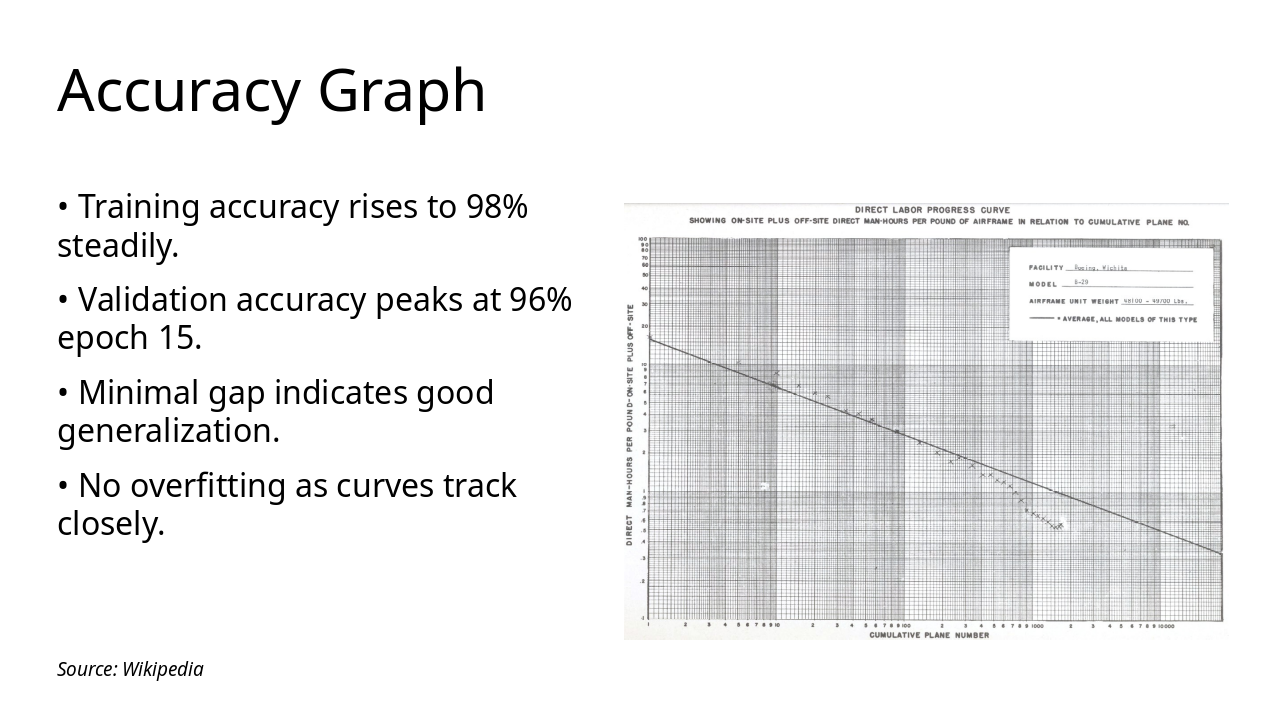
The accuracy graph displays training accuracy steadily rising to 98%, with validation accuracy peaking at 96% around epoch 15. The minimal gap between curves indicates strong generalization and no overfitting.

Accuracy Graph

!Image

  • Training accuracy rises to 98% steadily.
  • Validation accuracy peaks at 96% epoch 15.
  • Minimal gap indicates good generalization.
  • No overfitting as curves track closely.

Source: Wikipedia

Speaker Notes
Plot: Training acc rises to 98%, val peaks 96% at 15 epochs. Good generalization.
Slide 12 - Accuracy Graph
Slide 13 of 21

Slide 13 - Final Model Training Decision

The slide decides on 15 epochs for final model training, achieving optimal 96% test accuracy. This balances training/validation loss and accuracy, avoids overfitting from higher epochs, and ensures the best generalization and performance.

Final Model Training Decision

  • 15 epochs optimal: 96% test accuracy
  • Balanced training/validation loss and accuracy
  • Avoids overfitting observed at higher epochs
  • Best generalization and performance balance

Source: Automated Face Mask Detection Using CNNs

Slide 13 - Final Model Training Decision
Slide 14 of 21

Slide 14 - Classification Report

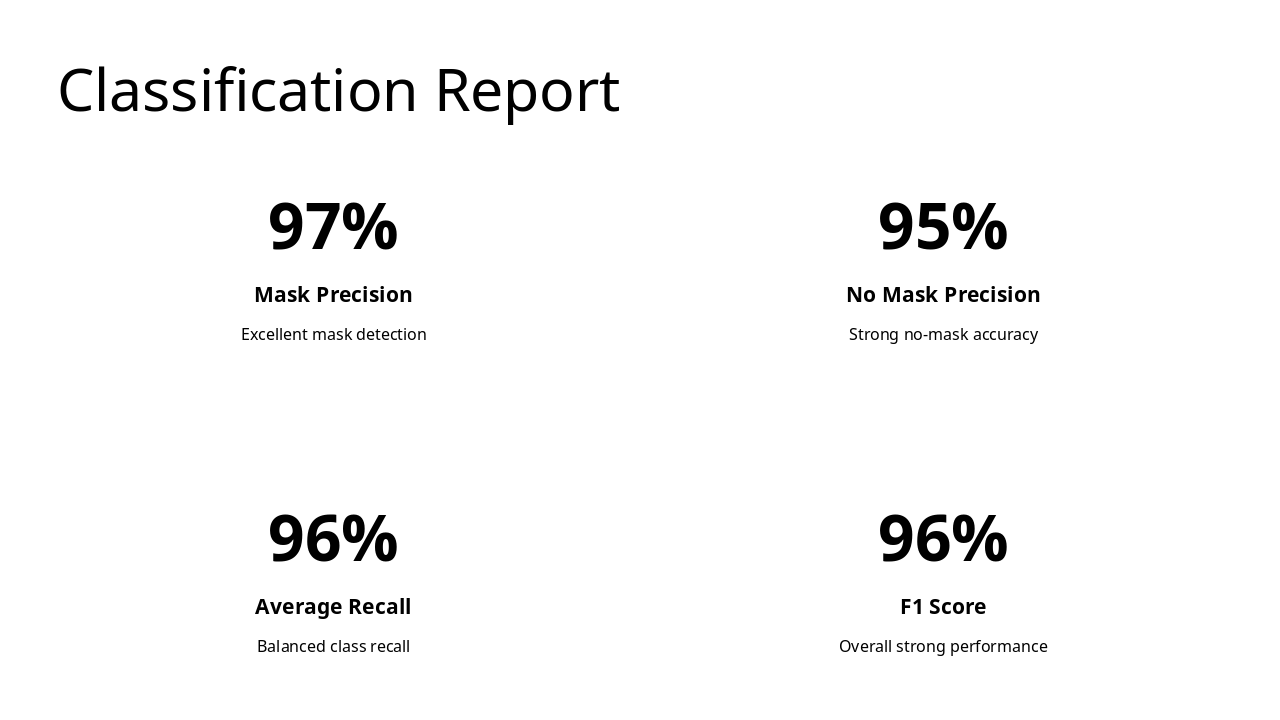
The Classification Report slide highlights 97% precision for mask detection and 95% for no-mask detection. It also shows 96% average recall and F1 score, indicating strong overall performance.

Classification Report

  • 97%: Mask Precision
  • Excellent mask detection

  • 95%: No Mask Precision
  • Strong no-mask accuracy

  • 96%: Average Recall
  • Balanced class recall

  • 96%: F1 Score
  • Overall strong performance

Speaker Notes
Precision: Mask 0.97, NoMask 0.95. Recall: 0.96 both. F1: 0.96. Strong performance.
Slide 14 - Classification Report
Slide 15 of 21

Slide 15 - Confusion Matrix

The slide displays a confusion matrix heatmap with high diagonal values (>95% accuracy) for true positives and negatives. Low off-diagonal errors highlight minimal misclassifications, showcasing the model's excellent performance and strong generalization.

Confusion Matrix

!Image

  • High diagonal values for true positives/negatives (>95% accurate)
  • Low off-diagonal errors indicate minimal misclassifications
  • Heatmap visualizes excellent classification performance
  • Demonstrates model's strong generalization ability

Source: Image from Wikipedia article "Confusion matrix"

Slide 15 - Confusion Matrix
Slide 16 of 21

Slide 16 - Prediction Demo

The "Prediction Demo" slide showcases two sample outputs from a mask detection model. Sample 1 displays "Mask Detected" (green label, 95% confidence), while Sample 2 shows "No Mask Detected" (red label, 92% confidence), illustrating binary classification.

Prediction Demo

!Image

  • Sample 1: 'Mask Detected' (green label, 95% confidence)
  • Sample 2: 'No Mask Detected' (red label, 92% confidence)
  • Demonstrates model's binary classification output

Source: Model Predictions

Speaker Notes
Illustrates real-world predictions with confidence scores for mask detection.
Slide 16 - Prediction Demo
Slide 17 of 21

Slide 17 - System Workflow Diagram

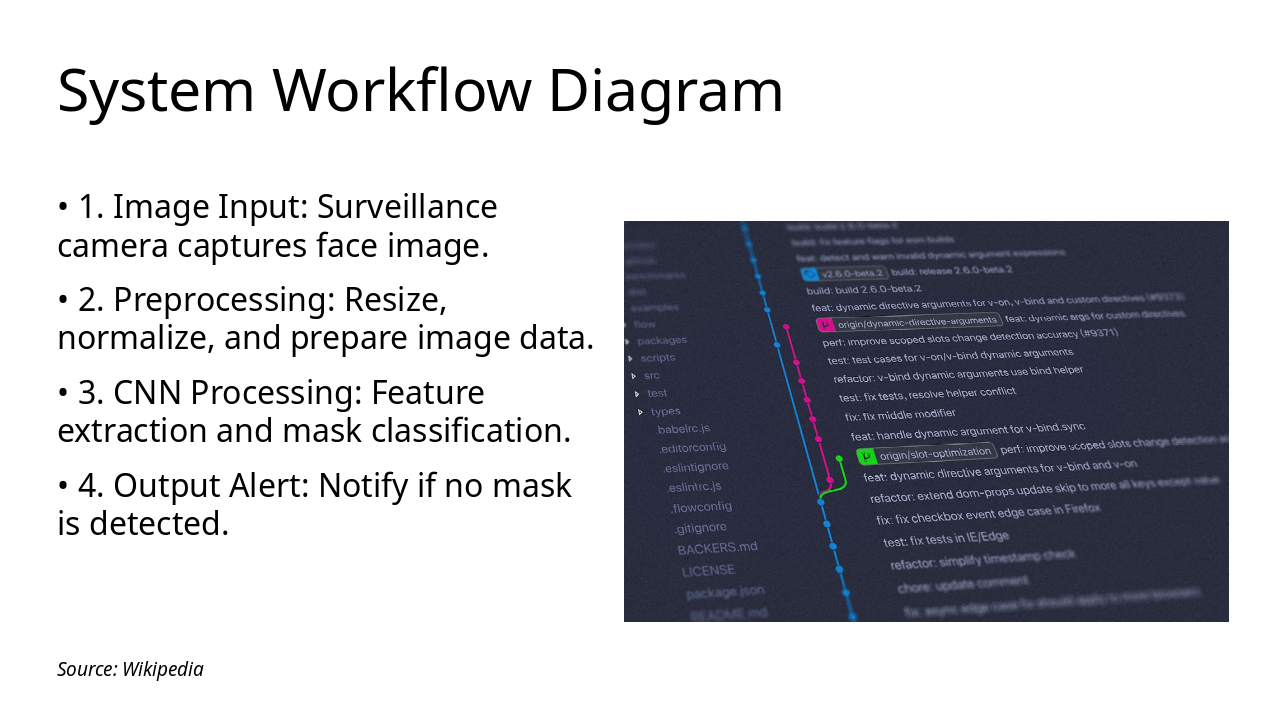
The slide depicts a system workflow diagram for mask detection using surveillance cameras. It outlines four steps: capturing a face image, preprocessing for resizing and normalization, CNN processing for feature extraction and mask classification, and alerting if no mask is detected.

System Workflow Diagram

!Image

  • 1. Image Input: Surveillance camera captures face image.
  • 2. Preprocessing: Resize, normalize, and prepare image data.
  • 3. CNN Processing: Feature extraction and mask classification.
  • 4. Output Alert: Notify if no mask is detected.

Source: Wikipedia

Speaker Notes
Flowchart depicting the end-to-end system workflow for face mask detection.
Slide 17 - System Workflow Diagram
Slide 18 of 21

Slide 18 - Limitations

The "Limitations" slide lists key challenges including susceptibility to lighting and angle variations, plus slow real-time speed on edge devices. It also covers bias from small dataset sizes and limited handling of occlusions and accessories.

Limitations

  • Susceptible to lighting and angle variations
  • Slow real-time speed on edge devices
  • Bias from small dataset size
  • Limited handling of occlusions and accessories

Source: Automated Face Mask Detection Using CNNs

Slide 18 - Limitations
Slide 19 of 21

Slide 19 - Future Improvements

Future improvements include adopting MobileNetV2 for enhanced efficiency. Plans also cover enabling app deployment on mobile/web platforms and expanding to larger, diverse datasets.

Future Improvements

  • Adopt MobileNetV2 for enhanced efficiency.
  • Enable app deployment on mobile/web platforms.
  • Expand to larger, diverse datasets.
Slide 19 - Future Improvements
Slide 20 of 21

Slide 20 - Conclusion

The conclusion slide highlights achieving 96% accuracy with a CNN detector that automates enforcement for public health safety. It closes by revolutionizing safety through AI and calls to deploy for enhanced community protection.

Conclusion

• Achieved 96% accuracy with CNN detector

  • Automates enforcement for public health safety

Closing: Revolutionizing safety through AI.

Call-to-Action: Deploy for enhanced community protection.

Source: Automated Face Mask Detection Using CNNs

Speaker Notes
Highlight key achievement of 96% accuracy, emphasize automation's role in public health safety, deliver closing message, and optional call-to-action.
Slide 20 - Conclusion
Slide 21 of 21

Slide 21 - References

The "References" slide lists key sources for a face mask detection project. It includes the Kaggle Face Mask Detection Dataset, papers by Loey et al. (2021) and Jiang & Fan (2020), plus tools TensorFlow, Keras, and OpenCV.

References

  • Kaggle Face Mask Detection Dataset
  • Loey et al. (2021)
  • Jiang & Fan (2020)
  • TensorFlow
  • Keras
  • OpenCV
Slide 21 - References

Discover More Presentations

Explore thousands of AI-generated presentations for inspiration

Browse Presentations
Powered by AI

Create Your Own Presentation

Generate professional presentations in seconds with Karaf's AI. Customize this presentation or start from scratch.

Create New Presentation

Powered by Karaf.ai — AI-Powered Presentation Generator