The Domestic Cat: Evolution to Companion

Generated from prompt:

Cats

This presentation explores the domestic cat's etymology, taxonomy, evolution from Near Eastern wildcats, domestication timeline, physical traits like retractable claws and night vision, behavior as so

November 28, 20259 slides
Slide 1 of 9

Slide 1 - The Domestic Cat

The slide is titled "The Domestic Cat" and serves as an introductory title slide. Its subtitle highlights an exploration of cats' fascinating world, covering topics from their domestication history to distinctive traits.

The Domestic Cat

Exploring the fascinating world of cats, from domestication to unique traits.
Slide 1 - The Domestic Cat
Slide 2 of 9

Slide 2 - Presentation Outline

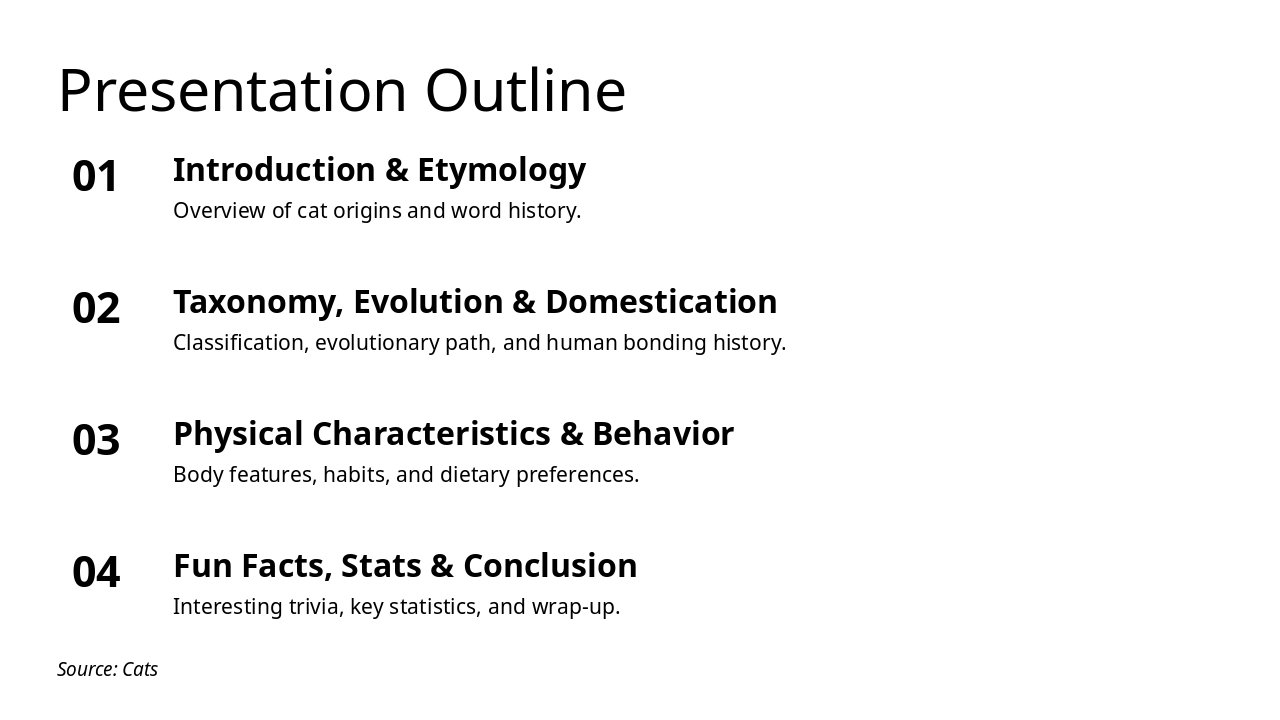
The agenda slide outlines a presentation on cats, starting with an introduction to their origins and the etymology of the word. It then covers taxonomy, evolution, and domestication; physical characteristics, behavior, and dietary preferences; before concluding with fun facts, statistics, and a wrap-up.

Presentation Outline

  1. Introduction & Etymology
  2. Overview of cat origins and word history.

  3. Taxonomy, Evolution & Domestication
  4. Classification, evolutionary path, and human bonding history.

  5. Physical Characteristics & Behavior
  6. Body features, habits, and dietary preferences.

  7. Fun Facts, Stats & Conclusion

Interesting trivia, key statistics, and wrap-up. Source: Cats

Slide 2 - Presentation Outline
Slide 3 of 9

Slide 3 - Etymology and Naming

This section header slide introduces the topic of "Etymology and Naming" for cats. It explains that the word "cat" originates from the Latin term "cattus" and is commonly known as the domestic cat or Felis catus.

Etymology and Naming

The word 'cat' derives from Latin 'cattus'; commonly called domestic cat or Felis catus.

Slide 3 - Etymology and Naming
Slide 4 of 9

Slide 4 - Taxonomy and Evolution

Domestic cats are the only domesticated species within the Felidae family, having evolved from Near Eastern wildcats. Genetic studies trace their origins back to around 7500 BC.

Taxonomy and Evolution

  • Only domesticated species in Felidae family
  • Evolved from Near Eastern wildcats
  • Genetic studies trace origins to 7500 BC
Slide 4 - Taxonomy and Evolution
Slide 5 of 9

Slide 5 - Domestication Timeline

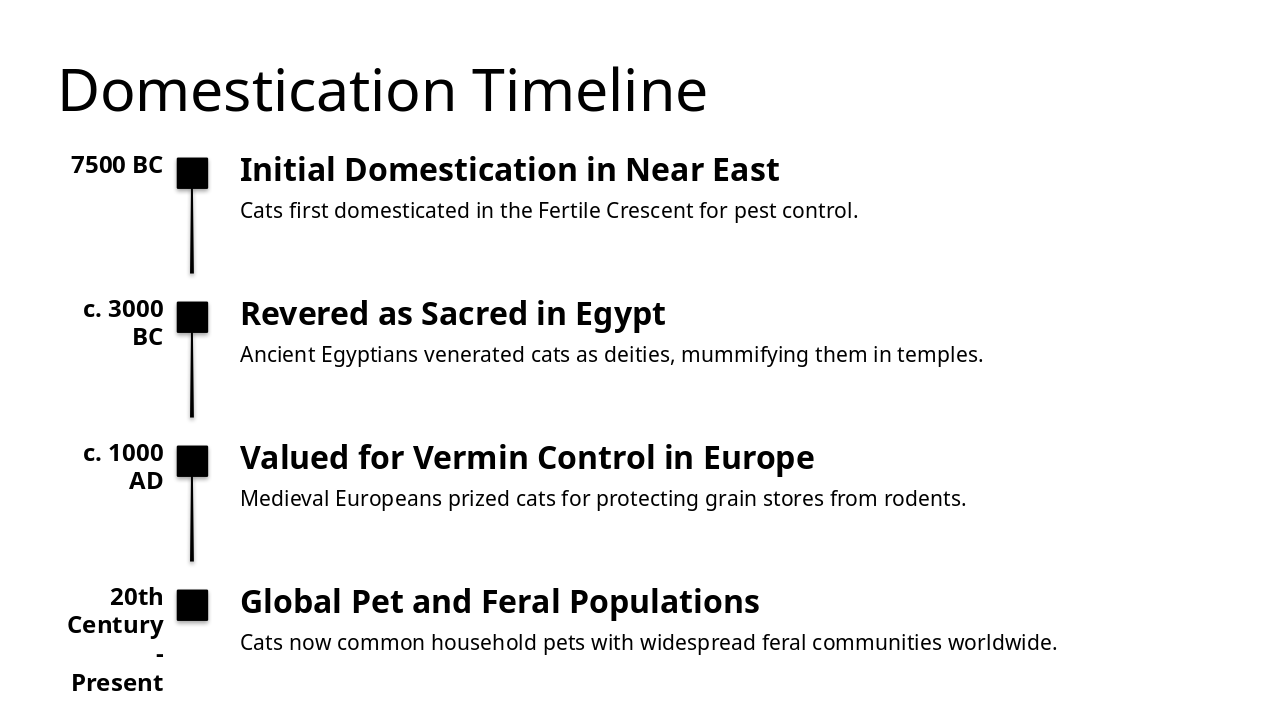
Cats were first domesticated around 7500 BC in the Near East's Fertile Crescent for pest control, later becoming sacred deities in ancient Egypt by 3000 BC, where they were mummified in temples. By 1000 AD, medieval Europeans valued them for protecting grain from rodents, evolving into global household pets with widespread feral populations from the 20th century to the present.

Domestication Timeline

7500 BC: Initial Domestication in Near East Cats first domesticated in the Fertile Crescent for pest control. c. 3000 BC: Revered as Sacred in Egypt Ancient Egyptians venerated cats as deities, mummifying them in temples. c. 1000 AD: Valued for Vermin Control in Europe Medieval Europeans prized cats for protecting grain stores from rodents. 20th Century - Present: Global Pet and Feral Populations Cats now common household pets with widespread feral communities worldwide.

Slide 5 - Domestication Timeline
Slide 6 of 9

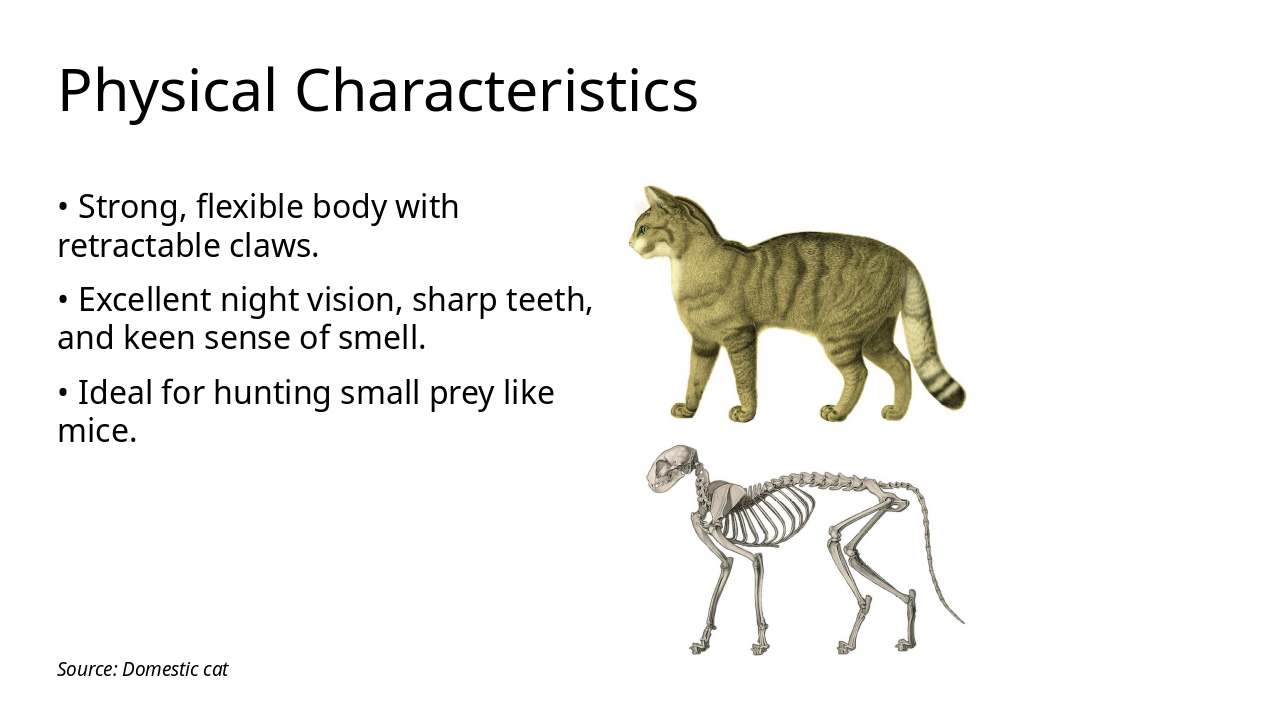
Slide 6 - Physical Characteristics

The slide titled "Physical Characteristics" describes an animal with a strong, flexible body equipped with retractable claws, making it agile and adaptable. It highlights excellent night vision, sharp teeth, and a keen sense of smell, ideal for hunting small prey like mice.

Physical Characteristics

!Image

  • Strong, flexible body with retractable claws.
  • Excellent night vision, sharp teeth, and keen sense of smell.
  • Ideal for hunting small prey like mice.

Source: Domestic cat

Speaker Notes
Strong, flexible body with retractable claws. Excellent night vision, sharp teeth, and keen sense of smell. Ideal for hunting small prey like mice.
Slide 6 - Physical Characteristics
Slide 7 of 9

Slide 7 - Behavior and Diet

These animals are obligate carnivores that thrive on meat-based diets and are solitary hunters active primarily at dawn and dusk. They exhibit social bonds with humans while remaining fiercely independent, and are prized as skilled vermin killers and loyal companions.

Behavior and Diet

  • Obligate carnivores requiring meat-based diets
  • Solitary hunters active at dawn and dusk
  • Social with humans yet fiercely independent
  • Skilled vermin killers valued as companions

Source: Cats

Slide 7 - Behavior and Diet
Slide 8 of 9

Slide 8 - Fun Facts and Stats

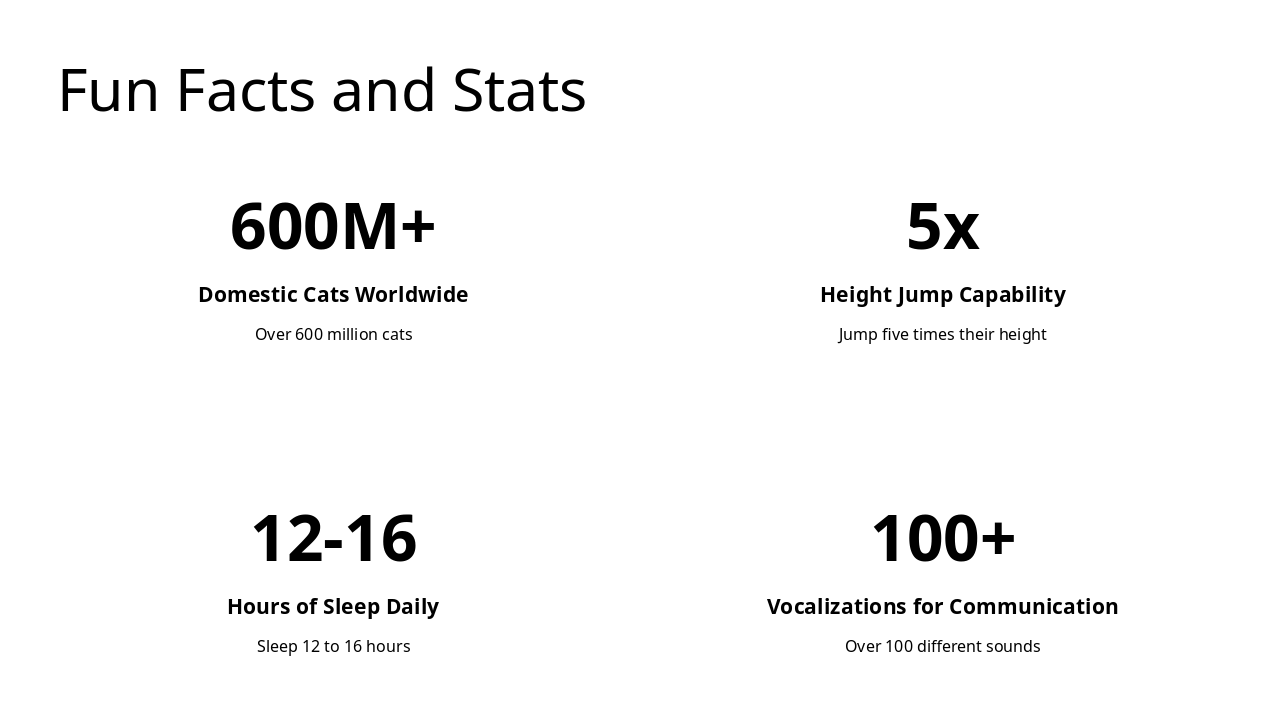
There are over 600 million domestic cats worldwide, capable of jumping five times their height while sleeping 12 to 16 hours daily. Cats also communicate using more than 100 different vocalizations.

Fun Facts and Stats

  • 600M+: Domestic Cats Worldwide
  • Over 600 million cats

  • 5x: Height Jump Capability
  • Jump five times their height

  • 12-16: Hours of Sleep Daily
  • Sleep 12 to 16 hours

  • 100+: Vocalizations for Communication
  • Over 100 different sounds

Slide 8 - Fun Facts and Stats
Slide 9 of 9

Slide 9 - Conclusion: Cats in Our World

The conclusion slide titled "Conclusion: Cats in Our World" highlights how cats have evolved from ancient companions to cherished modern pets, enriching human lives with their adaptability and charm. It ends with a thankful note and a cat emoji.

Conclusion: Cats in Our World

From ancient companions to modern pets, cats enrich our lives. Their adaptability and charm make them beloved. Thank you! 🐱

Source: Cats

Speaker Notes
Closing message: Cats enrich our lives forever. (5 words). Call-to-action: Share your cat stories with friends today. (6 words).
Slide 9 - Conclusion: Cats in Our World
Powered by AI

Create Your Own Presentation

Generate professional presentations in seconds with Karaf's AI. Customize this presentation or start from scratch.

Create New Presentation

Powered by Karaf.ai — AI-Powered Presentation Generator