Organizational Behavior Strategies for HII Executives

Generated from prompt:

Create a professional PowerPoint presentation for a college management course (MGMT311). Topic: Importance of Key Organizational Behavior Concepts for Executives at Huntington Ingalls Industries (HII). Slides: 1. Title Slide: Title, student name placeholder, course, date 2. Introduction: Purpose of assignment, overview of HII (defense contractor, shipbuilding, national security role) Section 1: Motivation and Engagement 3. Definition and key theories (Maslow, Herzberg, expectancy theory) 4. Importance for executives at HII (workforce productivity, safety, retention in defense sector) 5. Why Board of Directors must understand it (strategic workforce performance, mission success) Section 2: Managing Conflict and Negotiations 6. Definition and types of conflict 7. Application at HII (complex projects, unions, government contracts) 8. Importance for Board (risk management, contract success, organizational stability) Section 3: Communication Effectively with Others 9. Definition and communication channels 10. Relevance at HII (cross-functional teams, engineering, military stakeholders) 11. Board importance (alignment, compliance, transparency) Section 4: Organizational Strategy and Structure 12. Definition and types of structures (functional, matrix) 13. HII application (large-scale shipbuilding, coordination across divisions) 14. Importance for Board (long-term strategy, operational efficiency) 15. Summary Slide: Key takeaways 16. References Slide (APA style, include at least 4 credible sources related to OB and HII) Tone: Professional, academic, clear bullet points. Include speaker notes for each slide.

Analyzes key Organizational Behavior concepts—motivation theories, conflict management, communication channels, and organizational structure—and their strategic application to leadership at Huntington Ingalls Industries (HII), the largest US military

April 24, 202619 slides
Slide 1 of 19

Slide 1 - Title Slide

Organizational Behavior for Executives at Huntington Ingalls Industries

Student: [Name Placeholder] | Course: MGMT311 | Date: October 26, 2023
Slide 1 - Title Slide
Slide 2 of 19

Slide 2 - Introduction to HII and Assignment

  • Purpose: Analyze key Organizational Behavior (OB) concepts and their strategic application for leadership at HII.
  • Overview of HII: Largest military shipbuilding company in the US.
  • Critical role in national security: Designing, building, and maintaining nuclear-powered ships.
  • Operational scope: High-stakes environments requiring precise coordination and workforce excellence.
Slide 2 - Introduction to HII and Assignment
Slide 3 of 19

Slide 3 - Section 1: Motivation

1

Motivation and Engagement

Unlocking Workforce Potential in Defense Shipbuilding

Slide 3 - Section 1: Motivation
Slide 4 of 19

Slide 4 - Motivation: Key Theories

  • Maslow’s Hierarchy: Meeting physiological/safety needs to reach self-actualization.
  • Herzberg’s Two-Factor: Distinguishing between hygiene factors (pay, policy) and motivators (recognition, growth).
  • Expectancy Theory (Vroom): Employees perform if they believe effort leads to performance, performance to reward, and rewards are valued.
Slide 4 - Motivation: Key Theories
Slide 5 of 19

Slide 5 - Importance for HII Executives

  • Productivity: Linking technical tasks to national security mission.
  • Safety Culture: High-hazard shipbuilding environments require highly motivated, vigilant teams.
  • Retention: Competitive labor market in engineering/trades requires deep engagement and intrinsic motivation.
Slide 5 - Importance for HII Executives
Slide 6 of 19

Slide 6 - Board Perspective on Motivation

  • Mission Success: Linking workforce engagement to long-term operational health.
  • Risk Mitigation: An engaged, motivated workforce is more likely to follow safety protocols and quality standards.
  • Strategic Performance: Ensuring the human capital strategy supports multi-decade government contract fulfillment.
Slide 6 - Board Perspective on Motivation
Slide 7 of 19

Slide 7 - Section 2: Conflict Management

2

Managing Conflict and Negotiations

Navigating High-Stakes Environments

Slide 7 - Section 2: Conflict Management
Slide 8 of 19

Slide 8 - Conflict Definition and Strategies

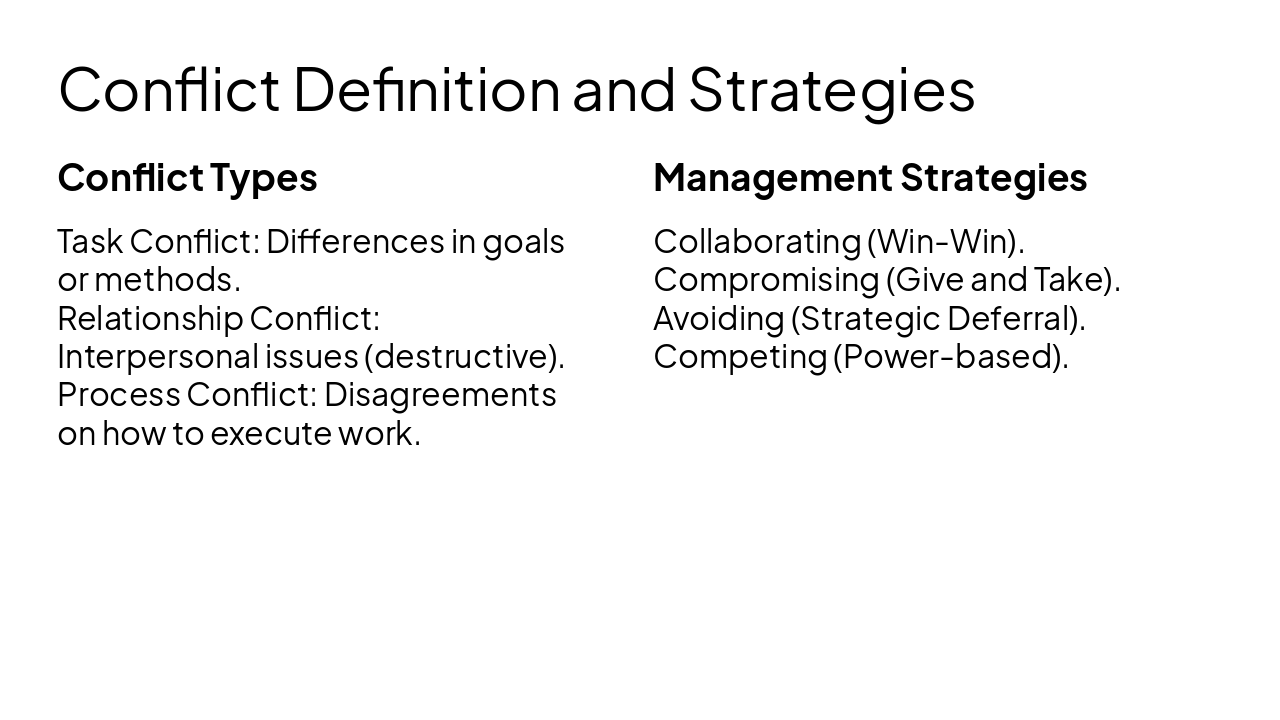
Conflict Types Task Conflict: Differences in goals or methods. Relationship Conflict: Interpersonal issues (destructive). Process Conflict: Disagreements on how to execute work.

Management Strategies Collaborating (Win-Win). Compromising (Give and Take). Avoiding (Strategic Deferral). Competing (Power-based).
Slide 8 - Conflict Definition and Strategies
Slide 9 of 19

Slide 9 - Conflict Application at HII

  • Project Coordination: Aligning multidisciplinary engineering and manufacturing teams.
  • Labor Relations: Navigating complex negotiations with unions in a heavy industrial setting.
  • External Contracting: Negotiating with government agencies and supply chain partners.
Slide 9 - Conflict Application at HII
Slide 10 of 19

Slide 10 - Board Role in Conflict Management

  • Contract Stability: Preventing cost overruns and delays caused by unmanaged disputes.
  • Risk Management: Identifying potential litigation or reputational threats early.
  • Organizational Stability: Fostering trust between management and labor stakeholders.
Slide 10 - Board Role in Conflict Management
Slide 11 of 19

Slide 11 - Section 3: Communication

3

Effective Communication

Bridging Organizational Silos

Slide 11 - Section 3: Communication
Slide 12 of 19

Slide 12 - Communication Channels and Barriers

  • Communication Definition: Exchange of info to ensure shared understanding.
  • Key Channels: Formal reports, direct management interaction, digital collaborative platforms, informal networks.
  • Barriers: Hierarchical distance, technical jargon, siloed departments, geographic dispersion.
Slide 12 - Communication Channels and Barriers
Slide 13 of 19

Slide 13 - Communication Relevance at HII

  • Cross-Functional Alignment: Connecting designers, engineers, tradespeople, and back-office.
  • Military Stakeholder Needs: Translating complex technical data into clear, actionable briefs for the US Navy/DOD.
  • Safety Information: Rapid, accurate communication is vital to maintain industrial safety standards.
Slide 13 - Communication Relevance at HII
Slide 14 of 19

Slide 14 - Board Importance for Communication

  • Corporate Compliance: Transparent, ethical internal reporting.
  • Strategic Alignment: Ensuring division goals remain consistent with company-wide objectives.
  • External Transparency: Maintaining shareholder confidence through clear reporting on project status.
Slide 14 - Board Importance for Communication
Slide 15 of 19

Slide 15 - Section 4: Strategy and Structure

4

Organizational Strategy and Structure

Designing for Operational Excellence

Slide 15 - Section 4: Strategy and Structure
Slide 16 of 19

Slide 16 - Organizational Structure Definitions

Structures Overview Functional Structure: Organized by specialization (engineering, finance, marketing). Matrix Structure: Employees report to both function and project managers. Improves coordination for large projects.

Strategic Alignment Strategy must drive structure, not vice versa. Structure dictates flow of information, accountability, and decision-making speed.
Slide 16 - Organizational Structure Definitions
Slide 17 of 19

Slide 17 - HII Application of Structure

  • Shipbuilding Complexity: Matrix structures facilitate resource sharing across multiple massive defense projects.

Coordination: Balancing functional expertise (naval architecture) with project deadlines. Integration: Ensuring global shipyard operations remain synchronized.
Slide 17 - HII Application of Structure
Slide 18 of 19

Slide 18 - Board Importance for Structure

  • Long-term Strategy: Aligning organizational capabilities with evolving national security needs.

Operational Efficiency: Streamlining structure to reduce costs and improve project turnaround. Governance: Ensuring the structure supports accountability and performance.
Slide 18 - Board Importance for Structure
Slide 19 of 19

Slide 19 - Summary of Key Takeaways

  • Motivation/Engagement: Crucial for productivity and safety in defense.
  • Conflict Management: Necessary for project continuity and stakeholder success.
  • Communication: The foundation of alignment and compliance.
  • Strategy/Structure: The framework that enables high-level mission success.
Slide 19 - Summary of Key Takeaways

Discover More Presentations

Explore thousands of AI-generated presentations for inspiration

Browse Presentations
Powered by AI

Create Your Own Presentation

Generate professional presentations in seconds with Karaf's AI. Customize this presentation or start from scratch.

Create New Presentation

Powered by Karaf.ai — AI-Powered Presentation Generator