Unsupervised Discriminative Feature Alignment for Domain Adaptation in WiFi-Based HAR

Generated from prompt:

Create a professional 5-slide presentation summarizing the uploaded paper “Unsupervised Discriminative Feature Alignment for Domain Adaptation in WiFi-Based Human Activity Recognition” by Amany Elkelany, Robert Ross, and Susan McKeever. Use a clean academic IEEE-style theme with blue/white colors, concise bullets, and clear visuals. Exactly 5 slides. Slide 1 — Title & Motivation Title: Unsupervised Discriminative Feature Alignment for Domain Adaptation in WiFi-Based HAR Subtitle: FA-DANN for robust cross-environment activity recognition using WiFi CSI signals Key points: WiFi-based HAR is privacy-preserving, device-free, and cost-effective; but models trained in one environment often fail in another because CSI patterns change with room layout, obstacles, furniture, subjects, and hardware. Visual: WiFi sensing in two different rooms showing domain shift. Slide 2 — Problem & Research Gap Main message: Cross-domain WiFi HAR is difficult without labeled target data. Bullets: Same-domain HAR performs well, but cross-domain performance drops sharply; target labels are expensive and time-consuming; DANN-style methods align domains globally but can lose class-discriminative activity structure; Gaussian feature alignment can oversimplify complex non-Gaussian CSI distributions. Visual: source-domain and target-domain feature distributions before adaptation. Slide 3 — Proposed Method: FA-DANN Main message: FA-DANN combines feature alignment with adversarial domain adaptation. Include: CNN-ABiLSTM activity classifier; shared encoder-decoder autoencoder; domain classifier with gradient reversal layer; unpaired L1 loss aligns reconstructed source and target features; trained with labeled source data and unlabeled target data only. Visual: architecture flow: source/target CSI → encoder → decoder → activity classifier + domain classifier/GRL. Slide 4 — Experiments & Key Results Main message: FA-DANN substantially improves cross-environment HAR. Include datasets: GJWiFi, OPERAnet, SHARP-2. Include preprocessing: CSI amplitude extraction, Hampel denoising, Z-score normalization, 1-second windows. Include key findings: no adaptation average F1-score = 14.34%; FA-DANN average F1-score = 85.57%; average improvement over state-of-the-art = 19.98%. Mention 5-fold cross-validation and cross-domain evaluation. Visual: bar chart comparing No DA vs FA-DANN, plus dataset labels. Slide 5 — Takeaways & Deployment Value Main message: FA-DANN enables scalable WiFi HAR in unseen environments without labeled target data. Bullets: preserves discriminative activity semantics; avoids Gaussian prior assumptions; robust under large domain shifts and noisy CSI; computationally practical for edge inference, around 4.27M–6.37M FLOPs per forward pass; ablation studies confirm the importance of both decoder and domain classifier. Future work: broader deployments, more users/devices, and model compression. Visual: deployment pipeline from WiFi access point to edge device to activity label. Make slides polished and presentation-ready, with speaker-friendly wording and minimal dense text.

This presentation introduces FA-DANN, an unsupervised discriminative feature alignment method for robust domain adaptation in WiFi-based Human Activity Recognition (HAR). It addresses the challenge of poor cross-environment performance by combining feature alignment with adversarial domain adaptation, demonstrating significant improvements in activity recognition across diverse environments and noisy signals. The method is computationally efficient for edge deployment, making scalable WiFi HAR feasible.

May 20, 20265 slides
Slide 1 of 5

Slide 1 - Unsupervised Discriminative Feature Alignment for Domain Adaptation in WiFi-Based HAR

Unsupervised Discriminative Feature Alignment for Domain Adaptation in WiFi-Based HAR

FA-DANN for robust cross-environment activity recognition using WiFi CSI signals

---

Photo by Kabiur Rahman Riyad on Unsplash
Slide 1 - Unsupervised Discriminative Feature Alignment for Domain Adaptation in WiFi-Based HAR
Slide 2 of 5

Slide 2 - Problem & Research Gap: Cross-Domain WiFi HAR Challenges

  • Same-domain HAR performs well, but cross-domain performance drops sharply.
  • Target labels are expensive and time-consuming.
  • DANN-style methods align domains globally but can lose class-discriminative activity structure.
  • Gaussian feature alignment can oversimplify complex non-Gaussian CSI distributions.

---

Photo by Jens Lelie on Unsplash

Slide 2 - Problem & Research Gap: Cross-Domain WiFi HAR Challenges
Slide 3 of 5

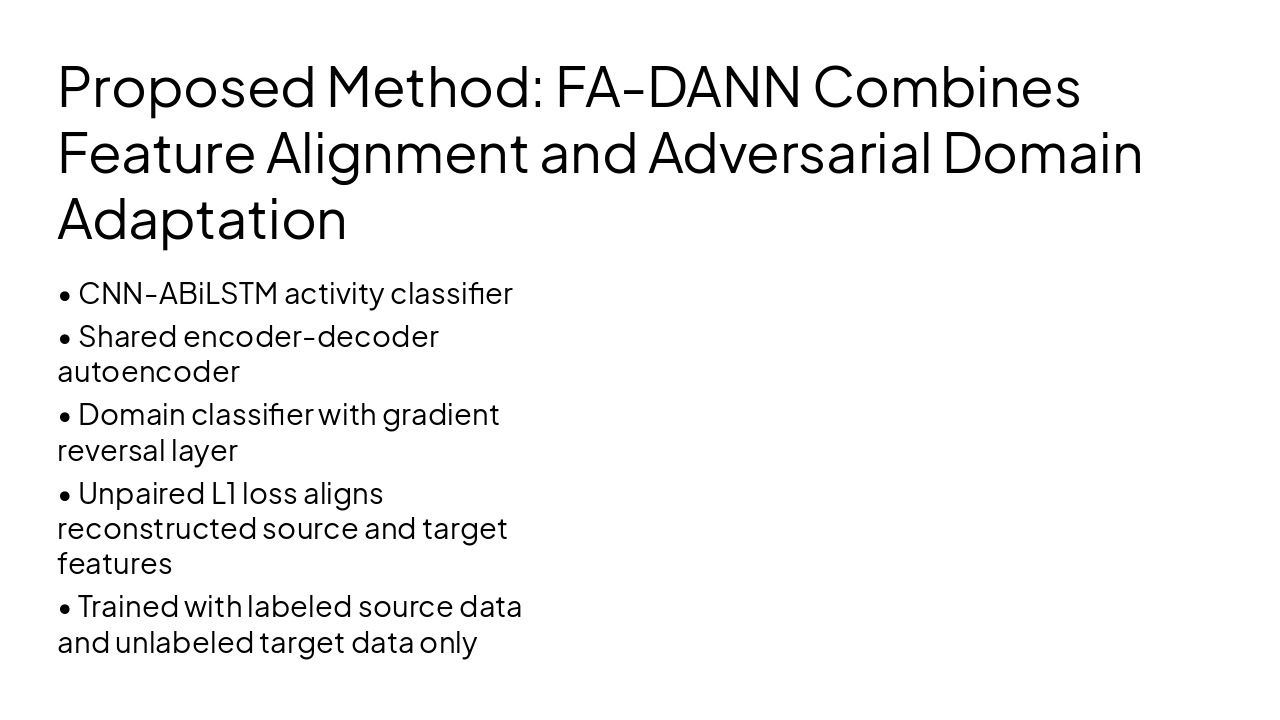
Slide 3 - Proposed Method: FA-DANN Combines Feature Alignment and Adversarial Domain Adaptation

  • CNN-ABiLSTM activity classifier
  • Shared encoder-decoder autoencoder
  • Domain classifier with gradient reversal layer
  • Unpaired L1 loss aligns reconstructed source and target features
  • Trained with labeled source data and unlabeled target data only
Slide 3 - Proposed Method: FA-DANN Combines Feature Alignment and Adversarial Domain Adaptation
Slide 4 of 5

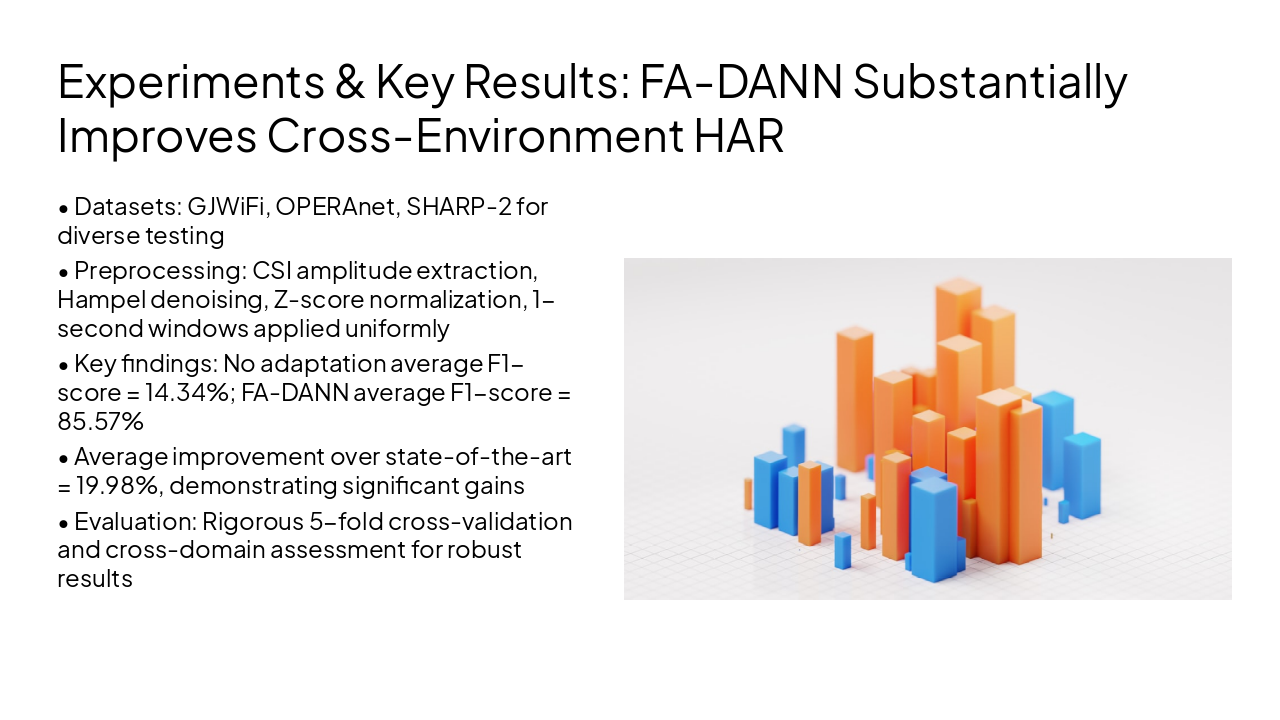
Slide 4 - Experiments & Key Results: FA-DANN Substantially Improves Cross-Environment HAR

  • Datasets: GJWiFi, OPERAnet, SHARP-2 for diverse testing
  • Preprocessing: CSI amplitude extraction, Hampel denoising, Z-score normalization, 1-second windows applied uniformly
  • Key findings: No adaptation average F1-score = 14.34%; FA-DANN average F1-score = 85.57%
  • Average improvement over state-of-the-art = 19.98%, demonstrating significant gains
  • Evaluation: Rigorous 5-fold cross-validation and cross-domain assessment for robust results

---

Photo by Nick Brunner on Unsplash

Slide 4 - Experiments & Key Results: FA-DANN Substantially Improves Cross-Environment HAR
Slide 5 of 5

Slide 5 - Key Takeaways & Deployment Value: Scalable WiFi HAR

  • FA-DANN preserves discriminative activity semantics, crucial for accurate HAR.
  • Avoids oversimplifying Gaussian prior assumptions, handling complex CSI distributions.
  • Demonstrates robustness under large domain shifts and noisy CSI signals.
  • Computationally practical for edge inference, requiring only 4.27M–6.37M FLOPs per forward pass.
  • Ablation studies confirm the critical importance of both the decoder and domain classifier components.
  • Future work includes broader deployments, supporting more users/devices, and model compression for efficiency.
Slide 5 - Key Takeaways & Deployment Value: Scalable WiFi HAR

Discover More Presentations

Explore thousands of AI-generated presentations for inspiration

Browse Presentations
Powered by AI

Create Your Own Presentation

Generate professional presentations in seconds with Karaf's AI. Customize this presentation or start from scratch.

Create New Presentation

Powered by Karaf.ai — AI-Powered Presentation Generator