Thesis Defense Presentation

Generated from prompt:

Can you generate a PPT for my thesis defense based in the attached file

This presentation outlines the complete structure of a typical thesis defense, covering the introduction, literature review, methodology, key results, discussion of findings, and directions for future work. It guides through the essential components for presenting academic research effectively.

May 22, 202619 slides
Slide 1 of 19

Slide 1 - Thesis Defense

Thesis Defense

[Your Name] | [Your Department/University] | [Date]

---

Photo by Sebastien Devocelle on Unsplash
Slide 1 - Thesis Defense
Slide 2 of 19

Slide 2

  • Introduction
  • Literature Review
  • Methodology
  • Results
  • Discussion
  • Conclusion
  • Future Work
  • Q&A

---

Photo by Jack B on Unsplash

Slide 2
Slide 4 of 19

Slide 4 - Research Overview

  • Problem Statement: Clearly defining the research problem and its significance
  • Research Questions: Outlining the specific questions the thesis aims to answer
  • Thesis Objectives: Stating the goals and aims of the research project
Slide 4 - Research Overview
Slide 5 of 19

Slide 5

2

Literature Review

Building on Existing Knowledge

---

Photo by Milad Fakurian on Unsplash
Slide 5
Slide 6 of 19

Slide 6 - Key Findings from Literature

  • Major Theories & Models: Summarizing foundational concepts and frameworks
  • Identified Gaps: Highlighting areas where existing research is insufficient or contradictory
  • Contributions of this Thesis: Positioning the research within the broader academic discourse
Slide 6 - Key Findings from Literature
Slide 7 of 19

Slide 7

3

Methodology

How the Research was Conducted

---

Photo by Trnava University on Unsplash
Slide 7
Slide 8 of 19

Slide 8 - Research Design

  • Approach: Describing the overall research strategy (e.g., quantitative, qualitative, mixed-methods)
  • Participants/Data Sources: Specifying the subjects or data sets used in the study
  • Data Collection Methods: Detailing the techniques for gathering information (e.g., surveys, experiments, interviews)
Slide 8 - Research Design
Slide 9 of 19

Slide 9 - Data Collection & Analysis

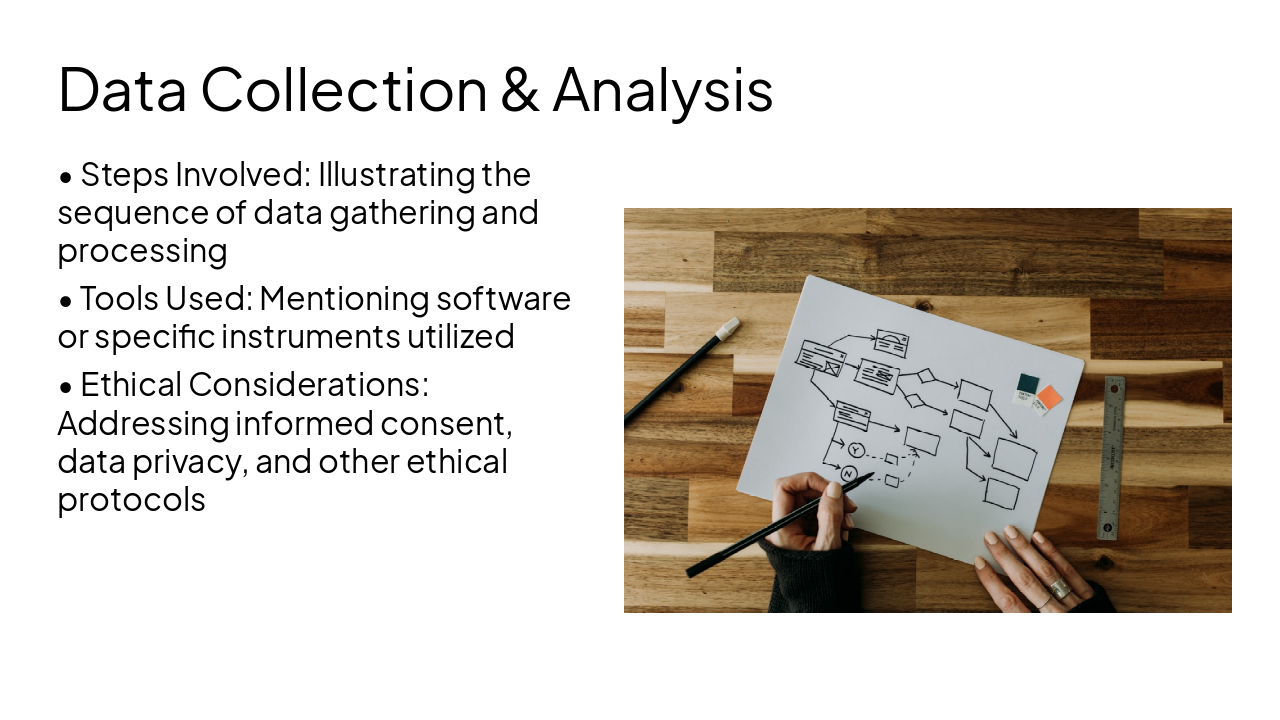
  • Steps Involved: Illustrating the sequence of data gathering and processing
  • Tools Used: Mentioning software or specific instruments utilized
  • Ethical Considerations: Addressing informed consent, data privacy, and other ethical protocols

---

Photo by Kelly Sikkema on Unsplash
Slide 9 - Data Collection & Analysis
Slide 10 of 19

Slide 10

4

Results

Presenting the Findings

---

Photo by Deng Xiang on Unsplash
Slide 10
Slide 11 of 19

Slide 11 - Major Findings

  • Key Outcomes: Summarizing the most significant discoveries or patterns
  • Statistical Significance: Presenting relevant statistical tests and p-values where applicable
  • Trends Observed: Discussing any notable tendencies or correlations within the data
Slide 11 - Major Findings
Slide 12 of 19

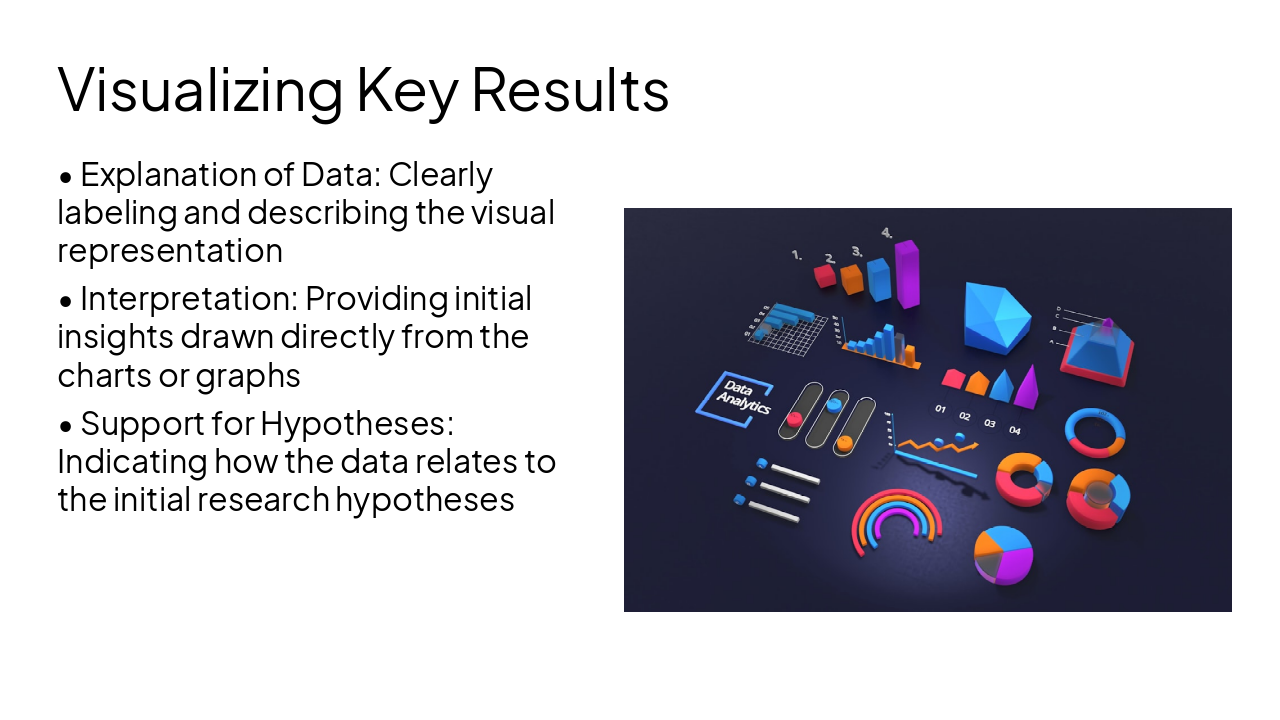
Slide 12 - Visualizing Key Results

  • Explanation of Data: Clearly labeling and describing the visual representation
  • Interpretation: Providing initial insights drawn directly from the charts or graphs
  • Support for Hypotheses: Indicating how the data relates to the initial research hypotheses

---

Photo by Deng Xiang on Unsplash

Slide 12 - Visualizing Key Results
Slide 13 of 19

Slide 13

5

Discussion

Interpreting the Implications

---

Photo by Austin Distel on Unsplash

Slide 13
Slide 14 of 19

Slide 14 - Interpretation & Limitations

Interpretation Meaning of Results: Explaining what the findings signify in context. Comparison with Literature: Discussing how results align with or diverge from previous studies. Theoretical & Practical Implications: Highlighting broader impacts on theory and application.

Limitations Study Constraints: Acknowledging factors that restricted the research scope or methodology. Potential Biases: Identifying any sources of error or systematic distortion. Areas for Improvement: Suggesting how future research could overcome these limitations.
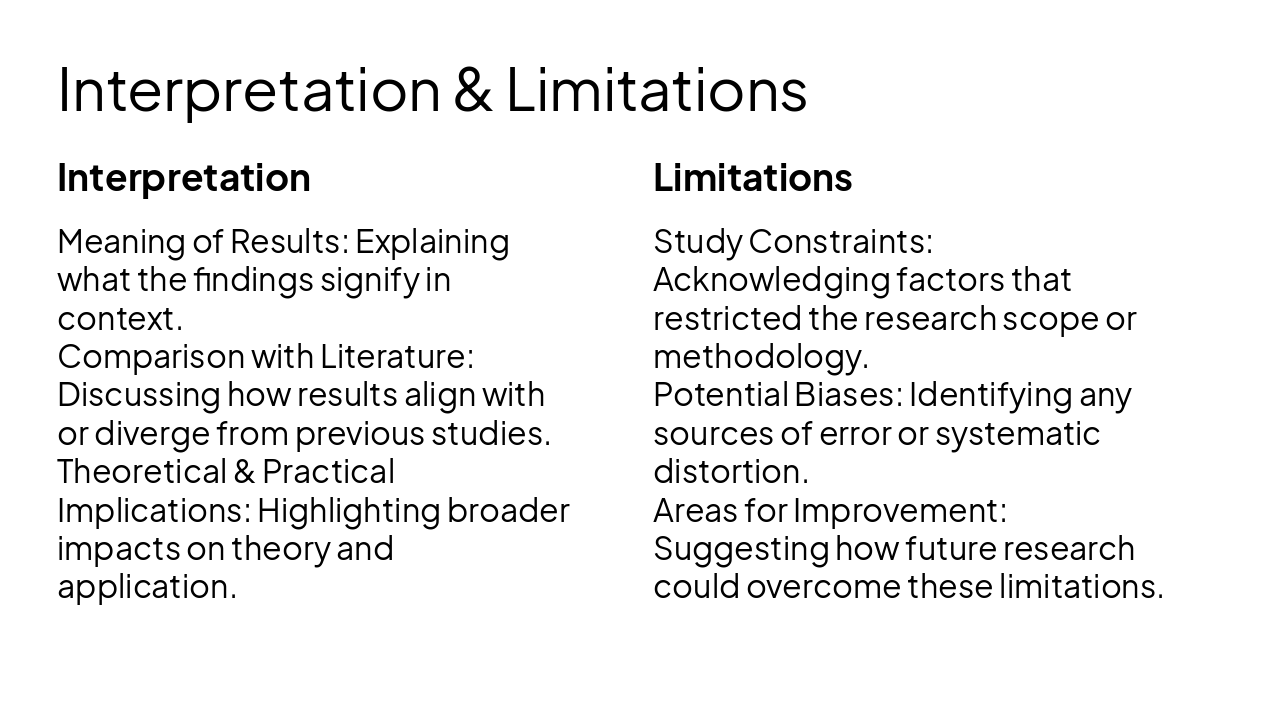
Slide 14 - Interpretation & Limitations
Slide 15 of 19

Slide 15

6

Conclusion & Future Work

Summarizing and Looking Ahead

---

Photo by Karsten Würth on Unsplash

Slide 15
Slide 16 of 19

Slide 16

The research successfully addressed the stated objectives and provided significant insights into [Thesis Topic].

Key takeaways from the study.

---

Photo by César Couto on Unsplash
Slide 16
Slide 17 of 19

Slide 17 - Future Research Directions

  • Unanswered Questions: Identifying new questions that emerged from the research
  • New Avenues of Inquiry: Proposing related topics or methodologies for future studies
  • Potential Extensions: Suggesting how the current work could be expanded or built upon
Slide 17 - Future Research Directions
Slide 18 of 19

Slide 18

> The important thing is not to stop questioning. Curiosity has its own reason for existence.

— Albert Einstein

---

Photo by Greg Rakozy on Unsplash
Slide 18
Slide 19 of 19

Slide 19

Thank you for your attention!

Questions?

---

Photo by AMONWAT DUMKRUT on Unsplash

Slide 19

Discover More Presentations

Explore thousands of AI-generated presentations for inspiration

Browse Presentations
Powered by AI

Create Your Own Presentation

Generate professional presentations in seconds with Karaf's AI. Customize this presentation or start from scratch.

Create New Presentation

Powered by Karaf.ai — AI-Powered Presentation Generator