Chola Art: South India's Golden Age

Generated from prompt:

Create an 8-slide PowerPoint presentation on 'Chola Art' for a college audience. The presentation should summarize key aspects of Chola Art including architecture, sculpture, bronze casting, paintings, and cultural legacy. Use a traditional heritage theme with warm gold, bronze, and temple motifs. Slides should include: 1. Title Slide: Chola Art – The Golden Age of South Indian Culture 2. Introduction to the Chola Dynasty and Historical Background 3. Patronage of Art and Architecture 4. Temple Architecture – Features and Famous Examples (e.g., Brihadeeswarar Temple) 5. Sculpture and Bronze Casting – The Lost Wax Technique 6. Iconography and Paintings – Themes and Symbolism 7. Cultural Significance and Legacy (UNESCO Recognition) 8. Conclusion and References

8-slide PPT on Chola Art for college audience, covering dynasty history, temple architecture (e.g., Brihadeeswarar), bronze casting via lost wax, iconography, paintings, and UNESCO-recognized legacy.

December 20, 20258 slides
Slide 1 of 8

Slide 1 - Chola Art – The Golden Age of South Indian Culture

The slide titled "Chola Art – The Golden Age of South Indian Culture" highlights the peak era of South Indian cultural achievement. Its subtitle, "A Legacy of South Indian Excellence," underscores the enduring impact of this artistic heritage.

Chola Art – The Golden Age of South Indian Culture

A Legacy of South Indian Excellence

Source: Title slide for Chola Art presentation

Speaker Notes
Introduce the topic to college audience, highlighting the golden age of South Indian culture with traditional heritage theme.
Slide 1 - Chola Art – The Golden Age of South Indian Culture
Slide 2 of 8

Slide 2 - Introduction to the Chola Dynasty

The Chola Dynasty ruled South India from the 9th to 13th century, peaking under Rajaraja I and Rajendra I. It excelled in Tamil culture, imperialism, maritime trade, and military conquests.

Introduction to the Chola Dynasty

  • Ruled South India (9th-13th century) under Rajaraja I & Rajendra I
  • Reached peak of Tamil culture and imperialism
  • Renowned for maritime trade networks
  • Celebrated for military prowess and conquests

Source: Chola Art Presentation

Speaker Notes
Provide historical context for Chola Art's golden era, highlighting rulers, cultural peak, and achievements.
Slide 2 - Introduction to the Chola Dynasty
Slide 3 of 8

Slide 3 - Patronage of Art and Architecture

Kings acted as divine patrons, funding grand temples and integrating Shaivism and Vaishnavism into art forms. This royal patronage symbolized power, devotion, and prosperity while driving artistic innovation and excellence through endowments.

Patronage of Art and Architecture

  • Kings as divine patrons funded grand temples
  • Integrated Shaivism and Vaishnavism in art forms
  • Art symbolized power, devotion, and prosperity
  • Royal endowments drove artistic innovation and excellence

Source: Chola Art Presentation

Slide 3 - Patronage of Art and Architecture
Slide 4 of 8

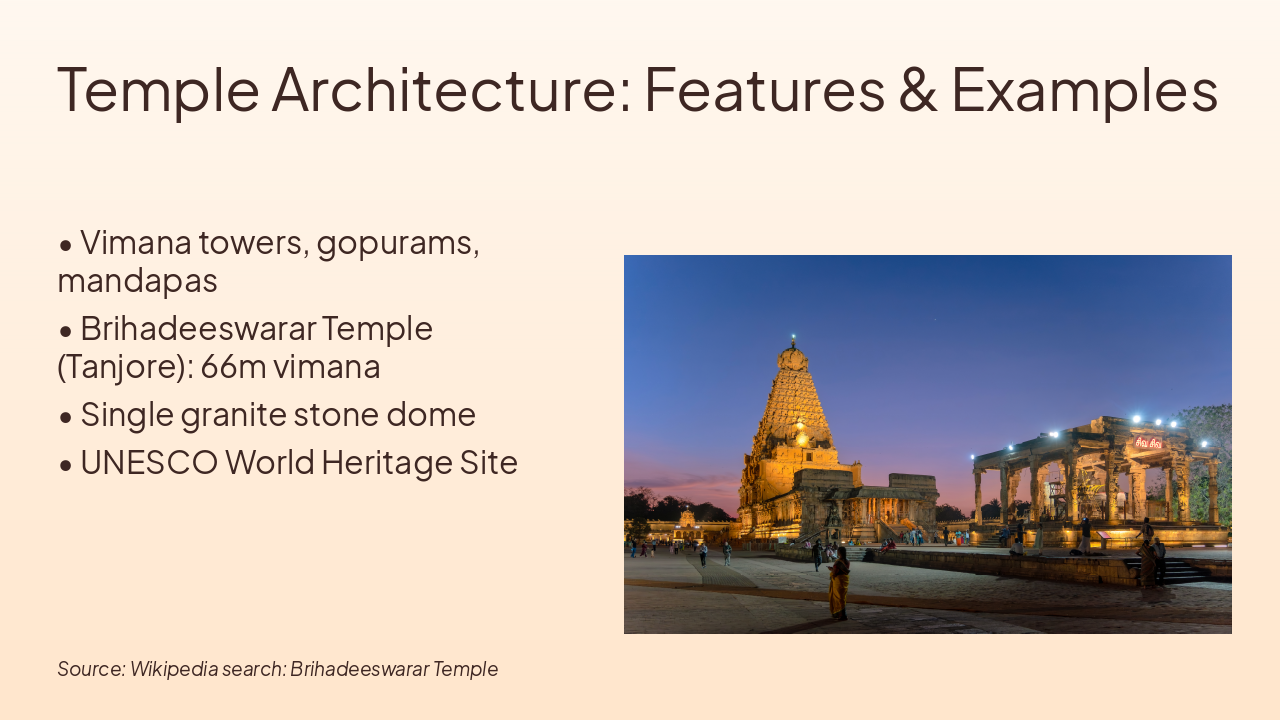
Slide 4 - Temple Architecture: Features & Examples

Temple Architecture features Vimana towers, gopurams, and mandapas, as highlighted on the slide. The Brihadeeswarar Temple in Tanjore exemplifies this with its 66m vimana, single granite stone dome, and UNESCO World Heritage status.

Temple Architecture: Features & Examples

!Image

  • Vimana towers, gopurams, mandapas
  • Brihadeeswarar Temple (Tanjore): 66m vimana
  • Single granite stone dome
  • UNESCO World Heritage Site

Source: Wikipedia search: Brihadeeswarar Temple

Speaker Notes
Highlight iconic Chola temple elements: towering vimanas, ornate gopurams, pillared mandapas. Focus on Brihadeeswarar Temple's engineering marvel - 66m vimana capped by single granite dome. UNESCO World Heritage Site built by Raja Raja Chola I.
Slide 4 - Temple Architecture: Features & Examples
Slide 5 of 8

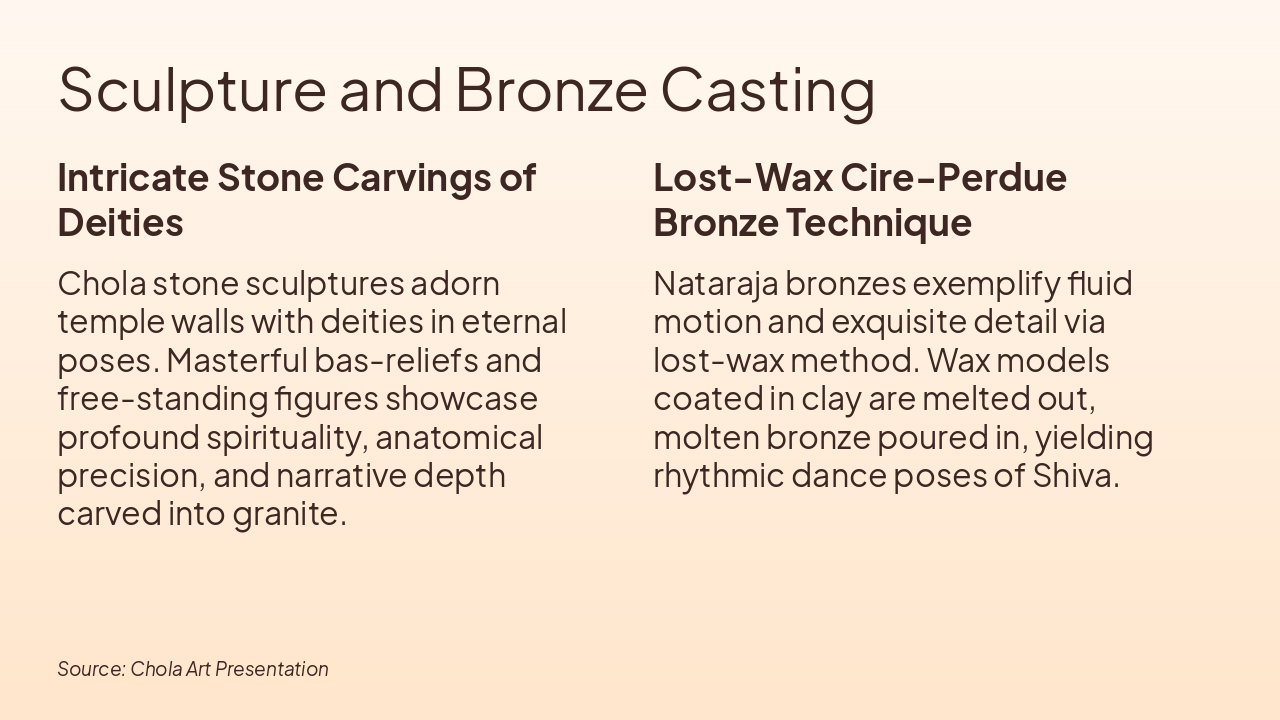
Slide 5 - Sculpture and Bronze Casting

The slide highlights Chola stone sculptures, featuring intricate carvings of deities on temple walls with profound spirituality, anatomical precision, and narrative depth in granite bas-reliefs and free-standing figures. It also details the lost-wax cire-perdue bronze technique, as seen in Nataraja bronzes depicting Shiva's rhythmic dance poses through wax models melted out and replaced with molten bronze.

Sculpture and Bronze Casting

Intricate Stone Carvings of DeitiesLost-Wax Cire-Perdue Bronze Technique
Chola stone sculptures adorn temple walls with deities in eternal poses. Masterful bas-reliefs and free-standing figures showcase profound spirituality, anatomical precision, and narrative depth carved into granite.Nataraja bronzes exemplify fluid motion and exquisite detail via lost-wax method. Wax models coated in clay are melted out, molten bronze poured in, yielding rhythmic dance poses of Shiva.

Source: Chola Art Presentation

Speaker Notes
Highlight the contrast between enduring stone sculptures and dynamic bronze figures. Emphasize the lost-wax technique's role in capturing fluid motion and exquisite details in Nataraja bronzes.
Slide 5 - Sculpture and Bronze Casting
Slide 6 of 8

Slide 6 - Iconography and Paintings

Shiva and Vishnu myths dominate the iconographic themes, with Nataraja's cosmic dance symbolizing creation and destruction through fire, drum, and serpent. Temple murals vividly depict Ramayana and Mahabharata epics.

Iconography and Paintings

  • Shiva and Vishnu myths dominate iconographic themes
  • Cosmic dance of Nataraja symbolizes creation and destruction
  • Fire, drum, and serpent embody profound symbolism
  • Temple murals vividly depict Ramayana and Mahabharata epics

Source: Chola Art Presentation

Slide 6 - Iconography and Paintings
Slide 7 of 8

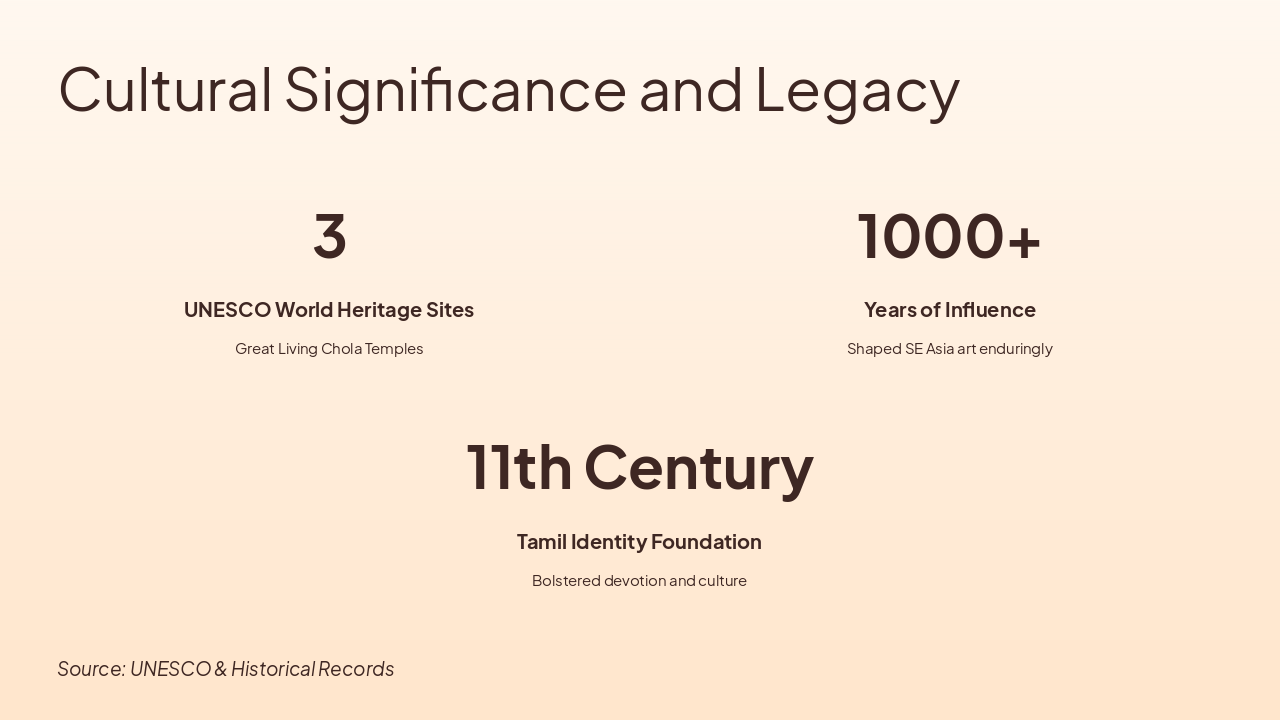
Slide 7 - Cultural Significance and Legacy

The slide highlights the Chola legacy with 3 UNESCO World Heritage Sites for the Great Living Chola Temples. It notes over 1000 years of influence on SE Asia art and an 11th-century foundation of Tamil identity through devotion and culture.

Cultural Significance and Legacy

  • 3: UNESCO World Heritage Sites
  • Great Living Chola Temples

  • 1000+: Years of Influence
  • Shaped SE Asia art enduringly

  • 11th Century: Tamil Identity Foundation

Bolstered devotion and culture Source: UNESCO & Historical Records

Slide 7 - Cultural Significance and Legacy
Slide 8 of 8

Slide 8 - Conclusion and References

The slide concludes by hailing Chola Art as the pinnacle of Dravidian genius, with a subtitle emphasizing its timeless legacy of mastery. It suggests further exploration via ASI Reports, UNESCO Documents, and Tamil Literature, ending with "Thank You!" and a Q&A invitation.

Conclusion and References

**Chola Art: Pinnacle of Dravidian Genius

Explore further:

  • ASI Reports
  • UNESCO Documents
  • Tamil Literature

Thank You!

Q&A**

Discover the timeless legacy of Chola mastery

Source: Chola Art: Pinnacle of Dravidian genius | Explore: ASI reports, UNESCO docs, Tamil literature | Thank you! Q&A

Speaker Notes
Summarize key points, share references, invite questions.
Slide 8 - Conclusion and References

Discover More Presentations

Explore thousands of AI-generated presentations for inspiration

Browse Presentations
Powered by AI

Create Your Own Presentation

Generate professional presentations in seconds with Karaf's AI. Customize this presentation or start from scratch.

Create New Presentation

Powered by Karaf.ai — AI-Powered Presentation Generator