Slide 1 - Introduction to Ecology
This title slide introduces the topic of ecology, serving as an opening for the presentation. Its subtitle emphasizes understanding our natural world.
Introduction to Ecology
Understanding Our Natural World

Generated from prompt:
Create a presentation about ecology, covering topics such as definition, importance, ecosystems, biodiversity, human impact, conservation, and sustainability.
This presentation introduces ecology's definition and importance, delves into ecosystems and biodiversity, examines human impacts with stats and timelines, and highlights conservation efforts and sust
This title slide introduces the topic of ecology, serving as an opening for the presentation. Its subtitle emphasizes understanding our natural world.
Understanding Our Natural World

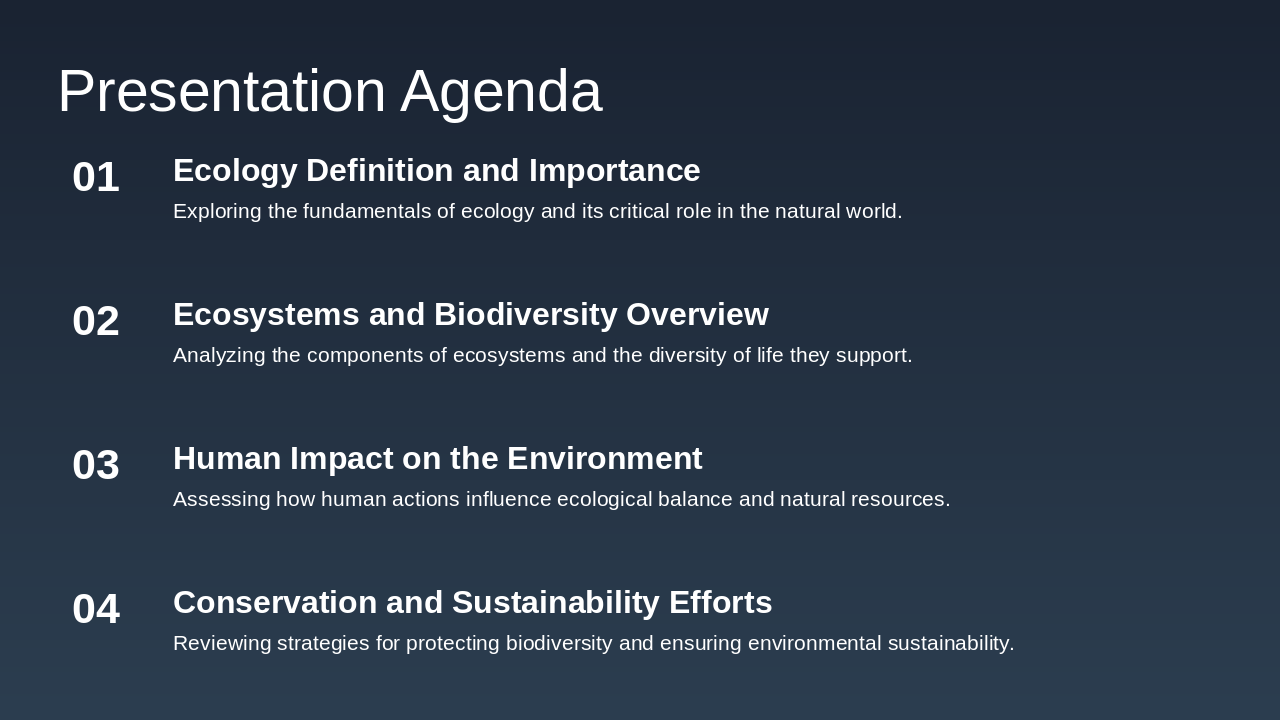
The presentation agenda outlines four key topics on ecology, starting with its definition and importance in the natural world. It then covers ecosystems and biodiversity, human impacts on the environment, and strategies for conservation and sustainability.
Exploring the fundamentals of ecology and its critical role in the natural world.
Analyzing the components of ecosystems and the diversity of life they support.
Assessing how human actions influence ecological balance and natural resources.
Reviewing strategies for protecting biodiversity and ensuring environmental sustainability.

Ecology is the study of interactions between organisms—such as plants and animals—and their environment, including abiotic factors like soil and climate. It draws from fields like botany to examine how living and non-living elements mutually influence each other.

Ecology plays a vital role in guiding conservation efforts to safeguard natural habitats and informing policy decisions for environmental protection. It also enables predictions of environmental changes, supports sustainable living for future generations, and tackles global issues like climate change.

This section header slide introduces "Understanding Ecosystems" as section 03. It provides a subtitle overview describing ecosystems as dynamic complexes of living organisms interacting with their physical environment.
03
Overview of ecosystems as dynamic complexes of living organisms interacting with their physical environment.

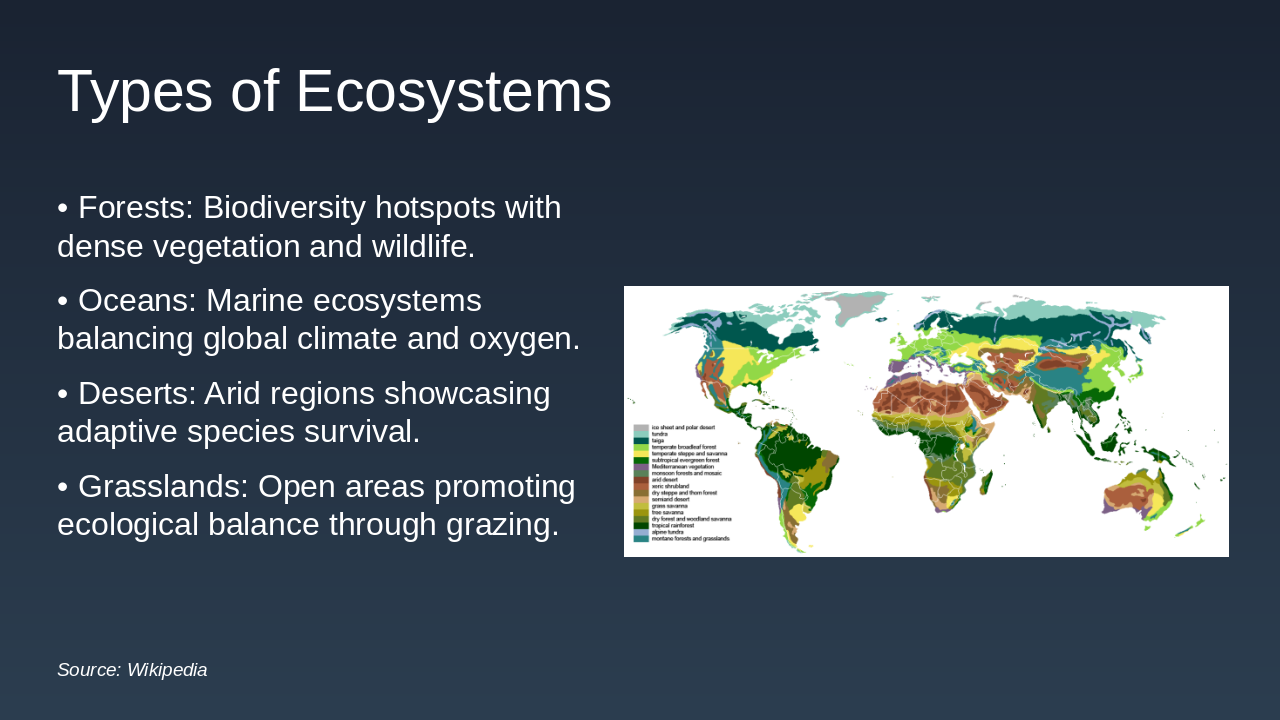
The slide titled "Types of Ecosystems" highlights four major ecosystem categories through an illustrative image and key descriptions. Forests serve as biodiversity hotspots with dense vegetation and wildlife, oceans act as marine systems that regulate global climate and produce oxygen, deserts feature arid environments with species adapted for survival, and grasslands maintain ecological balance via open landscapes and grazing.
Source: Wikipedia

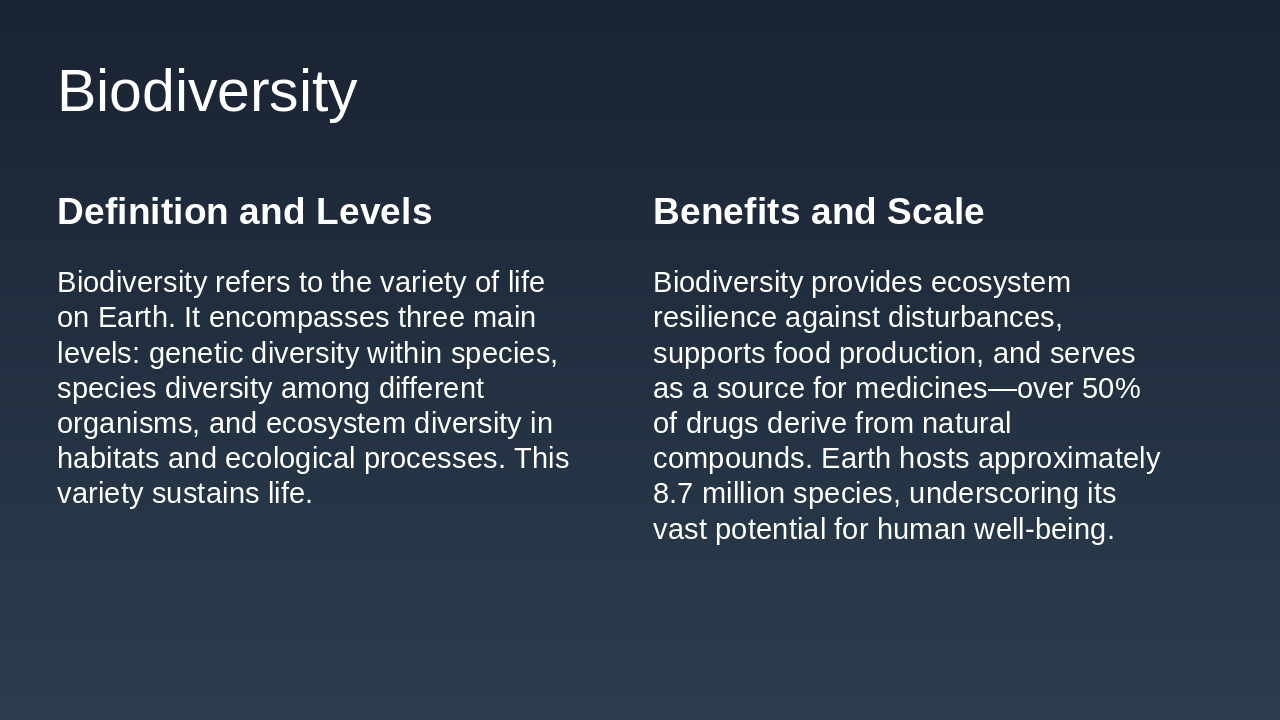
Biodiversity encompasses the variety of life on Earth at three main levels—genetic diversity within species, species diversity among organisms, and ecosystem diversity in habitats and processes—which sustains all life. It offers key benefits like ecosystem resilience, food production, and medicines (with over 50% of drugs from natural sources), while Earth supports about 8.7 million species with vast potential for human well-being.
| Definition and Levels | Benefits and Scale |
|---|---|
| Biodiversity refers to the variety of life on Earth. It encompasses three main levels: genetic diversity within species, species diversity among different organisms, and ecosystem diversity in habitats and ecological processes. This variety sustains life. | Biodiversity provides ecosystem resilience against disturbances, supports food production, and serves as a source for medicines—over 50% of drugs derive from natural compounds. Earth hosts approximately 8.7 million species, underscoring its vast potential for human well-being. |

The timeline slide "Human Impact on Ecology" outlines key periods of environmental degradation starting with the Industrial Revolution from 1760-1840, which sparked rapid pollution and worldwide ecological harm through industrialization. It continues with 20th-century deforestation between 1900-2000, driven by logging and agriculture causing massive forest loss and habitat destruction, and extends to the modern era from 2000 onward, where global warming and human activities intensify biodiversity decline and habitat loss.
1760-1840: Industrial Revolution Begins Rapid industrialization causes a surge in pollution and environmental degradation worldwide. 1900-2000: 20th Century Deforestation Intensive logging and agriculture lead to massive forest loss and habitat destruction. 2000-Present: Modern Climate Change Era Global warming and human activities accelerate habitat loss and biodiversity decline.

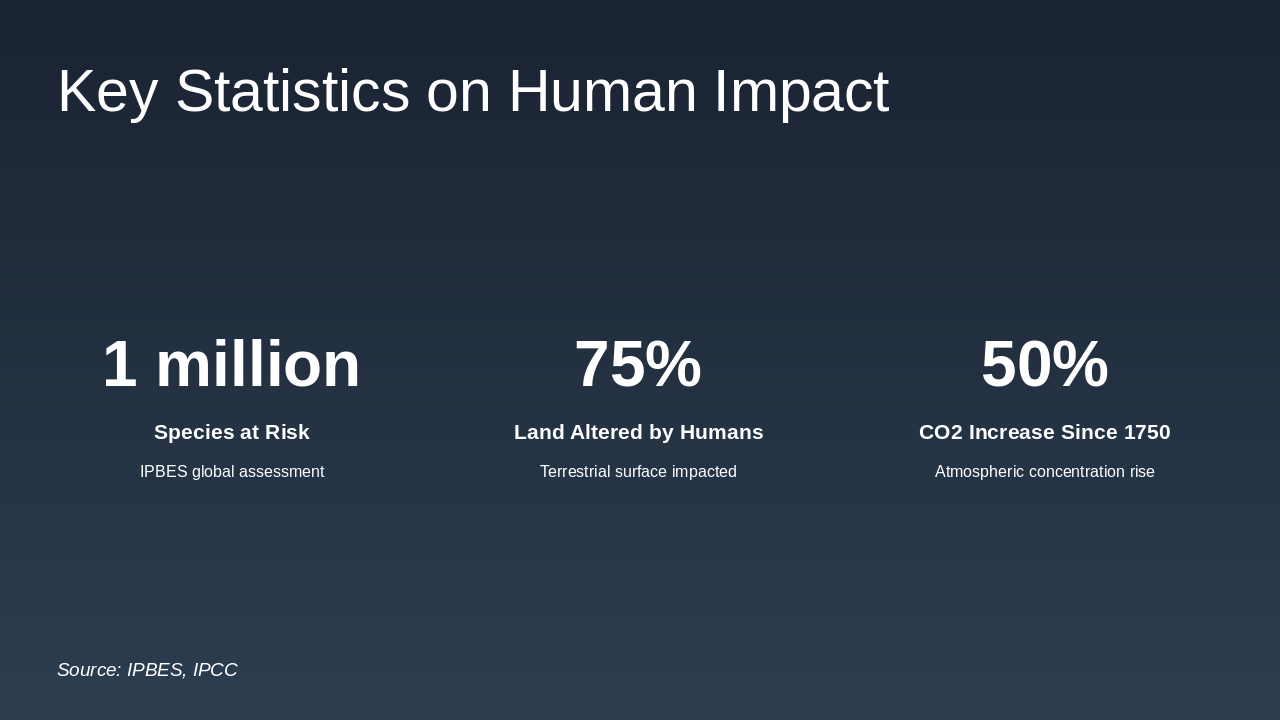
The slide "Key Statistics on Human Impact" highlights three critical metrics from global assessments: approximately 1 million species are at risk of extinction according to the IPBES report. It also notes that humans have altered 75% of the Earth's terrestrial surface and driven a 50% increase in atmospheric CO2 concentrations since 1750.
IPBES global assessment
Terrestrial surface impacted
Atmospheric concentration rise Source: IPBES, IPCC

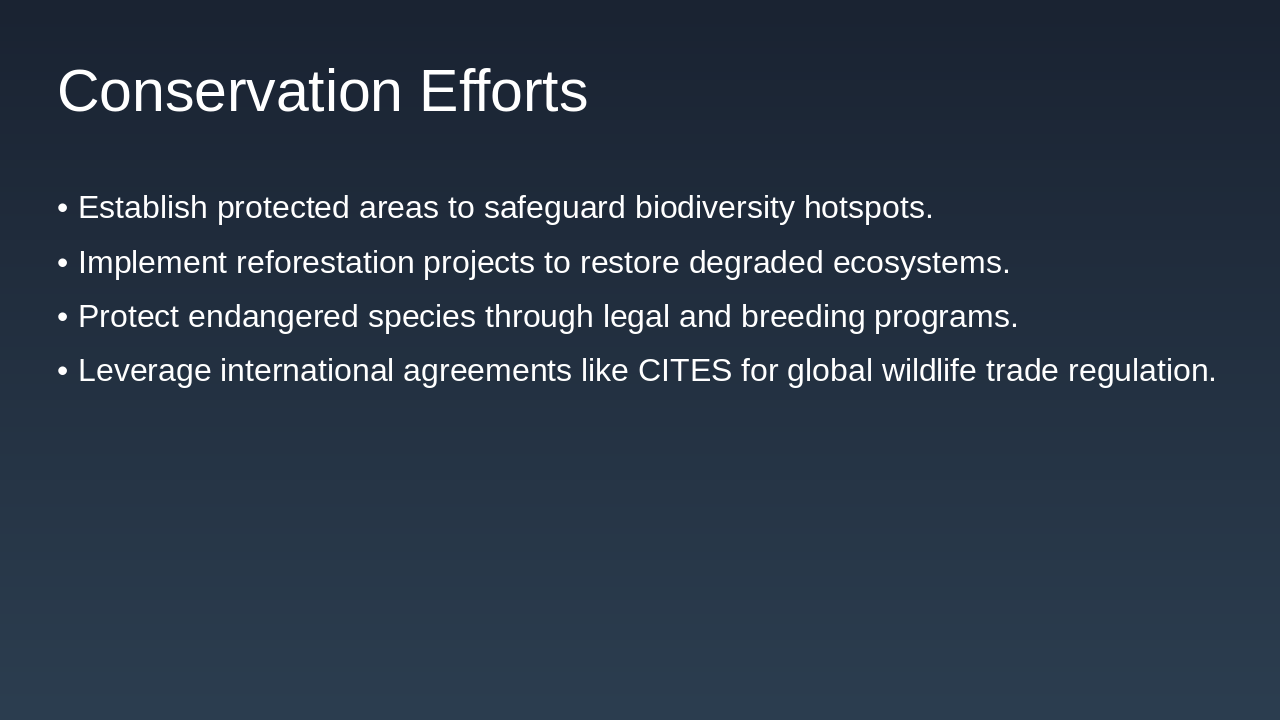
Conservation efforts focus on establishing protected areas to safeguard biodiversity hotspots and implementing reforestation projects to restore degraded ecosystems. Additional measures include protecting endangered species via legal and breeding programs, along with leveraging international agreements like CITES to regulate global wildlife trade.

The slide features a Native American proverb stating, "We do not inherit the earth from our ancestors; we borrow it from our children," emphasizing stewardship of the planet for future generations. It further explains that true sustainability involves balancing human advancement with the long-term health of the Earth.
> We do not inherit the earth from our ancestors; we borrow it from our children. True sustainability requires harmonizing human progress with the planet's enduring health.
— Native American Proverb

The conclusion slide, titled "Towards a Sustainable Future," emphasizes that ecology teaches us the importance of protecting our planet. It urges adopting sustainable practices to benefit generations ahead.
Ecology teaches us to protect our planet.
Adopt sustainable practices for generations ahead.

Explore thousands of AI-generated presentations for inspiration
Generate professional presentations in seconds with Karaf's AI. Customize this presentation or start from scratch.