5 Steps to Robust Cloud Security

Generated from prompt:

Create a Google Slides presentation about 'Cloud Security Steps'. Include slides for the following steps with at least three points each: 1) Identify Cloud Assets, 2) Assess Risks, 3) Implement Security Controls, 4) Monitor and Respond, 5) Ensure Compliance. Make it professional and easy to understand.

Professional Google Slides deck on cloud security: agenda, 5 key steps (identify assets, assess risks, implement controls, monitor/respond, ensure compliance) with bullet points, plus title and cyclic

December 12, 20258 slides
Slide 1 of 8

Slide 1 - Cloud Security Steps

This title slide is titled "Cloud Security Steps." Its subtitle reads "A Comprehensive Guide to Securing Your Cloud Environment."

Cloud Security Steps

A Comprehensive Guide to Securing Your Cloud Environment

Source: A comprehensive guide to securing your cloud environment through key steps. Professional and easy to follow.

Speaker Notes
Introduction to the presentation on key steps for cloud security. Context: Google Slides presentation with slides for Identify Cloud Assets, Assess Risks, Implement Security Controls, Monitor and Respond, Ensure Compliance.
Slide 1 - Cloud Security Steps
Slide 2 of 8

Slide 2 - Presentation Agenda

This slide outlines the presentation agenda with six key steps for cloud security. They include identifying cloud assets, assessing risks, implementing security controls, monitoring and responding, ensuring compliance, and conclusion.

Presentation Agenda

  1. 1. Identify Cloud Assets
  2. 2. Assess Risks
  3. 3. Implement Security Controls
  4. 4. Monitor and Respond
  5. 5. Ensure Compliance
  6. 6. Conclusion

Source: Cloud Security Steps

Speaker Notes
Outline of the key sections in the Cloud Security Steps presentation.
Slide 2 - Presentation Agenda
Slide 3 of 8

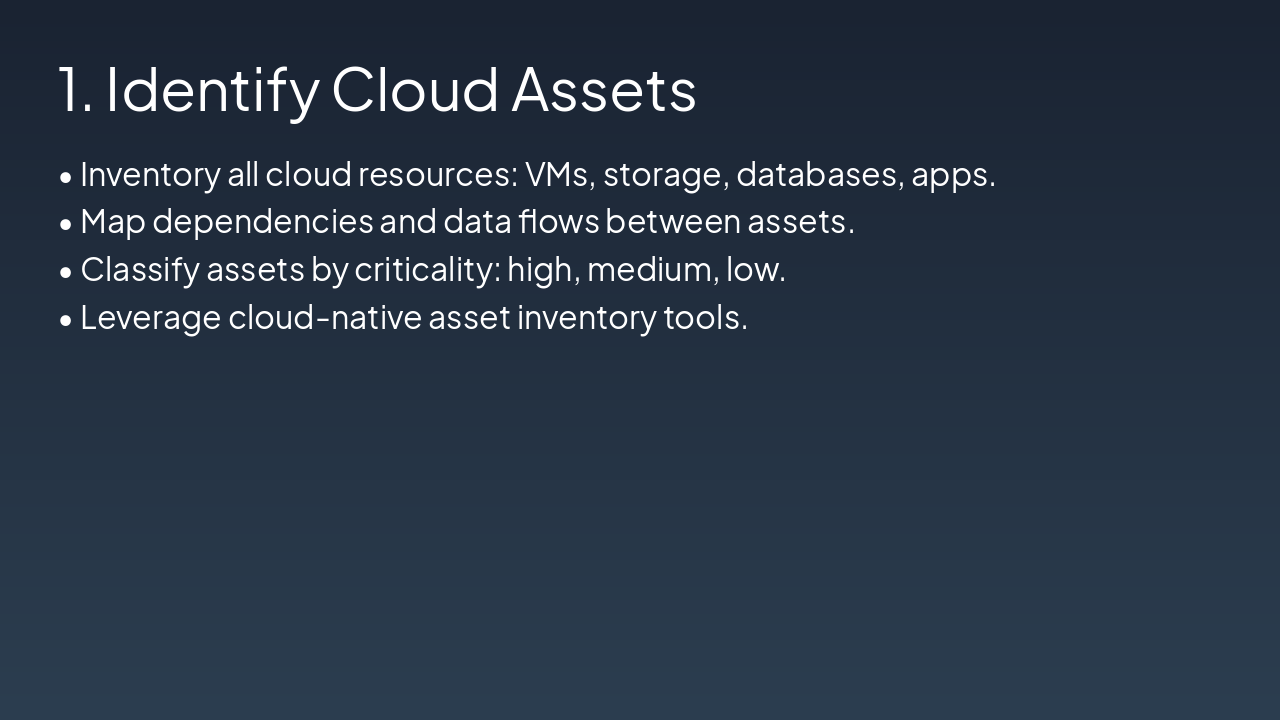
Slide 3 - 1. Identify Cloud Assets

This slide outlines identifying cloud assets by inventorying resources like VMs, storage, databases, and apps, mapping dependencies and data flows, and classifying them by criticality (high, medium, low). It recommends leveraging cloud-native asset inventory tools.

1. Identify Cloud Assets

  • Inventory all cloud resources: VMs, storage, databases, apps.
  • Map dependencies and data flows between assets.
  • Classify assets by criticality: high, medium, low.
  • Leverage cloud-native asset inventory tools.
Slide 3 - 1. Identify Cloud Assets
Slide 4 of 8

Slide 4 - 2. Assess Risks

This slide on "Assess Risks" instructs performing threat modeling and vulnerability scans to identify threats like misconfigurations and insider risks. It also covers prioritizing risks with CVSS and business impact scoring, then documenting findings in a risk register.

2. Assess Risks

  • Perform threat modeling and vulnerability scans.
  • Identify potential threats like misconfigurations and insider risks.
  • Prioritize risks using CVSS and business impact scoring.
  • Document findings in a risk register.
Slide 4 - 2. Assess Risks
Slide 5 of 8

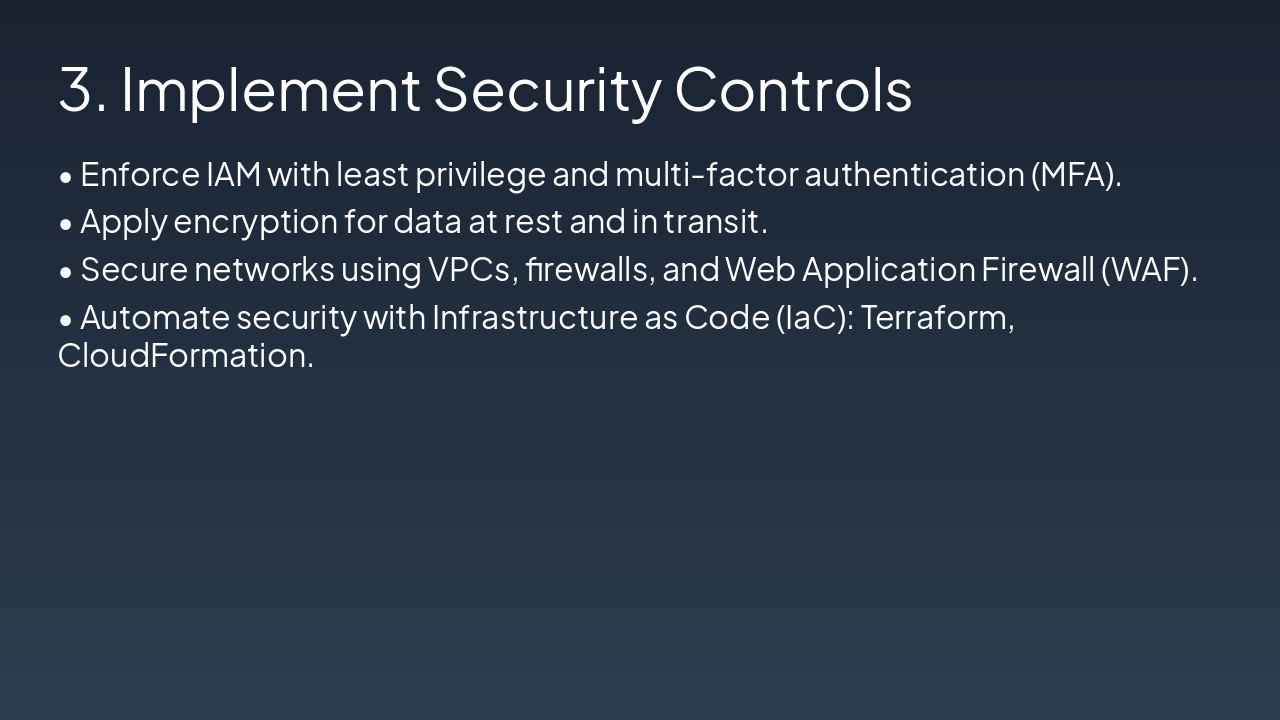
Slide 5 - 3. Implement Security Controls

This slide recommends implementing security controls by enforcing IAM with least privilege and MFA, applying encryption for data at rest and in transit, and securing networks via VPCs, firewalls, and WAF. It also advocates automating these measures using Infrastructure as Code tools like Terraform and CloudFormation.

3. Implement Security Controls

  • Enforce IAM with least privilege and multi-factor authentication (MFA).
  • Apply encryption for data at rest and in transit.
  • Secure networks using VPCs, firewalls, and Web Application Firewall (WAF).
  • Automate security with Infrastructure as Code (IaC): Terraform, CloudFormation.
Slide 5 - 3. Implement Security Controls
Slide 6 of 8

Slide 6 - 4. Monitor and Respond

This slide on "Monitor and Respond" recommends deploying SIEM and logging tools like CloudWatch and Splunk, plus setting up alerts for security anomalies. It also advises developing an incident response playbook and conducting regular drills and updates.

4. Monitor and Respond

  • Deploy SIEM and logging (CloudWatch, Splunk)
  • Set up alerts for security anomalies
  • Develop incident response playbook
  • Conduct regular drills and updates

Source: Deploy SIEM and logging (CloudWatch, Splunk). Set up alerts for anomalies. Develop incident response playbook. Conduct regular drills and updates.

Speaker Notes
Highlight proactive monitoring to detect and mitigate threats swiftly.
Slide 6 - 4. Monitor and Respond
Slide 7 of 8

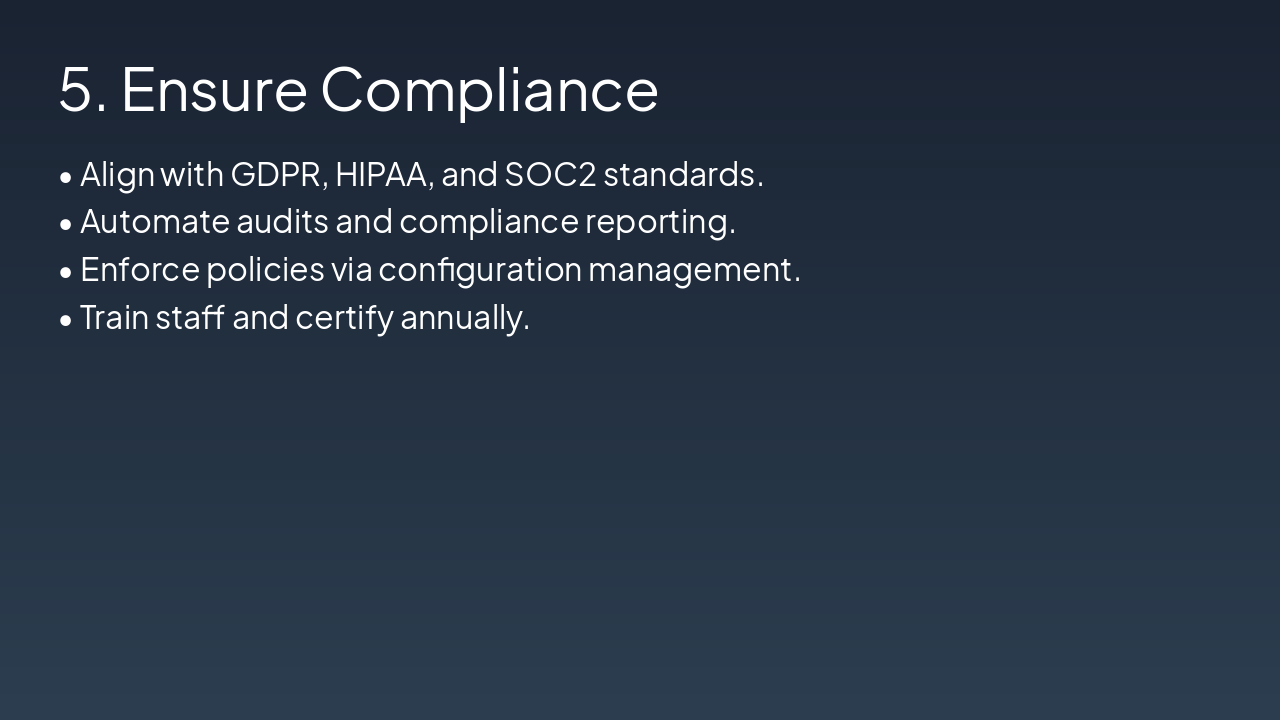
Slide 7 - 5. Ensure Compliance

This slide, titled "5. Ensure Compliance," stresses aligning with GDPR, HIPAA, and SOC2 standards. It advocates automating audits and reporting, enforcing policies via configuration management, and conducting annual staff training and certification.

5. Ensure Compliance

  • Align with GDPR, HIPAA, and SOC2 standards.
  • Automate audits and compliance reporting.
  • Enforce policies via configuration management.
  • Train staff and certify annually.
Slide 7 - 5. Ensure Compliance
Slide 8 of 8

Slide 8 - Key Takeaways

The Key Takeaways conclusion slide recommends following five steps cyclically for robust cloud security. It urges staying proactive, auditing regularly, adapting to threats, and invites questions for discussion.

Key Takeaways

Follow these 5 steps cyclically for robust cloud security.

Stay proactive, audit regularly, and adapt to threats.

Questions? Let's discuss! 🔒

Source: Cloud Security Steps Presentation

Speaker Notes
Emphasize the cyclic process, proactive mindset, and open the floor for discussion.
Slide 8 - Key Takeaways

Discover More Presentations

Explore thousands of AI-generated presentations for inspiration

Browse Presentations
Powered by AI

Create Your Own Presentation

Generate professional presentations in seconds with Karaf's AI. Customize this presentation or start from scratch.

Create New Presentation

Powered by Karaf.ai — AI-Powered Presentation Generator