Chipko Movement: Key Features

Generated from prompt:

Create a PowerPoint presentation titled 'Features of the Chipko Movement' under the subject 'Environmental Development and Sustainable Development'. The presentation should include: - Cover slide with student name: Sita Rohidas, SY B.Com Sem IV, subject teacher: Rupali Mam. - Slides explaining the key features of the Chipko Movement, its background, origin, main objectives, key leaders (like Sunderlal Bahuguna and Gaura Devi), and its impact on environmental conservation. - Include visuals such as photos of Chipko activists, forests, and charts/graphs about deforestation or tree conservation. - Use simple English that is easy to understand for all students. - Keep the design professional and visually engaging with clear, readable fonts and relevant images. - Add an 'Environmental and Sustainable Development' context to connect the Chipko Movement with modern sustainability efforts.

PowerPoint on Chipko Movement's background, non-violent tree-hugging protests, objectives, leaders like Gaura Devi & Sunderlal Bahuguna, conservation impact, and ties to sustainable development. By Si

January 16, 20268 slides
Slide 1 of 8

Slide 1 - Features of the Chipko Movement

This title slide is titled "Features of the Chipko Movement" and is presented by Sita Rohidas, a SY B.Com Sem IV student, under the guidance of Subject Teacher Rupali Mam. The subtitle indicates the topic relates to "Environmental Development and Sustainable Development."

Sita Rohidas

SY B.Com Sem IV Subject Teacher: Rupali Mam

Environmental Development and Sustainable Development

Source: Environmental Development and Sustainable Development

Speaker Notes
Title slide for presentation on Chipko Movement by Sita Rohidas, SY B.Com Sem IV, Subject Teacher: Rupali Mam. Include image of forest with hugging trees.
Slide 1 - Features of the Chipko Movement
Slide 2 of 8

Slide 2 - Background and Origin

This section header slide, titled "Background and Origin" and numbered "01", introduces the origins of the movement. It highlights the 1973 events in Uttarakhand, where villagers hugged trees to prevent logging.

Background and Origin

01

Background and Origin

The 1973 origins in Uttarakhand where villagers hugged trees to halt logging

Source: [Image: Himalayan forests]

Speaker Notes
The Chipko Movement began in 1973 in Uttarakhand, India. Villagers hugged trees to stop logging.
Slide 2 - Background and Origin
Slide 3 of 8

Slide 3 - Key Features

The slide highlights the key features of a non-violent protest where local women activists hugged trees to protect forests from deforestation. It emphasizes this simple, community-led action focused on conservation.

Key Features

  • Non-violent protest: Hugging trees to protect forests
  • Initiated by local women activists
  • Focused on saving forests from deforestation
  • Simple, community-led action for conservation

Source: Chipko Movement

Speaker Notes
Highlight how these simple actions by local women inspired global conservation efforts, linking to sustainable development.
Slide 3 - Key Features
Slide 4 of 8

Slide 4 - Main Objectives

The slide titled "Main Objectives" outlines key goals for forest protection, including preventing commercial logging. It also emphasizes preventing floods and soil erosion, ensuring water supply for villagers, and securing livelihoods through tree conservation.

Main Objectives

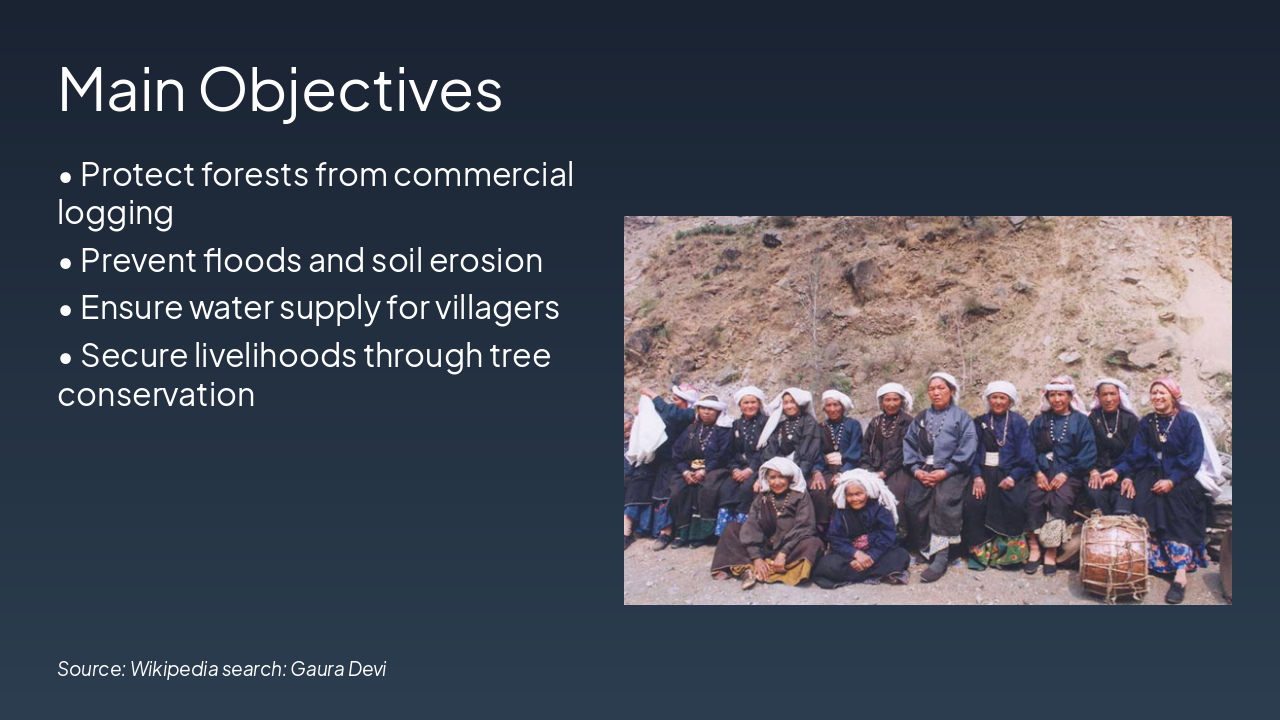
!Image

  • Protect forests from commercial logging
  • Prevent floods and soil erosion
  • Ensure water supply for villagers
  • Secure livelihoods through tree conservation

Source: Wikipedia search: Gaura Devi

Slide 4 - Main Objectives
Slide 5 of 8

Slide 5 - Key Leaders

Sunderlal Bahuguna led the Chipko campaigns against deforestation, inspiring villagers with Gandhi's non-violence to hug trees and save Himalayan forests. Gaura Devi mobilized 27 women in Reni village in 1974 to bravely face loggers by hugging trees, sparking women's roles in environmental conservation.

Key Leaders

Sunderlal BahugunaGaura Devi
Led Chipko campaigns against deforestation. Inspired by Gandhi's non-violence. United villagers to hug trees, saving Himalayan forests for sustainability.Mobilized 27 women in Reni village, 1974. Faced loggers bravely, hugging trees. Sparked women's role in environmental conservation.

Source: [Photos of Sunderlal Bahuguna (left) and Gaura Devi (right)]

Speaker Notes
Highlight how these leaders, inspired by Gandhi, mobilized communities for forest protection, linking to sustainable development.
Slide 5 - Key Leaders
Slide 6 of 8

Slide 6 - Impact on Conservation

The "Impact on Conservation" slide highlights key stats from the Chipko movement, including 25,000 trees saved in its first decade and a 1980 logging ban in the Himalayas. It also notes over 50% reduction in deforestation post-movement and its inspiration for global green activism.

Impact on Conservation

  • 25,000: Trees Saved
  • In first decade of movement

  • 1980: Himalayas Logging Ban
  • Led to complete ban

  • 50%+: Deforestation Reduced
  • Post-Chipko movement impact

  • Global: Green Movements Inspired

Influenced worldwide activism Source: Chipko Movement Outcomes

Slide 6 - Impact on Conservation
Slide 7 of 8

Slide 7 - Link to Sustainable Development

This slide highlights how the initiative promotes community forests for local empowerment and balances environmental protection with economic growth. It also inspires modern eco-villages worldwide and aligns with the UN Sustainable Development Goals.

Link to Sustainable Development

  • Promotes community forests for local empowerment
  • Balances environment protection with economic growth
  • Inspires modern eco-villages worldwide
  • Aligns with UN Sustainable Development Goals

Source: [Image: Modern forest conservation]

Speaker Notes
This slide connects Chipko to today's sustainability, like UN SDGs and eco-villages.
Slide 7 - Link to Sustainable Development
Slide 8 of 8

Slide 8 - Conclusion

The Chipko movement teaches the importance of collectively protecting nature for a sustainable future. The slide closes with thanks, an invitation for Q&A, a call to hug trees today, and an action to join conservation efforts now.

Conclusion

Chipko teaches: Protect nature together for sustainable future! 🌳

Thank you Q&A

Closing: Hug trees today! Action: Join conservation efforts now.

Source: Chipko Movement Presentation

Speaker Notes
Summarize key lesson, thank audience, invite questions.
Slide 8 - Conclusion

Discover More Presentations

Explore thousands of AI-generated presentations for inspiration

Browse Presentations
Powered by AI

Create Your Own Presentation

Generate professional presentations in seconds with Karaf's AI. Customize this presentation or start from scratch.

Create New Presentation

Powered by Karaf.ai — AI-Powered Presentation Generator