Gupta Temple Architecture: Golden Age

Generated from prompt:

Regenerate the PowerPoint presentation titled 'Temple Architecture during the Gupta Period' with an authentic 'Ancient Sandstone Edition' theme. Preserve all original text and content. Use realistic sandstone textures as backgrounds with earthy ochre and amber tones, gold highlights, and carved stone relief borders. Include subtle overlays of temple carvings and sculptures. Keep cinematic morph, zoom, and fade transitions, along with soft temple bell chime audio during transitions. Maintain interactive navigation buttons (Home, Next, Back) and 16:9 widescreen layout for presentations.

Recreated PowerPoint on Gupta Period temple design in an 'Ancient Sandstone Edition' theme. Features realistic sandstone textures, earthy tones, gold accents, carved borders, cinematic transitions wit

January 9, 20268 slides
Slide 1 of 8

Slide 1 - Temple Architecture during the Gupta Period

The title slide, "Temple Architecture during the Gupta Period," invites viewers to discover the Golden Age of Indian Temple Design. Its subtitle highlights exploring innovations and artistic splendor in Gupta Era sanctuaries.

Discover the Golden Age of Indian Temple Design

Exploring Innovations and Artistic Splendor in Gupta Era Sanctuaries

Slide 1 - Temple Architecture during the Gupta Period
Slide 2 of 8

Slide 2 - Introduction to Gupta Period

This slide introduces the Gupta Period as Section 01, titled "Introduction to Gupta Period." It highlights the era as the Golden Age of Indian Art and the evolution of temple architecture, spanning approximately 320-550 CE.

Introduction to Gupta Period

01

Introduction to Gupta Period

Golden Age of Indian Art and Temple Architecture Evolution (c. 320-550 CE)

Source: Temple Architecture during the Gupta Period - Ancient Sandstone Edition

Speaker Notes
Overview of the Gupta Era (c. 320-550 CE) as the Golden Age of Indian art, focusing on temple architecture evolution. Theme: Realistic sandstone textures with earthy ochre/amber tones, gold highlights, carved stone borders, subtle temple carvings overlay. Cinematic transitions with temple bell chimes, interactive nav buttons, 16:9 layout.
Slide 2 - Introduction to Gupta Period
Slide 3 of 8

Slide 3 - Key Characteristics

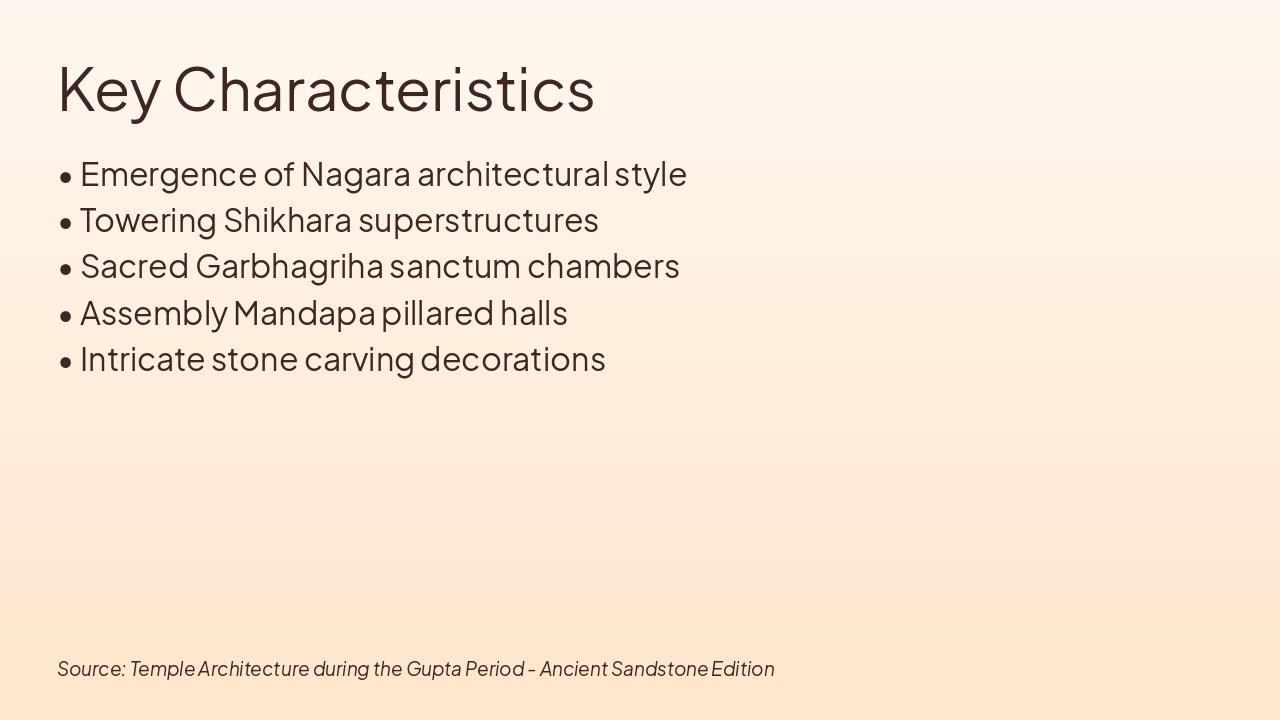
The slide highlights the key characteristics of the Nagara architectural style, including the emergence of this style and towering Shikhara superstructures. It also features sacred Garbhagriha sanctum chambers, assembly Mandapa pillared halls, and intricate stone carving decorations.

Key Characteristics

  • Emergence of Nagara architectural style
  • Towering Shikhara superstructures
  • Sacred Garbhagriha sanctum chambers
  • Assembly Mandapa pillared halls
  • Intricate stone carving decorations

Source: Temple Architecture during the Gupta Period - Ancient Sandstone Edition

Speaker Notes
Highlight the defining features of Gupta temple architecture, including Nagara style origins, towering shikharas, sacred garbhagriha, assembly mandapas, and detailed stone artistry.
Slide 3 - Key Characteristics
Slide 4 of 8

Slide 4 - Major Gupta Temples

The slide highlights major Gupta temples, including the Dashavatara Temple at Deogarh, the earliest Vishnu temple with five shrines and intricate carvings. It also features the Bhitargaon Temple, the oldest surviving brick temple in Nagara style with terracotta panels, and the simple yet elegant rock-cut Temple 17 on Nagarjuni Hill.

Major Gupta Temples

  • Dashavatara Temple at Deogarh: Earliest Vishnu temple, five shrines, intricate carvings.
  • Bhitargaon Temple: Oldest surviving brick temple, terracotta panels, Nagara style.
  • Temple 17, Nagarjuni Hill: Rock-cut, simple yet elegant Gupta proportions.

Source: Wikipedia search queries: Dashavatara Temple Deogarh, Bhitargaon Temple, Nagarjuni Hill Temple 17

Speaker Notes
Highlighting key extant Gupta temples with realistic sandstone architecture from early 5th century.
Slide 4 - Major Gupta Temples
Slide 5 of 8

Slide 5 - Architectural Innovations

Gupta temples showcased structural innovations like sturdy square bases, soaring curved shikharas, and intricate jalis that balanced engineering and aesthetics. Sculptural motifs featured ornate carvings of deities such as Vishnu and Shiva, mythical beings, and floral patterns, bringing divine and natural themes to life in stone reliefs.

Architectural Innovations

Structural ElementsSculptural Motifs
Gupta temples featured sturdy square bases for stability, soaring curved spires (shikharas) that tapered gracefully skyward, and intricate lattice windows (jalis) allowing light filtration, blending engineering prowess with aesthetic harmony.Ornate carvings adorned surfaces with majestic deities like Vishnu and Shiva, mythical beings such as apsaras and ganas, and lush floral patterns, infusing divine narratives and natural motifs into living stone reliefs.

Source: Temple Architecture during the Gupta Period - Ancient Sandstone Edition

Speaker Notes
Highlight the innovative structural and decorative elements defining Gupta temple architecture, evoking the era's artistic pinnacle.
Slide 5 - Architectural Innovations
Slide 6 of 8

Slide 6 - Evolution Timeline

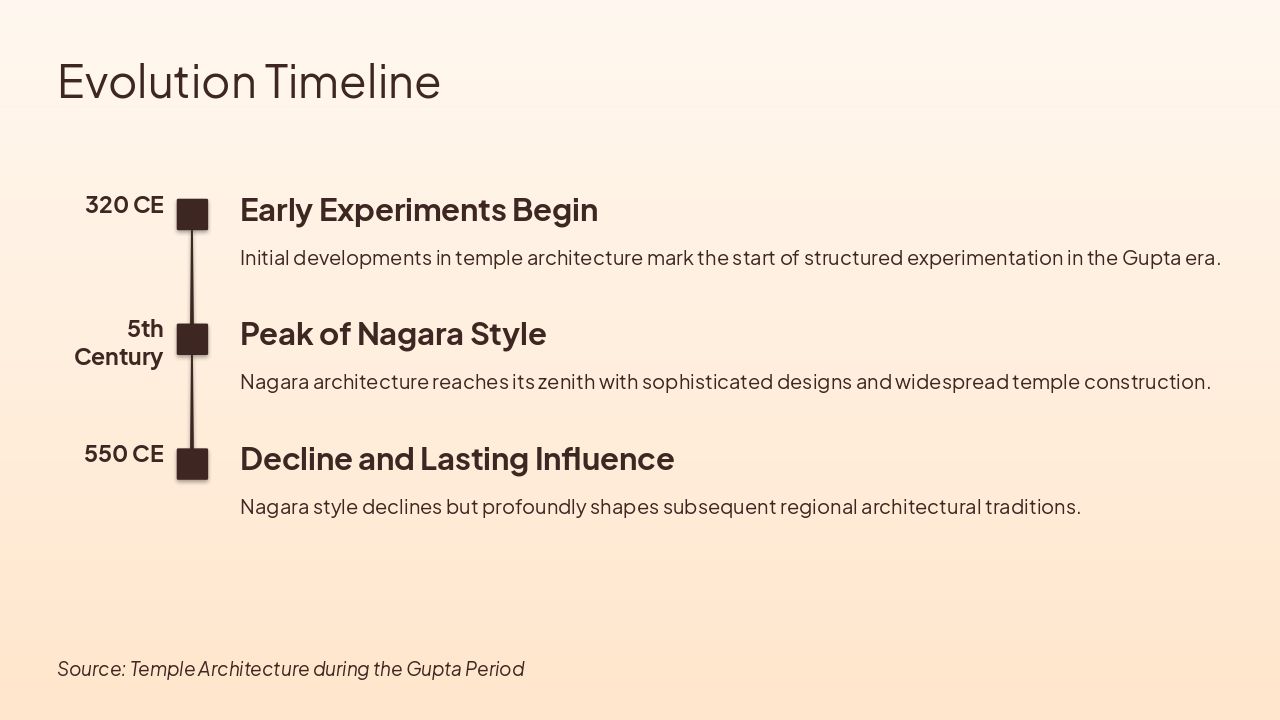
The timeline traces the evolution of Nagara temple architecture, starting with early experiments in structured designs during the Gupta era around 320 CE. It peaks in the 5th century with sophisticated temple construction, before declining around 550 CE while leaving a lasting influence on regional traditions.

Evolution Timeline

320 CE: Early Experiments Begin Initial developments in temple architecture mark the start of structured experimentation in the Gupta era. 5th Century: Peak of Nagara Style Nagara architecture reaches its zenith with sophisticated designs and widespread temple construction. 550 CE: Decline and Lasting Influence Nagara style declines but profoundly shapes subsequent regional architectural traditions.

Source: Temple Architecture during the Gupta Period

Speaker Notes
This timeline outlines the evolution from early experiments to the peak and decline of Nagara style during and post-Gupta period.
Slide 6 - Evolution Timeline
Slide 7 of 8

Slide 7 - Notable Facts & Stats

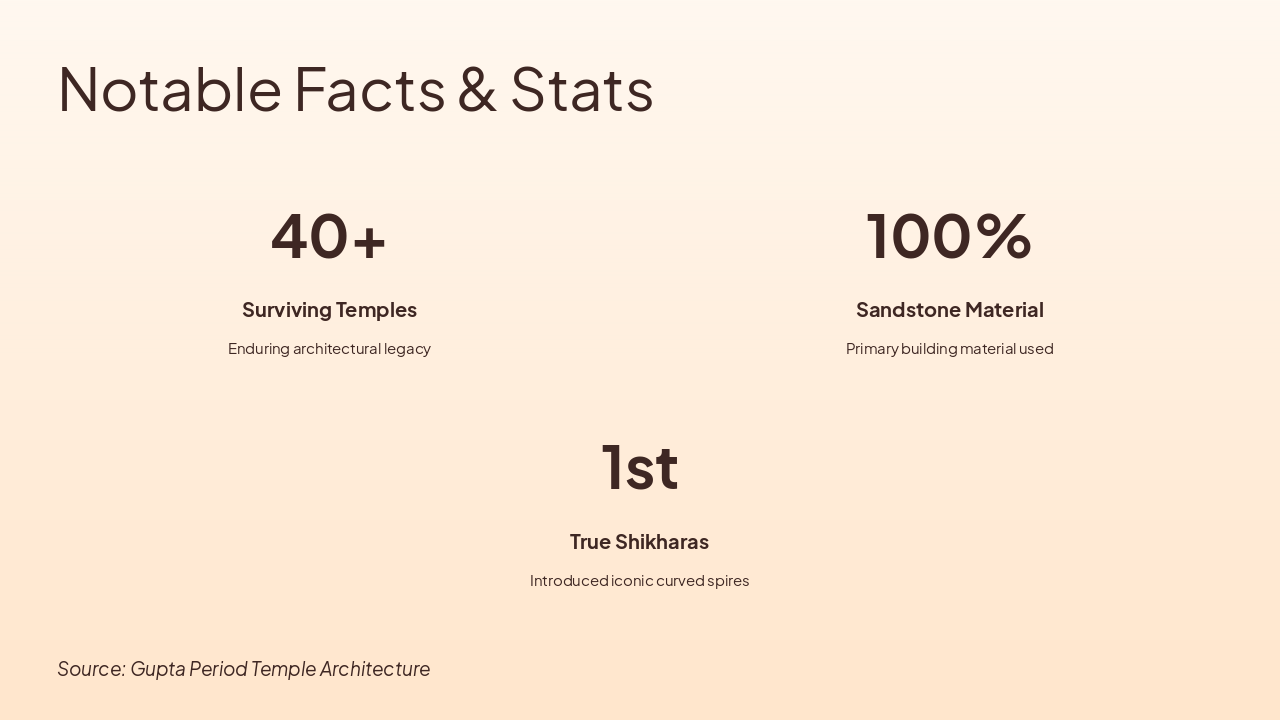
The slide highlights key stats on ancient temples: over 40 surviving structures made entirely from sandstone, representing an enduring architectural legacy. It also notes their pioneering role as the first to introduce true shikharas, the iconic curved spires.

Notable Facts & Stats

  • 40+: Surviving Temples
  • Enduring architectural legacy

  • 100%: Sandstone Material
  • Primary building material used

  • 1st: True Shikharas

Introduced iconic curved spires Source: Gupta Period Temple Architecture

Slide 7 - Notable Facts & Stats
Slide 8 of 8

Slide 8 - Legacy of Gupta Temples

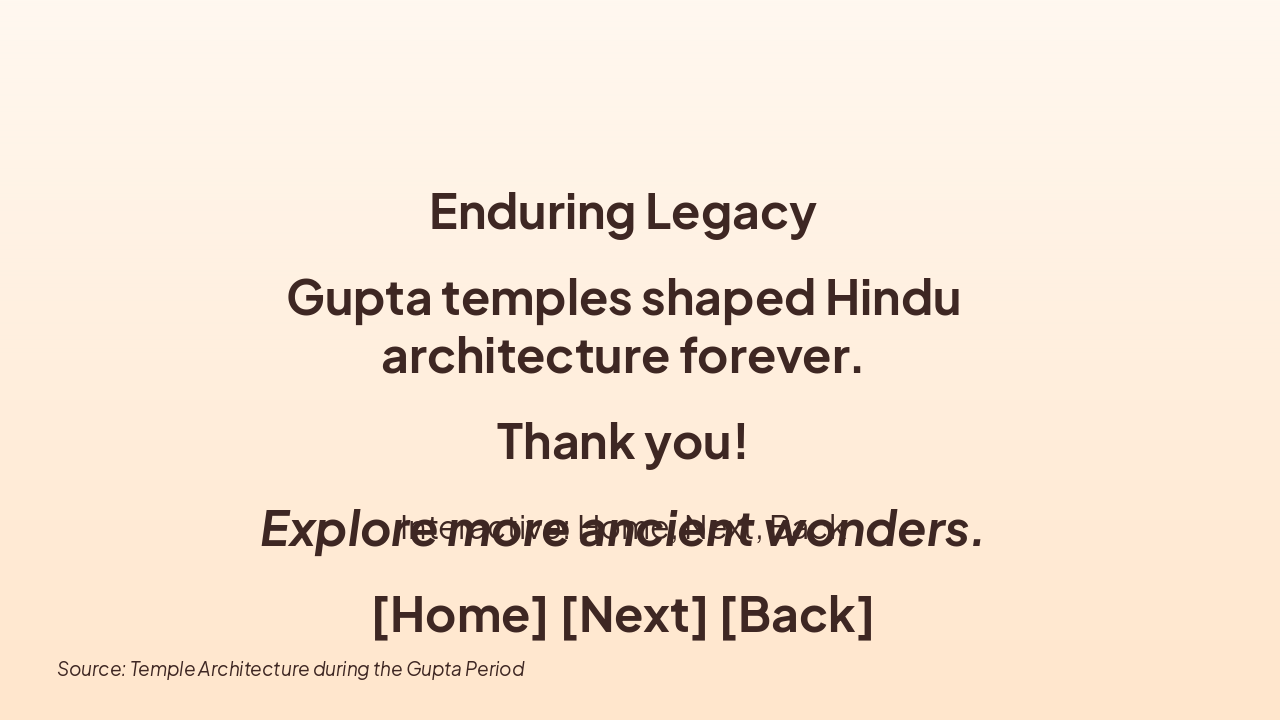
The slide titled "Legacy of Gupta Temples" concludes by highlighting the enduring legacy of Gupta temples, which shaped Hindu architecture forever. It ends with a "Thank you!" message, an invitation to explore more ancient wonders, and interactive navigation buttons for Home, Next, and Back.

Legacy of Gupta Temples

**Enduring Legacy

Gupta temples shaped Hindu architecture forever.

Thank you!

Explore more ancient wonders.

[Home] [Next] [Back]**

Interactive: Home, Next, Back

Source: Temple Architecture during the Gupta Period

Speaker Notes
Summarize the enduring influence on Hindu temple architecture. Thank the audience and invite questions.
Slide 8 - Legacy of Gupta Temples

Discover More Presentations

Explore thousands of AI-generated presentations for inspiration

Browse Presentations
Powered by AI

Create Your Own Presentation

Generate professional presentations in seconds with Karaf's AI. Customize this presentation or start from scratch.

Create New Presentation

Powered by Karaf.ai — AI-Powered Presentation Generator