Timur Destanı: Legend and Legacy of Tamerlane

Generated from prompt:

Timur destanı

This deck explores the historical Timur (Tamerlane), his rise to power, Timurid Empire conquests, and transformation into the epic 'Timur Destanı' in Turkish literature, including cultural impacts and enduring legacy.

March 25, 20269 slides
Slide 1 of 9

Slide 1 - Timur Destanı

Timur Destanı: The Legend of Timur

An Exploration of the Legend and Legacy of Tamerlane

---

Photo by Mark Rasmuson on Unsplash
Slide 1 - Timur Destanı
Slide 2 of 9

Slide 2 - Agenda

  • Historical Context of Timur the Great
  • The Rise of the Timurid Empire
  • Cultural Impact and Literary Depictions
  • Legacy and Historical Significance

---

Photo by Nik Shuliahin 💛💙 on Unsplash
Slide 2 - Agenda
Slide 3 of 9

Slide 3 - Section 1

1

The Historical Timur

From Local Warlord to Conqueror of the World

---

Photo by Ekaterina Boltaga on Unsplash
Slide 3 - Section 1
Slide 4 of 9

Slide 4 - Who Was Timur?

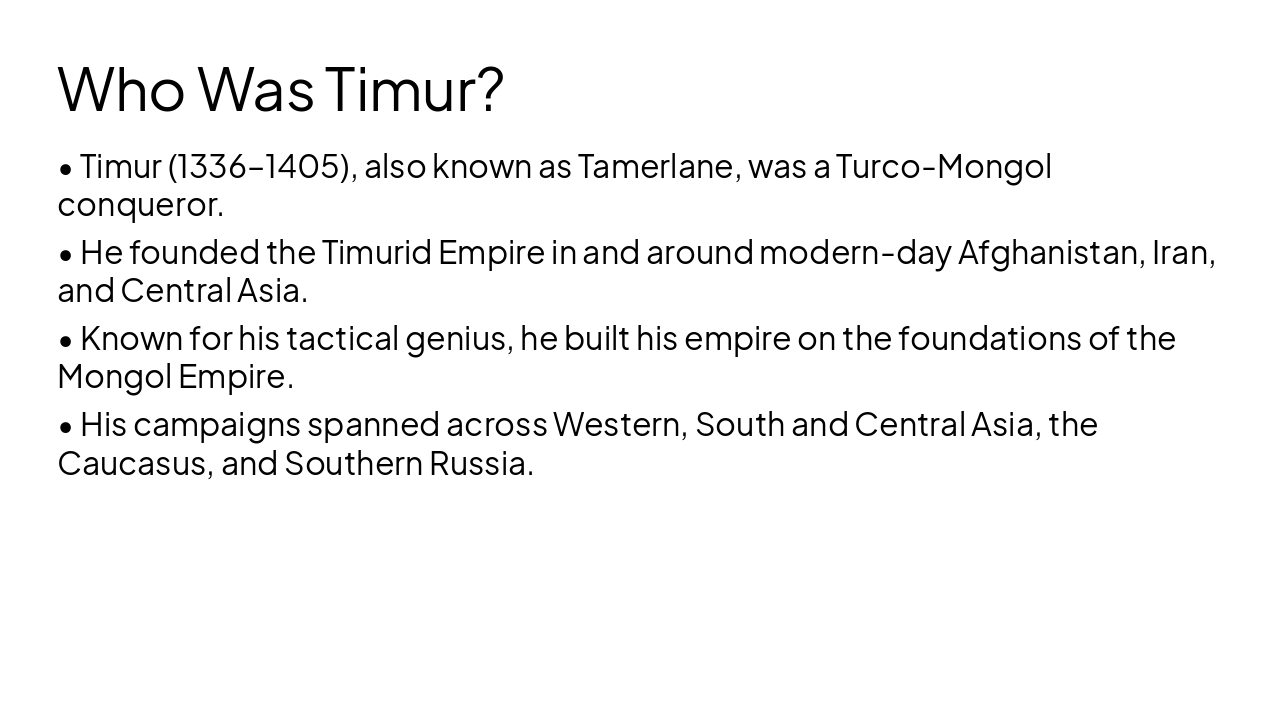
  • Timur (1336–1405), also known as Tamerlane, was a Turco-Mongol conqueror.
  • He founded the Timurid Empire in and around modern-day Afghanistan, Iran, and Central Asia.
  • Known for his tactical genius, he built his empire on the foundations of the Mongol Empire.
  • His campaigns spanned across Western, South and Central Asia, the Caucasus, and Southern Russia.
Slide 4 - Who Was Timur?
Slide 5 of 9

Slide 5 - Key Milestones in Timur's Life

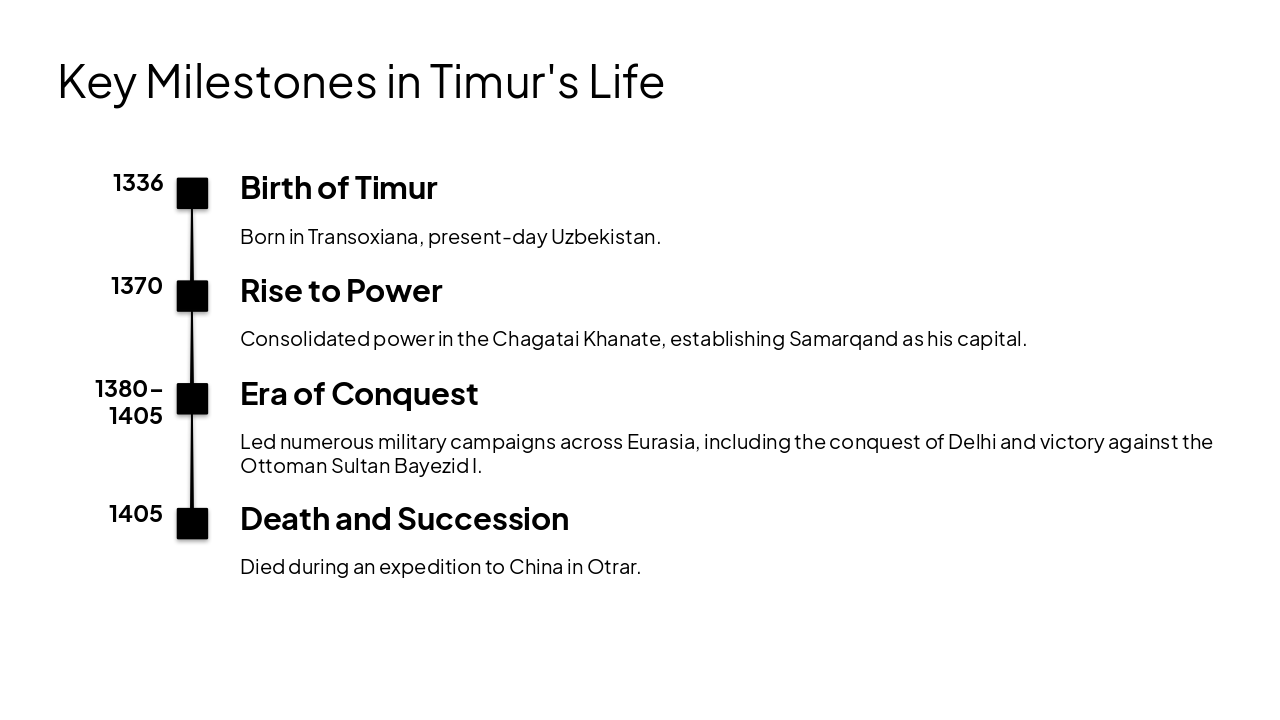
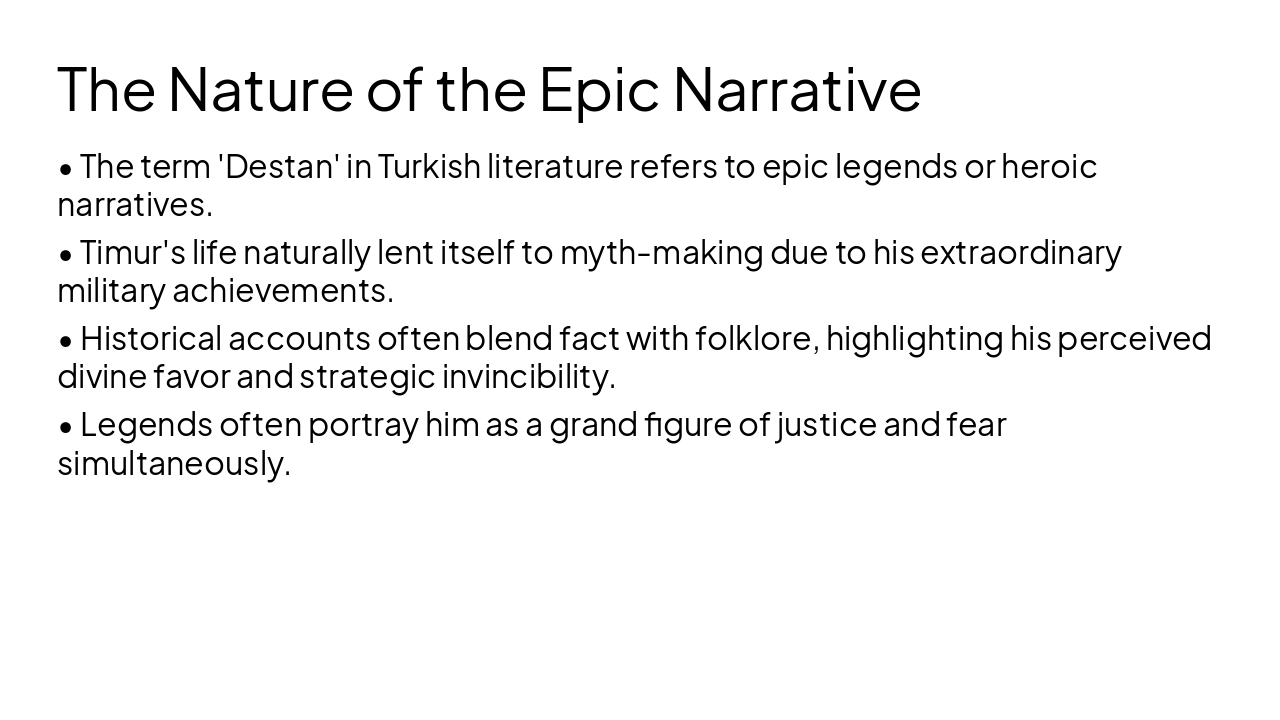
1336: Birth of Timur Born in Transoxiana, present-day Uzbekistan. 1370: Rise to Power Consolidated power in the Chagatai Khanate, establishing Samarqand as his capital. 1380–1405: Era of Conquest Led numerous military campaigns across Eurasia, including the conquest of Delhi and victory against the Ottoman Sultan Bayezid I. 1405: Death and Succession Died during an expedition to China in Otrar.
Slide 5 - Key Milestones in Timur's Life
Slide 6 of 9

Slide 6 - Section 2

2

The Timur Destanı (Legend)

How History Transformed into Oral and Written Tradition

---

Photo by Yishen Ji on Unsplash

Slide 6 - Section 2
Slide 7 of 9

Slide 7 - The Nature of the Epic Narrative

  • The term 'Destan' in Turkish literature refers to epic legends or heroic narratives.
  • Timur's life naturally lent itself to myth-making due to his extraordinary military achievements.
  • Historical accounts often blend fact with folklore, highlighting his perceived divine favor and strategic invincibility.
  • Legends often portray him as a grand figure of justice and fear simultaneously.
Slide 7 - The Nature of the Epic Narrative
Slide 8 of 9

Slide 8 - Visualizing the Conqueror

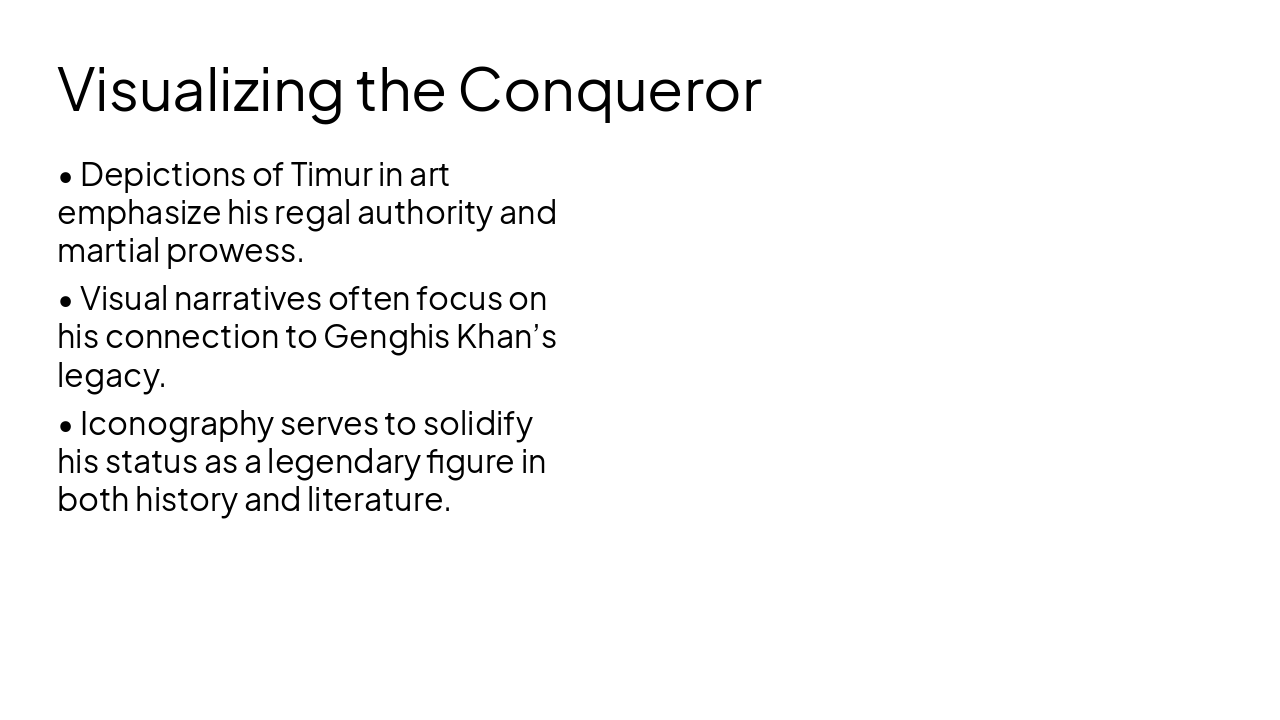
  • Depictions of Timur in art emphasize his regal authority and martial prowess.
  • Visual narratives often focus on his connection to Genghis Khan’s legacy.
  • Iconography serves to solidify his status as a legendary figure in both history and literature.
Slide 8 - Visualizing the Conqueror
Slide 9 of 9

Slide 9 - Conclusion

The enduring legacy of Timur continues to inspire and provoke debate across Eurasia.

From a historic warlord to an eternal legend in history and literature.

---

Photo by Catherine Zaidova on Unsplash
Slide 9 - Conclusion

Discover More Presentations

Explore thousands of AI-generated presentations for inspiration

Browse Presentations
Powered by AI

Create Your Own Presentation

Generate professional presentations in seconds with Karaf's AI. Customize this presentation or start from scratch.

Create New Presentation

Powered by Karaf.ai — AI-Powered Presentation Generator