Women, Caste & Reform: Heroes of Change (34 chars)

Generated from prompt:

Create a 10-slide PowerPoint presentation for Class 8 students on the NCERT History topic 'Women, Caste and Reform'. The presentation should be formal and academic, but slightly fun and engaging for a school audience. Include the following slides: 1. Title Slide: Women, Caste and Reform 2. Introduction: Overview of 19th-century India and need for reforms 3. Social Issues: Womenโ€™s status and caste discrimination 4. Reform Movements: Early reformers and their goals 5. Women Reformers: Key figures like Raja Ram Mohan Roy, Ishwar Chandra Vidyasagar, Jyotirao and Savitribai Phule 6. Education and Womenโ€™s Rights: Growth of education and its impact 7. Caste Reform: Efforts to remove untouchability and caste barriers 8. Religious Reform Movements: Brahmo Samaj, Arya Samaj, etc. 9. Outcomes: Changes achieved and continuing challenges 10. Conclusion: Summary and reflection Use simple language suitable for Class 8, include short bullet points and relevant images or icons for visual appeal.

10-slide PPT for Class 8 on 19th-century India: social evils like sati/child marriage/untouchability, reformers (Roy, Vidyasagar, Phules), education/widow rights, religious movements, outcomes & lesso

December 6, 202510 slides
Slide 1 of 10

Slide 1 - Women, Caste and Reform

This title slide features the main heading "Women, Caste and Reform." It is subtitled for NCERT Class 8 History, focusing on 19th-century reforms in India.

Women, Caste and Reform

NCERT Class 8 History ๐ŸŒŸ Exploring 19th-century reforms in India

Source: NCERT Class 8 History

Speaker Notes
Introduce the topic and excite students about the engaging journey through 19th-century reforms.
Slide 1 - Women, Caste and Reform
Slide 2 of 10

Slide 2 - Introduction

In 19th-century India, rigid customs, inequalities, and social evils like sati and child marriage dominated society. Brave reformers rose to challenge these injustices.

Introduction

  • Rigid customs and inequalities gripped 19th-century India
  • Social evils like sati and child marriage prevailed
  • Brave reformers rose to challenge these injustices!

Source: NCERT History Class 8: Women, Caste and Reform

Speaker Notes
Slide 2/10. Discuss 19th-century India's challenges briefly. Show Vintage India illustration for visual engagement. Keep tone exciting about reformers.
Slide 2 - Introduction
Slide 3 of 10

Slide 3 - Social Issues

The slide on Social Issues outlines gender discrimination, including women denied education, forced early marriages, and the tragic Sati practice for widows. It also details caste-based oppression, such as untouchability, barriers to opportunities, and severe hardships for lower castes.

Social Issues

  • Women denied education and forced into early marriage.
  • Sati practice led to widows' tragic deaths ๐Ÿ˜”.
  • Untouchability isolated lower castes.
  • Caste barriers blocked opportunities.
  • Lower castes faced severe hardships ๐Ÿ”’.
Slide 3 - Social Issues
Slide 4 of 10

Slide 4 - Reform Movements

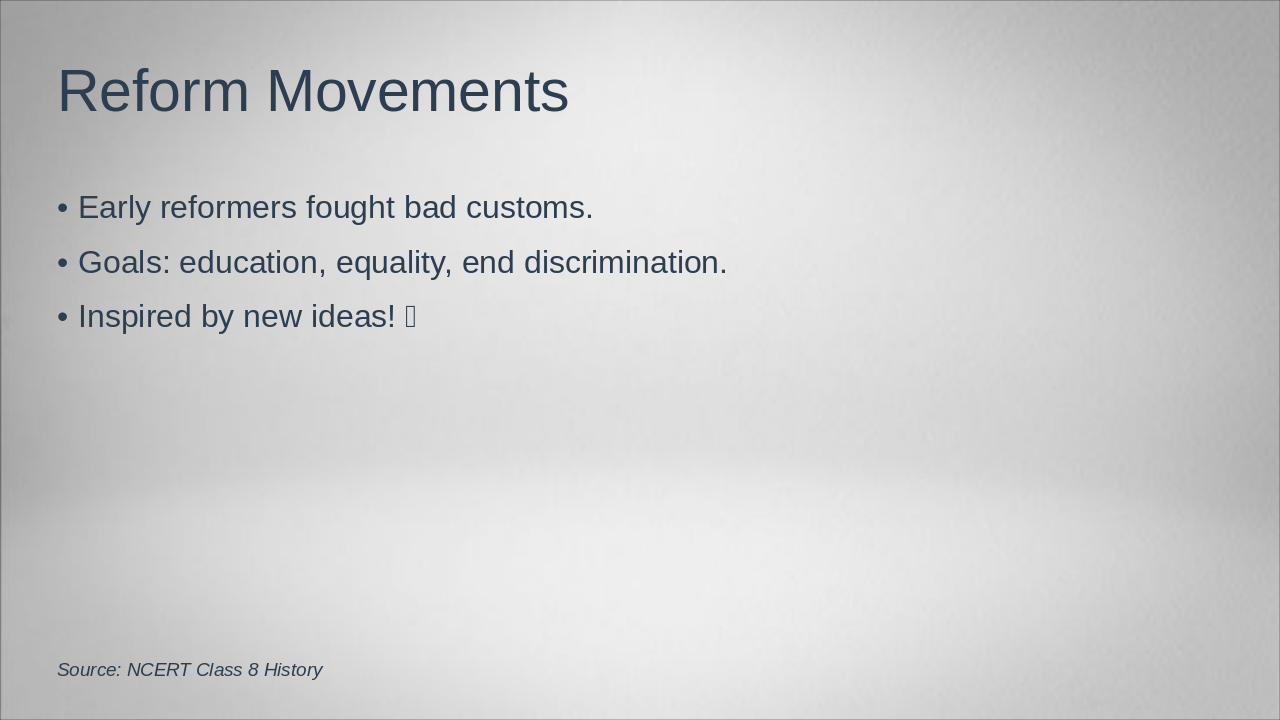
Early reformers challenged harmful customs to promote education, equality, and an end to discrimination. They were inspired by innovative new ideas.

Reform Movements

  • Early reformers fought bad customs.
  • Goals: education, equality, end discrimination.
  • Inspired by new ideas! ๐Ÿ’ก

Source: NCERT Class 8 History

Speaker Notes
Image: Group of reformers. Engaging for Class 8 students.
Slide 4 - Reform Movements
Slide 5 of 10

Slide 5 - Key Reformers

The "Key Reformers" slide highlights Raja Ram Mohan Roy, who founded Brahmo Samaj and fought against Sati, alongside Ishwar Chandra Vidyasagar, who pushed for widow remarriage and women's education. It also features Jyotirao and Savitribai Phule as equality pioneers who opened India's first schools for girls and lower castes while challenging caste barriers.

Key Reformers

Raja Ram Mohan Roy & Ishwar Chandra VidyasagarJyotirao & Savitribai Phule

| โ€ข Raja Ram Mohan Roy: Founded Brahmo Samaj Fought against Sati

  • Ishwar Chandra Vidyasagar:
  • Pushed for Widow Remarriage Promoted women's education | โ€ข Pioneers for equality

  • Opened first schools
  • for girls & lower castes

  • Challenged caste barriers ๐Ÿ‘

Super heroes of reform! |

Slide 5 - Key Reformers
Slide 6 of 10

Slide 6 - Education & Womenโ€™s Rights

The slide highlights pioneering efforts like the first girls' schools established by Jyotirao and Savitribai Phule in 1848 and the Widow Remarriage Law passed in 1856 by Vidyasagar. It emphasizes how rising girls' education broke barriers and empowered women to challenge inequalities.

Education & Womenโ€™s Rights

  • First girls' schools by Jyotirao & Savitribai Phule (1848)
  • Widow Remarriage Law passed in 1856 (Vidyasagar)
  • Rising girls' education broke barriers ๐Ÿ“š
  • Empowered women challenged inequalities โœจ

Source: NCERT Class 8 History

Speaker Notes
Explain Phules' pioneering role and Vidyasagar's law; discuss empowerment through education for Class 8.
Slide 6 - Education & Womenโ€™s Rights
Slide 7 of 10

Slide 7 - Caste Reform

Leaders like Phules fought untouchability and led temple entry movements for equal access. Growing demands for caste rights slowly broke down barriers.

Caste Reform

  • Fighting untouchability: Phules and others led bravely
  • Temple entry movements pushed equal access
  • Demands grew for rights across castes
  • Slowly breaking caste walls! ๐ŸŒˆ

Source: NCERT History Class 8: Women, Caste and Reform

Slide 7 - Caste Reform
Slide 8 of 10

Slide 8 - Religious Reform Movements

The slide on Religious Reform Movements compares two key groups in a two-column format. Brahmo Samaj (1828, Raja Ram Mohan Roy) promoted monotheism, rational worship, and opposed idol worship, child marriage, and caste discrimination; Arya Samaj (1875, Swami Dayanand Saraswati) advocated returning to the Vedas, rejected idols and rituals, and pushed Vedic education for all, including women and lower castes.

Religious Reform Movements

Brahmo Samaj (Raja Ram Mohan Roy)Arya Samaj (Swami Dayanand Saraswati)
Founded in 1828. Believed in one God (monotheism). Opposed idol worship, child marriage, and caste discrimination. Promoted rational worship and social equality. (22 words)Founded in 1875. 'Back to Vedas' โ€“ pure Hinduism. Opposed idol worship and rituals. Emphasized Vedic education for all, including women and lower castes. (28 words)

Source: NCERT History Class 8

Slide 8 - Religious Reform Movements
Slide 9 of 10

Slide 9 - Outcomes

The Outcomes slide highlights the 1829 ban on Sati (widow immolation) and a 10X growth in schools with rapid education expansion. It also shows progress continuing despite caste challenges.

Outcomes

  • 1829: Sati Banned
  • Widow immolation outlawed

  • 10X: Schools Grew
  • Education expanded rapidly

  • ๐Ÿ“ˆ: Progress Continues
  • Despite caste challenges

Slide 9 - Outcomes
Slide 10 of 10

Slide 10 - Conclusion

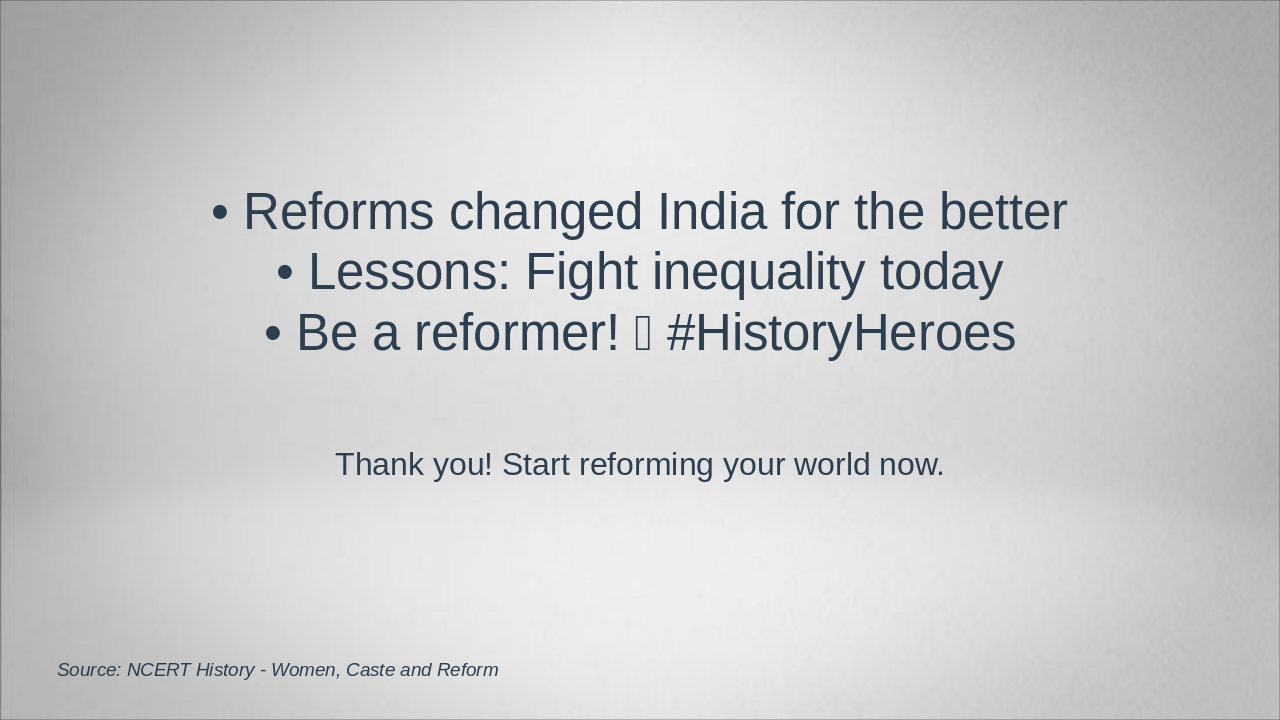
The conclusion slide states that reforms improved India, draws lessons to fight inequality today, and calls viewers to be reformers (#HistoryHeroes). It ends with a thank you and an invitation to start reforming the world now.

Conclusion

โ€ข Reforms changed India for the better

  • Lessons: Fight inequality today
  • Be a reformer! ๐ŸŒŸ #HistoryHeroes

Thank you! Start reforming your world now.

Source: NCERT History - Women, Caste and Reform

Speaker Notes
Summarize key reforms' impact, draw modern lessons, inspire students to act. End with Q&A.
Slide 10 - Conclusion

Discover More Presentations

Explore thousands of AI-generated presentations for inspiration

Browse Presentations
Powered by AI

Create Your Own Presentation

Generate professional presentations in seconds with Karaf's AI. Customize this presentation or start from scratch.

Create New Presentation

Powered by Karaf.ai โ€” AI-Powered Presentation Generator