PEGASIS in Hierarchical WSN Routing

Generated from prompt:

Create a 10-slide academic PowerPoint presentation about Hierarchical Routing Protocols in Wireless Sensor Networks (WSN), focusing on the PEGASIS (Power-Efficient GAthering in Sensor Information System) protocol. Use a clean white background theme. Include slides for: 1. Introduction to WSN, 2. Hierarchical Routing Concepts, 3. Advantages over Flat Routing, 4. PEGASIS Overview, 5. Algorithmic Steps, 6. Comparison with LEACH, 7. Advantages, 8. Limitations, and 9. Conclusion.

This presentation explores hierarchical routing in wireless sensor networks, emphasizing the PEGASIS protocol. It covers WSN basics, concepts, advantages over flat routing, PEGASIS overview and steps,

November 26, 202510 slides
Slide 1 of 10

Slide 1 - Hierarchical Routing Protocols in WSN: PEGASIS

This title slide introduces the topic of hierarchical routing protocols in wireless sensor networks, with a specific focus on PEGASIS. The subtitle welcomes viewers to an academic overview that highlights PEGASIS's role in enhancing energy efficiency.

Hierarchical Routing Protocols in WSN: PEGASIS

Welcome to this academic overview of hierarchical routing in wireless sensor networks, emphasizing the PEGASIS protocol for energy efficiency.

Slide 1 - Hierarchical Routing Protocols in WSN: PEGASIS
Slide 2 of 10

Slide 2 - Introduction to WSN

Wireless Sensor Networks (WSN) are composed of distributed sensor nodes that collect data and enable real-time monitoring across diverse environments. The slide highlights key challenges such as energy constraints, scalability, and routing efficiency, alongside applications in areas like environmental monitoring and healthcare systems.

Introduction to WSN

  • Wireless Sensor Networks (WSN) consist of distributed sensor nodes for data collection.
  • Sensor nodes enable real-time monitoring in various environments.
  • Key challenges include energy constraints, scalability, and routing efficiency.
  • Applications span environmental monitoring and healthcare systems.
Slide 2 - Introduction to WSN
Slide 3 of 10

Slide 3 - Hierarchical Routing Concepts

Hierarchical routing organizes network nodes into clusters led by elected cluster heads (CHs), which perform data aggregation to minimize transmissions and reduce energy consumption through efficient routing. Unlike flat networks, it employs multi-level structures to enhance scalability and performance.

Hierarchical Routing Concepts

  • Organizes nodes into clusters with elected leaders (CHs)
  • CHs perform data aggregation to minimize transmissions
  • Reduces energy consumption through efficient routing
  • Features multi-level structures unlike flat networks
Slide 3 - Hierarchical Routing Concepts
Slide 4 of 10

Slide 4 - Advantages over Flat Routing

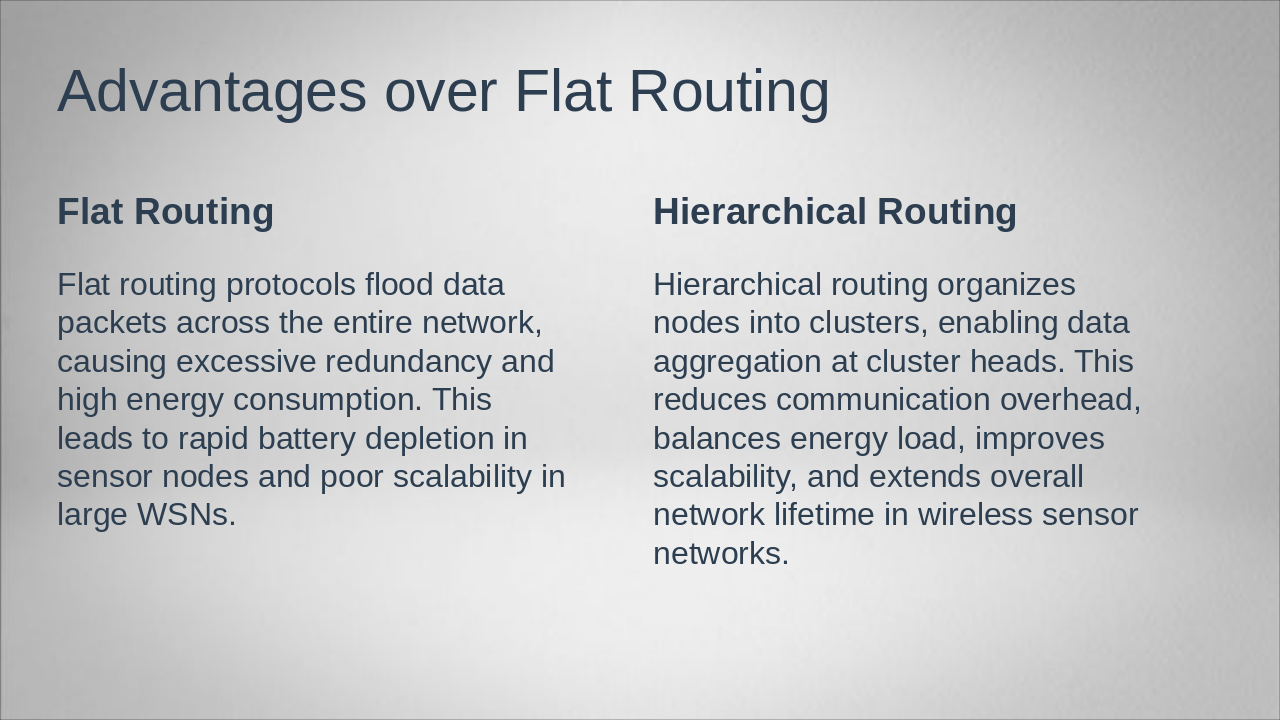
Flat routing floods data packets across the entire network, leading to excessive redundancy, high energy use, rapid battery depletion in sensor nodes, and poor scalability in large wireless sensor networks. In contrast, hierarchical routing organizes nodes into clusters for data aggregation at cluster heads, which reduces communication overhead, balances energy load, enhances scalability, and extends the overall network lifetime.

Advantages over Flat Routing

Flat RoutingHierarchical Routing
Flat routing protocols flood data packets across the entire network, causing excessive redundancy and high energy consumption. This leads to rapid battery depletion in sensor nodes and poor scalability in large WSNs.Hierarchical routing organizes nodes into clusters, enabling data aggregation at cluster heads. This reduces communication overhead, balances energy load, improves scalability, and extends overall network lifetime in wireless sensor networks.
Slide 4 - Advantages over Flat Routing
Slide 5 of 10

Slide 5 - PEGASIS Overview

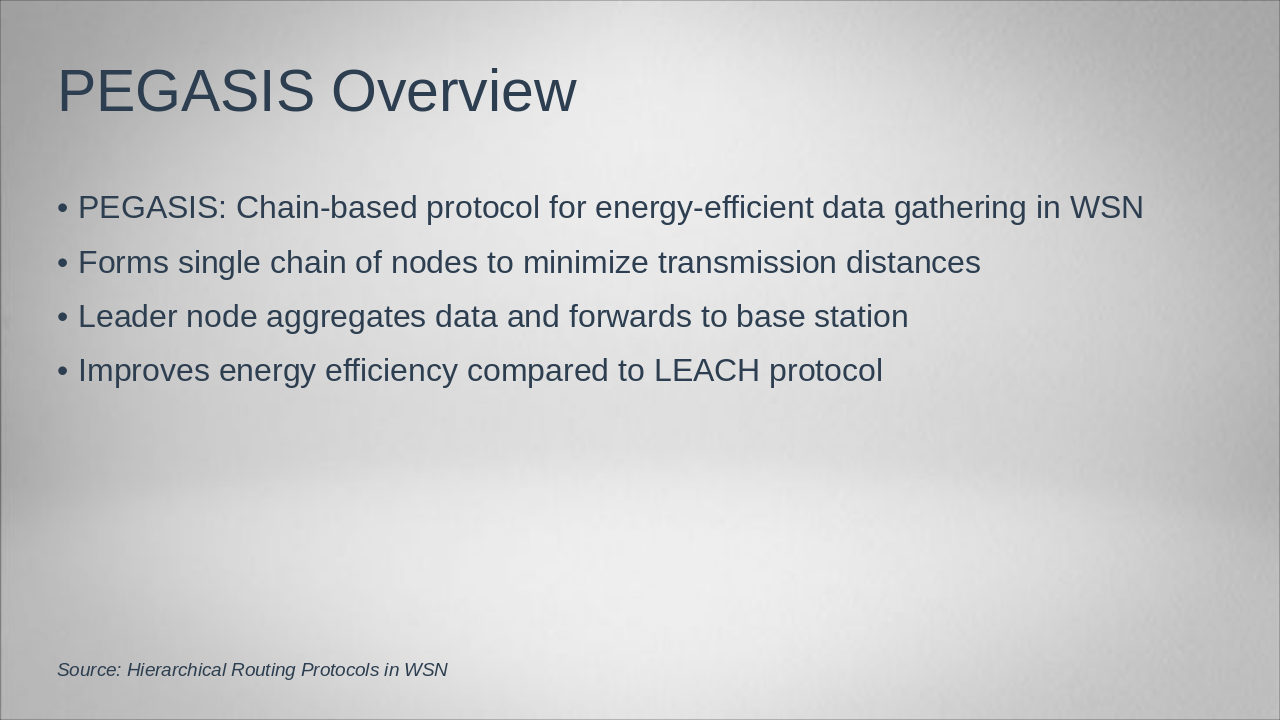
PEGASIS is a chain-based protocol designed for energy-efficient data gathering in wireless sensor networks (WSN), where nodes form a single chain to minimize transmission distances. A leader node aggregates the data and forwards it to the base station, offering improved energy efficiency over the LEACH protocol.

PEGASIS Overview

  • PEGASIS: Chain-based protocol for energy-efficient data gathering in WSN
  • Forms single chain of nodes to minimize transmission distances
  • Leader node aggregates data and forwards to base station
  • Improves energy efficiency compared to LEACH protocol

Source: Hierarchical Routing Protocols in WSN

Speaker Notes
PEGASIS is a chain-based protocol for WSN. Forms a single chain of nodes to minimize distance. Leader node sends aggregated data to base station, enhancing energy efficiency over LEACH.
Slide 5 - PEGASIS Overview
Slide 6 of 10

Slide 6 - Algorithmic Steps

The slide outlines a five-step algorithmic process for energy-efficient data aggregation in a sensor network. It begins with constructing a chain of nodes using a greedy method, selecting a random leader, aggregating data along the chain to the leader, transmitting the aggregated data to the base station, and rotating the leader for the next round to balance energy use.

Algorithmic Steps

Step 1: Construct Chain via Greedy Algorithm Form a chain connecting all sensor nodes using a greedy approach to minimize energy consumption. Step 2: Select Random Leader Node Choose a random node from the chain to act as the leader for data aggregation in this round. Step 3: Aggregate Data Along Chain Nodes pass and aggregate data sequentially along the chain towards the selected leader node. Step 4: Leader Transmits to Base Station The leader node sends the aggregated data directly to the base station. Step 5: Rotate Leader for Next Round Select a new leader for the subsequent round to distribute energy load evenly.

Slide 6 - Algorithmic Steps
Slide 7 of 10

Slide 7 - Comparison with LEACH

LEACH is a cluster-based protocol that randomly elects cluster heads for data aggregation and multi-hop communication to the base station, effectively balancing energy but struggling with uneven head distribution in large networks. In contrast, PEGASIS creates a single chain linking all nodes to a leader for data relay, bypassing clusters and elections to minimize transmission overhead, save more energy, and prolong network lifetime in expansive setups.

Comparison with LEACH

LEACHPEGASIS
LEACH is a cluster-based protocol that elects cluster heads (CHs) randomly. It uses multi-hop intra-cluster communication to aggregate data and send to the base station, balancing energy load but suffering from uneven CH distribution in large networks.PEGASIS forms a single chain connecting all nodes, eliminating clusters and CH elections. Data is passed along the chain to a leader node, reducing CH dependency. It saves more energy in large networks by minimizing transmission overhead and extending network lifetime.
Slide 7 - Comparison with LEACH
Slide 8 of 10

Slide 8 - Advantages

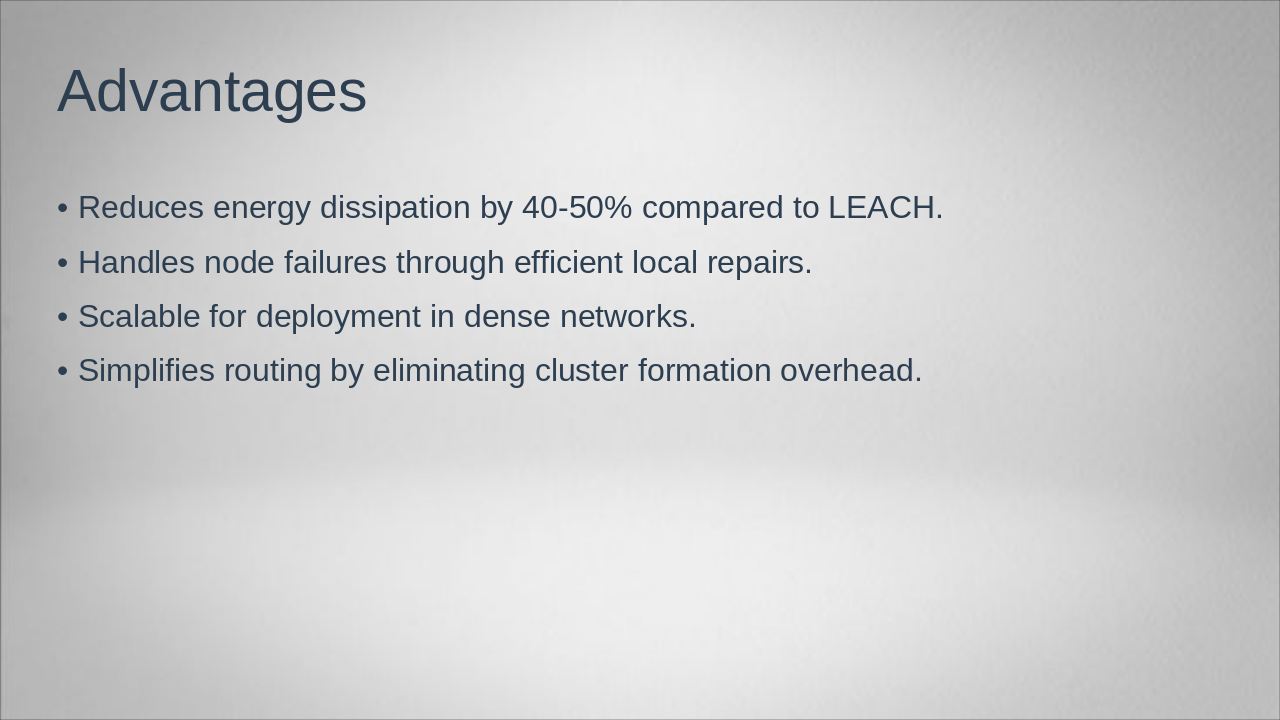
This slide outlines key advantages of the proposed protocol over LEACH, including a 40-50% reduction in energy dissipation and simplified routing by avoiding cluster formation overhead. It also highlights efficient handling of node failures via local repairs and scalability for dense network deployments.

Advantages

  • Reduces energy dissipation by 40-50% compared to LEACH.
  • Handles node failures through efficient local repairs.
  • Scalable for deployment in dense networks.
  • Simplifies routing by eliminating cluster formation overhead.
Slide 8 - Advantages
Slide 9 of 10

Slide 9 - Limitations

The slide outlines key limitations of a chain-based protocol, noting that long chains in large networks heighten latency. It also highlights risks like single points of failure at the leader node, unsuitability for sparse or mobile wireless sensor networks, and the need for global knowledge to build chains.

Limitations

  • Long chains increase latency in large networks.
  • Single point of failure at the leader node.
  • Not ideal for very sparse or mobile WSNs.
  • Requires global knowledge for chain construction.
Slide 9 - Limitations
Slide 10 of 10

Slide 10 - Conclusion

PEGASIS advances hierarchical routing in wireless sensor networks (WSN) by optimizing energy efficiency through chaining, making it ideal for static and dense deployments. Future enhancements could focus on addressing mobility and latency challenges.

Conclusion

PEGASIS advances hierarchical routing in WSN by optimizing energy via chaining. Ideal for static, dense deployments. Future enhancements could address mobility and latency issues.

PEGASIS: Pioneering Energy Efficiency in WSN

Slide 10 - Conclusion

Discover More Presentations

Explore thousands of AI-generated presentations for inspiration

Browse Presentations
Powered by AI

Create Your Own Presentation

Generate professional presentations in seconds with Karaf's AI. Customize this presentation or start from scratch.

Create New Presentation

Powered by Karaf.ai — AI-Powered Presentation Generator