Cascade Systems for Cryogenic Cooling

Generated from prompt:

Create a 5-slide academic presentation on 'Cascade Refrigeration System for Cryogenic Applications'. Include the following slides: 1. **Introduction** – Overview of refrigeration systems and need for cryogenic temperatures. 2. **Principle of Cascade Refrigeration** – Explain working concept and thermodynamic basis. 3. **System Components** – Compressors, condensers, evaporators, inter-stage heat exchangers, and refrigerants. 4. **Applications in Cryogenics** – Use in liquefaction of gases (nitrogen, helium, etc.), and cryogenic research. 5. **Advantages and Limitations** – Efficiency, achievable temperature range, complexity, and maintenance challenges. Ensure academic tone, concise technical text, and visually clear slide layout.

This presentation explores cascade refrigeration systems for achieving cryogenic temperatures below -150°C. It covers principles, components like multi-stage compressors and heat exchangers, applicati

November 27, 20255 slides
Slide 1 of 5

Slide 1 - Introduction

Conventional vapor-compression cycles can reach temperatures down to -40°C, but cryogenic applications demand much lower levels below -150°C for gas liquefaction. Cascade systems address this by staging multiple cycles to achieve ultra-low temperatures, driven by demands in scientific, medical, and industrial fields.

Introduction

  • Conventional vapor-compression cycles achieve temperatures down to -40°C.
  • Cryogenic applications require temperatures below -150°C for gas liquefaction.
  • Cascade systems stage multiple cycles to reach ultra-low temperatures.
  • Driven by needs in scientific, medical, and industrial fields.

Source: Overview of refrigeration systems and need for cryogenic temperatures.

Speaker Notes
Overview of refrigeration systems: Conventional vapor-compression cycles achieve temperatures down to -40°C, but cryogenic applications require below -150°C for processes like gas liquefaction. Cascade systems address this by staging multiple cycles for ultra-low temperatures. Necessity driven by scientific, medical, and industrial needs.
Slide 1 - Introduction
Slide 2 of 5

Slide 2 - Principle of Cascade Refrigeration

Cascade refrigeration uses multiple stages in series, each with a refrigerant of successively lower boiling points, where the heat rejected by the lower stage's condenser is absorbed by the upper stage's evaporator to enable progressive cooling. Thermodynamically, it builds on Carnot efficiency by minimizing irreversibilities via optimized pressure ratios and intercooling, allowing temperatures near absolute zero in cryogenic applications through improved overall cycle efficiency.

Principle of Cascade Refrigeration

Working ConceptThermodynamic Basis
Cascade refrigeration employs multiple stages in series, each with a different refrigerant featuring successively lower boiling points. The heat rejected by the lower stage's condenser is absorbed by the upper stage's evaporator, enabling progressive cooling.Based on Carnot efficiency limits, multi-stage systems minimize irreversibilities through optimized pressure ratios and intercooling. This approach achieves temperatures approaching absolute zero by enhancing overall cycle efficiency in cryogenic applications.
Slide 2 - Principle of Cascade Refrigeration
Slide 3 of 5

Slide 3 - System Components

The slide outlines key components of a multi-stage refrigeration system, including multi-stage compressors (reciprocating or centrifugal), air- or water-cooled condensers for heat dissipation, evaporators for managing cooling loads, and inter-stage heat exchangers for efficient heat transfer between cascades. It also specifies refrigerants like R-134a for high stages and hydrocarbons or helium for low stages to ensure compatibility.

System Components

  • Compressors: Multi-stage, reciprocating or centrifugal for each cycle.
  • Condensers: Air- or water-cooled to dissipate heat effectively.
  • Evaporators: Manage cooling loads in lower temperature stages.
  • Inter-stage Heat Exchangers: Enable efficient heat transfer between cascades.
  • Refrigerants: High-stage (e.g., R-134a); low-stage (e.g., hydrocarbons, helium) for compatibility.
Slide 3 - System Components
Slide 4 of 5

Slide 4 - Applications in Cryogenics

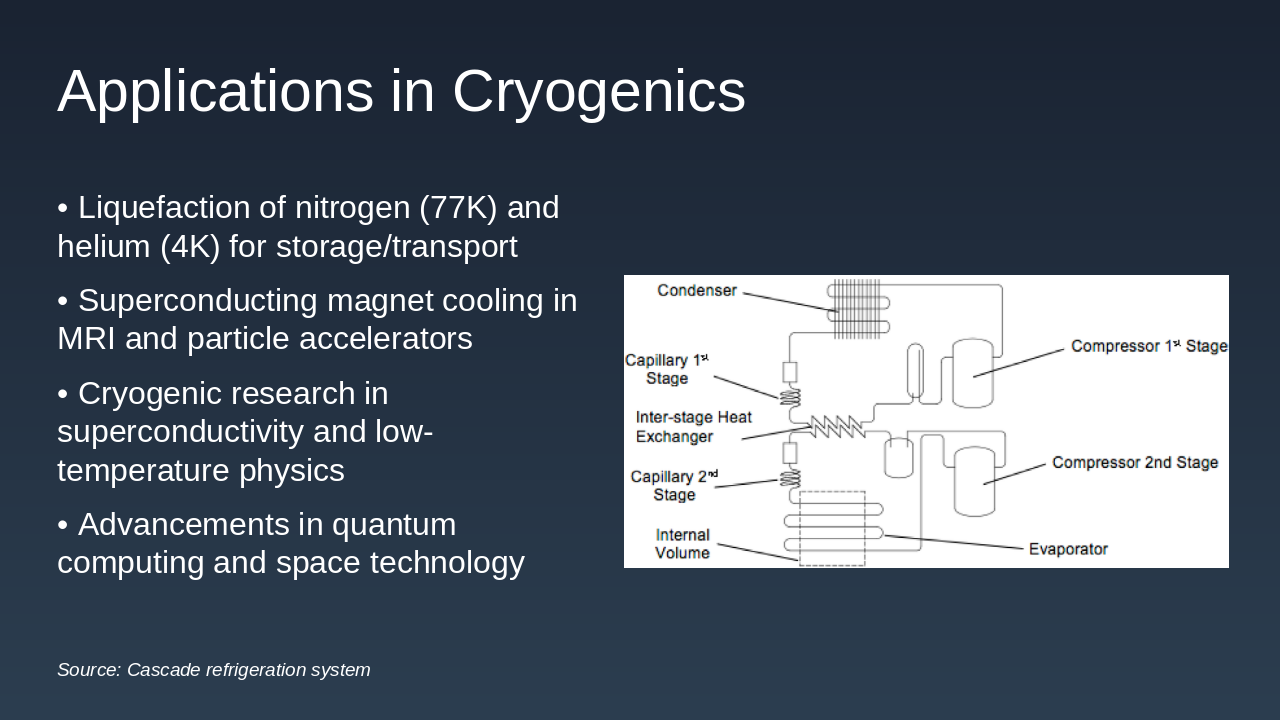
Cryogenics finds key applications in liquefying nitrogen at 77K and helium at 4K for efficient storage and transport. It also supports superconducting magnet cooling in MRI machines and particle accelerators, advances research in superconductivity and low-temperature physics, and drives innovations in quantum computing and space technology.

Applications in Cryogenics

!Image

  • Liquefaction of nitrogen (77K) and helium (4K) for storage/transport
  • Superconducting magnet cooling in MRI and particle accelerators
  • Cryogenic research in superconductivity and low-temperature physics
  • Advancements in quantum computing and space technology

Source: Cascade refrigeration system

Speaker Notes
Visual: Diagram of cascade system in gas liquefaction plant. Key uses: Liquefaction of air gases like nitrogen (77K) and helium (4K) for storage/transport; superconducting magnet cooling in MRI and particle accelerators; cryogenic research in superconductivity and low-temperature physics. Enables advancements in quantum computing and space tech.
Slide 4 - Applications in Cryogenics
Slide 5 of 5

Slide 5 - Advantages and Limitations

The slide highlights key advantages of the multi-stage system, including achieving ultra-low temperatures down to 4K with a higher coefficient of performance than single-stage setups and flexible refrigerant options for improved efficiency. It also notes limitations such as high complexity leading to elevated initial costs and maintenance needs, potential leaks in multi-stage configurations, and the requirement for precise control to prevent inefficiencies, while concluding that it remains vital for cryogenic advancements despite these challenges.

Advantages and Limitations

**Advantages:

  • Achieves ultra-low temperatures (down to 4K) with higher COP than single-stage
  • Flexible refrigerant selection improves efficiency

Limitations:

  • High complexity increases initial costs and maintenance
  • Potential leaks in multi-stage setups
  • Requires precise control to avoid inefficiencies

Overall: Vital for cryogenic advancements despite challenges.**

Speaker Notes
Closing message: Cascade systems drive cryogenic progress. Call-to-action: Integrate into research for ultra-low temperature applications.
Slide 5 - Advantages and Limitations

Discover More Presentations

Explore thousands of AI-generated presentations for inspiration

Browse Presentations
Powered by AI

Create Your Own Presentation

Generate professional presentations in seconds with Karaf's AI. Customize this presentation or start from scratch.

Create New Presentation

Powered by Karaf.ai — AI-Powered Presentation Generator