Semiconductors: Revolutionizing Electronics

Generated from prompt:

make a presentation about semiconductors

This presentation explores semiconductors, from core concepts like silicon doping and transistor structures to historical milestones, industry stats, advantages/challenges, modern applications in AI a

November 20, 202511 slides
Slide 1 of 11

Slide 1 - Semiconductors: A Revolution in Electronics

The slide's title, "Semiconductors: A Revolution in Electronics," highlights the pivotal impact of semiconductors on the field of electronics. Its subtitle introduces the foundational concepts of semiconductors and their transformative influence on contemporary technology.

Semiconductors: A Revolution in Electronics

Introduction to the world of semiconductors and their transformative role in modern technology.
Slide 1
Slide 2 of 11

Slide 2 - Presentation Agenda

The presentation agenda outlines a structured overview of semiconductors, starting with an introduction to their basics and followed by a historical timeline of the industry's evolution. It then covers key milestones from Fairchild, current industry statistics and applications, and concludes with a summary and future outlook.

Presentation Agenda

  1. Introduction to Semiconductors

Overview of what semiconductors are and their basics.

  1. Historical Timeline

Evolution of the semiconductor industry over time.

  1. Key Milestones with Fairchild

Significant achievements and innovations from Fairchild.

  1. Industry Stats and Applications

Current statistics and modern uses in technology.

  1. Conclusion

Summary of key points and future outlook.

Slide 2
Slide 3 of 11

Slide 3 - What Are Semiconductors?

Semiconductors are fundamental materials that conduct electricity only under specific conditions, making them essential for modern electronics. This slide introduces the concept, highlighting their role in enabling key components like transistors and integrated circuits (ICs).

What Are Semiconductors?

What Are Semiconductors?

Fundamental materials that conduct electricity under certain conditions, enabling transistors and ICs.

Slide 3
Slide 4 of 11

Slide 4 - Core Concepts

Semiconductors are constructed from materials like silicon or germanium and are doped to form n-type or p-type variants, serving as the foundation for essential components such as diodes, transistors, and microchips. These materials enable significant miniaturization and improved efficiency in modern electronic devices.

Core Concepts

  • Constructed from silicon or germanium materials.
  • Doped to create n-type or p-type semiconductors.
  • Form the basis for diodes, transistors, and microchips.
  • Enable miniaturization and efficiency in electronic devices.
Slide 4
Slide 5 of 11

Slide 5 - Semiconductor Structure

The slide on Semiconductor Structure explains that transistors control the flow of electrons in semiconductor materials. It highlights the basic structure of a transistor, including the emitter, base, and collector, and notes that integrated circuits integrate multiple transistors to enable various functions.

Semiconductor Structure

!Image

  • Transistors control electron flow in semiconductors
  • Basic structure includes emitter, base, and collector
  • Integrated circuits combine multiple transistors for functionality

Source: Bipolar junction transistor

--- Speaker Notes: Visual diagram showing a basic transistor and integrated circuit layout, illustrating electron flow. Context: presentation about semiconductors.

Slide 5
Slide 6 of 11

Slide 6 - Historical Timeline

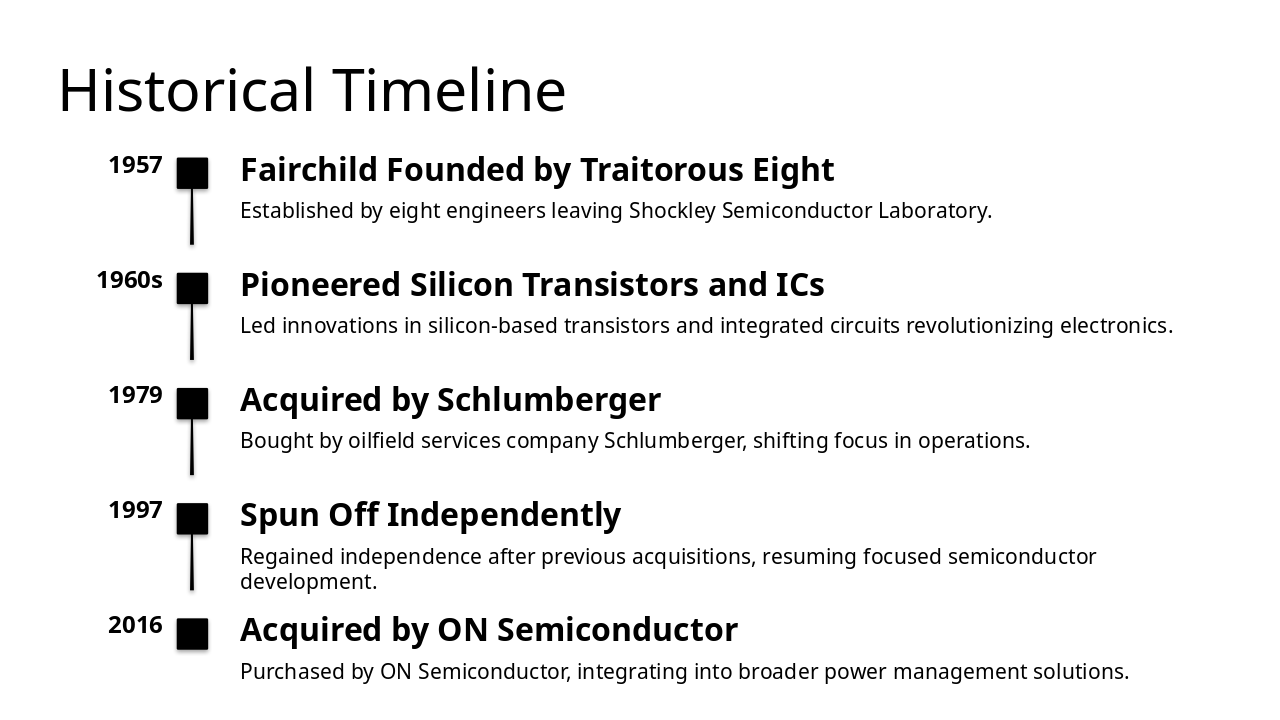
The historical timeline slide outlines Fairchild Semiconductor's key milestones, starting with its founding in 1957 by the "Traitorous Eight" engineers who left Shockley Semiconductor Laboratory. It highlights innovations in silicon transistors and integrated circuits during the 1960s, followed by acquisitions in 1979 by Schlumberger, a 1997 spin-off for independence, and a 2016 purchase by ON Semiconductor.

Historical Timeline

1957: Fairchild Founded by Traitorous Eight Established by eight engineers leaving Shockley Semiconductor Laboratory. 1960s: Pioneered Silicon Transistors and ICs Led innovations in silicon-based transistors and integrated circuits revolutionizing electronics. 1979: Acquired by Schlumberger Bought by oilfield services company Schlumberger, shifting focus in operations. 1997: Spun Off Independently Regained independence after previous acquisitions, resuming focused semiconductor development. 2016: Acquired by ON Semiconductor Purchased by ON Semiconductor, integrating into broader power management solutions.

Slide 6
Slide 7 of 11

Slide 7 - Industry Impact Stats

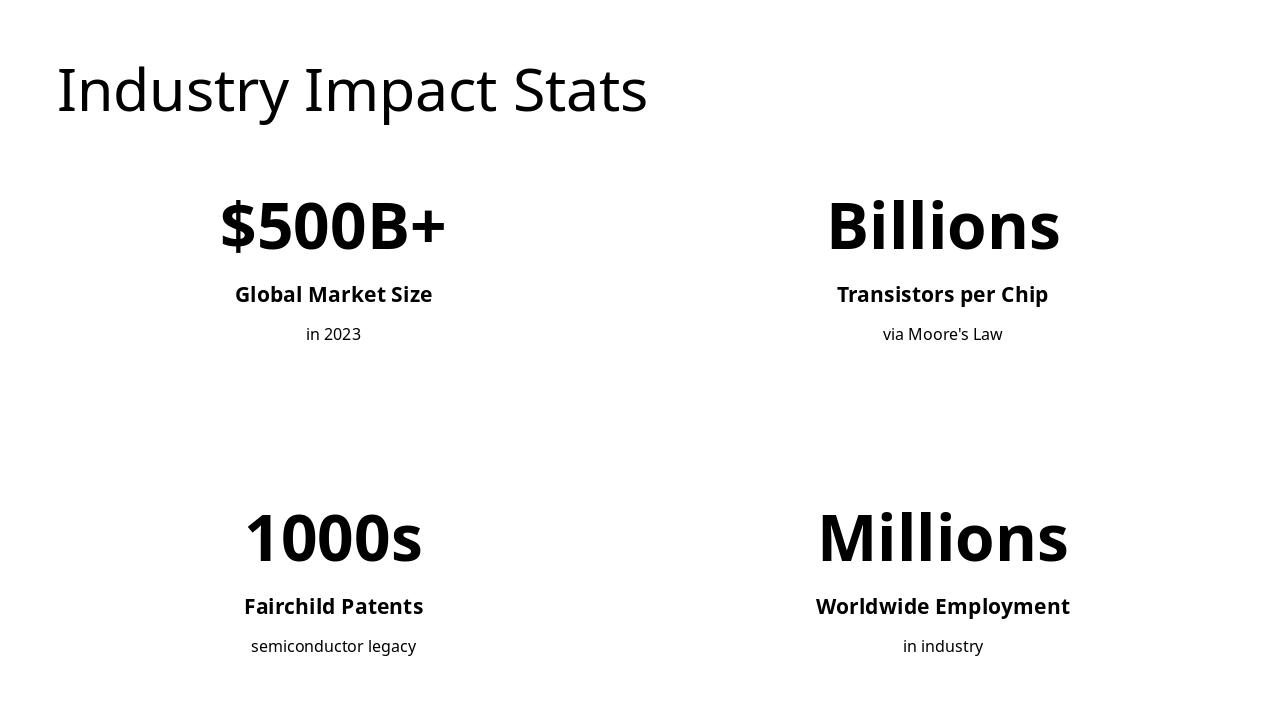
The Industry Impact Stats slide highlights the semiconductor sector's global market size exceeding $500 billion in 2023. It also showcases key metrics like billions of transistors per chip driven by Moore's Law, thousands of Fairchild patents underscoring its legacy, and millions of worldwide jobs supported by the industry.

Industry Impact Stats

  • $500B+: Global Market Size

in 2023

  • Billions: Transistors per Chip

via Moore's Law

  • 1000s: Fairchild Patents

semiconductor legacy

  • Millions: Worldwide Employment

in industry

Slide 7
Slide 8 of 11

Slide 8 - Pioneering Vision

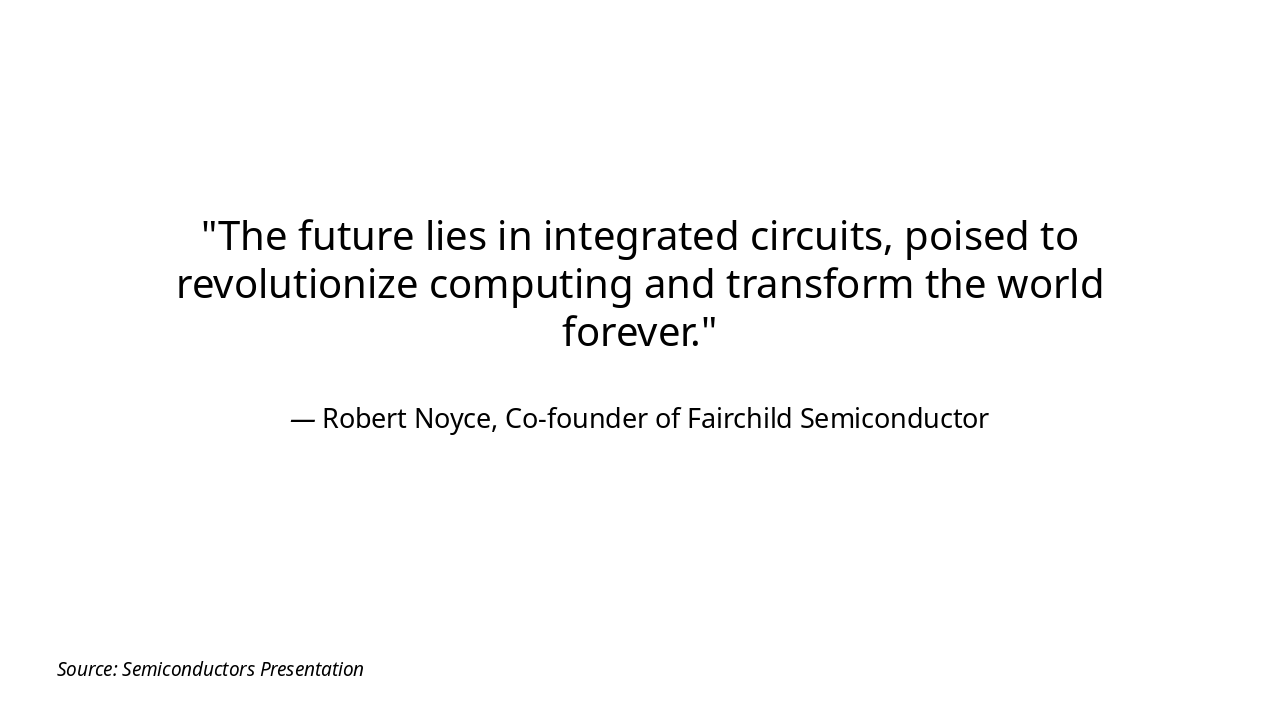
The slide, titled "Pioneering Vision," features a quote from Robert Noyce, co-founder of Fairchild Semiconductor. In it, he foresees integrated circuits as the key to revolutionizing computing and transforming the world forever.

Pioneering Vision

> The future lies in integrated circuits, poised to revolutionize computing and transform the world forever.

— Robert Noyce, Co-founder of Fairchild Semiconductor

Source: Semiconductors Presentation

--- Speaker Notes: Context: Making a presentation about semiconductors. Original description: 'The future is in integrated circuits.' – Robert Noyce, Fairchild co-founder, on revolutionizing computing.

Slide 8
Slide 9 of 11

Slide 9 - Advantages vs. Challenges

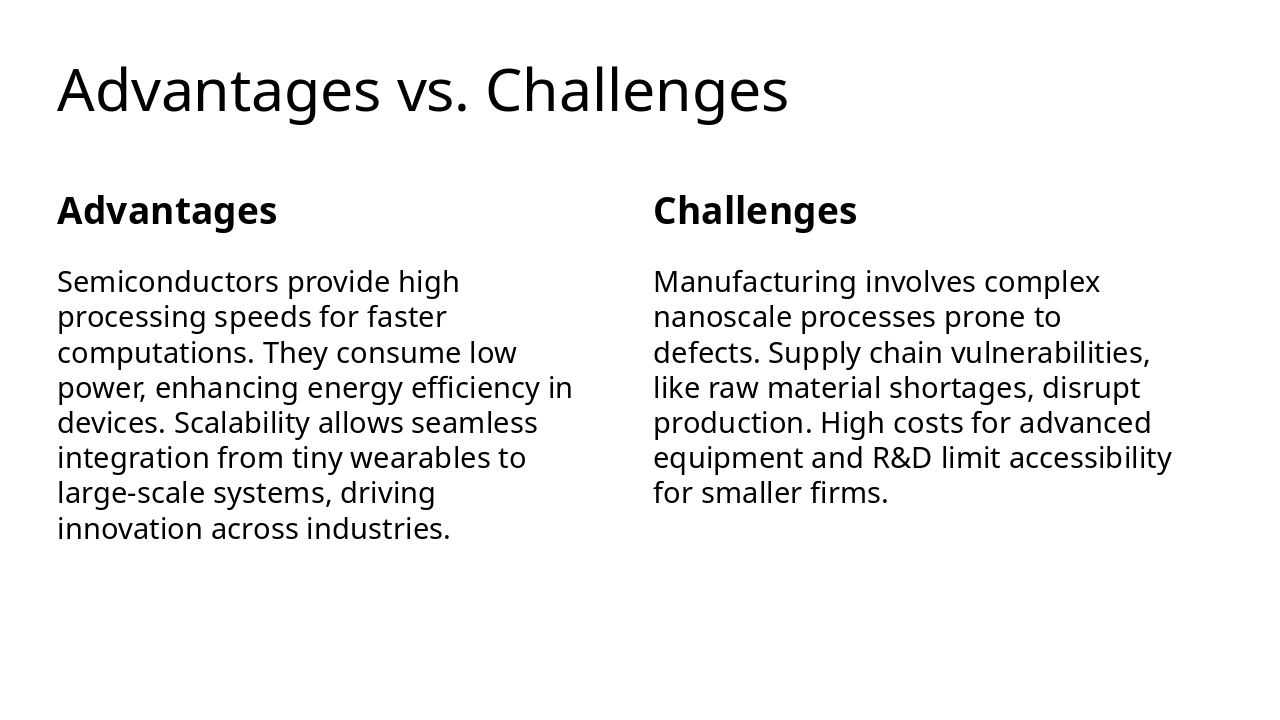
Semiconductors offer key advantages including high processing speeds for faster computations, low power consumption for energy efficiency, and scalability that enables integration from small wearables to large systems, fostering industry innovation. However, they face challenges such as complex nanoscale manufacturing prone to defects, supply chain vulnerabilities from raw material shortages, and high costs for advanced equipment and R&D that restrict access for smaller firms.

Advantages vs. Challenges

AdvantagesChallenges
Semiconductors provide high processing speeds for faster computations. They consume low power, enhancing energy efficiency in devices. Scalability allows seamless integration from tiny wearables to large-scale systems, driving innovation across industries.Manufacturing involves complex nanoscale processes prone to defects. Supply chain vulnerabilities, like raw material shortages, disrupt production. High costs for advanced equipment and R&D limit accessibility for smaller firms.
Slide 9
Slide 10 of 11

Slide 10 - Modern Applications

Semiconductors drive modern technology by enabling high-speed processing in smartphones and computers, while also fueling advancements in AI and machine learning. They further enhance efficiency in renewable energy solar cells and power electric vehicles along with autonomous driving systems.

Modern Applications

  • Semiconductors enable high-speed processing in smartphones and computers.
  • Semiconductors fuel advancements in AI and machine learning.
  • Semiconductors enhance efficiency in renewable energy solar cells.
  • Semiconductors power electric vehicles and autonomous driving systems.
Slide 10
Slide 11 of 11

Slide 11 - The Future of Semiconductors

Semiconductors are the driving force behind innovation, with ongoing advances poised to deliver smarter and more sustainable technologies. The slide concludes with a thank you and an encouragement to stay ahead in semiconductor advancements.

The Future of Semiconductors

Semiconductors drive innovation; ongoing advances promise smarter, sustainable tech.

Thank you! Stay ahead in semiconductor advancements.

--- Speaker Notes: make a presentation about semiconductors

Slide 11
Powered by AI

Create Your Own Presentation

Generate professional presentations in seconds with Karaf's AI. Customize this presentation or start from scratch.

Create New Presentation

Powered by Karaf.ai — AI-Powered Presentation Generator