Data Science in Agriculture: Sentiment Analysis & Disease AI

Generated from prompt:

Create a professional PowerPoint presentation for a Data Science Internship report with 15 slides: Slide 1: Title Slide Project Title Internship Title Student Name College Name Date Image: AI + Agriculture concept Slide 2: Introduction What is Data Science Role of AI in real-world problems Overview of internship work Image: AI ecosystem diagram Slide 3: Objectives of the Internship Learn Data Science workflow Work on NLP project Work on Computer Vision project Build end-to-end models Image: Target/goal icon Slide 4: Tools & Technologies Used Python Pandas NumPy Scikit-learn TensorFlow / Keras Google Colab Image: Tech stack icons Slide 5: Project 1 – Sentiment Analysis Overview Definition Purpose Applications (Twitter, reviews) Image: Social media sentiment icons Slide 6: NLP Workflow Data loading Data cleaning Text preprocessing Feature extraction (TF-IDF) Model training Image: Flowchart Slide 7: NLP Model & Results Model used Accuracy Confusion matrix Observations Image: Graph/chart Slide 8: Project 2 – Plant Disease Detection Problem statement Importance in agriculture Objective Image: Healthy vs diseased plants Slide 9: Image Processing Steps Dataset handling Image preprocessing Train/test split Image: Image pipeline Slide 10: CNN Model Architecture Convolution layer Pooling layer Dense layer Image: CNN diagram Slide 11: Model Training & Optimization Epochs, batch size Data augmentation Dropout (overfitting control) Image: Training graph Slide 12: Results & Evaluation Model accuracy Testing with new images Observations Image: Prediction outputs Slide 13: Learning Outcomes NLP concepts Machine Learning Deep Learning (CNN) Data preprocessing Problem-solving Image: Skills infographic Slide 14: Challenges & Solutions Data cleaning issues Model accuracy improvement Overfitting problem Solutions applied Image: Problem-solving diagram Slide 15: Conclusion & Future Scope Summary of internship Key achievements Future improvements Thank You Image: Future AI concept Use a modern professional theme with icons and visuals on each slide.

Data Science internship report showcasing NLP-based sentiment analysis and CNN-powered plant disease detection for agriculture. Covers workflows, tools (Python, TensorFlow), models, results, learnings, challenges, and future mobile deployment.

April 21, 202626 slides
Slide 1 of 26

Slide 1 - Data Science Internship Report

Data Science Applications in Agriculture: Sentiment Analysis and Disease Detection

Data Science Internship Report | Presented by [Student Name] | [College Name] | [Date]
Slide 1 - Data Science Internship Report
Slide 2 of 26

Slide 2 - Data Science Internship Report

Data Science Applications in Agriculture: Sentiment Analysis and Disease Detection

Data Science Internship Report | Presented by [Student Name] | [College Name] | [Date]
Slide 2 - Data Science Internship Report
Slide 3 of 26

Slide 3 - Data Science Internship Report

Data Science Applications in Agriculture: Sentiment Analysis and Disease Detection

Data Science Internship Report | Presented by [Student Name] | [College Name] | [Date]
Slide 3 - Data Science Internship Report
Slide 4 of 26

Slide 4 - Data Science Internship Report

Data Science Applications in Agriculture: Sentiment Analysis and Disease Detection

Data Science Internship Report | Presented by [Student Name] | [College Name] | [Date]

---

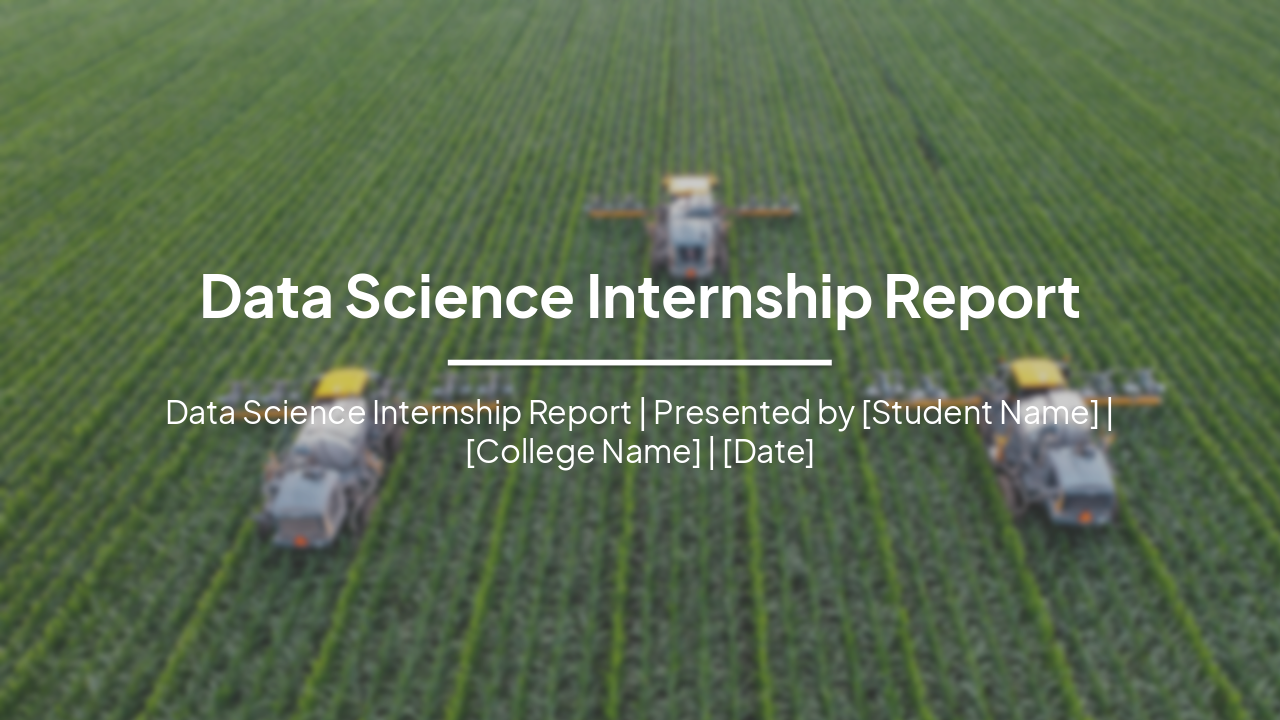
Photo by James Baltz on Unsplash
Slide 4 - Data Science Internship Report
Slide 5 of 26

Slide 5 - Data Science Internship Report

Data Science Applications in Agriculture: Sentiment Analysis and Disease Detection

Data Science Internship Report | Presented by [Student Name] | [College Name] | [Date]
Slide 5 - Data Science Internship Report
Slide 6 of 26

Slide 6 - Data Science Internship Report

Data Science Applications in Agriculture: Sentiment Analysis and Disease Detection

Data Science Internship Report | Presented by [Student Name] | [College Name] | [Date]
Slide 6 - Data Science Internship Report
Slide 7 of 26

Slide 7 - Introduction

  • Data Science: Extracting actionable insights from structured and unstructured data.
  • Role of AI: Solving complex real-world challenges through predictive modeling and pattern recognition.
  • Internship Overview: Focused on developing end-to-end machine learning pipelines for NLP and Computer Vision.

---

Photo by Conny Schneider on Unsplash
Slide 7 - Introduction
Slide 8 of 26

Slide 8 - Objectives of the Internship

  • Understand the complete end-to-end Data Science workflow.
  • Develop and deploy an NLP project for sentiment analysis.
  • Execute a Computer Vision project for automated image analysis.
  • Gain hands-on experience building, training, and evaluating predictive models.

---

Photo by onehundredseventyfive on Unsplash
Slide 8 - Objectives of the Internship
Slide 9 of 26

Slide 9 - Tools & Technologies Used

  • Programming: Python.
  • Data Manipulation: Pandas, NumPy.
  • ML Libraries: Scikit-learn, TensorFlow, Keras.
  • Development Environment: Google Colab.

---

Photo by Delaney Van on Unsplash

Slide 9 - Tools & Technologies Used
Slide 10 of 26

Slide 10 - Project 1 – Sentiment Analysis Overview

  • Definition: Identifying the emotional tone behind a body of text.
  • Purpose: To interpret human sentiment from digital data automatically.
  • Applications: Analyzing Twitter feeds, product reviews, and public feedback.

---

Photo by Yuriy Dellutri on Unsplash
Slide 10 - Project 1 – Sentiment Analysis Overview
Slide 11 of 26

Slide 11 - NLP Workflow

  • Data Loading: Importing raw datasets.
  • Data Cleaning: Handling missing values and noise.
  • Text Preprocessing: Tokenization, normalization.
  • Feature Extraction: Utilizing TF-IDF for numerical representation.
  • Model Training: Building the sentiment classifier.

---

Photo by Logan Voss on Unsplash

Slide 11 - NLP Workflow
Slide 12 of 26

Slide 12 - NLP Model & Results

  • Model: Utilized [Model Name, e.g., Logistic Regression or Naive Bayes].
  • Accuracy: Achieved [Insert %] accuracy.
  • Confusion Matrix: Detailed breakdown of true/false positives and negatives.
  • Observations: High model performance on balanced data sets.

---

Photo by Piotr Wilk on Unsplash

Slide 12 - NLP Model & Results
Slide 13 of 26

Slide 13 - Project 2 – Plant Disease Detection

  • Problem Statement: Rapid identification of plant diseases to prevent crop loss.
  • Importance: Enhancing agricultural sustainability and yield protection.
  • Objective: Automate disease detection using deep learning image recognition.
Slide 13 - Project 2 – Plant Disease Detection
Slide 14 of 26

Slide 14 - Image Processing Steps

  • Dataset Handling: Curating and labeling agricultural images.
  • Image Preprocessing: Resizing, normalization, and color conversion.
  • Train/Test Split: Creating robust partitions for model validation.

---

Photo by Adrian Infernus on Unsplash
Slide 14 - Image Processing Steps
Slide 15 of 26

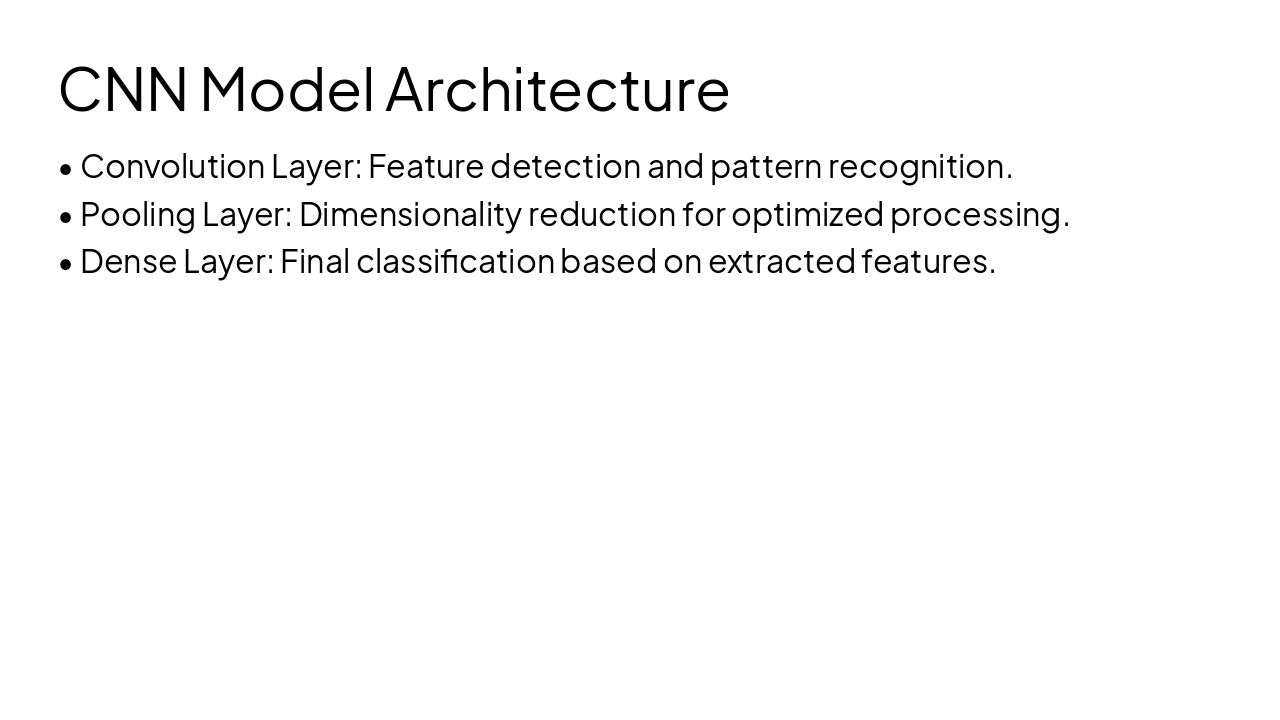
Slide 15 - CNN Model Architecture

  • Convolution Layer: Feature detection and pattern recognition.
  • Pooling Layer: Dimensionality reduction for optimized processing.
  • Dense Layer: Final classification based on extracted features.
Slide 15 - CNN Model Architecture
Slide 16 of 26

Slide 16 - Model Training & Optimization

  • Training Parameters: Defined epochs, batch size, and learning rate.
  • Data Augmentation: Improving generalizability with synthetic variations.
  • Dropout: Implementing layers to mitigate overfitting.

---

Photo by Pawel Czerwinski on Unsplash
Slide 16 - Model Training & Optimization
Slide 17 of 26

Slide 17 - Results & Evaluation

  • Model Accuracy: Achieved [Insert %] testing accuracy.
  • Testing: Validated model performance on unseen field images.
  • Observations: High sensitivity to early-stage disease patterns.

---

Photo by TheStandingDesk on Unsplash
Slide 17 - Results & Evaluation
Slide 18 of 26

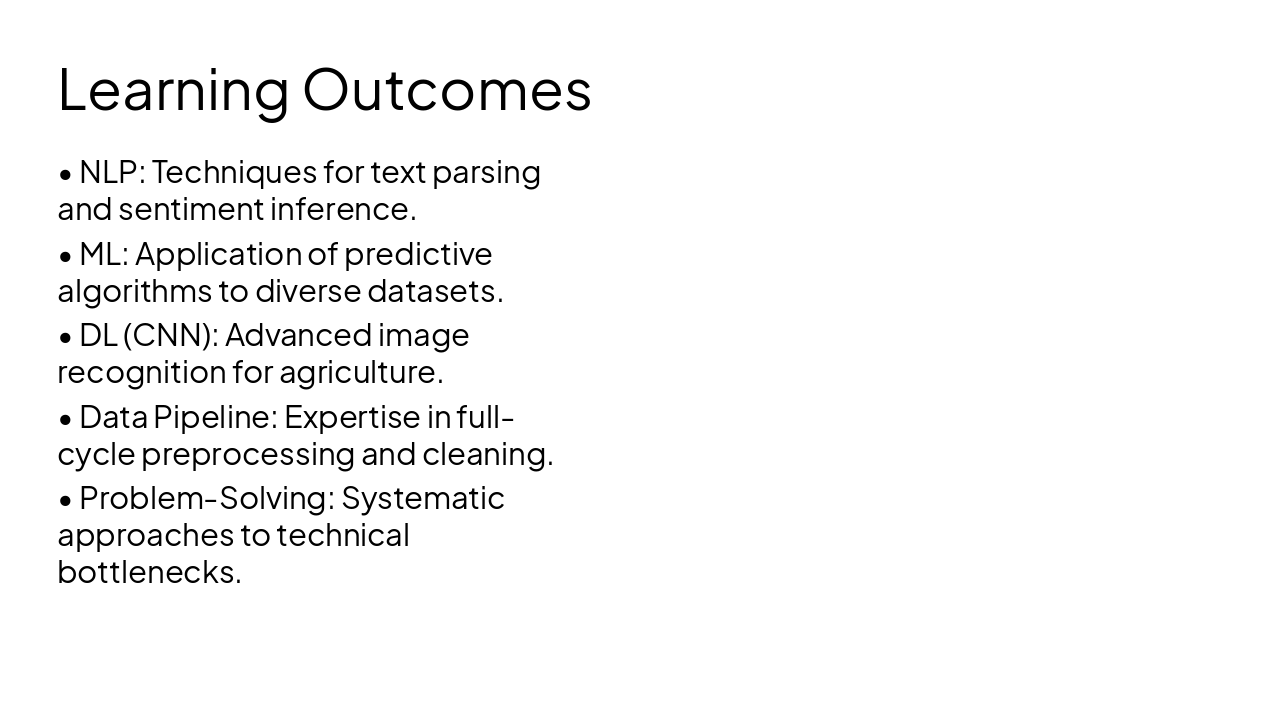
Slide 18 - Learning Outcomes

  • NLP: Techniques for text parsing and sentiment inference.
  • ML: Application of predictive algorithms to diverse datasets.
  • DL (CNN): Advanced image recognition for agriculture.
  • Data Pipeline: Expertise in full-cycle preprocessing and cleaning.
  • Problem-Solving: Systematic approaches to technical bottlenecks.
Slide 18 - Learning Outcomes
Slide 19 of 26

Slide 19 - Learning Outcomes

  • NLP: Techniques for text parsing and sentiment inference.
  • Machine Learning: Predictive algorithms to diverse datasets.
  • Deep Learning (CNN): Advanced image recognition for agriculture.
  • Data Preprocessing: Expert cycle efficiency.
  • Problem-solving: Technical bottleneck management.

---

Photo by Nastuh Abootalebi on Unsplash
Slide 19 - Learning Outcomes
Slide 20 of 26

Slide 20 - Challenges & Solutions

  • Challenge: Complex data cleaning issues; Solution: Developed automated filtering scripts.
  • Challenge: Stagnant model accuracy; Solution: Optimized hyperparameters and increased training data.
  • Challenge: Overfitting the training set; Solution: Applied dropout and data augmentation.

---

Photo by Tanja Tepavac on Unsplash
Slide 20 - Challenges & Solutions
Slide 21 of 26

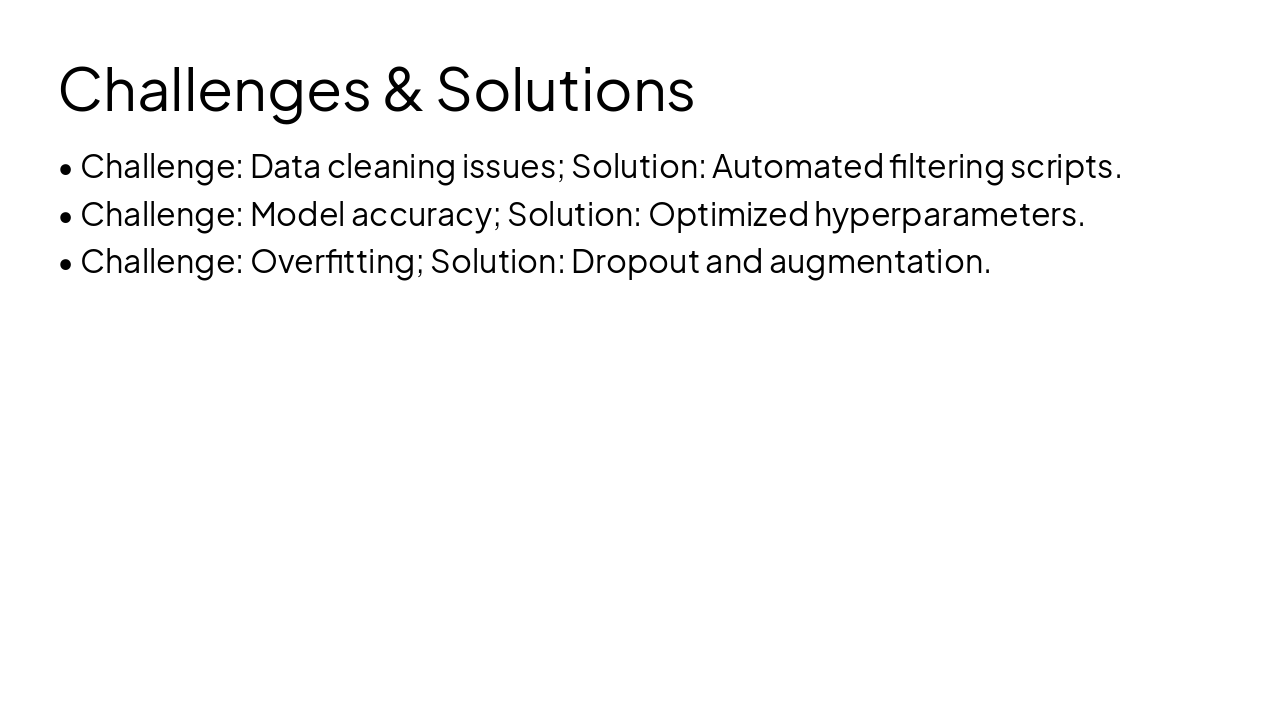
Slide 21 - Challenges & Solutions

  • Challenge: Data cleaning issues; Solution: Automated filtering scripts.
  • Challenge: Model accuracy; Solution: Optimized hyperparameters.
  • Challenge: Overfitting; Solution: Dropout and augmentation.
Slide 21 - Challenges & Solutions
Slide 22 of 26

Slide 22 - Conclusion & Future Scope

Key achievements include successful predictive model implementation. Future scope involves mobile deployment and real-time field monitoring.

Thank you for your time. Questions?
Slide 22 - Conclusion & Future Scope
Slide 23 of 26

Slide 23 - Conclusion & Future Scope

Key achievements include successful predictive model implementation. Future scope involves mobile deployment and real-time field monitoring.

Thank you for your time. Questions?
Slide 23 - Conclusion & Future Scope
Slide 24 of 26

Slide 24 - Conclusion & Future Scope

Key achievements include successful predictive model implementation. Future scope involves mobile deployment and real-time field monitoring.

Thank you for your time. Questions?
Slide 24 - Conclusion & Future Scope
Slide 25 of 26

Slide 25 - Conclusion & Future Scope

Internship Summary: Successfully applied NLP and CNN models to solve critical real-world problems. Key achievements include [Insert Key Achievement]. Future scope involves scaling models for mobile deployment and real-time field monitoring.

Thank you for your time. Questions?
Slide 25 - Conclusion & Future Scope
Slide 26 of 26

Slide 26 - Conclusion & Future Scope

Key achievements include successful predictive model implementation. Future scope involves mobile deployment and real-time field monitoring.

Thank you for your time. Questions?
Slide 26 - Conclusion & Future Scope

Discover More Presentations

Explore thousands of AI-generated presentations for inspiration

Browse Presentations
Powered by AI

Create Your Own Presentation

Generate professional presentations in seconds with Karaf's AI. Customize this presentation or start from scratch.

Create New Presentation

Powered by Karaf.ai — AI-Powered Presentation Generator