Smart Auto Door with DC Motors & Sensors

Generated from prompt:

Automatic Door using DC Motor and Sensors.

This presentation outlines an IoT-based automatic door system using DC motors for movement and IR/ultrasonic sensors for detection. It covers components, working principle, implementation steps, advan

November 14, 202510 slides
Slide 1 of 10

Slide 1 - Automatic Door Using DC Motor and Sensors

The slide's title is "Automatic Door Using DC Motor and Sensors," introducing a project on building an automatic door system. The subtitle explains that it uses a DC motor and sensors to enable hands-free operation.

Automatic Door Using DC Motor and Sensors

Building an Automatic Door System with DC Motor and Sensors for Hands-Free Operation

Source: Context: Automatic Door using DC Motor and Sensors.

--- Speaker Notes: Welcome slide introducing the project on building an automatic door system with DC motor and sensors for hands-free operation.
Slide 1
Slide 2 of 10

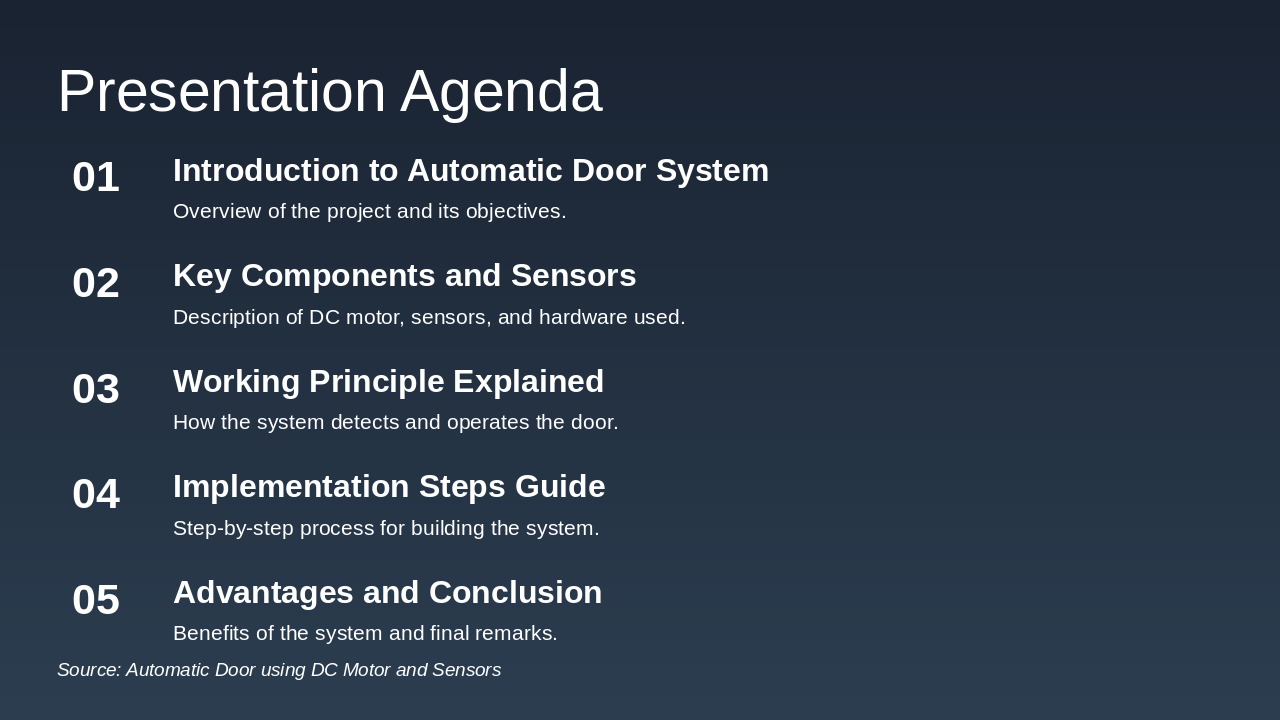
Slide 2 - Presentation Agenda

The presentation agenda outlines the structure for discussing an Automatic Door System project, beginning with an introduction to its overview and objectives. It then covers key components like DC motors and sensors, the system's working principle, step-by-step implementation guide, and concludes with advantages and final remarks.

Presentation Agenda

  1. Introduction to Automatic Door System

Overview of the project and its objectives.

  1. Key Components and Sensors

Description of DC motor, sensors, and hardware used.

  1. Working Principle Explained

How the system detects and operates the door.

  1. Implementation Steps Guide

Step-by-step process for building the system.

  1. Advantages and Conclusion

Benefits of the system and final remarks.

Source: Automatic Door using DC Motor and Sensors

Slide 2
Slide 3 of 10

Slide 3 - Project Introduction

Slide 3
Slide 4 of 10

Slide 4 - Key Components

The slide outlines the key components of a door automation system, including a DC motor for controlling opening and closing movements. It also features IR or ultrasonic sensors for detecting human presence, an Arduino microcontroller to process signals and coordinate operations, and a power supply to energize the motor and electronics.

Key Components

  • DC Motor controls door opening and closing movements.
  • IR or Ultrasonic sensors detect human presence for activation.
  • Arduino microcontroller processes signals and coordinates operations.
  • Power supply provides energy to motor and electronics.

Source: Automatic Door using DC Motor and Sensors.

Slide 4
Slide 5 of 10

Slide 5 - System Diagram

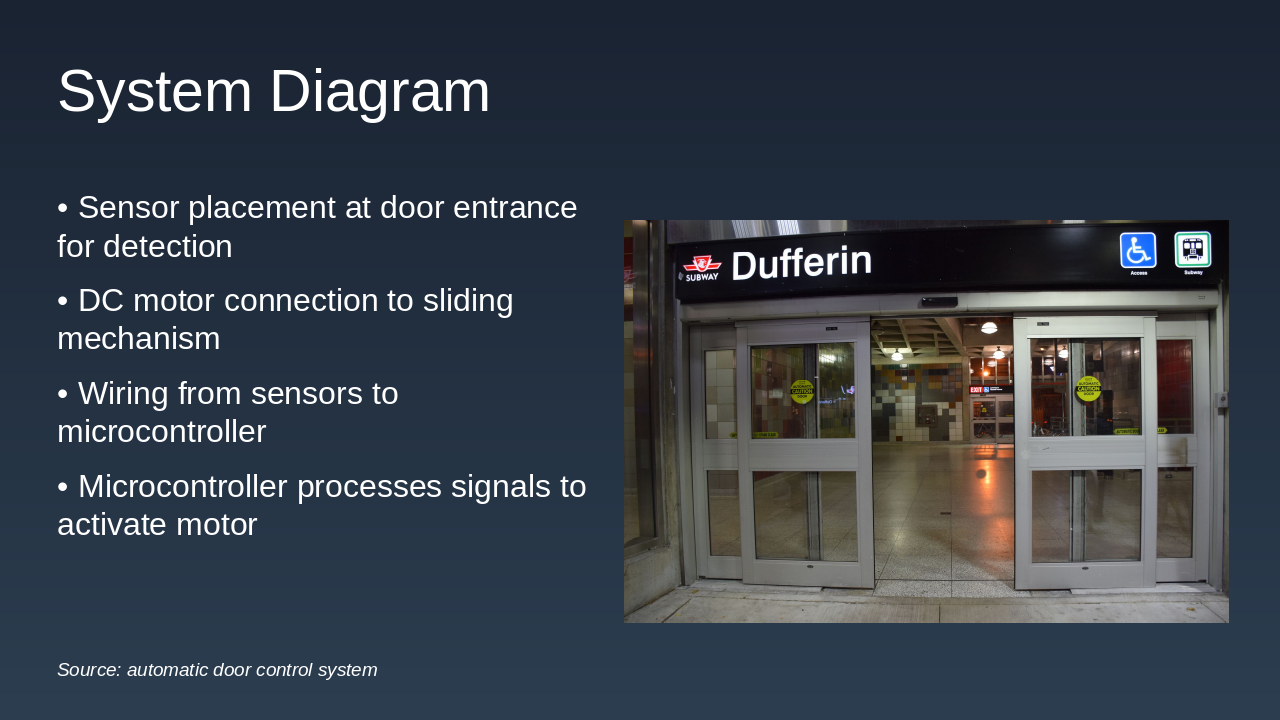
The slide presents a system diagram illustrating the integration of components for an automated door mechanism. It highlights sensor placement at the door entrance for detection, DC motor connection to the sliding mechanism, wiring from sensors to the microcontroller, and the microcontroller's role in processing signals to activate the motor.

System Diagram

!Image

  • Sensor placement at door entrance for detection
  • DC motor connection to sliding mechanism
  • Wiring from sensors to microcontroller
  • Microcontroller processes signals to activate motor

Source: automatic door control system

Slide 5
Slide 6 of 10

Slide 6 - Working Principle

The slide explains the working principle of an automatic door system using DC motors and sensors, divided into motion detection and motor activation. When motion is detected nearby, the sensor signals the microcontroller to initiate the door sequence; the microcontroller then activates the DC motor to open the door smoothly, followed by a delay before reversing it to close securely.

Working Principle

Motion DetectionMotor Activation
The sensor identifies nearby motion and immediately transmits a signal to the microcontroller, initiating the automatic door sequence in the Automatic Door system using DC Motor and Sensors.Upon receiving the signal, the microcontroller powers the DC motor to open the door smoothly; after a programmed delay, it reverses the motor direction to close the door securely.
Slide 6
Slide 7 of 10

Slide 7 - Implementation Steps

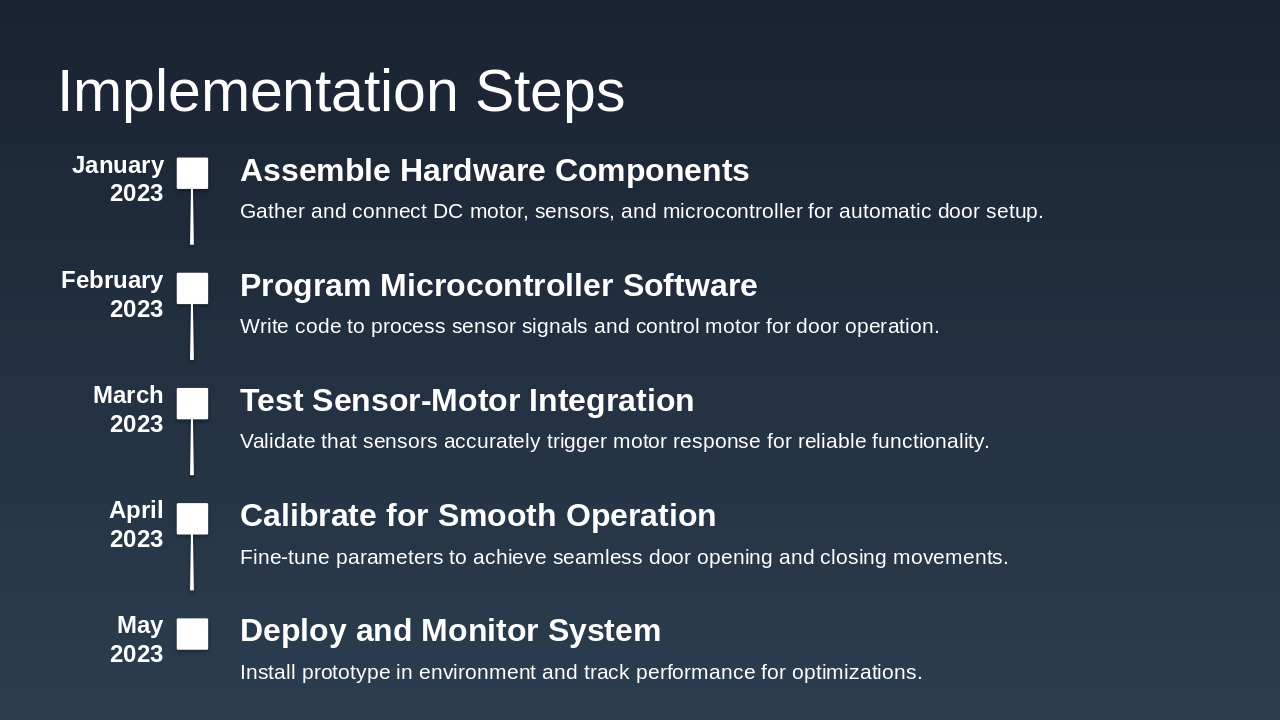
The timeline slide outlines the implementation steps for an automatic door system, starting with assembling hardware components like a DC motor, sensors, and microcontroller in January 2023. It progresses through programming the microcontroller in February, testing integration in March, calibrating for smooth operation in April, and finally deploying and monitoring the system in May.

Implementation Steps

January 2023: Assemble Hardware Components Gather and connect DC motor, sensors, and microcontroller for automatic door setup. February 2023: Program Microcontroller Software Write code to process sensor signals and control motor for door operation. March 2023: Test Sensor-Motor Integration Validate that sensors accurately trigger motor response for reliable functionality. April 2023: Calibrate for Smooth Operation Fine-tune parameters to achieve seamless door opening and closing movements. May 2023: Deploy and Monitor System Install prototype in environment and track performance for optimizations.

Slide 7
Slide 8 of 10

Slide 8 - Advantages and Stats

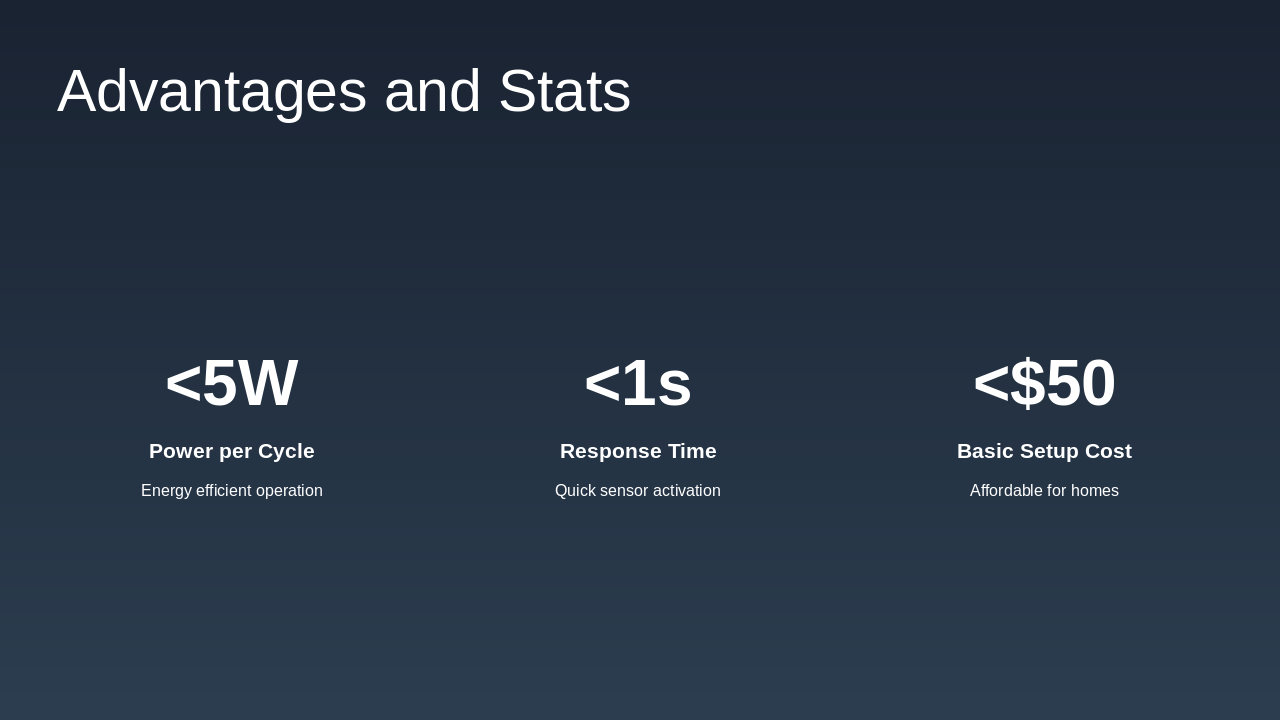
The slide highlights key advantages of a sensor system, emphasizing its energy efficiency with power consumption under 5W per cycle. It also showcases a response time of less than 1 second, quick activation, and a basic setup cost below $50, making it affordable for home use.

Advantages and Stats

  • <5W: Power per Cycle

Energy efficient operation

  • <1s: Response Time

Quick sensor activation

  • <$50: Basic Setup Cost

Affordable for homes

Slide 8
Slide 9 of 10

Slide 9 - Expert Insight

The slide, titled "Expert Insight," features a quote from Dr. Alex Rivera, a Robotics Engineer, emphasizing how automation streamlines daily life. In the quote, Dr. Rivera explains that sensor-driven systems power seamless interactions, like DC motor-operated automatic doors, rendering everyday tasks effortless and efficient.

Expert Insight

> Automation simplifies life by harnessing sensor-driven systems that enable seamless interactions, such as automatic doors powered by DC motors, making everyday tasks effortless and efficient.

— Dr. Alex Rivera, Robotics Engineer

Source: On sensor-driven systems for automatic doors

Slide 9
Slide 10 of 10

Slide 10 - Conclusion

This project showcases a practical IoT application for automatic door systems, utilizing DC motors and sensors. Future enhancements could include voice control or app integration, and thank you for your attention.

Conclusion

This project demonstrates practical IoT application in automatic door systems using DC motors and sensors. Future enhancements: Add voice control or app integration.

Thank you!

Source: Automatic Door using DC Motor and Sensors

--- Speaker Notes: Closing message: Innovative IoT door automation achieved. Call-to-action: Consider voice control enhancements for your projects.

Slide 10
Powered by AI

Create Your Own Presentation

Generate professional presentations in seconds with Karaf's AI. Customize this presentation or start from scratch.

Create New Presentation

Powered by Karaf.ai — AI-Powered Presentation Generator