Exploring SaaS, Open SaaS & SOA Architectures

Generated from prompt:

Create a 20-slide PowerPoint presentation on the topic 'Software as a Service (SaaS), Open SaaS & SOA Architecture)'. Include a title slide and a thank you slide. Presented by Aditi Gorai, Ankur Sasmal, Ritesh Kumar, and Krishnendu Ghosh with roll numbers 10000222040, 10000222039, 10000222004, and 10000222069. The presentation should explain key concepts, benefits, architecture, examples, and comparisons of SaaS, Open SaaS, and SOA, including visuals and diagrams where appropriate.

This presentation introduces SaaS as subscription-based software delivery with multi-tenant efficiency, Open SaaS as customizable open-source via hosting, and SOA as loosely coupled reusable services.

November 25, 202520 slides
Slide 1 of 20

Slide 1 - Software as a Service (SaaS), Open SaaS & SOA Architecture

The title slide introduces the topic of Software as a Service (SaaS), Open SaaS, and SOA Architecture, focusing on cloud-based software models. It is presented by Aditi Gorai, Ankur Sasmal, Ritesh Kumar, and Krishnendu Ghosh.

Software as a Service (SaaS), Open SaaS & SOA Architecture

Presented by Aditi Gorai (10000222040), Ankur Sasmal (10000222039), Ritesh Kumar (10000222004), Krishnendu Ghosh (10000222069) Introduction to cloud-based software models.

Slide 1 - Software as a Service (SaaS), Open SaaS & SOA Architecture
Slide 2 of 20

Slide 2 - Presentation Agenda

The presentation agenda outlines a structured exploration starting with an introduction to SaaS, covering its concepts, benefits, architecture, and examples. It proceeds to delve into Open SaaS, SOA principles and architecture, comparisons with market insights, and concludes with key takeaways.

Presentation Agenda

  1. Introduction to SaaS
  2. Overview of SaaS concepts, benefits, architecture, and examples.

  3. Open SaaS Exploration
  4. Detailed overview, benefits, and business model of Open SaaS.

  5. SOA Principles and Architecture
  6. Core principles, benefits, and architectural components of SOA.

  7. Comparisons and Market Insights
  8. Comparative analysis of SaaS, Open SaaS, and SOA with market statistics.

  9. Conclusion and Summary
  10. Key takeaways and final thoughts on the topics discussed.

Slide 2 - Presentation Agenda
Slide 3 of 20

Slide 3 - What is SaaS?

This section header slide introduces the topic "What is SaaS?" as the first section (01) of the presentation. It defines SaaS as a cloud computing model that delivers software applications over the internet through a subscription-based service.

What is SaaS?

01

What is SaaS?

A cloud computing model delivering software over the internet on a subscription basis.

Slide 3 - What is SaaS?
Slide 4 of 20

Slide 4 - Key Concepts of SaaS

SaaS, or Software as a Service, delivers software through subscription-based access and a multi-tenant architecture that efficiently shares resources among users. Providers manage scalability and updates, ensuring seamless access from any internet-connected device.

Key Concepts of SaaS

  • Subscription-based access to software services
  • Multi-tenant architecture for efficient resource sharing
  • Provider handles scalability and seamless updates
  • Accessible from any device with internet connection
Slide 4 - Key Concepts of SaaS
Slide 5 of 20

Slide 5 - Benefits of SaaS

SaaS offers key benefits like cost savings by eliminating upfront hardware investments and simplifying maintenance through automatic updates. It also provides global accessibility from anywhere, along with rapid deployment and easy scalability.

Benefits of SaaS

  • Achieve cost savings without upfront hardware investments
  • Simplify maintenance and automatic updates
  • Ensure global accessibility from anywhere
  • Enable rapid deployment and scalability
Slide 5 - Benefits of SaaS
Slide 6 of 20

Slide 6 - SaaS Architecture Diagram

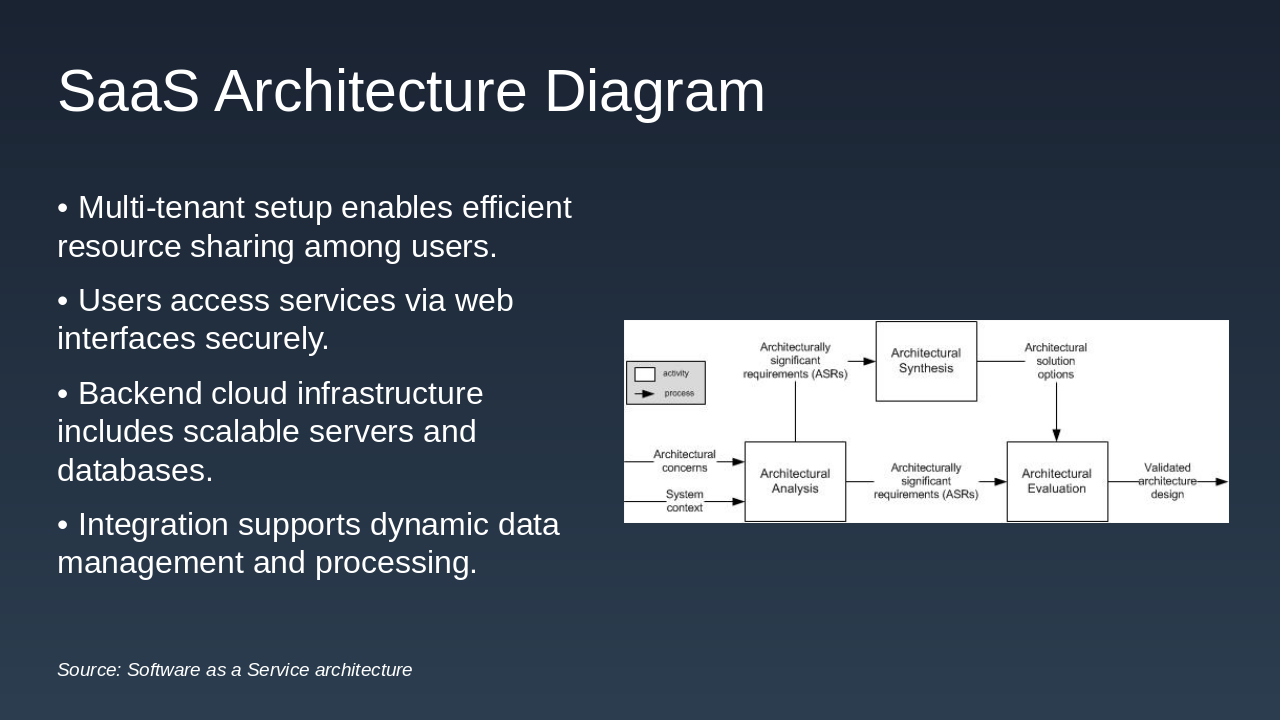
The slide presents a diagram of SaaS architecture, highlighting a multi-tenant setup that enables efficient resource sharing among users while allowing secure access to services through web interfaces. It also depicts the backend cloud infrastructure with scalable servers and databases, supporting integration for dynamic data management and processing.

SaaS Architecture Diagram

!Image

  • Multi-tenant setup enables efficient resource sharing among users.
  • Users access services via web interfaces securely.
  • Backend cloud infrastructure includes scalable servers and databases.
  • Integration supports dynamic data management and processing.

Source: Software as a Service architecture

Speaker Notes
Diagram illustrates key components of SaaS multi-tenant architecture for the presentation.
Slide 6 - SaaS Architecture Diagram
Slide 7 of 20

Slide 7 - Examples of SaaS Applications

This slide, titled "Examples of SaaS Applications," presents a bullet-point list of popular software-as-a-service tools. It highlights Google Workspace for email, documents, and collaboration; Salesforce as a CRM platform; Dropbox for cloud file storage and sharing; and Zoom for video conferencing and virtual meetings.

Examples of SaaS Applications

  • Google Workspace: Email, documents, and collaboration tools
  • Salesforce: Customer relationship management (CRM) platform
  • Dropbox: Cloud-based file storage and sharing
  • Zoom: Video conferencing and virtual meetings
Slide 7 - Examples of SaaS Applications
Slide 8 of 20

Slide 8 - Open SaaS

This section header slide, titled "Open SaaS" and numbered 02, introduces a software model that merges traditional SaaS delivery with open-source principles. It emphasizes customizable, community-driven solutions for enhanced flexibility and collaboration.

Open SaaS

02

Open SaaS

Combines SaaS delivery with open-source principles for customizable, community-driven software.

Slide 8 - Open SaaS
Slide 9 of 20

Slide 9 - Understanding Open SaaS

Open SaaS involves delivering open-source code through SaaS hosting, which allows for easy modifications and third-party integrations. It strikes a balance between proprietary features and open models, fostering innovation via community collaboration.

Understanding Open SaaS

  • Open-source code delivered via SaaS hosting
  • Enables modifications and third-party integrations
  • Balances proprietary elements with open models
  • Drives innovation through community collaboration
Slide 9 - Understanding Open SaaS
Slide 10 of 20

Slide 10 - Benefits of Open SaaS

Open SaaS offers cost-effective customization through open-source flexibility and accelerates feature development with community contributions. It also enhances transparency and security via audits while avoiding vendor lock-in for better portability.

Benefits of Open SaaS

  • Cost-effective customization through open-source flexibility
  • Faster feature development via community contributions
  • Enhanced transparency and security through audits
  • Avoids vendor lock-in for greater portability
Slide 10 - Benefits of Open SaaS
Slide 11 of 20

Slide 11 - Open SaaS Model Illustration

The slide illustrates an open SaaS model, with an open-source codebase serving as the foundation and a SaaS delivery platform enabling scalability. It highlights user customization layers for flexibility and community contributions to drive ongoing innovation.

Open SaaS Model Illustration

!Image

  • Open-source codebase as foundation
  • SaaS delivery platform for scalability
  • User customization layers for flexibility
  • Community contributions drive innovation

Source: Wikipedia: Software as a service

Speaker Notes
Diagram showing open-source SaaS architecture components.
Slide 11 - Open SaaS Model Illustration
Slide 12 of 20

Slide 12 - SOA Architecture

This section header slide, numbered 11, introduces the topic of SOA Architecture. It defines SOA as a design approach in which applications are constructed from interconnected services.

SOA Architecture

11

SOA Architecture

A design approach where applications are built as interconnected services.

Slide 12 - SOA Architecture
Slide 13 of 20

Slide 13 - Key Principles of SOA

The slide on Key Principles of SOA highlights how loose coupling allows services to be developed and deployed independently, while reusability across applications boosts efficiency and cuts down on redundancy. It also emphasizes interoperability through standards like SOAP and REST for smooth integration, alongside a modular, scalable design that fosters flexibility and growth.

Key Principles of SOA

  • Loose coupling of services enables independent development and deployment
  • Reusability across applications promotes efficiency and reduces redundancy
  • Interoperability via standards like SOAP and REST ensures seamless integration
  • Modular and scalable design supports flexibility and growth
Slide 13 - Key Principles of SOA
Slide 14 of 20

Slide 14 - Benefits of SOA

Service-Oriented Architecture (SOA) offers key benefits including improved agility for updates and changes, as well as better integration with legacy systems. It also promotes cost efficiency via component reuse and enhances overall maintainability and scalability.

Benefits of SOA

  • Improved agility in updates and changes
  • Better integration of legacy systems
  • Cost efficiency through component reuse
  • Enhanced maintainability and scalability
Slide 14 - Benefits of SOA
Slide 15 of 20

Slide 15 - SOA Architecture Diagram

The SOA Architecture Diagram illustrates key components of Service-Oriented Architecture, where services communicate via an Enterprise Service Bus (ESB) and are discovered and managed through a service registry. It also highlights orchestration for coordinating service interactions and workflows, along with endpoints that connect services to external applications.

SOA Architecture Diagram

!Image

  • Services communicate through Enterprise Service Bus (ESB).
  • Service registry enables discovery and management of services.
  • Orchestration coordinates service interactions and workflows.
  • Endpoints connect services to external applications.

Source: Service-oriented architecture

Speaker Notes
This diagram illustrates the core components of SOA, highlighting communication and management elements.
Slide 15 - SOA Architecture Diagram
Slide 16 of 20

Slide 16 - Comparison: SaaS vs Open SaaS vs SOA

SaaS provides cloud-based applications via subscriptions with minimal setup, scalability, and accessibility, though it limits customization for vendor consistency. In contrast, Open SaaS combines open-source flexibility and high customizability with SaaS's subscription model, while SOA emphasizes modular, reusable services for integration and adaptability in on-premises or cloud environments.

Comparison: SaaS vs Open SaaS vs SOA

SaaSOpen SaaS & SOA
Software as a Service (SaaS) delivers applications over the cloud on a subscription model. It requires minimal user setup and maintenance, offering scalability and accessibility, but with limited customization to ensure vendor control and consistency across users.Open SaaS merges open-source flexibility with SaaS delivery, allowing high customization through accessible code while maintaining cloud-based subscriptions. SOA (Service-Oriented Architecture) focuses on modular, reusable services deployable on-premises or in the cloud, promoting integration and adaptability in enterprise environments.
Slide 16 - Comparison: SaaS vs Open SaaS vs SOA
Slide 17 of 20

Slide 17 - Market Statistics

The SaaS market reached $195 billion in 2023, with an 18% year-over-year growth rate. Additionally, 40% of enterprises are adopting open SaaS hybrid models, while 60% of large organizations use SOA for integration purposes.

Market Statistics

  • $195B: SaaS Market Size 2023
  • Growing 18% YoY

  • 40%: Open SaaS Hybrid Adoption
  • Enterprises using models

  • 60%: SOA in Large Orgs

For integration purposes Source: Gartner estimates

Slide 17 - Market Statistics
Slide 18 of 20

Slide 18 - Expert Quote

The slide, titled "Expert Quote," features a statement from SOA authority Thomas Erl emphasizing that Service-Oriented Architecture (SOA) allows businesses to adapt quickly in a digital world. This quote highlights SOA's role in enabling agile responses to modern technological demands.

Expert Quote

> SOA enables businesses to adapt quickly in a digital world.

— Thomas Erl, SOA authority

Speaker Notes
Highlights the flexibility of these architectures.
Slide 18 - Expert Quote
Slide 19 of 20

Slide 19 - Key Takeaways

SaaS offers easy access and scalability, while Open SaaS enhances openness and customization for users. SOA enables modular integration, and the choice among them should align with specific innovation and efficiency requirements.

Key Takeaways

  • SaaS provides easy access and scalability
  • Open SaaS enables openness and customization
  • SOA supports modular integration
  • Choose based on innovation and efficiency needs
Slide 19 - Key Takeaways
Slide 20 of 20

Slide 20 - Thank You

The slide concludes the presentation with a thank you message for the audience's attention and invites questions by contacting the team. It is presented by Aditi Gorai, Ankur Sasmal, Ritesh Kumar, and Krishnendu Ghosh, including their respective IDs.

Thank You

Thank you for your attention!

Questions? Contact the team.

Presented by: Aditi Gorai (10000222040) Ankur Sasmal (10000222039) Ritesh Kumar (10000222004) Krishnendu Ghosh (10000222069)

Closing Message: Thank you for your attention! (4 words) Call-to-Action: Questions? Feel free to contact the team for more details. (8 words)

Slide 20 - Thank You

Discover More Presentations

Explore thousands of AI-generated presentations for inspiration

Browse Presentations
Powered by AI

Create Your Own Presentation

Generate professional presentations in seconds with Karaf's AI. Customize this presentation or start from scratch.

Create New Presentation

Powered by Karaf.ai — AI-Powered Presentation Generator