Risk-Based Containment Strategy: HPAPI Facility Case Study

Generated from prompt:

Redesign and beautify a professional PowerPoint presentation titled "Risk-Based Containment Strategy – A Case Study for Synthetic Molecule API Facility (ISPE, Nov-Dec 2025)". Goals: - Modern, clean, high-end pharma/engineering style - Consistent color palette (deep blue, white, subtle teal accents) - Strong visual hierarchy, minimal text per slide - Use icons, diagrams, and data visualization where possible Slides structure: 1. Title Slide – bold, minimal, with subtitle 2. Why Containment Systems Matter – 4 pillars with icons (Work Safety, Product Quality, Regulatory Compliance, Cross-Contamination) 3. Regulatory Landscape – clean infographic style 4. Design & Verification Process – step-by-step diagram 5. Risk Assessment Framework (3 slides) – visual flow 6. Exposure Evaluation – factors + categories 7. Hierarchy of Controls – pyramid diagram 8. Risk Review & Verification Testing 9. FJ2 Facility Case Study – overview 10. FJ2 Case Study – processes + achievements (highlight award) 11. Risk Management Approach – early assessment + engineering controls 12. Implementation Results (2 slides) – charts/visual metrics 13. Performance Achievement – big numbers (<0.05 μg/m³, 100% compliance) 14. Continuous Improvement – before/after data visualization 15. Key Takeaways – clean summary with icons Enhancements: - Replace dense text with bullets (max 5 per slide) - Add consistent icons and section dividers - Emphasize key metrics visually - Improve grammar/wording where needed - Use whitespace and alignment for readability Output as a polished, client-ready presentation.

This presentation details a risk-based containment strategy for high-potency synthetic molecule API facilities, including regulatory compliance, risk assessment frameworks, exposure controls, hierarchy of controls, verification testing, and the FJ2施設

March 20, 202615 slides
Slide 1 of 15

Slide 1 - Risk-Based Containment Strategy

Risk-Based Containment Strategy

Case Study for Synthetic Molecule API Facility | ISPE, Nov-Dec 2025

---

Photo by Nastuh Abootalebi on Unsplash
Slide 1 - Risk-Based Containment Strategy
Slide 2 of 15

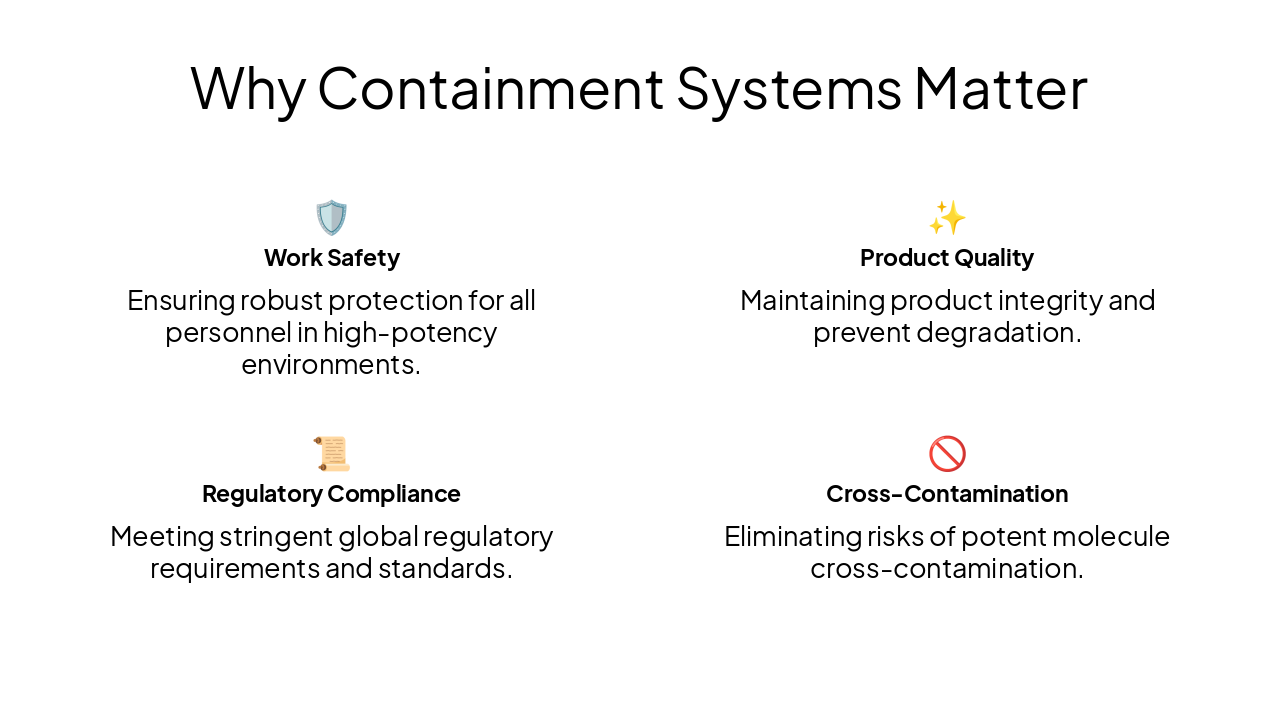
Slide 2 - Why Containment Systems Matter

🛡️ Work Safety Ensuring robust protection for all personnel in high-potency environments.

Product Quality Maintaining product integrity and prevent degradation.

📜 Regulatory Compliance Meeting stringent global regulatory requirements and standards.

🚫 Cross-Contamination Eliminating risks of potent molecule cross-contamination.
Slide 2 - Why Containment Systems Matter
Slide 3 of 15

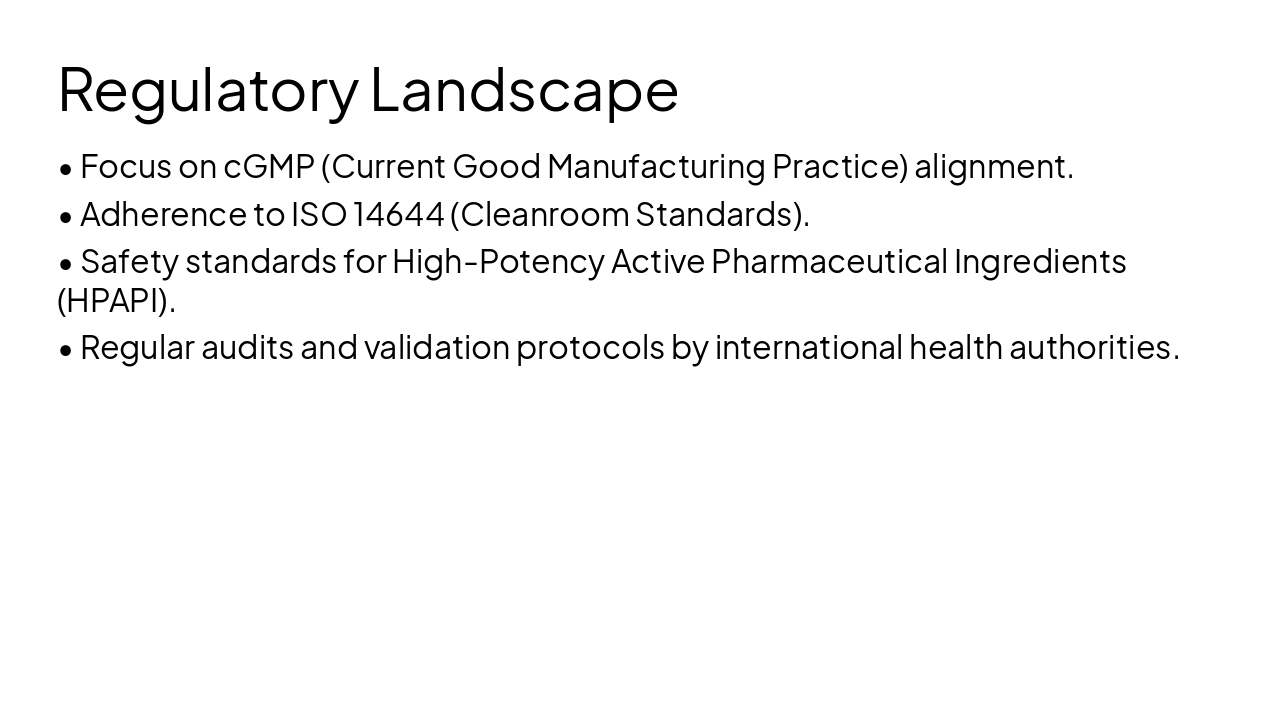
Slide 3 - Regulatory Landscape

  • Focus on cGMP (Current Good Manufacturing Practice) alignment.
  • Adherence to ISO 14644 (Cleanroom Standards).
  • Safety standards for High-Potency Active Pharmaceutical Ingredients (HPAPI).
  • Regular audits and validation protocols by international health authorities.
Slide 3 - Regulatory Landscape
Slide 4 of 15

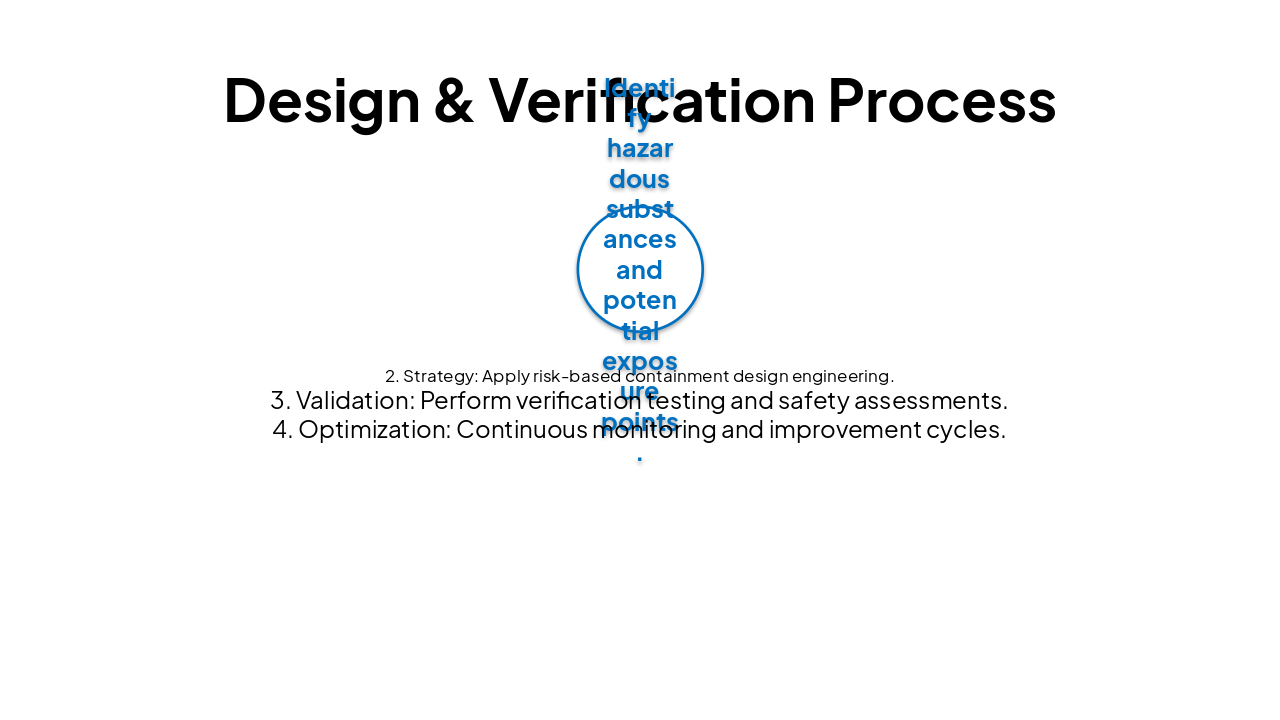
Slide 4 - Design & Verification Process

1. Assessment2. Strategy3. Validation4. Optimization
Identify hazardous substances and potential exposure points.Apply risk-based containment design engineering.Perform verification testing and safety assessments.Continuous monitoring and improvement cycles.
Slide 4 - Design & Verification Process
Slide 5 of 15

Slide 5 - Risk Assessment Framework Part 1

1

Risk Assessment Framework

Comprehensive evaluation of facility containment needs.

---

Photo by Tom Parkes on Unsplash
Slide 5 - Risk Assessment Framework Part 1
Slide 6 of 15

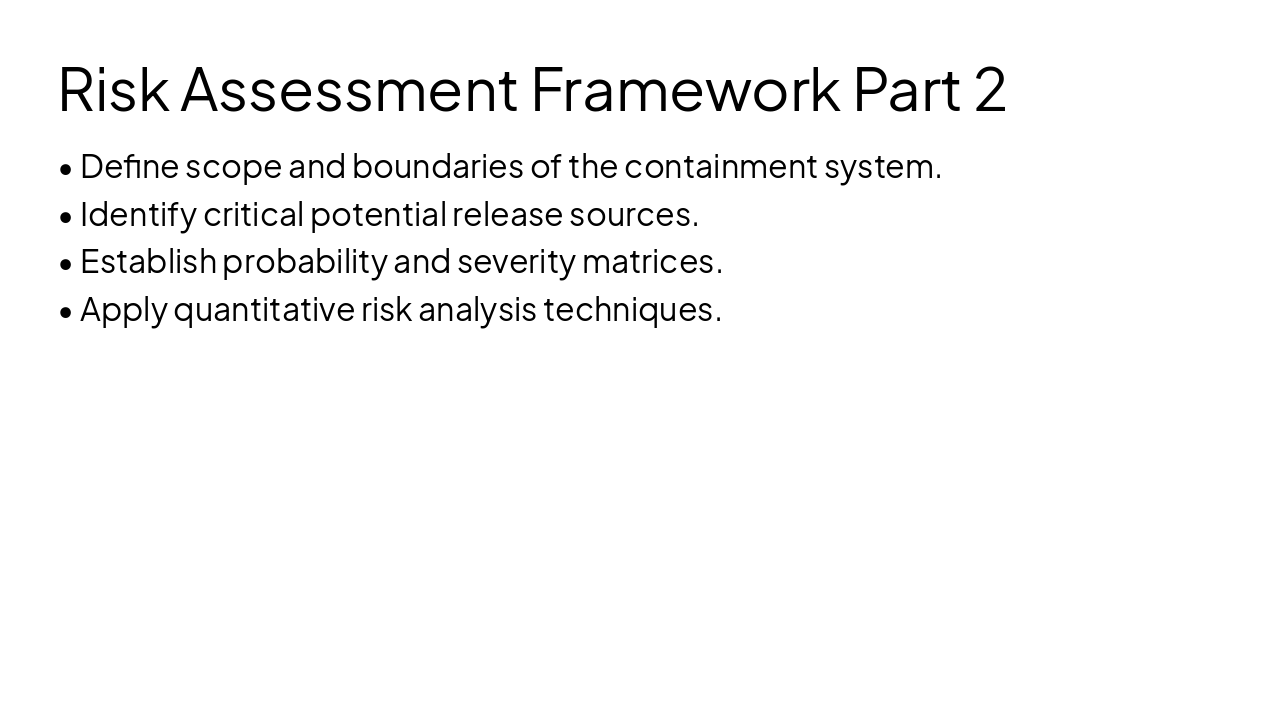
Slide 6 - Risk Assessment Framework Part 2

  • Define scope and boundaries of the containment system.
  • Identify critical potential release sources.
  • Establish probability and severity matrices.
  • Apply quantitative risk analysis techniques.
Slide 6 - Risk Assessment Framework Part 2
Slide 7 of 15

Slide 7 - Exposure Evaluation & Controls

  • Exposure Factors: Frequency, duration, and quantity of handling.
  • Categorization: Classifying molecules by potency (e.g., OEL 1-5).
  • Containment Strategy: Matching technology to OEL levels.
  • Verification: Ongoing monitoring of air quality metrics.
Slide 7 - Exposure Evaluation & Controls
Slide 8 of 15

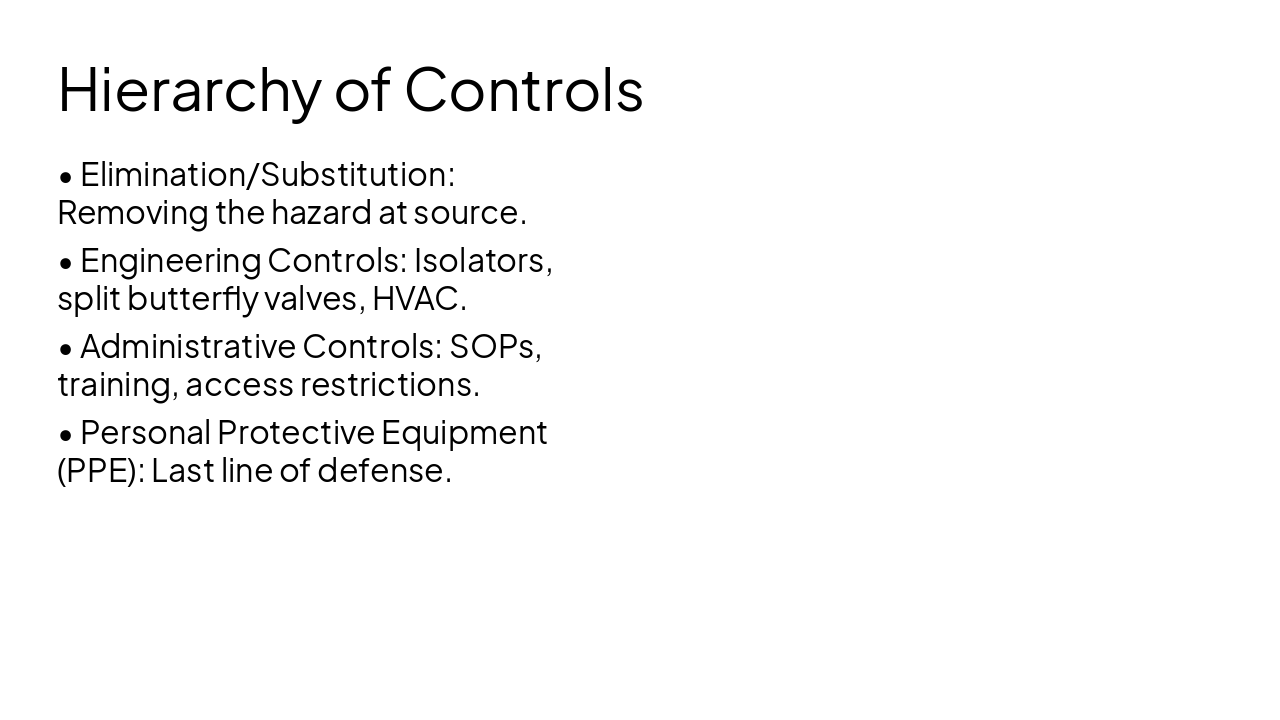
Slide 8 - Hierarchy of Controls

  • Elimination/Substitution: Removing the hazard at source.
  • Engineering Controls: Isolators, split butterfly valves, HVAC.
  • Administrative Controls: SOPs, training, access restrictions.
  • Personal Protective Equipment (PPE): Last line of defense.
Slide 8 - Hierarchy of Controls
Slide 9 of 15

Slide 9 - Risk Review & Verification Testing

  • Routine periodic validation of seals and pressures.
  • Particle count and air change efficacy testing.
  • Safety interlock testing for isolator chambers.
  • Corrective action plans for threshold exceedances.
Slide 9 - Risk Review & Verification Testing
Slide 10 of 15

Slide 10 - Case Study Overview

2

FJ2 Facility Case Study

High-performance synthetic molecule API facility.

---

Photo by Tom Parkes on Unsplash
Slide 10 - Case Study Overview
Slide 11 of 15

Slide 11 - FJ2 Facility Achievements

  • Integrated automated workflow for synthesis and filtration.
  • Multi-stage RABS (Restricted Access Barrier Systems).
  • Achieved industry-leading safety standards.
  • Recognized with 2025 Pharma Facility Innovation Award.
Slide 11 - FJ2 Facility Achievements
Slide 12 of 15

Slide 12 - Risk Management Approach

  • Early engagement with engineering/toxicology teams.
  • Integration of containment equipment at design phase.
  • Modular design for scalability and maintenance.
  • Proactive identification of containment failures.
Slide 12 - Risk Management Approach
Slide 13 of 15

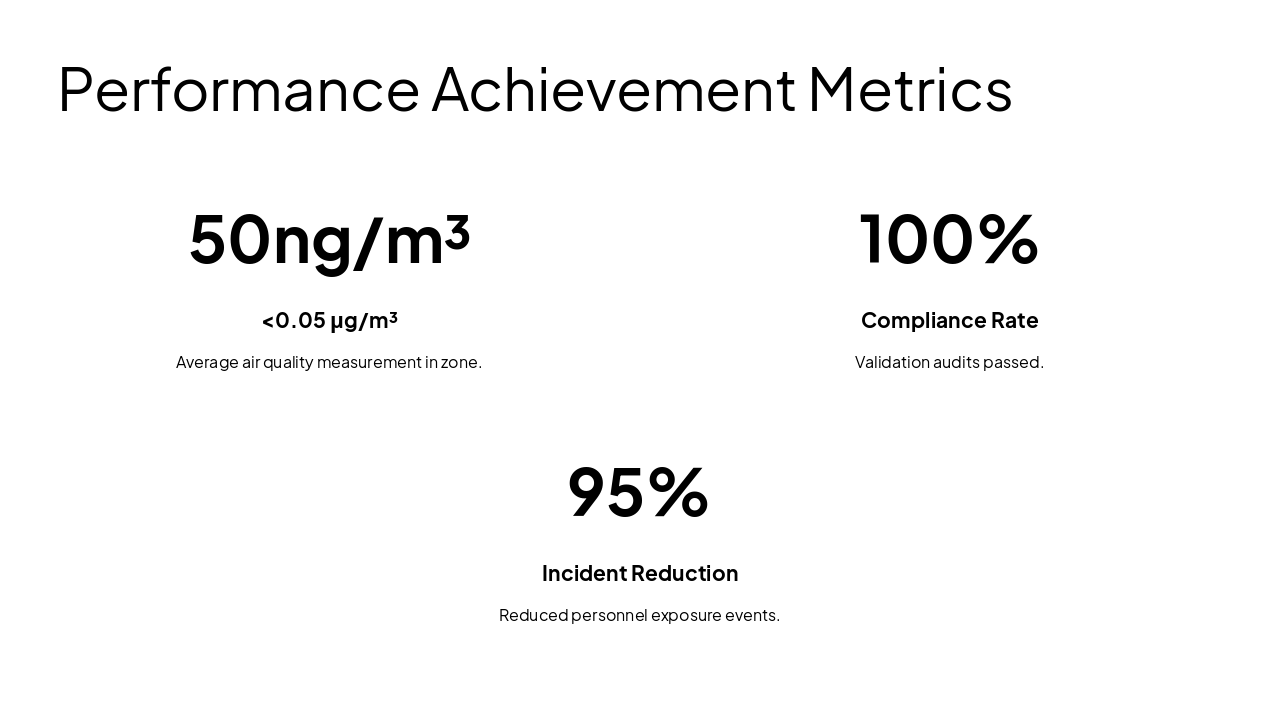
Slide 13 - Performance Achievement Metrics

  • 50ng/m³: <0.05 μg/m³
  • 100%: Compliance Rate
  • 95%: Incident Reduction
Slide 13 - Performance Achievement Metrics
Slide 14 of 15

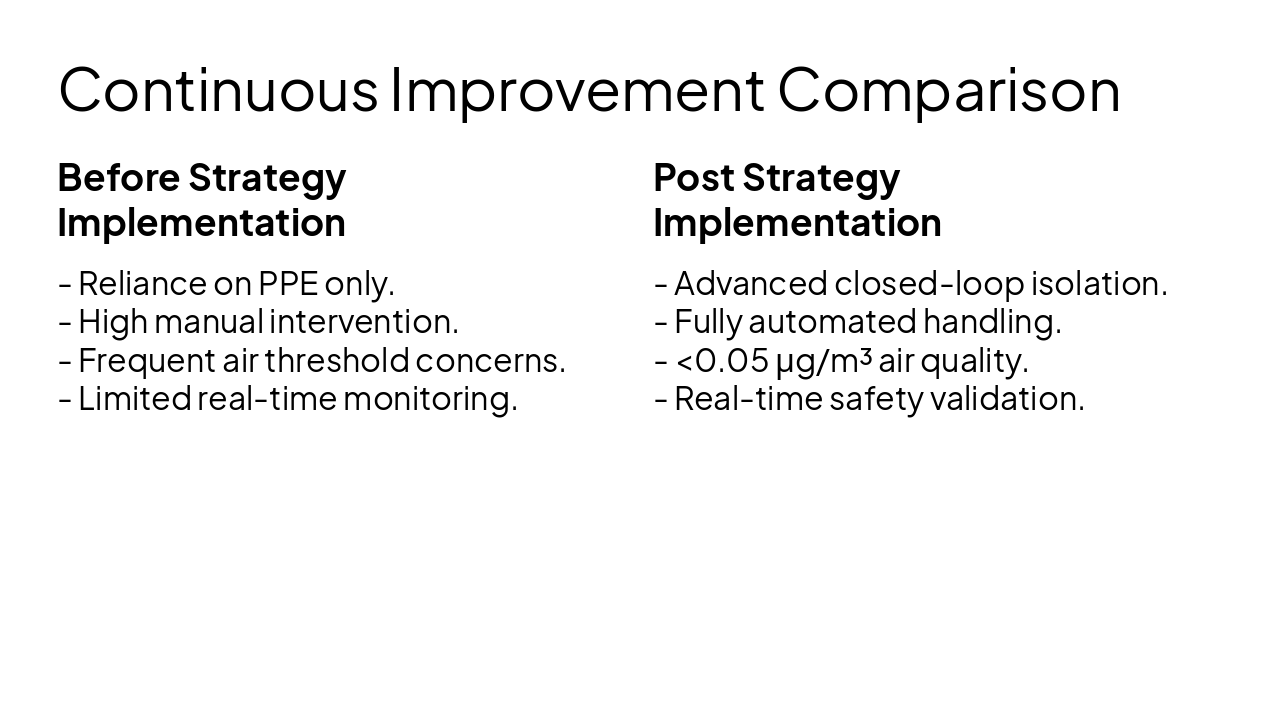
Slide 14 - Continuous Improvement Comparison

Before Strategy Implementation

  • Reliance on PPE only.
  • High manual intervention.
  • Frequent air threshold concerns.
  • Limited real-time monitoring.

Post Strategy Implementation

  • Advanced closed-loop isolation.
  • Fully automated handling.
  • <0.05 μg/m³ air quality.
  • Real-time safety validation.
Slide 14 - Continuous Improvement Comparison
Slide 15 of 15

Slide 15 - Key Takeaways

Risk-based design ensures safety, efficiency, and compliance.

Summary for ISPE November 2025 presentation.

---

Photo by Nastuh Abootalebi on Unsplash
Slide 15 - Key Takeaways

Discover More Presentations

Explore thousands of AI-generated presentations for inspiration

Browse Presentations
Powered by AI

Create Your Own Presentation

Generate professional presentations in seconds with Karaf's AI. Customize this presentation or start from scratch.

Create New Presentation

Powered by Karaf.ai — AI-Powered Presentation Generator