AI Revolutionizing the World

Generated from prompt:

Create a presentation about artificial intelligence

This presentation explores artificial intelligence, covering its core concepts like machine learning and neural networks, historical timeline, industry applications, ethical considerations, expert ins

November 9, 202512 slides
Slide 1 of 12

Slide 1 - Artificial Intelligence: Revolutionizing the World

The slide, titled "Artificial Intelligence: Revolutionizing the World," serves as an introductory title slide for a presentation. Its subtitle highlights an exploration of AI's transformative effects on both society and technology.

Artificial Intelligence: Revolutionizing the World

Exploring AI's Transformative Impact on Society and Technology
Slide 1
Slide 2 of 12

Slide 2 - Presentation Agenda

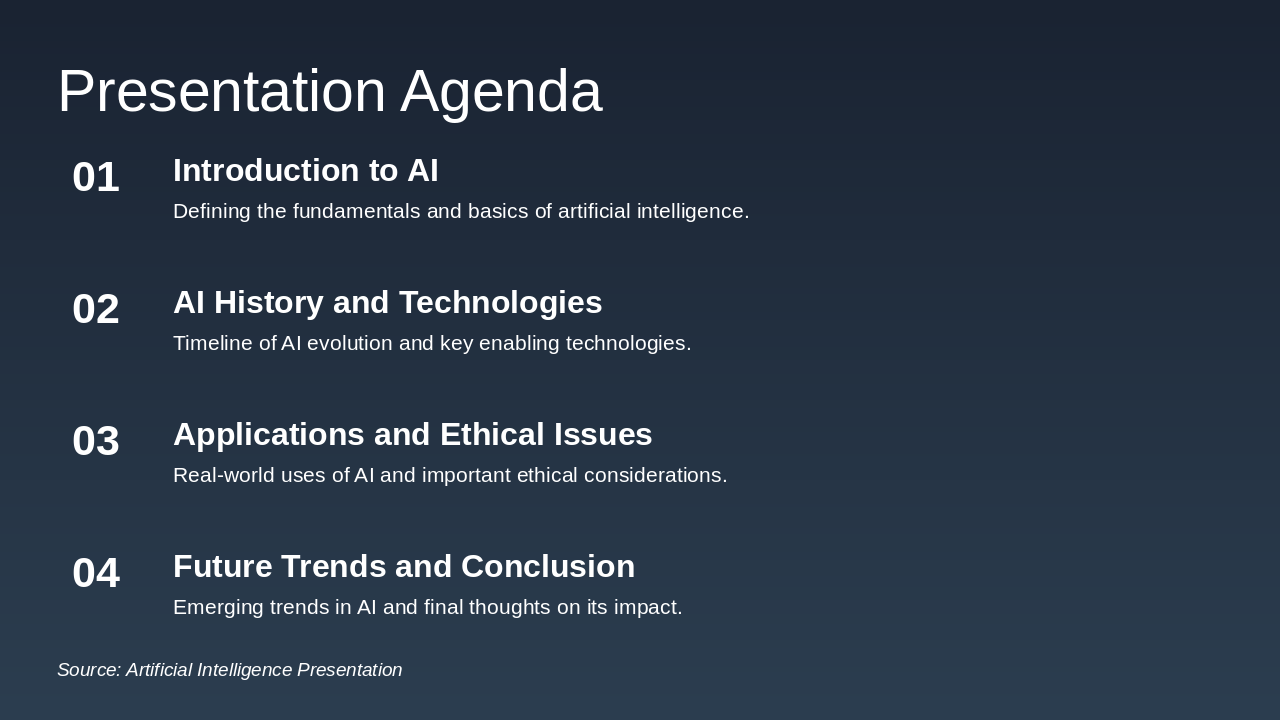
The presentation agenda outlines four main sections on artificial intelligence. It begins with an introduction to AI fundamentals, followed by its history and key technologies, then explores real-world applications alongside ethical issues, and concludes with future trends and overall impact.

Presentation Agenda

  1. Introduction to AI

Defining the fundamentals and basics of artificial intelligence.

  1. AI History and Technologies

Timeline of AI evolution and key enabling technologies.

  1. Applications and Ethical Issues

Real-world uses of AI and important ethical considerations.

  1. Future Trends and Conclusion

Emerging trends in AI and final thoughts on its impact.

Source: Artificial Intelligence Presentation

Slide 2
Slide 3 of 12

Slide 3 - What is Artificial Intelligence?

This section header slide introduces the topic "What is Artificial Intelligence?" by providing a definition and outlining its core principles. It also distinguishes between narrow AI, general AI, and superintelligence to clarify different levels of AI capability.

What is Artificial Intelligence?

What is Artificial Intelligence?

Definition and core principles of AI, distinguishing between narrow AI, general AI, and superintelligence.

Slide 3
Slide 4 of 12

Slide 4 - Core Concepts of AI

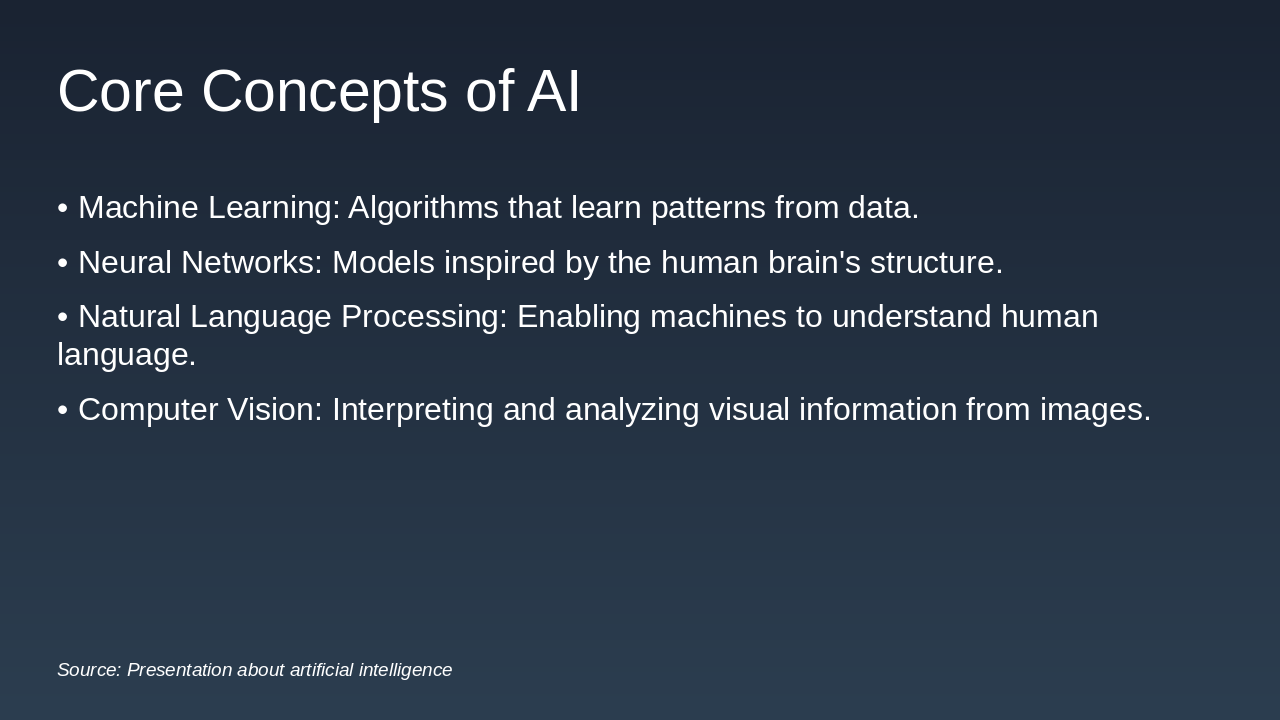
The slide titled "Core Concepts of AI" outlines fundamental technologies in artificial intelligence. It covers machine learning, which uses algorithms to learn patterns from data; neural networks, modeled after the human brain; natural language processing for understanding human language; and computer vision for interpreting visual information from images.

Core Concepts of AI

  • Machine Learning: Algorithms that learn patterns from data.
  • Neural Networks: Models inspired by the human brain's structure.
  • Natural Language Processing: Enabling machines to understand human language.
  • Computer Vision: Interpreting and analyzing visual information from images.

Source: Presentation about artificial intelligence

Slide 4
Slide 5 of 12

Slide 5 - History of AI

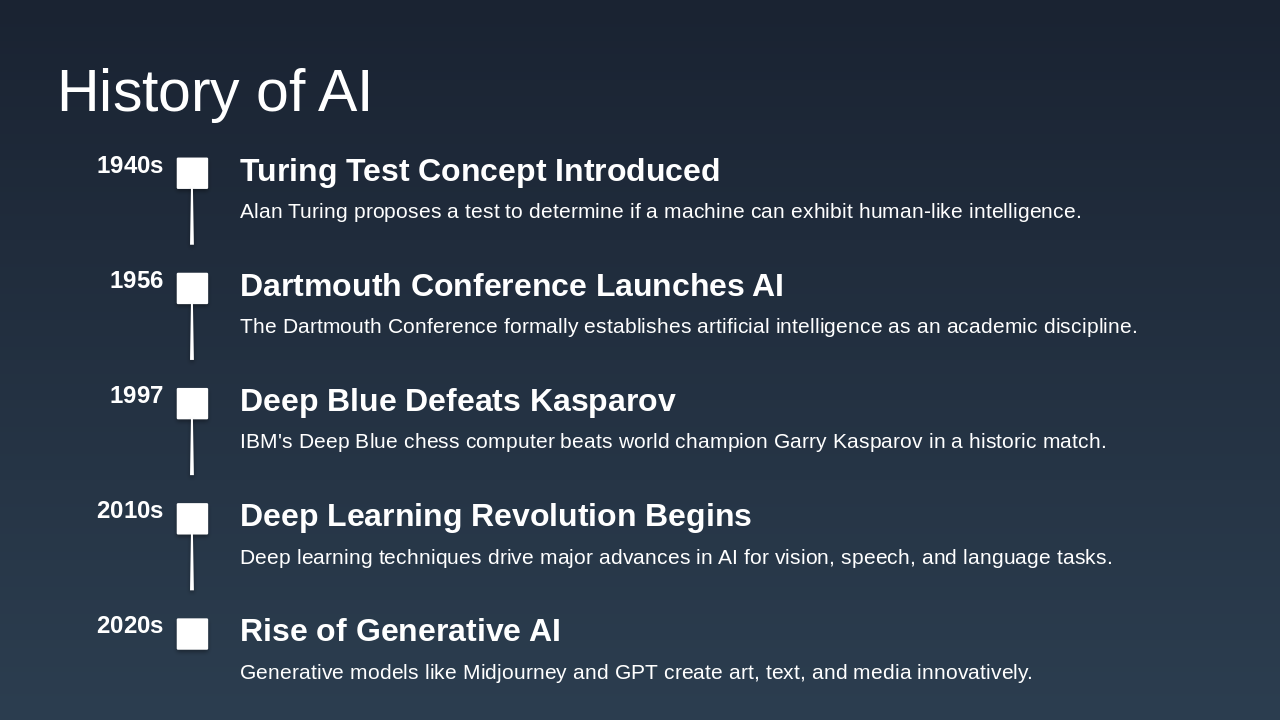
The History of AI timeline slide outlines key milestones starting in the 1940s with Alan Turing's introduction of the Turing Test to assess machine intelligence, followed by the 1956 Dartmouth Conference that established AI as an academic field. It continues through 1997's landmark Deep Blue victory over chess champion Garry Kasparov, the 2010s deep learning revolution advancing vision, speech, and language capabilities, and the 2020s emergence of generative AI tools like Midjourney and GPT for creating innovative art, text, and media.

History of AI

1940s: Turing Test Concept Introduced Alan Turing proposes a test to determine if a machine can exhibit human-like intelligence. 1956: Dartmouth Conference Launches AI The Dartmouth Conference formally establishes artificial intelligence as an academic discipline. 1997: Deep Blue Defeats Kasparov IBM's Deep Blue chess computer beats world champion Garry Kasparov in a historic match. 2010s: Deep Learning Revolution Begins Deep learning techniques drive major advances in AI for vision, speech, and language tasks. 2020s: Rise of Generative AI Generative models like Midjourney and GPT create art, text, and media innovatively.

Slide 5
Slide 6 of 12

Slide 6 - AI Impact Statistics

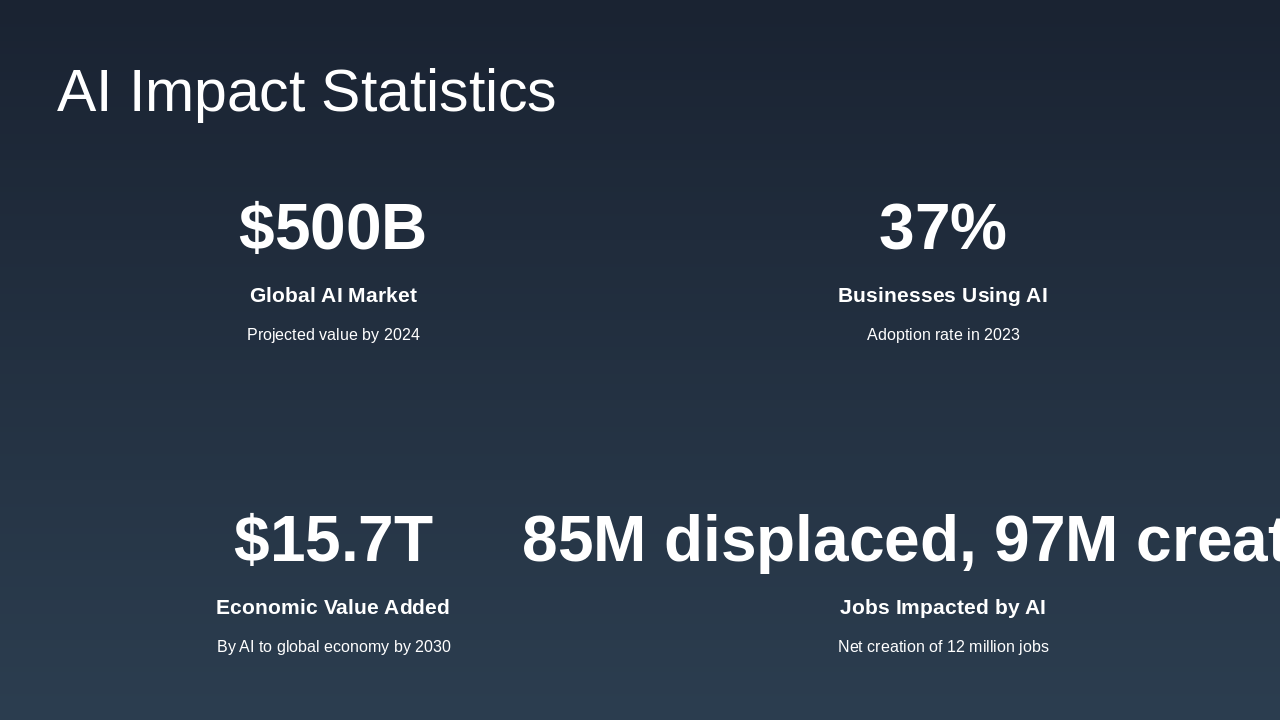
The AI Impact Statistics slide highlights the global AI market's projected value of $500 billion by 2024 and a 37% adoption rate among businesses in 2023. It also projects AI adding $15.7 trillion to the global economy by 2030, while impacting jobs by displacing 85 million but creating 97 million for a net gain of 12 million.

AI Impact Statistics

  • $500B: Global AI Market

Projected value by 2024

  • 37%: Businesses Using AI

Adoption rate in 2023

  • $15.7T: Economic Value Added

By AI to global economy by 2030

  • 85M displaced, 97M created: Jobs Impacted by AI

Net creation of 12 million jobs

Slide 6
Slide 7 of 12

Slide 7 - AI Applications Across Industries

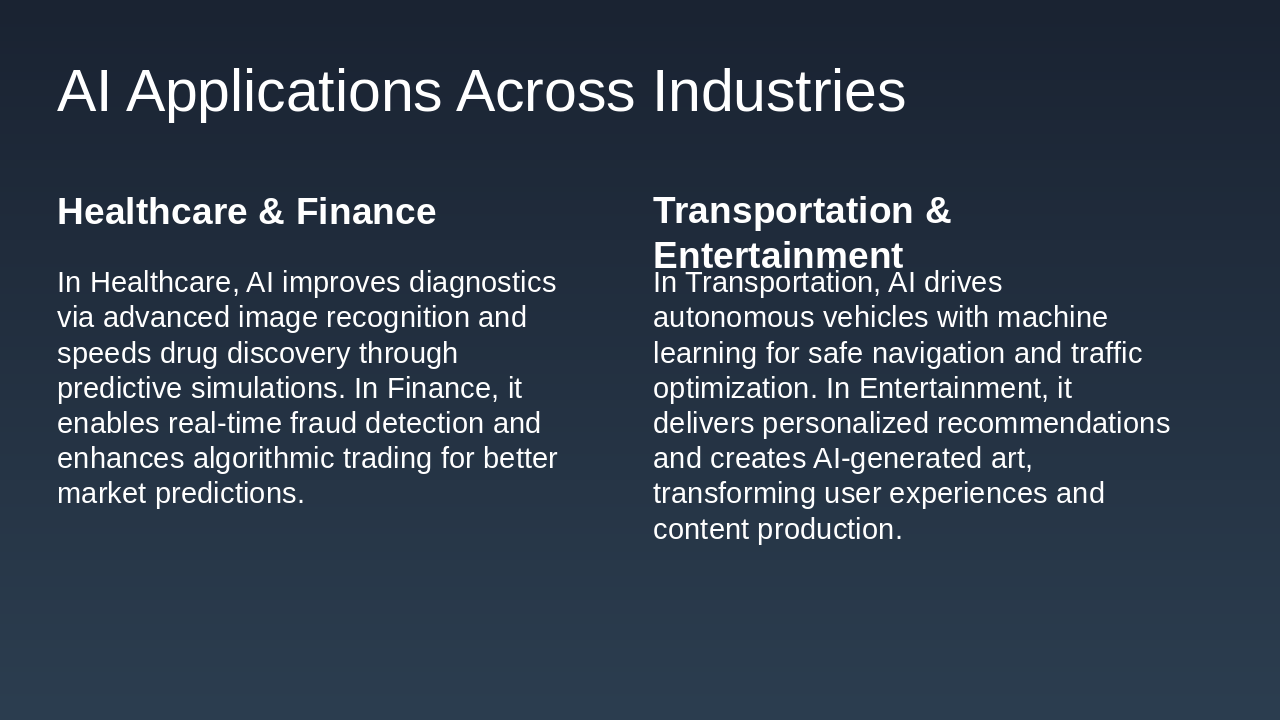
In the healthcare and finance sectors, AI enhances diagnostics through image recognition, accelerates drug discovery with simulations, detects fraud in real-time, and improves algorithmic trading for market predictions. In transportation and entertainment, it powers autonomous vehicles for safe navigation and traffic optimization, while offering personalized recommendations and generating art to revolutionize user experiences and content creation.

AI Applications Across Industries

Healthcare & FinanceTransportation & Entertainment
In Healthcare, AI improves diagnostics via advanced image recognition and speeds drug discovery through predictive simulations. In Finance, it enables real-time fraud detection and enhances algorithmic trading for better market predictions.In Transportation, AI drives autonomous vehicles with machine learning for safe navigation and traffic optimization. In Entertainment, it delivers personalized recommendations and creates AI-generated art, transforming user experiences and content production.
Slide 7
Slide 8 of 12

Slide 8 - AI in Art: Théâtre D'opéra Spatial

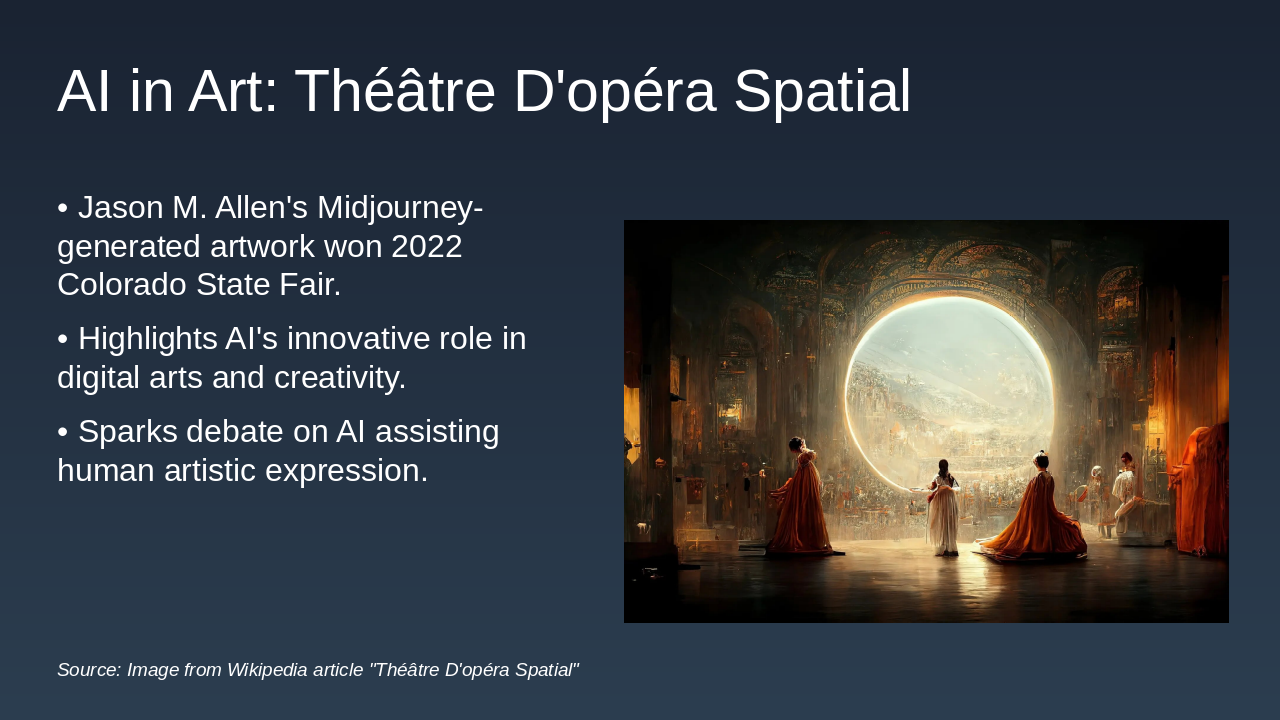
Jason M. Allen's artwork, generated using Midjourney AI and titled Théâtre D'opéra Spatial, won first place at the 2022 Colorado State Fair. The slide highlights AI's innovative contributions to digital arts and creativity while sparking debates on its role in assisting human artistic expression.

AI in Art: Théâtre D'opéra Spatial

!Image

  • Jason M. Allen's Midjourney-generated artwork won 2022 Colorado State Fair.
  • Highlights AI's innovative role in digital arts and creativity.
  • Sparks debate on AI assisting human artistic expression.

Source: Image from Wikipedia article "Théâtre D'opéra Spatial"

Slide 8
Slide 9 of 12

Slide 9 - Expert Insights on AI

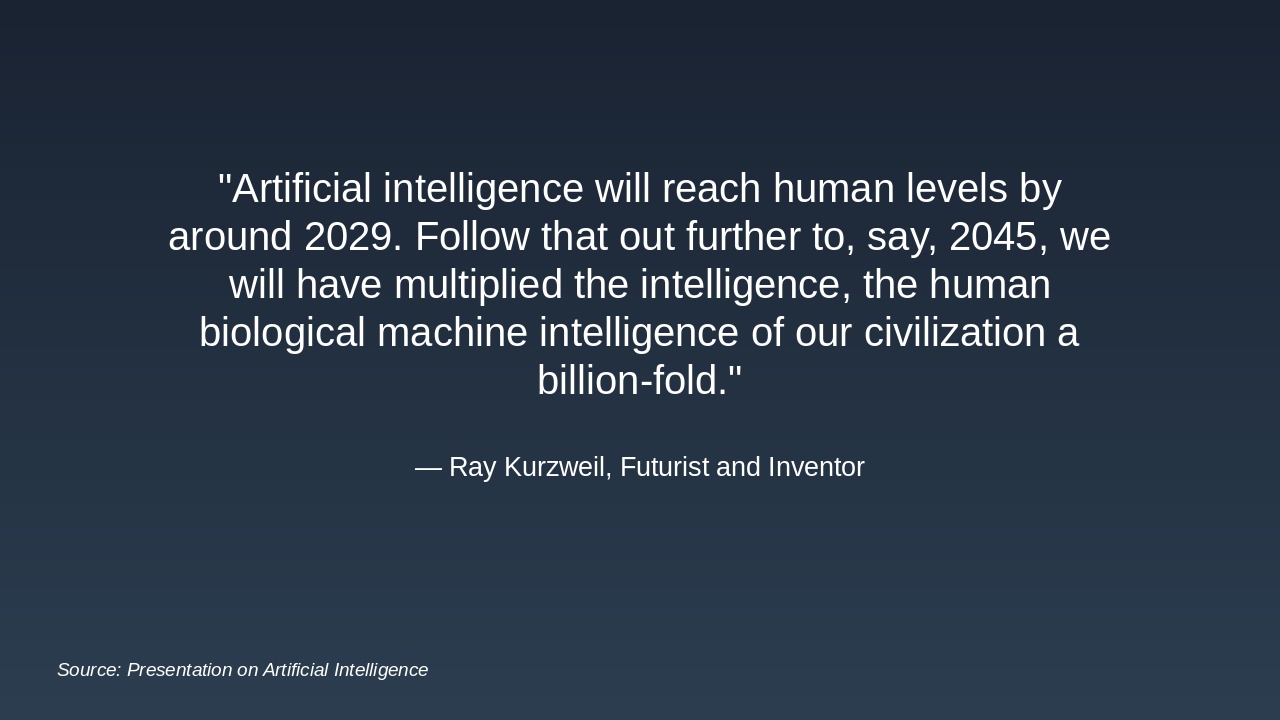
Ray Kurzweil, a renowned futurist and inventor, predicts in this quote that artificial intelligence will achieve human-level capabilities by around 2029. He further envisions that by 2045, this will amplify our civilization's human biological intelligence by a billion times.

Expert Insights on AI

> Artificial intelligence will reach human levels by around 2029. Follow that out further to, say, 2045, we will have multiplied the intelligence, the human biological machine intelligence of our civilization a billion-fold.

— Ray Kurzweil, Futurist and Inventor

Source: Presentation on Artificial Intelligence

Slide 9
Slide 10 of 12

Slide 10 - Ethical Considerations and Future

This section header slide is titled "Ethical Considerations and Future," focusing on key issues in AI development and application. It features a subtitle that outlines discussions on biases, privacy concerns, job impacts, and AI's potential role in addressing global challenges.

Ethical Considerations and Future

Ethical Considerations and Future

Discussing biases, privacy concerns, job impacts, and AI's role in global challenges.

Source: Artificial Intelligence Presentation

--- Speaker Notes: Discuss biases, privacy, job impacts, and AI's potential in solving global challenges.

Slide 10
Slide 11 of 12

Slide 11 - Future Trends in AI

Future trends in AI emphasize developing robust ethics frameworks and global regulations to ensure responsible and safe innovation. Key advancements include integrating quantum computing for enhanced capabilities, fostering human-AI collaboration for productivity, and promoting sustainable practices to minimize environmental impact.

Future Trends in AI

  • Developing robust AI ethics frameworks for responsible innovation.
  • Integrating quantum computing to exponentially enhance AI capabilities.
  • Fostering seamless human-AI collaboration for boosted productivity.
  • Establishing global regulations and governance for safe AI deployment.
  • Promoting sustainable AI development to reduce environmental impact.
Slide 11
Slide 12 of 12

Slide 12 - Conclusion: Embracing AI's Potential

AI drives innovation across industries, transforming work and daily life, but its potential must be harnessed responsibly to tackle ethical challenges and promote equitable benefits. The slide urges embracing AI wisely by staying informed and adopting it ethically to shape a better future.

Conclusion: Embracing AI's Potential

AI drives innovation across industries, transforming how we work and live. Yet, its potential must be harnessed responsibly to address ethical challenges and ensure equitable benefits.

Embrace AI's potential wisely.

Stay informed and adopt AI ethically to shape a better future.

Source: AI Presentation

--- Speaker Notes: Summarize key points: AI drives innovation but requires responsible use. Closing message: Embrace AI's potential wisely. Call to action: Stay informed and adopt AI ethically to shape a better future.

Slide 12
Powered by AI

Create Your Own Presentation

Generate professional presentations in seconds with Karaf's AI. Customize this presentation or start from scratch.

Create New Presentation

Powered by Karaf.ai — AI-Powered Presentation Generator