7th Grade CBSE: Angle Properties

Generated from prompt:

i want a presentation on 7th grade cbse maths properties of angles

Explore angles in Class 7 CBSE Maths: definitions, complementary/supplementary pairs, vertically opposite angles, and key takeaways with practice tips. (128 chars)

January 22, 20268 slides
Slide 1 of 8

Slide 1 - Properties of Angles

This title slide introduces "Properties of Angles" for Class 7 CBSE Mathematics. The subtitle highlights exploring key concepts in geometry.

Properties of Angles

Class 7 CBSE Mathematics

Exploring Key Concepts in Geometry

Source: Class 7 CBSE Mathematics

Speaker Notes
Welcome slide introducing the topic on angle properties for CBSE Class 7 Maths with an engaging angle graphic.
Slide 1 - Properties of Angles
Slide 2 of 8

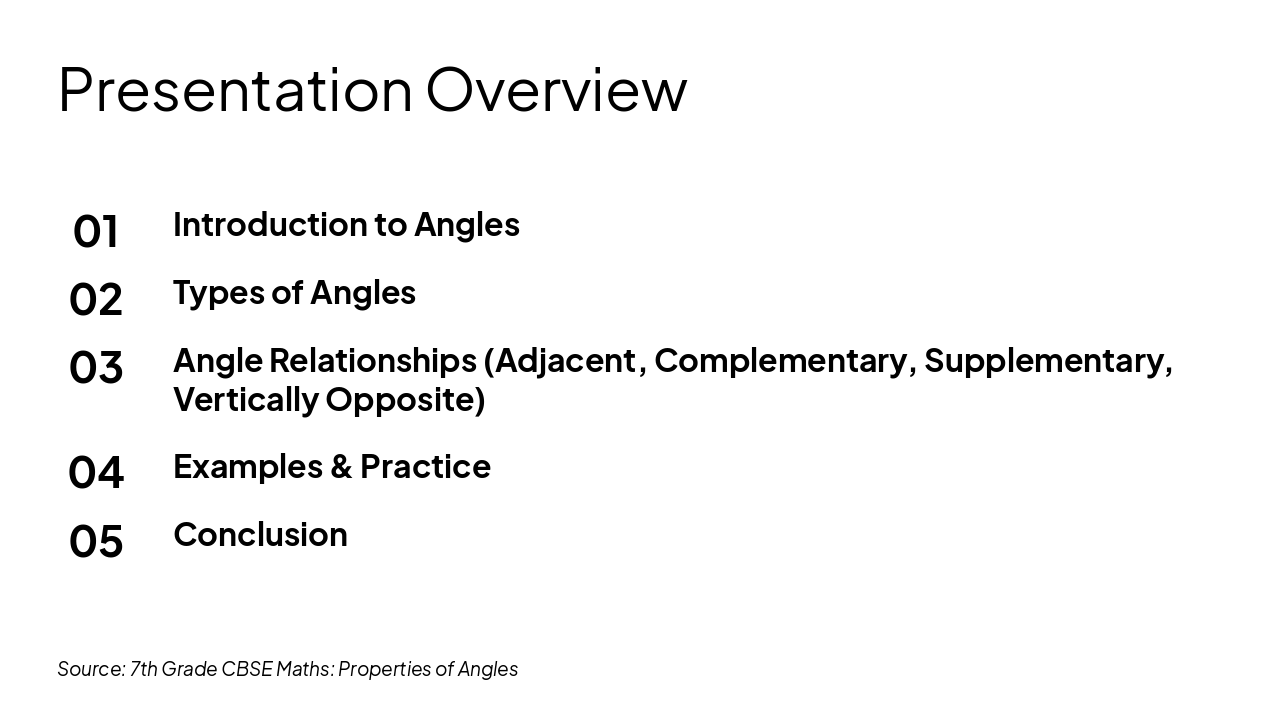
Slide 2 - Presentation Overview

This agenda slide outlines a presentation on angles, starting with an introduction to angles and types of angles. It then covers angle relationships such as adjacent, complementary, supplementary, and vertically opposite angles, followed by examples and practice, and concludes with a summary.

Presentation Overview

  1. Introduction to Angles
  2. Types of Angles
  3. Angle Relationships (Adjacent, Complementary, Supplementary, Vertically Opposite)
  4. Examples & Practice
  5. Conclusion

Source: 7th Grade CBSE Maths: Properties of Angles

Speaker Notes
Outline the key sections of the angles presentation for 7th grade CBSE Maths.
Slide 2 - Presentation Overview
Slide 3 of 8

Slide 3 - What is an Angle?

An angle is formed by two rays sharing a common vertex and is measured in degrees (°). Angles are classified as acute (less than 90°), right (exactly 90°), obtuse (greater than 90° but less than 180°), or straight (exactly 180°).

What is an Angle?

  • Two rays sharing a common vertex
  • Measured in degrees (°)
  • Acute: less than 90°
  • Right: exactly 90°
  • Obtuse: greater than 90° but less than 180°
  • Straight: exactly 180°

Source: 7th Grade CBSE Maths: Properties of Angles

Slide 3 - What is an Angle?
Slide 4 of 8

Slide 4 - Key Properties of Angles

This section header slide introduces "Key Properties of Angles" as Section 03. It features a subtitle exploring essential angle relationships in CBSE Class 7 Maths.

Key Properties of Angles

03

Key Properties of Angles

Exploring essential angle relationships in CBSE Class 7 Maths

Source: CBSE Class 7 Maths

Speaker Notes
Introduce key angle relationships and properties for Class 7 students.
Slide 4 - Key Properties of Angles
Slide 5 of 8

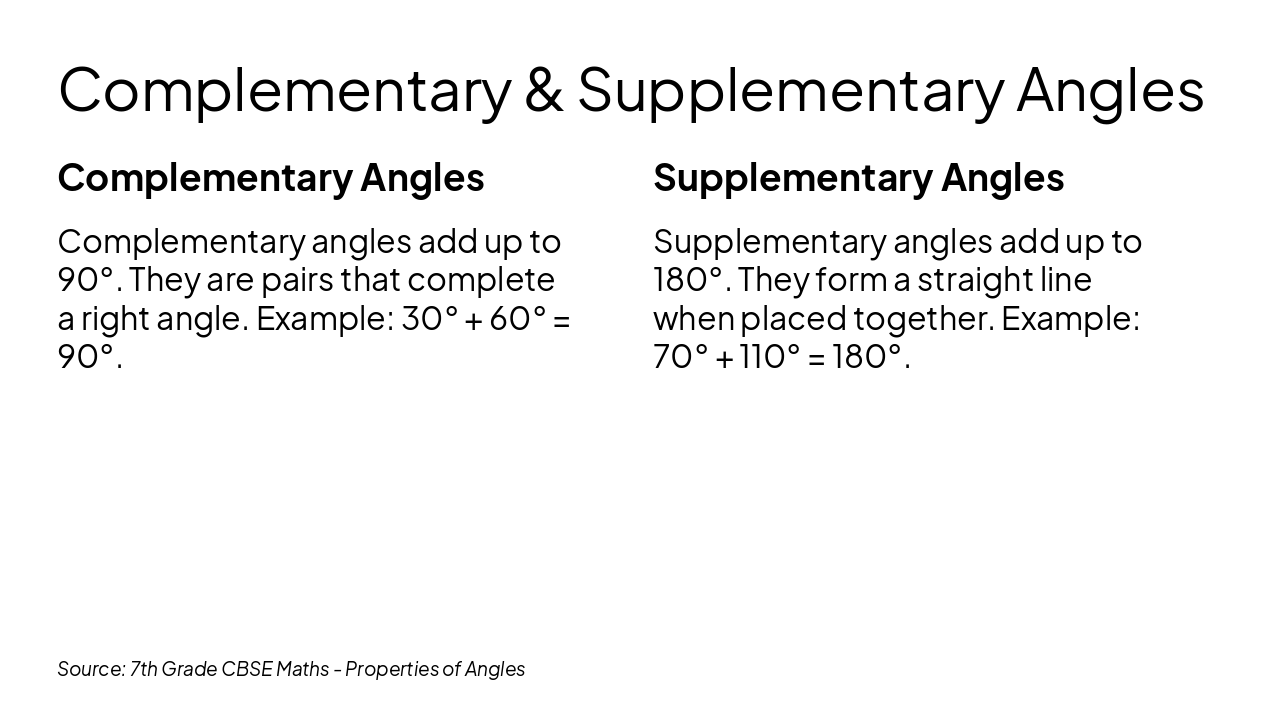
Slide 5 - Complementary & Supplementary Angles

Complementary angles add up to 90°, forming a right angle, as in the example of 30° + 60° = 90°. Supplementary angles add up to 180°, forming a straight line, as in the example of 70° + 110° = 180°.

Complementary & Supplementary Angles

Complementary AnglesSupplementary Angles
Complementary angles add up to 90°. They are pairs that complete a right angle. Example: 30° + 60° = 90°.Supplementary angles add up to 180°. They form a straight line when placed together. Example: 70° + 110° = 180°.

Source: 7th Grade CBSE Maths - Properties of Angles

Slide 5 - Complementary & Supplementary Angles
Slide 6 of 8

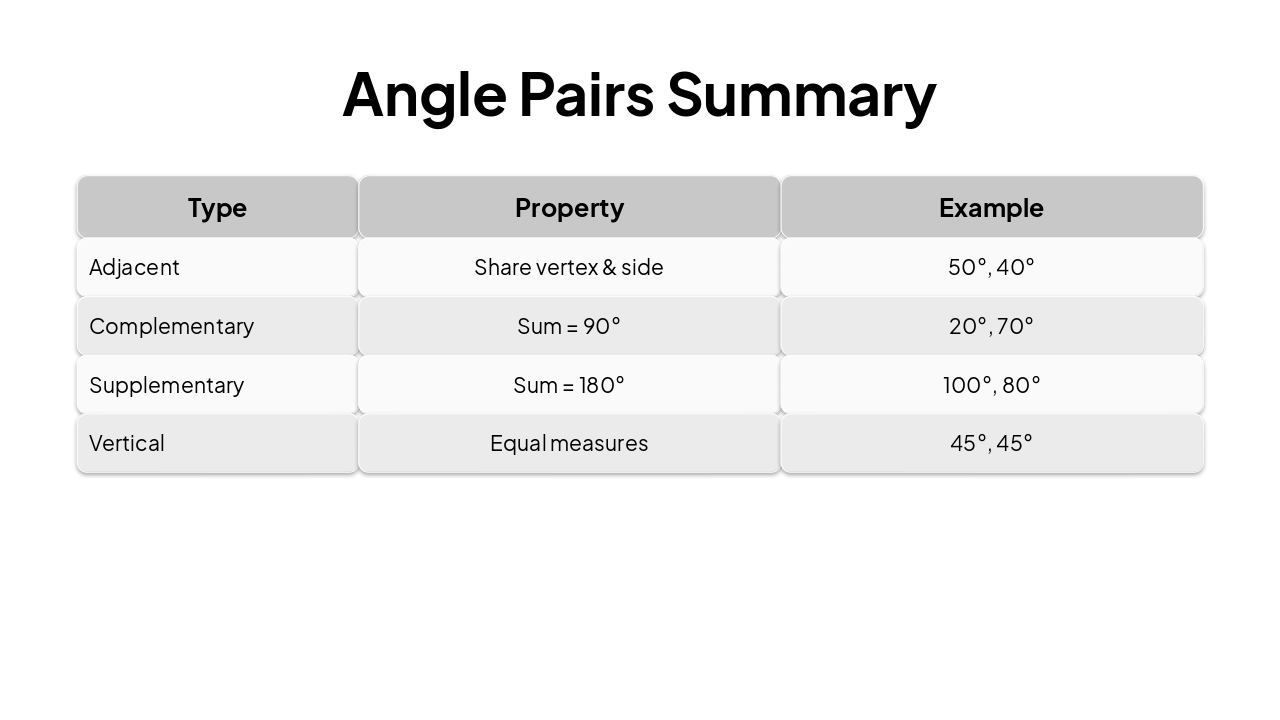
Slide 6 - Angle Pairs Summary

The slide summarizes four types of angle pairs in a table: adjacent angles share a vertex and side (e.g., 50°, 40°), complementary angles sum to 90° (e.g., 20°, 70°), supplementary angles sum to 180° (e.g., 100°, 80°), and vertical angles are equal (e.g., 45°, 45°). It uses clear properties and examples for each type.

Angle Pairs Summary

TypePropertyExample
AdjacentShare vertex & side50°, 40°
ComplementarySum = 90°20°, 70°
SupplementarySum = 180°100°, 80°
VerticalEqual measures45°, 45°
Slide 6 - Angle Pairs Summary
Slide 7 of 8

Slide 7 - Vertically Opposite Angles

Vertically opposite angles are formed when two lines intersect and are always equal in measure, such as ∠1 = ∠3 and ∠2 = ∠4. This equality is proven because adjacent angles sum to 180°.

Vertically Opposite Angles

  • Formed when two lines intersect
  • Always equal in measure
  • Example: ∠1 = ∠3, ∠2 = ∠4
  • Proof: Adjacent angles sum to 180°

Source: 7th Grade CBSE Maths: Properties of Angles

Slide 7 - Vertically Opposite Angles
Slide 8 of 8

Slide 8 - Key Takeaways

Master angles by understanding types and solving problems with complementary, supplementary, and vertically opposite angles. Practice with CBSE worksheets today and reach out for any questions.

Key Takeaways

Master angles! Practice CBSE worksheets today. Questions? 📚

Understand types, solve with complementary, supplementary & vertically opposite angles.

Slide 8 - Key Takeaways

Discover More Presentations

Explore thousands of AI-generated presentations for inspiration

Browse Presentations
Powered by AI

Create Your Own Presentation

Generate professional presentations in seconds with Karaf's AI. Customize this presentation or start from scratch.

Create New Presentation

Powered by Karaf.ai — AI-Powered Presentation Generator