Introduction to QuickCheck Testing

Generated from prompt:

Quick test presentation

This presentation introduces QuickCheck, a Haskell library for property-based testing. It covers its features, benefits like early bug detection and reduced manual testing, real-world examples, and ho

November 9, 20258 slides
Slide 1 of 8

Slide 1 - Introduction to QuickCheck

The slide, titled "Introduction to QuickCheck," serves as a title page for an introductory presentation. Its subtitle provides a quick overview of QuickCheck, a tool for property-based testing in the Haskell programming language.

Introduction to QuickCheck

Quick overview of QuickCheck for property-based testing in Haskell

Source: Quick test presentation

--- Speaker Notes: Welcome to a quick overview of QuickCheck, a Haskell library for automated testing. Explore property-based testing to ensure robust code.
Slide 1
Slide 2 of 8

Slide 2 - Presentation Agenda

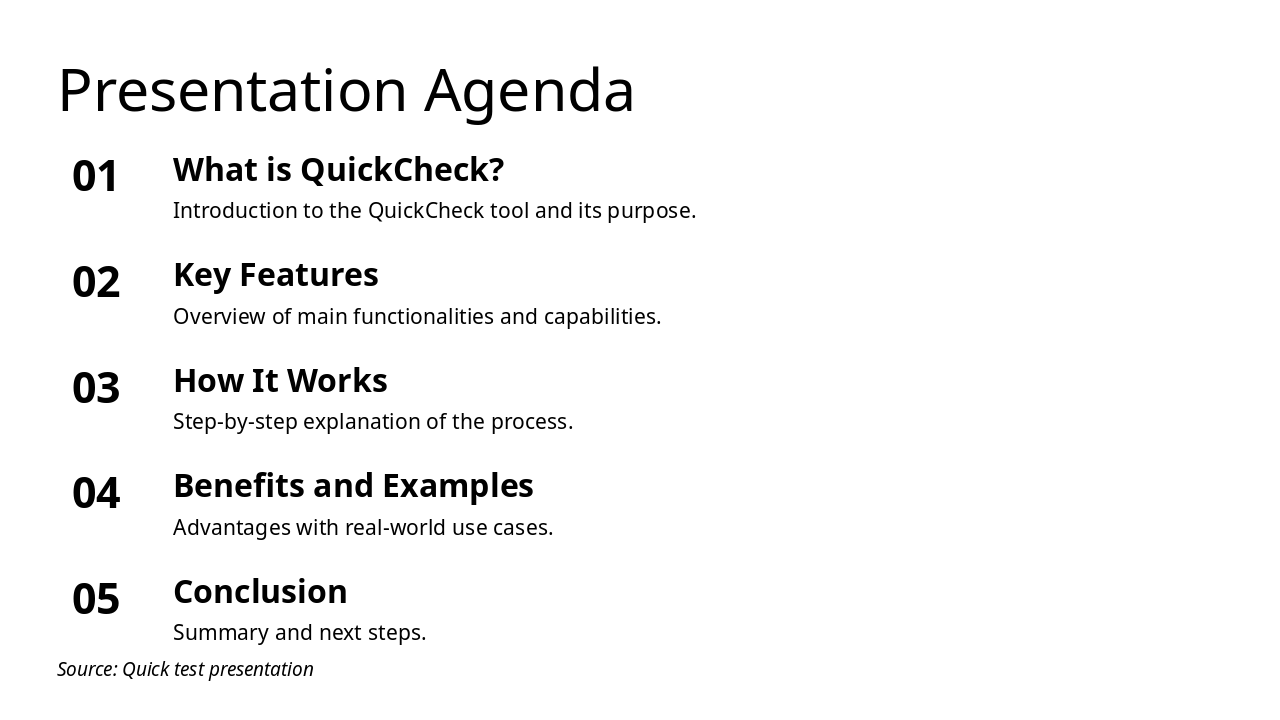
The presentation agenda outlines the structure of the QuickCheck session, starting with an introduction to the tool and its purpose. It then covers key features and capabilities, a step-by-step explanation of how it works, benefits with real-world examples, and concludes with a summary and next steps.

Presentation Agenda

  1. What is QuickCheck?

Introduction to the QuickCheck tool and its purpose.

  1. Key Features

Overview of main functionalities and capabilities.

  1. How It Works

Step-by-step explanation of the process.

  1. Benefits and Examples

Advantages with real-world use cases.

  1. Conclusion

Summary and next steps.

Source: Quick test presentation

Slide 2
Slide 3 of 8

Slide 3 - What is QuickCheck?

QuickCheck is a combinator library for the Haskell programming language, specifically designed for property-based testing. It automatically generates test cases to focus on verifying software correctness.

What is QuickCheck?

  • Haskell combinator library
  • Designed for property testing
  • Automatically generates test cases
  • Focuses on software verification
Slide 3
Slide 4 of 8

Slide 4 - Key Features

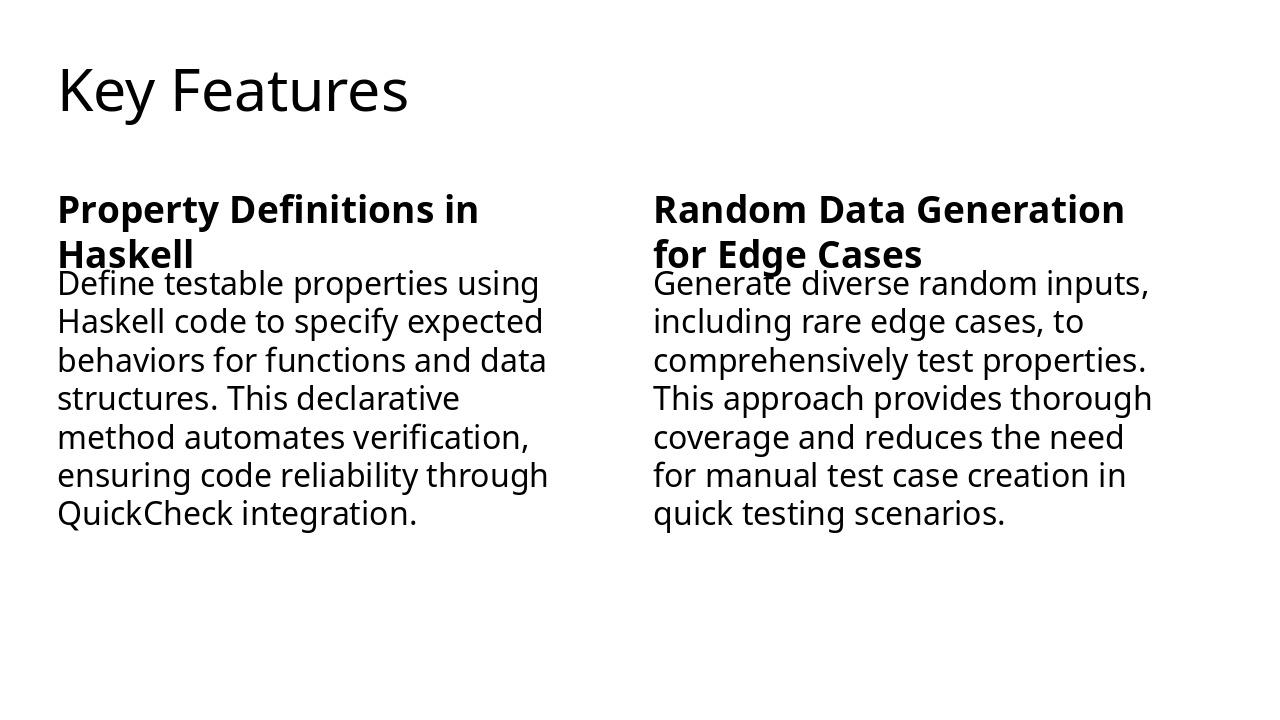
The slide highlights key features of property-based testing in Haskell, focusing on defining testable properties through declarative Haskell code that automates verification and integrates with QuickCheck for reliable code checking. It also emphasizes generating diverse random inputs, including edge cases, to ensure comprehensive test coverage and minimize manual test creation in quick scenarios.

Key Features

Property Definitions in HaskellRandom Data Generation for Edge Cases
Define testable properties using Haskell code to specify expected behaviors for functions and data structures. This declarative method automates verification, ensuring code reliability through QuickCheck integration.Generate diverse random inputs, including rare edge cases, to comprehensively test properties. This approach provides thorough coverage and reduces the need for manual test case creation in quick testing scenarios.
Slide 4
Slide 5 of 8

Slide 5 - A Notable Insight

The slide, titled "A Notable Insight," features a quote from Wikipedia highlighting how QuickCheck transforms software testing by automatically generating test cases for suites. It emphasizes the strength of property-based testing as a core innovation in this approach.

A Notable Insight

> QuickCheck revolutionizes software testing by automatically generating test cases for suites, embodying the power of property-based testing.

— Wikipedia, Collaborative Knowledge Base

Source: Wikipedia

--- Speaker Notes: Context: Quick test presentation. Description: QuickCheck assists in software testing by generating test cases for test suites – an approach known as property testing.

Slide 5
Slide 6 of 8

Slide 6 - QuickCheck in Action

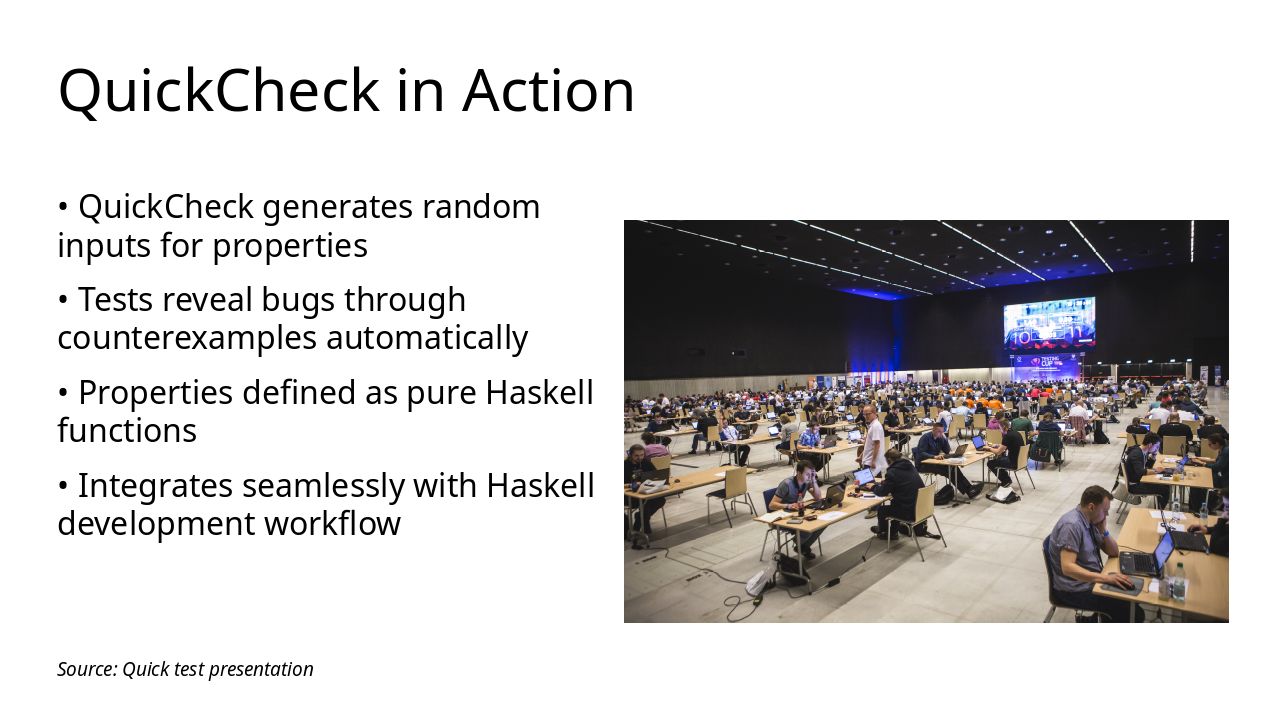
QuickCheck is a Haskell tool that generates random inputs to test defined properties, which are written as pure functions, and automatically uncovers bugs by providing counterexamples. It integrates seamlessly into the Haskell development workflow, enhancing efficient property-based testing.

QuickCheck in Action

!Image

  • QuickCheck generates random inputs for properties
  • Tests reveal bugs through counterexamples automatically
  • Properties defined as pure Haskell functions
  • Integrates seamlessly with Haskell development workflow

Source: Quick test presentation

--- Speaker Notes: Visual: Example Haskell code snippet using QuickCheck for property testing. (Suggest image of code output showing generated tests.)

Slide 6
Slide 7 of 8

Slide 7 - Benefits and Use Cases

The slide highlights key benefits of the tool, including catching bugs early in development and reducing manual test writing efforts. It also explores related tools like SmallCheck and references the original Haskell implementation.

Benefits and Use Cases

  • Catches bugs early in development
  • Reduces manual test writing efforts
  • Explores related tools like SmallCheck
  • References original Haskell implementation
Slide 7
Slide 8 of 8

Slide 8 - Wrapping Up

The slide, titled "Wrapping Up," concludes that QuickCheck revolutionizes Haskell testing. It urges viewers to integrate property-based testing today for more reliable software.

Wrapping Up

QuickCheck revolutionizes Haskell testing.

Integrate property-based testing today for reliable software!

Source: Wikipedia

Slide 8
Powered by AI

Create Your Own Presentation

Generate professional presentations in seconds with Karaf's AI. Customize this presentation or start from scratch.

Create New Presentation

Powered by Karaf.ai — AI-Powered Presentation Generator