Introduction to QuickCheck Testing

Generated from prompt:

Quick test presentation

This presentation introduces QuickCheck, a Haskell library for automatic test case generation. It covers its agenda, definition, key features like property combinators and random input generation, a q

November 10, 20258 slides
Slide 1 of 8

Slide 1 - Welcome to QuickCheck

The slide titled "Welcome to QuickCheck" serves as the title slide for a presentation. It includes a subtitle that overviews QuickCheck as a combinator library for property-based testing in Haskell.
Welcome to QuickCheck

Overview of QuickCheck: A Combinator Library for Property-Based Testing in Haskell

Source: Quick test presentation

--- Speaker Notes: Overview of QuickCheck, a combinator library for property-based testing in Haskell.
Slide 1
Slide 2 of 8

Slide 2 - Presentation Agenda

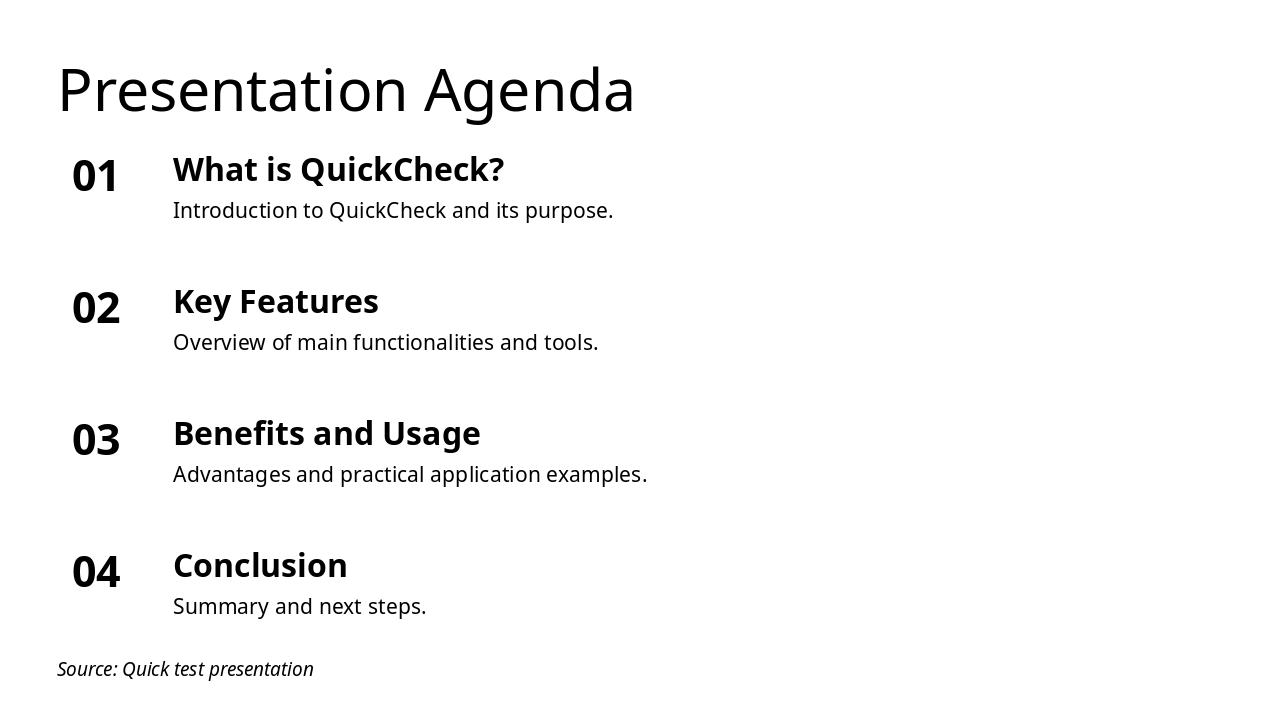
The presentation agenda outlines the structure of the talk on QuickCheck, starting with an introduction to what QuickCheck is and its purpose. It then covers key features with an overview of main functionalities, benefits and usage through advantages and practical examples, and ends with a conclusion summarizing the content and next steps.

Presentation Agenda

  1. What is QuickCheck?

Introduction to QuickCheck and its purpose.

  1. Key Features

Overview of main functionalities and tools.

  1. Benefits and Usage

Advantages and practical application examples.

  1. Conclusion

Summary and next steps.

Source: Quick test presentation

Slide 2
Slide 3 of 8

Slide 3 - What is QuickCheck?

QuickCheck is a software library originally developed in Haskell, designed for automatic test case generation. It focuses on property-based testing, verifying software correctness through automated creation of test cases.

What is QuickCheck?

  • Software library originally developed in Haskell
  • Designed for automatic test case generation
  • Focuses on property-based testing
  • Verifies software through automated case creation

Source: Quick test presentation

Slide 3
Slide 4 of 8

Slide 4 - Key Features

The slide outlines key features of a property-based testing tool, including a combinator library for defining properties and the ability to generate random inputs for code testing. It also highlights support for shrinking inputs to identify minimal failing cases, along with seamless integration into Haskell's testing ecosystem.

Key Features

  • Combinator library for property definition
  • Generates random inputs to test code
  • Supports shrinking for minimal failing cases
  • Integrates with Haskell's testing ecosystem

Source: Quick test presentation

Slide 4
Slide 5 of 8

Slide 5 - A Quote on QuickCheck

The slide, titled "A Quote on QuickCheck," features a quote from Koen Claessen, co-creator of QuickCheck, describing it as a practical tool for automated testing. The quote highlights how QuickCheck generates random test cases to efficiently verify software properties and detect bugs early in development.

A Quote on QuickCheck

> QuickCheck is a practical tool for automated testing, generating random test cases to efficiently verify software properties and catch bugs early in development.

— Koen Claessen, Co-creator of QuickCheck

Source: Wikipedia

--- Speaker Notes: Highlights its role in efficient software testing. Context: Quick test presentation

Slide 5
Slide 6 of 8

Slide 6 - QuickCheck in Action

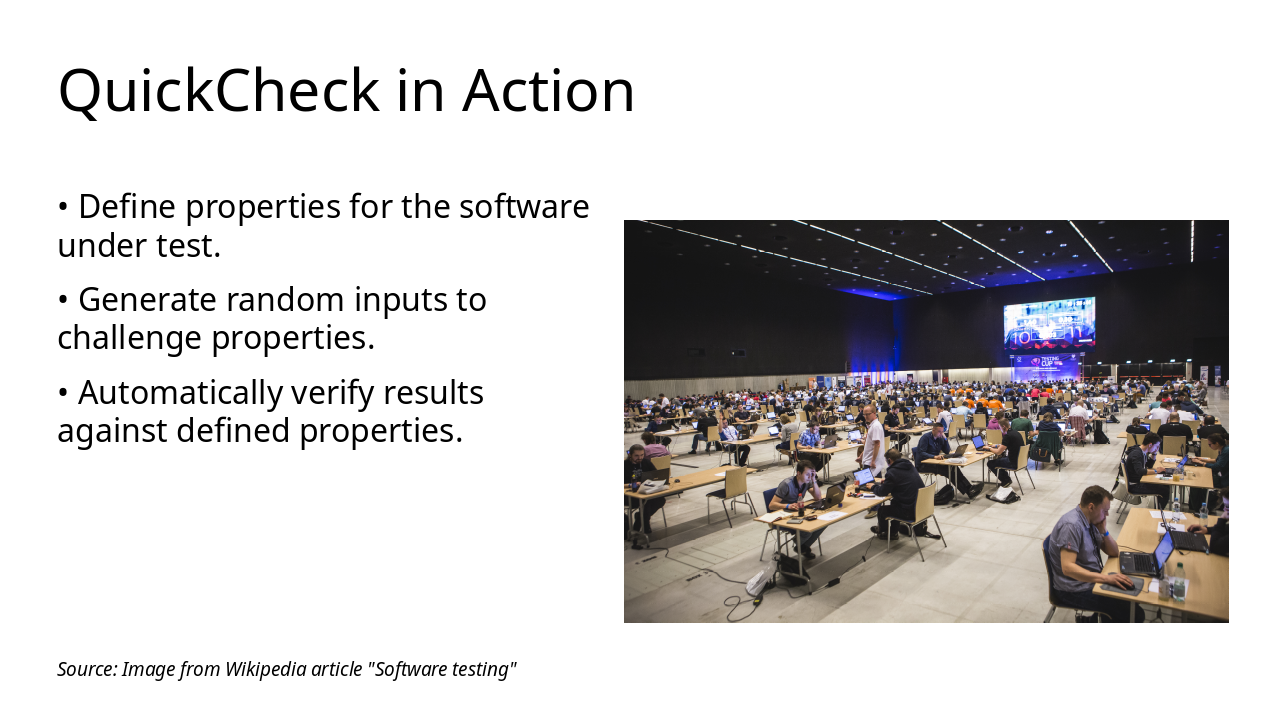
The slide titled "QuickCheck in Action" illustrates the process of using QuickCheck for property-based testing in software development. It outlines three key steps: defining properties for the software under test, generating random inputs to challenge those properties, and automatically verifying results against the defined properties.

QuickCheck in Action

!Image

  • Define properties for the software under test.
  • Generate random inputs to challenge properties.
  • Automatically verify results against defined properties.

Source: Image from Wikipedia article "Software testing"

--- Speaker Notes: Visual representation of test generation process: Properties → Random Inputs → Verification. (Imagine a flowchart diagram here.) Context: Quick test presentation

Slide 6
Slide 7 of 8

Slide 7 - Impact of QuickCheck

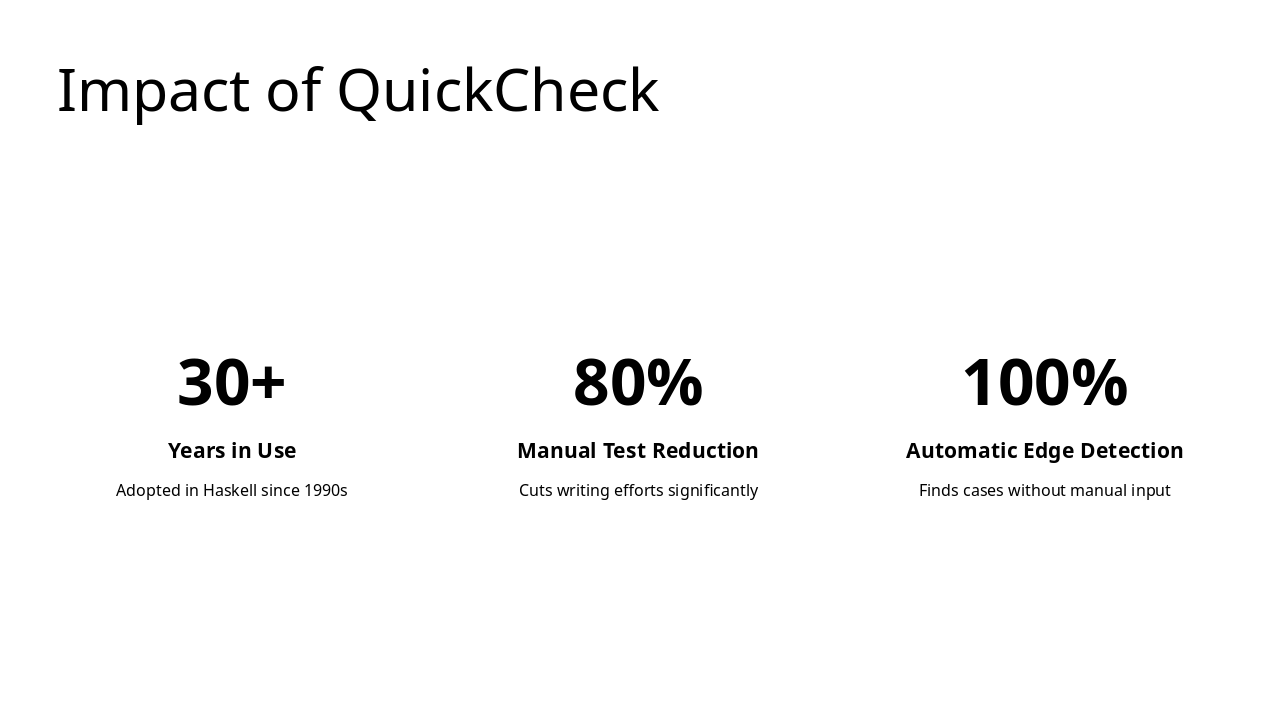
QuickCheck has been adopted in Haskell for over 30 years, demonstrating its long-standing reliability in software testing. It reduces manual testing efforts by 80% while providing 100% automatic edge case detection without requiring manual input.

Impact of QuickCheck

  • 30+: Years in Use

Adopted in Haskell since 1990s

  • 80%: Manual Test Reduction

Cuts writing efforts significantly

  • 100%: Automatic Edge Detection

Finds cases without manual input

Slide 7
Slide 8 of 8

Slide 8 - Wrapping Up QuickCheck

The slide titled "Wrapping Up QuickCheck" concludes the presentation with a motivational call to action: "Start testing smarter today!" It includes a subtitle encouraging viewers to explore available resources and begin implementing QuickCheck in their projects.

Wrapping Up QuickCheck

Start testing smarter today!

Explore resources and implement QuickCheck.

Source: Quick test presentation

--- Speaker Notes: QuickCheck revolutionizes testing with property-based approaches. Explore further via Wikipedia links and external resources. Start testing smarter today!

Slide 8
Powered by AI

Create Your Own Presentation

Generate professional presentations in seconds with Karaf's AI. Customize this presentation or start from scratch.

Create New Presentation

Powered by Karaf.ai — AI-Powered Presentation Generator