Boosting Critical Thinking via Metacognitive Training

Generated from prompt:

Create a 6-slide academic presentation based on the provided outline about the research paper 'The Effectiveness of a Metacognitive Training Program on Critical Thinking' by Ahmed Falah Al-Alwan & Khitam Alghazo, published in the Journal of Educational Sciences – Qatar University (2007). **Slide 1 – Cover** Title: The Effectiveness of a Metacognitive Training Program on Critical Thinking Authors: Ahmed Falah Al-Alwan & Khitam Alghazo Journal: Journal of Educational Sciences – Qatar University (2007) journals.qu.edu.qa Prepared by: [Your Name] – [Course / Date] **Slide 2 – Introduction to the Paper** - Define metacognitive thinking (“thinking about your thinking”) - Importance: critical thinking vs rote learning - Aim: test whether metacognitive training improves critical thinking **Slide 3 – Problem and Proposed Solution** Problem: - University students rely on rote learning and lack metacognitive skills Solution: - Design and test a metacognitive training program (plan, monitor, evaluate) Research question: Does metacognitive training significantly improve critical thinking? **Slide 4 – Methodology** - Quasi-experimental design: pre-test/post-test with control group - Participants: 72 university students - Experimental vs control groups - 16 training sessions, 13 topics (planning, monitoring, evaluating) - Measurement: Watson–Glaser Critical Thinking Test - Data analysis: ANCOVA **Slide 5 – Results** - Metacognitive training significantly improved critical thinking scores - No differences by gender, college, or level of education **Slide 6 – Conclusion and Implications** - Metacognitive training enhances critical thinking across groups - Universities should integrate metacognitive skills into courses - Future research: other countries, school levels, outcomes (problem-solving, creativity) Make the design academic and professional, with a subtle modern color palette and clean layout.

This presentation reviews Al-Alwan & Alghazo's 2007 study on a metacognitive training program for university students. It covers metacognition basics, the rote learning problem, quasi-experimental met

December 1, 20256 slides
Slide 1 of 6

Slide 1 - The Effectiveness of a Metacognitive Training Program on Critical Thinking

The slide presents a title on the effectiveness of a metacognitive training program in enhancing critical thinking skills. It includes authorship by Ahmed Falah Al-Alwan and Khitam Alghazo, publication details from the Journal of Educational Sciences at Qatar University in 2007, and preparation notes by [Your Name] for [Course / Date].

The Effectiveness of a Metacognitive Training Program on Critical Thinking

Authors: Ahmed Falah Al-Alwan & Khitam Alghazo Journal: Journal of Educational Sciences – Qatar University (2007) Prepared by: [Your Name] – [Course / Date]

Source: journals.qu.edu.qa

Slide 1 - The Effectiveness of a Metacognitive Training Program on Critical Thinking
Slide 2 of 6

Slide 2 - Introduction to the Paper

The slide introduces metacognitive thinking as the process of "thinking about your thinking," highlighting its importance in fostering critical thinking over mere rote learning. It outlines the paper's aim to test whether metacognitive training can enhance critical thinking skills.

Introduction to the Paper

  • Define metacognitive thinking as 'thinking about your thinking'.
  • Emphasize importance: critical thinking over rote learning.
  • Aim: Test if metacognitive training improves critical thinking skills.

Source: Journal of Educational Sciences – Qatar University (2007)

Slide 2 - Introduction to the Paper
Slide 3 of 6

Slide 3 - Problem and Proposed Solution

University students often depend on rote learning, which hinders deep comprehension and the development of metacognitive skills crucial for critical thinking. The proposed solution is to create and apply a metacognitive training program focused on planning, monitoring, and evaluating thought processes, with a research question exploring whether it significantly enhances critical thinking in these students.

Problem and Proposed Solution

ProblemProposed Solution
University students predominantly rely on rote learning methods, which limits deep understanding and fosters a lack of metacognitive skills essential for effective critical thinking development.Design and implement a metacognitive training program emphasizing planning, monitoring, and evaluating thinking processes. Research question: Does metacognitive training significantly improve critical thinking among university students?

Source: Journal of Educational Sciences – Qatar University (2007)

Slide 3 - Problem and Proposed Solution
Slide 4 of 6

Slide 4 - Methodology

The study employs a quasi-experimental design featuring pre-test and post-test assessments with a control group, involving 72 university students divided between experimental and control groups. It includes 16 training sessions covering 13 topics on planning, monitoring, and evaluating, with critical thinking measured via the Watson-Glaser Critical Thinking Test and data analyzed using ANCOVA.

Methodology

  • Quasi-experimental design: pre-test/post-test with control group.
  • Participants: 72 university students in experimental and control groups.
  • 16 training sessions on 13 topics (planning, monitoring, evaluating).
  • Measurement: Watson–Glaser Critical Thinking Test.
  • Data analysis: ANCOVA.
Slide 4 - Methodology
Slide 5 of 6

Slide 5 - Results

Metacognitive training led to significant improvements in critical thinking scores among participants. No notable differences were found based on gender, college affiliation, or education level.

Results

  • Metacognitive training significantly improved critical thinking scores.
  • No significant differences observed by gender.
  • No significant differences by college affiliation.
  • No significant differences by education level.

Source: Journal of Educational Sciences – Qatar University (2007)

Slide 5 - Results
Slide 6 of 6

Slide 6 - Conclusion and Implications

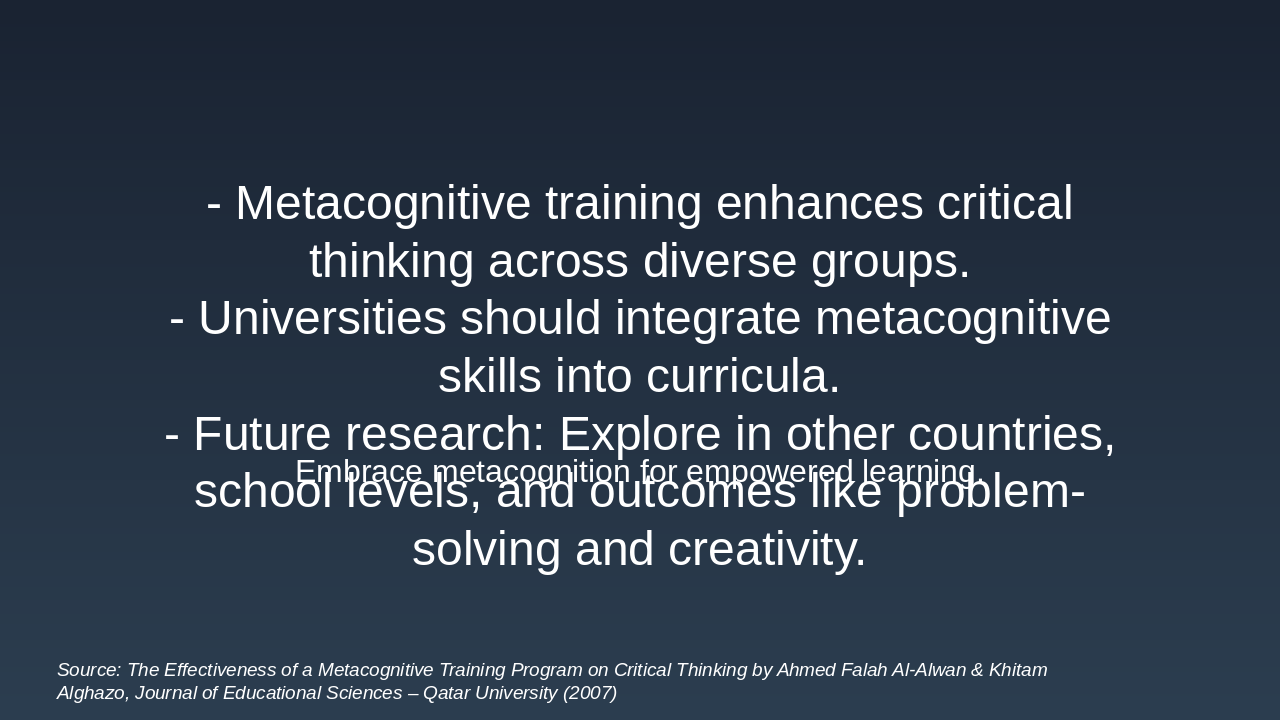
Metacognitive training improves critical thinking skills in various groups, so universities should incorporate these skills into their curricula. Future studies should investigate its effects in different countries, educational levels, and areas like problem-solving and creativity, embracing metacognition to empower learning.

Conclusion and Implications

- Metacognitive training enhances critical thinking across diverse groups.

  • Universities should integrate metacognitive skills into curricula.
  • Future research: Explore in other countries, school levels, and outcomes like problem-solving and creativity.

Embrace metacognition for empowered learning.

Source: The Effectiveness of a Metacognitive Training Program on Critical Thinking by Ahmed Falah Al-Alwan & Khitam Alghazo, Journal of Educational Sciences – Qatar University (2007)

Speaker Notes
Summarize key findings, discuss implications for education, and suggest future research directions. Encourage audience to consider integrating metacognitive training.
Slide 6 - Conclusion and Implications

Discover More Presentations

Explore thousands of AI-generated presentations for inspiration

Browse Presentations
Powered by AI

Create Your Own Presentation

Generate professional presentations in seconds with Karaf's AI. Customize this presentation or start from scratch.

Create New Presentation

Powered by Karaf.ai — AI-Powered Presentation Generator