AI's Evolution: From Myths to Modernity

Generated from prompt:

make a presentation about the history of artificial intelligence

This presentation traces AI's history from ancient philosophical roots and Turing's foundational work, through 1950s birth, AI winters, key revivals, modern stats, to future ethical integration and on

November 4, 202511 slides
Slide 1 of 11

Slide 1 - The History of Artificial Intelligence

The slide is titled "The History of Artificial Intelligence" and serves as an introductory title slide. Its subtitle welcomes viewers to an overview of AI's evolution, tracing from its philosophical origins to modern innovations that influence the world today.

The History of Artificial Intelligence

Welcome to an overview of AI's journey, from philosophical roots to cutting-edge innovations that shape our world today.
Source: Welcome to an overview of AI's journey, from philosophical roots to cutting-edge innovations that shape our world today.
Slide 1
Slide 2 of 11

Slide 2 - Presentation Agenda

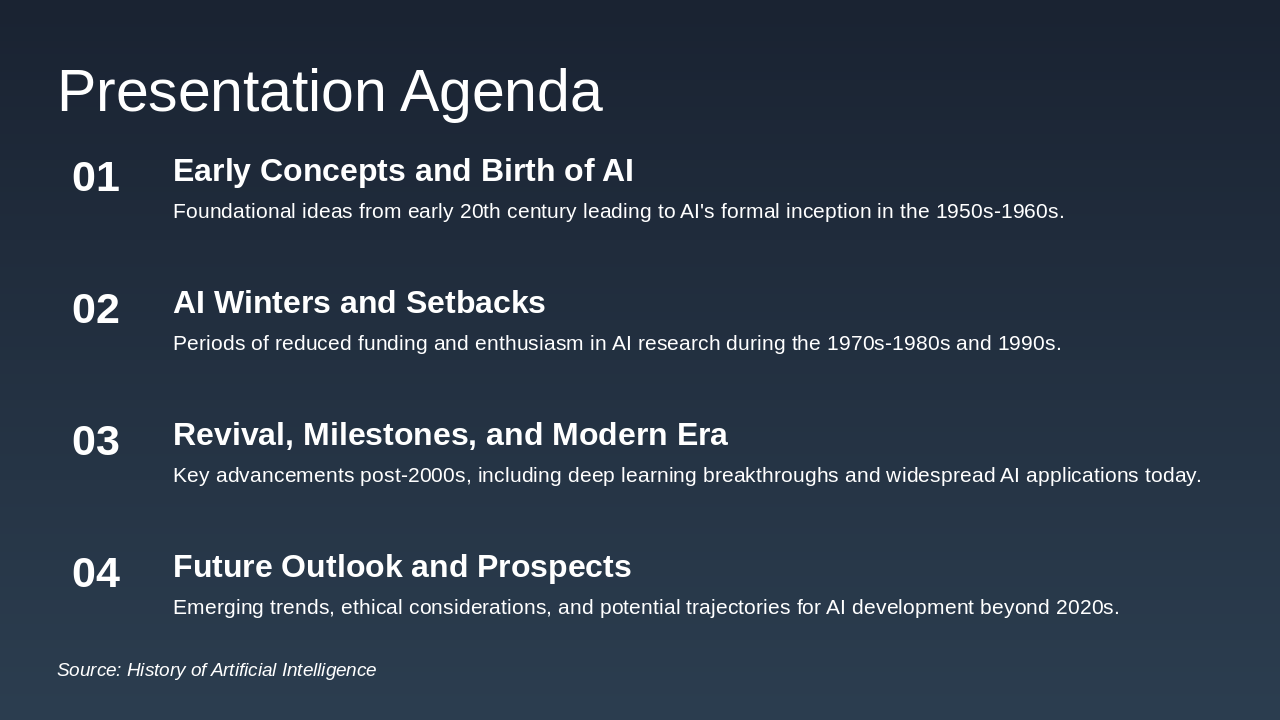
The presentation agenda outlines the historical evolution of AI, starting with its early concepts and formal birth in the 1950s-1960s. It then covers periods of setbacks during AI winters in the 1970s-1990s, followed by post-2000s revivals through milestones like deep learning, and concludes with future outlooks including emerging trends and ethical issues beyond the 2020s.

Presentation Agenda

  1. Early Concepts and Birth of AI

Foundational ideas from early 20th century leading to AI's formal inception in the 1950s-1960s.

  1. AI Winters and Setbacks

Periods of reduced funding and enthusiasm in AI research during the 1970s-1980s and 1990s.

  1. Revival, Milestones, and Modern Era

Key advancements post-2000s, including deep learning breakthroughs and widespread AI applications today.

  1. Future Outlook and Prospects

Emerging trends, ethical considerations, and potential trajectories for AI development beyond 2020s.

Source: History of Artificial Intelligence

Slide 2
Slide 3 of 11

Slide 3 - Early Concepts of AI

This slide serves as a section header titled "Early Concepts of AI," marking it as the second section in the presentation. It invites exploration of philosophical and foundational ideas that predated computers, laying the groundwork for the development of machine intelligence.

02

Early Concepts of AI

Explore philosophical and foundational ideas predating computers, setting the stage for machine intelligence.

Slide 3
Slide 4 of 11

Slide 4 - Philosophical Roots

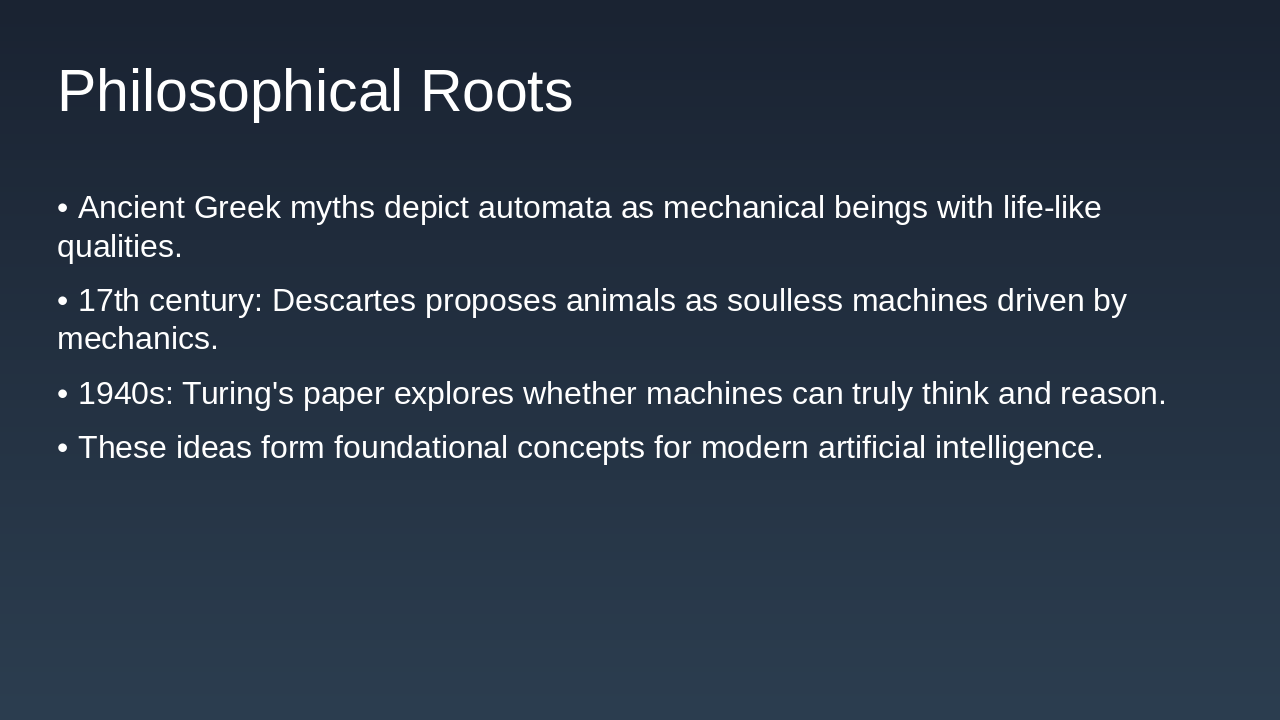
Ancient Greek myths portrayed automata as lifelike mechanical beings, while 17th-century philosopher Descartes viewed animals as soulless machines governed by mechanics. In the 1940s, Alan Turing questioned if machines could genuinely think and reason, with these historical ideas laying the groundwork for modern artificial intelligence.

Philosophical Roots

  • Ancient Greek myths depict automata as mechanical beings with life-like qualities.
  • 17th century: Descartes proposes animals as soulless machines driven by mechanics.
  • 1940s: Turing's paper explores whether machines can truly think and reason.
  • These ideas form foundational concepts for modern artificial intelligence.
Slide 4
Slide 5 of 11

Slide 5 - Alan Turing and Early AI

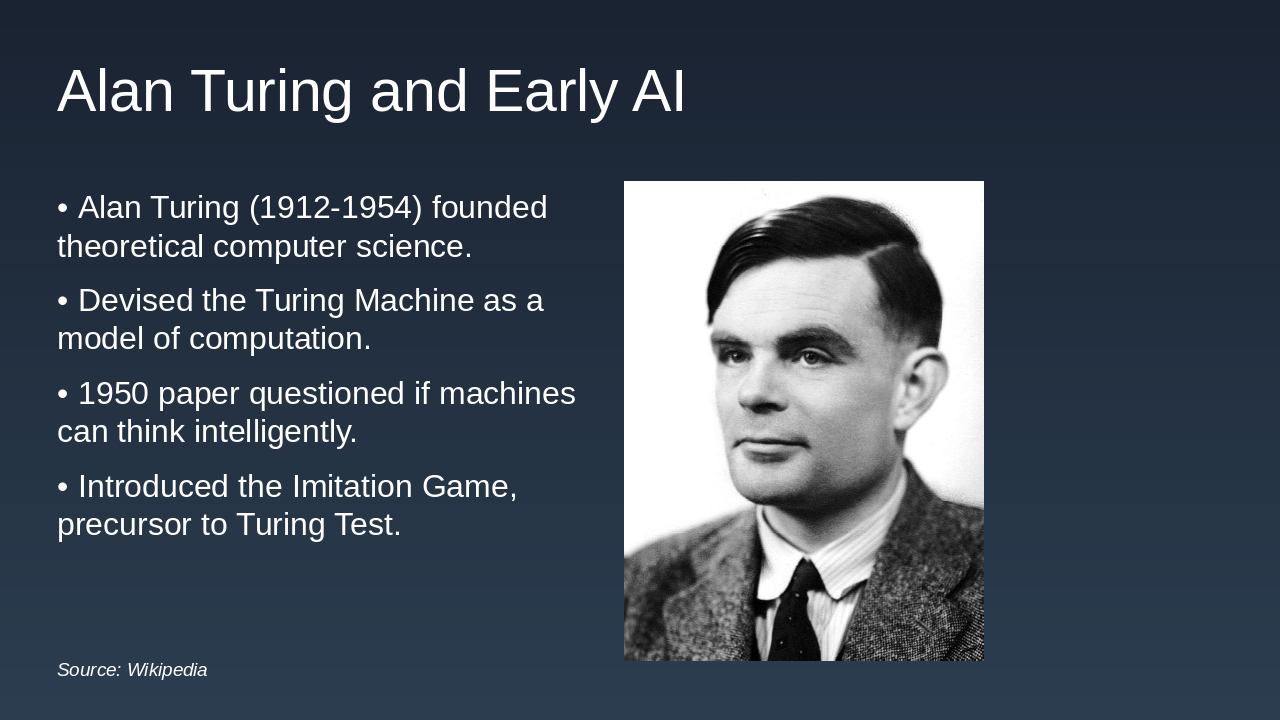
Alan Turing (1912-1954) founded theoretical computer science and devised the Turing Machine as a foundational model of computation. His 1950 paper explored whether machines can think intelligently, introducing the Imitation Game as a precursor to the modern Turing Test.

Alan Turing and Early AI

!Image

  • Alan Turing (1912-1954) founded theoretical computer science.
  • Devised the Turing Machine as a model of computation.
  • 1950 paper questioned if machines can think intelligently.
  • Introduced the Imitation Game, precursor to Turing Test.

Source: Wikipedia

Slide 5
Slide 6 of 11

Slide 6 - Birth of AI: 1950s-1960s

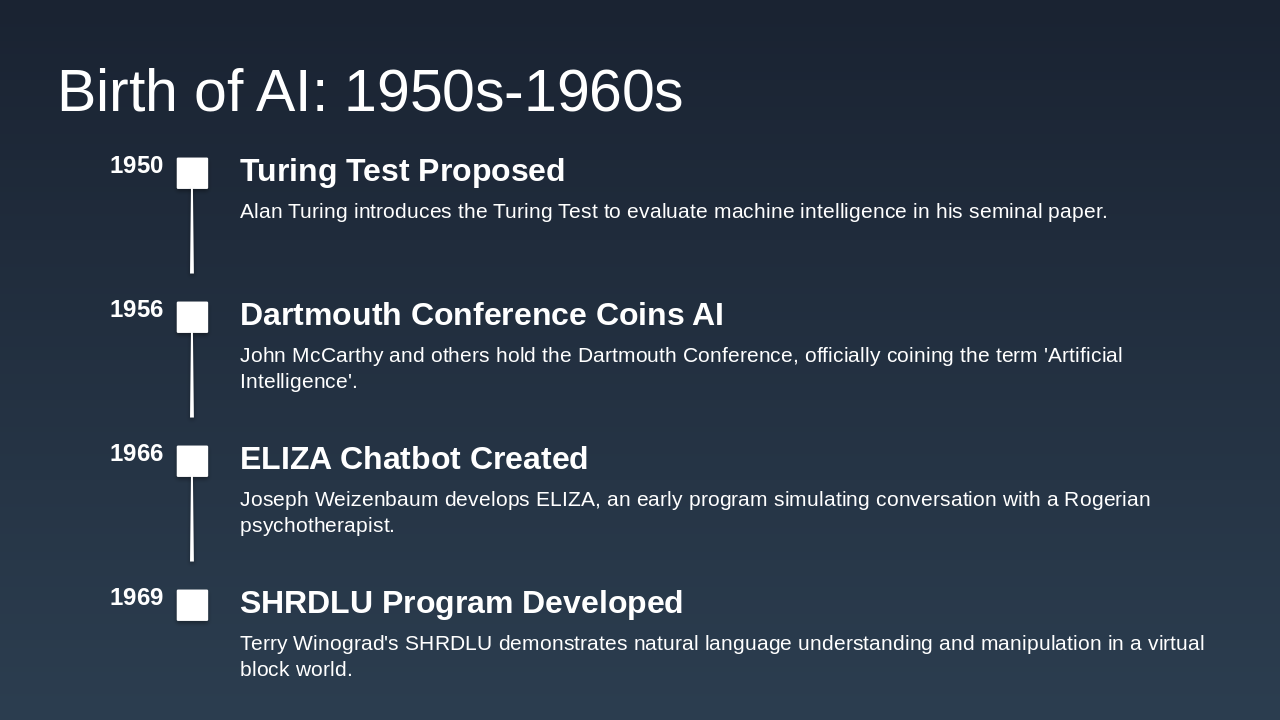
In the 1950s, Alan Turing proposed the Turing Test in 1950 to evaluate machine intelligence, and the 1956 Dartmouth Conference coined the term "Artificial Intelligence" under John McCarthy's leadership. The 1960s saw early AI advancements, including Joseph Weizenbaum's 1966 ELIZA chatbot simulating psychotherapy conversations and Terry Winograd's 1969 SHRDLU program demonstrating natural language understanding in a virtual block world.

Birth of AI: 1950s-1960s

1950: Turing Test Proposed Alan Turing introduces the Turing Test to evaluate machine intelligence in his seminal paper. 1956: Dartmouth Conference Coins AI John McCarthy and others hold the Dartmouth Conference, officially coining the term 'Artificial Intelligence'. 1966: ELIZA Chatbot Created Joseph Weizenbaum develops ELIZA, an early program simulating conversation with a Rogerian psychotherapist. 1969: SHRDLU Program Developed Terry Winograd's SHRDLU demonstrates natural language understanding and manipulation in a virtual block world.

Slide 6
Slide 7 of 11

Slide 7 - AI Winters

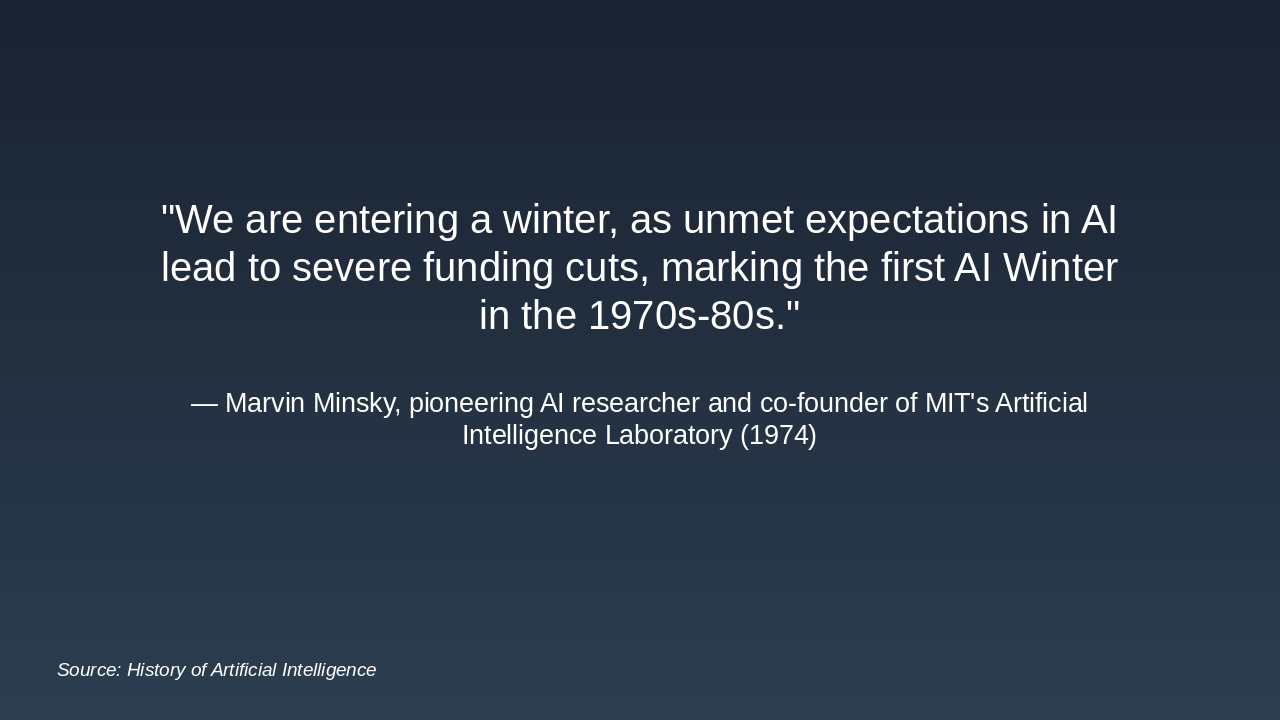
The slide, titled "AI Winters," features a quote from Marvin Minsky, a pioneering AI researcher and co-founder of MIT's Artificial Intelligence Laboratory in 1974. In the quote, Minsky warns that unmet expectations in AI are ushering in a "winter" era of severe funding cuts, reminiscent of the first AI Winter from the 1970s to 1980s.

AI Winters

> We are entering a winter, as unmet expectations in AI lead to severe funding cuts, marking the first AI Winter in the 1970s-80s.

— Marvin Minsky, pioneering AI researcher and co-founder of MIT's Artificial Intelligence Laboratory (1974)

Source: History of Artificial Intelligence

--- Speaker Notes: Funding cuts in 1970s-80s due to unmet expectations; second winter in 1980s after expert systems hype.

Slide 7
Slide 8 of 11

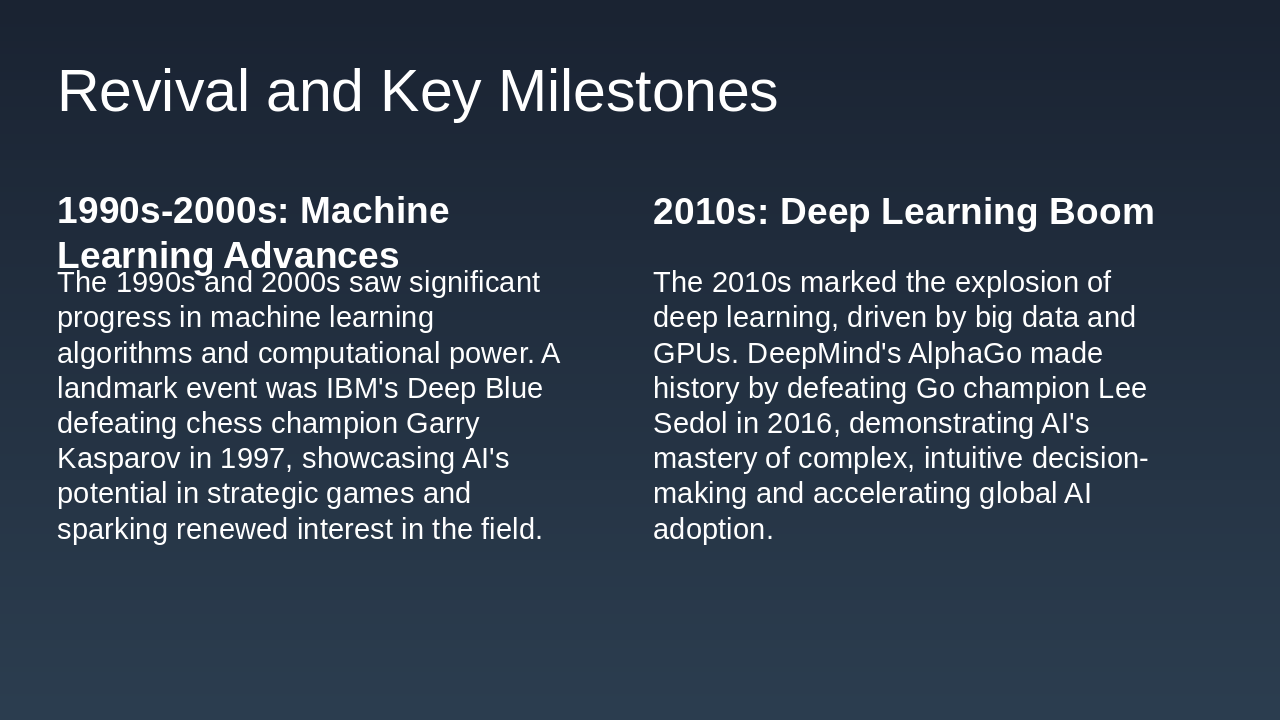
Slide 8 - Revival and Key Milestones

The slide highlights AI's revival through key milestones, starting with 1990s-2000s advances in machine learning algorithms and computational power, exemplified by IBM's Deep Blue defeating chess champion Garry Kasparov in 1997. In the 2010s, deep learning boomed thanks to big data and GPUs, with DeepMind's AlphaGo triumphing over Go champion Lee Sedol in 2016, showcasing AI's prowess in complex decision-making and fueling global adoption.

Revival and Key Milestones

1990s-2000s: Machine Learning Advances2010s: Deep Learning Boom
The 1990s and 2000s saw significant progress in machine learning algorithms and computational power. A landmark event was IBM's Deep Blue defeating chess champion Garry Kasparov in 1997, showcasing AI's potential in strategic games and sparking renewed interest in the field.The 2010s marked the explosion of deep learning, driven by big data and GPUs. DeepMind's AlphaGo made history by defeating Go champion Lee Sedol in 2016, demonstrating AI's mastery of complex, intuitive decision-making and accelerating global AI adoption.
Slide 8
Slide 9 of 11

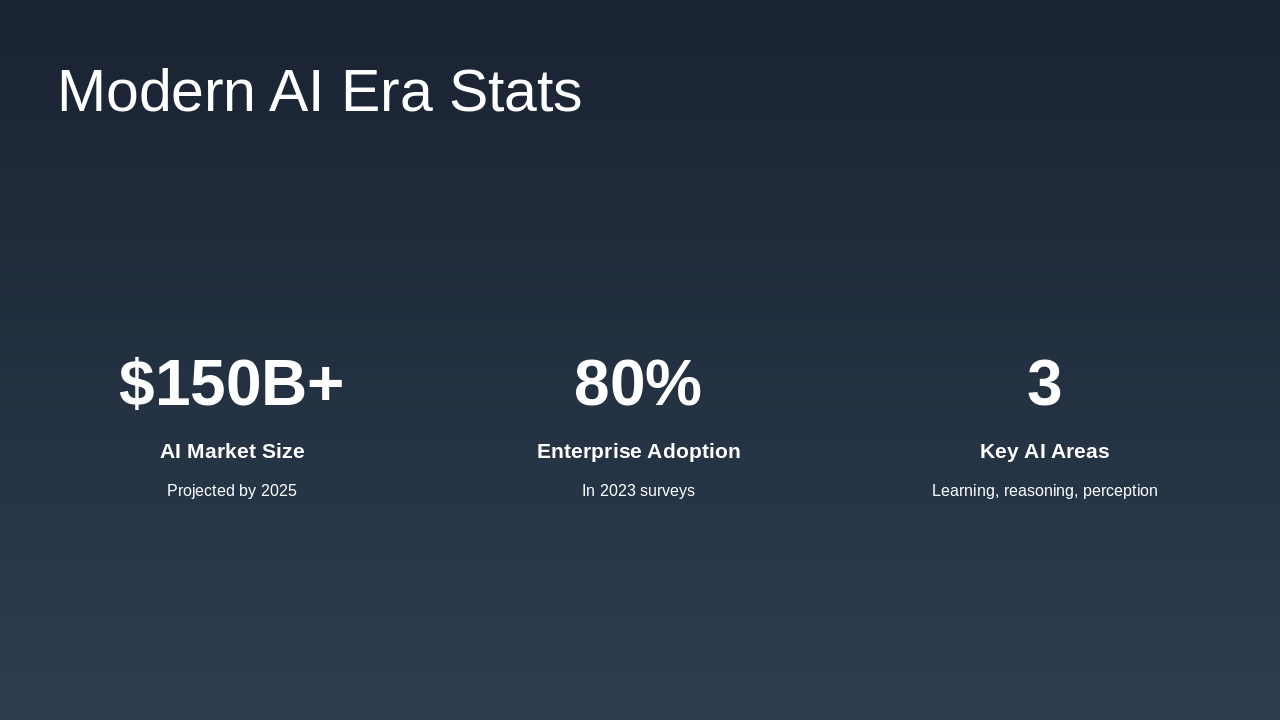
Slide 9 - Modern AI Era Stats

The Modern AI Era Stats slide highlights key metrics from the AI landscape, including a projected market size exceeding $150 billion by 2025. It also notes that 80% of enterprises adopted AI based on 2023 surveys, while identifying three core areas: learning, reasoning, and perception.

Modern AI Era Stats

  • $150B+: AI Market Size

Projected by 2025

  • 80%: Enterprise Adoption

In 2023 surveys

  • 3: Key AI Areas

Learning, reasoning, perception

Slide 9
Slide 10 of 11

Slide 10 - Future of AI

The "Future of AI" slide outlines how AI will deeply integrate with human goals, planning, decision-making, and capabilities to foster enhanced collaboration and unlock superintelligence for societal transformation. It also addresses key challenges, including navigating ethical issues and implementing robust regulations.

Future of AI

  • Deep integration with human goals, planning, and decision-making
  • Navigating ethical challenges and implementing robust regulations
  • Unlocking potential for superintelligence and societal transformation
  • Enhancing collaboration between AI and human capabilities

Source: History of Artificial Intelligence Presentation

--- Speaker Notes: Discuss how AI's future builds on its history, emphasizing integration, ethics, and superintelligence potential.

Slide 10
Slide 11 of 11

Slide 11 - Conclusion: AI's Ongoing Journey

The conclusion slide, titled "AI's Ongoing Journey," highlights how AI has progressed from theoretical concepts to a transformative technology in modern applications. It emphasizes that ongoing innovation will bring exciting advancements while necessitating efforts to address associated risks, under the subtitle "AI's Journey: From Theory to Tomorrow."

Conclusion: AI's Ongoing Journey

AI has evolved from theory to transformative technology. Continued innovation promises exciting advancements while addressing risks.

AI's Journey: From Theory to Tomorrow

--- Speaker Notes: Call-to-action: Stay curious about AI developments and consider ethical implications in your work.

Slide 11
Powered by AI

Create Your Own Presentation

Generate professional presentations in seconds with Karaf's AI. Customize this presentation or start from scratch.

Create New Presentation

Powered by Karaf.ai — AI-Powered Presentation Generator