Renewable Energy: Powering a Sustainable Future

Generated from prompt:

make a presentation about renewable energy

This presentation explores renewable energy, covering its definition, types like solar and wind, historical timeline, key statistics, pros and cons, expert insights, and a call to embrace renewables f

November 18, 202510 slides
Slide 1 of 10

Slide 1 - Renewable Energy: Powering a Sustainable Future

The slide features the title "Renewable Energy: Powering a Sustainable Future," highlighting the role of renewables in achieving sustainability. Its subtitle, "Exploring Renewable Sources for a Sustainable Tomorrow," introduces a focus on investigating these energy options for long-term environmental benefits.

Renewable Energy: Powering a Sustainable Future

Exploring Renewable Sources for a Sustainable Tomorrow

--- Speaker Notes: Welcome slide introducing the topic of renewable energy sources and their role in sustainability.
Slide 1
Slide 2 of 10

Slide 2 - Presentation Agenda

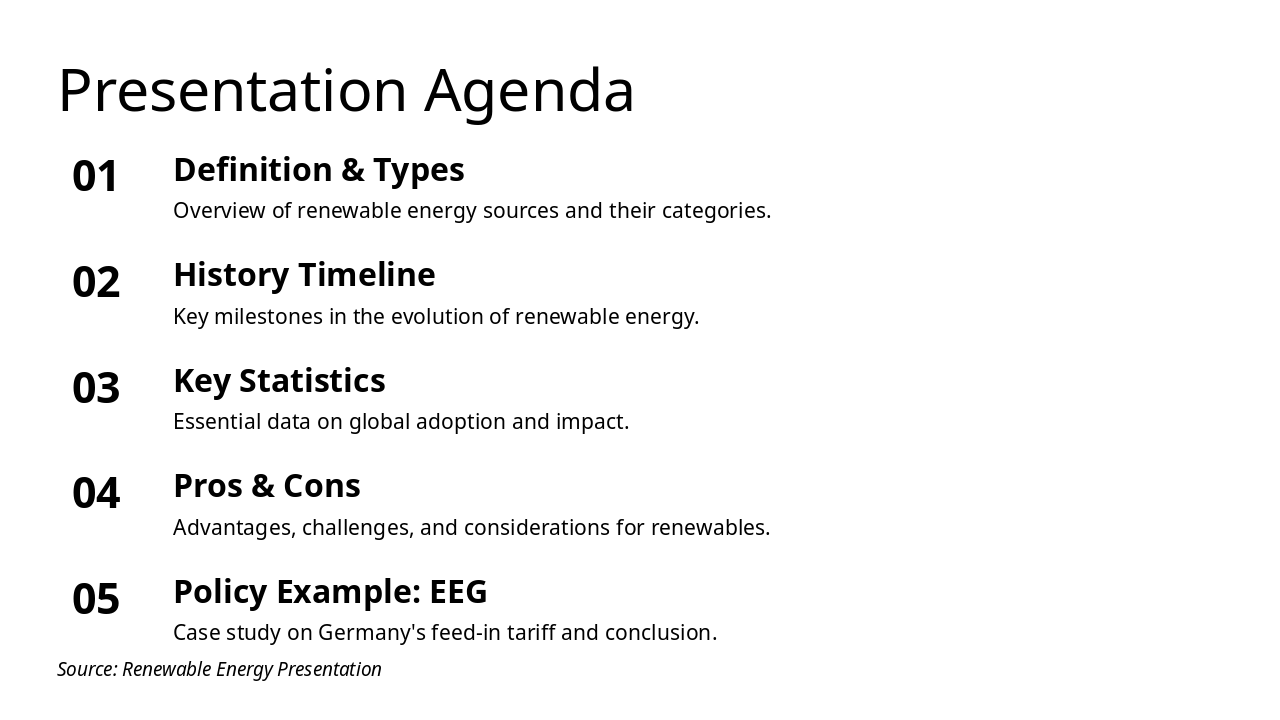
The presentation agenda outlines a structured overview of renewable energy, starting with its definition, types, and historical milestones, followed by key global statistics on adoption and impact. It then covers the pros and cons of renewables, concluding with a case study on Germany's EEG feed-in tariff policy.

Presentation Agenda

  1. Definition & Types

Overview of renewable energy sources and their categories.

  1. History Timeline

Key milestones in the evolution of renewable energy.

  1. Key Statistics

Essential data on global adoption and impact.

  1. Pros & Cons

Advantages, challenges, and considerations for renewables.

  1. Policy Example: EEG

Case study on Germany's feed-in tariff and conclusion.

Source: Renewable Energy Presentation

Slide 2
Slide 3 of 10

Slide 3 - What is Renewable Energy?

Renewable energy refers to power derived from natural sources that replenish quickly, such as sunlight, wind, and water. This approach reduces greenhouse gas emissions and promotes long-term environmental sustainability.

What is Renewable Energy?

What is Renewable Energy?

Natural sources that replenish quickly, reducing emissions and promoting sustainability.

Source: Renewable Energy Presentation

--- Speaker Notes: Renewable energy comes from natural sources that replenish quickly, unlike fossil fuels. It reduces emissions and promotes sustainability.

Slide 3
Slide 4 of 10

Slide 4 - Types of Renewable Energy

Renewable energy sources harness natural, sustainable resources to generate electricity without depleting them. The slide highlights key types: solar energy from sunlight via photovoltaic panels, wind energy from turbines capturing kinetic motion, hydropower from flowing water driving turbines, geothermal energy from Earth's internal heat, and biomass energy from processing organic materials.

Types of Renewable Energy

  • Solar energy: Harnesses sunlight using photovoltaic panels to generate electricity.
  • Wind energy: Turbines convert wind's kinetic energy into electrical power.
  • Hydropower: Flowing water drives turbines to produce electricity.
  • Geothermal energy: Extracts Earth's internal heat for energy generation.
  • Biomass energy: Converts organic materials into energy via combustion or processing.
Slide 4
Slide 5 of 10

Slide 5 - Visualizing Renewable Sources

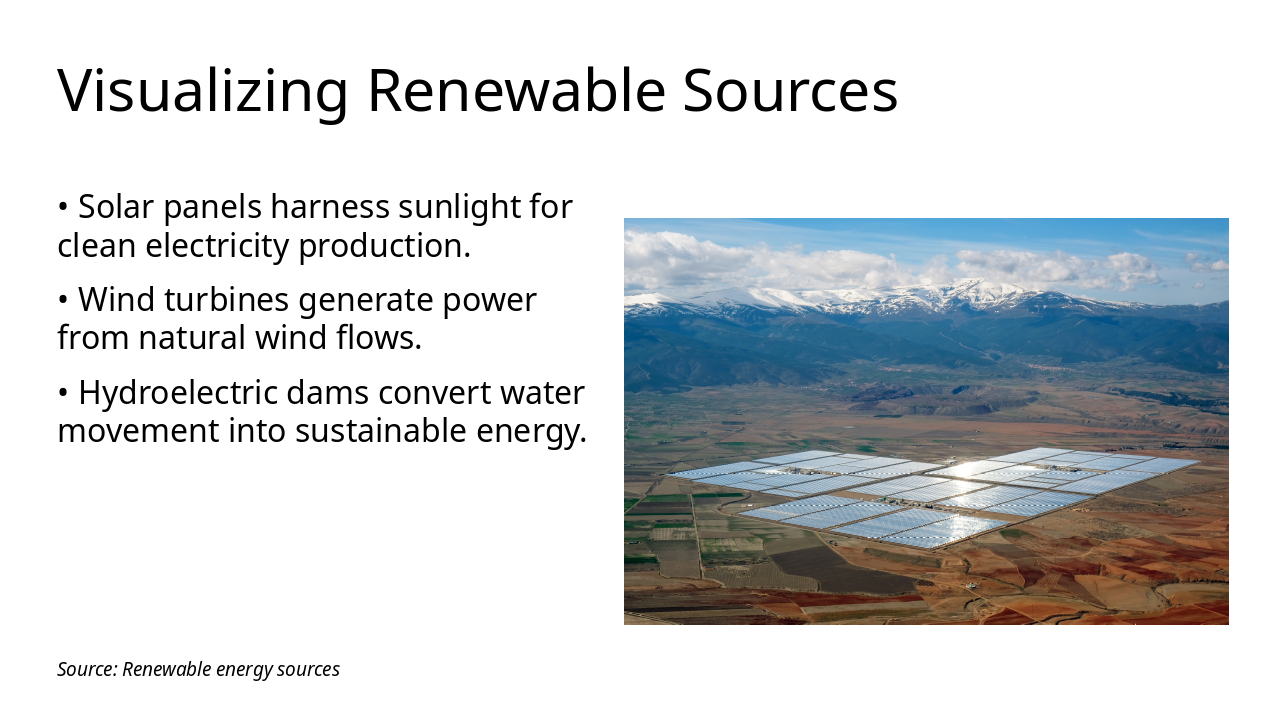
The slide titled "Visualizing Renewable Sources" features an image illustrating key renewable energy methods. It highlights solar panels that capture sunlight for clean electricity, wind turbines that harness natural wind flows for power generation, and hydroelectric dams that transform water movement into sustainable energy.

Visualizing Renewable Sources

!Image

  • Solar panels harness sunlight for clean electricity production.
  • Wind turbines generate power from natural wind flows.
  • Hydroelectric dams convert water movement into sustainable energy.

Source: Renewable energy sources

--- Speaker Notes: Image of solar panels, wind turbines, and hydroelectric dams in action, showcasing diverse renewable technologies.

Slide 5
Slide 6 of 10

Slide 6 - History of Renewable Energy

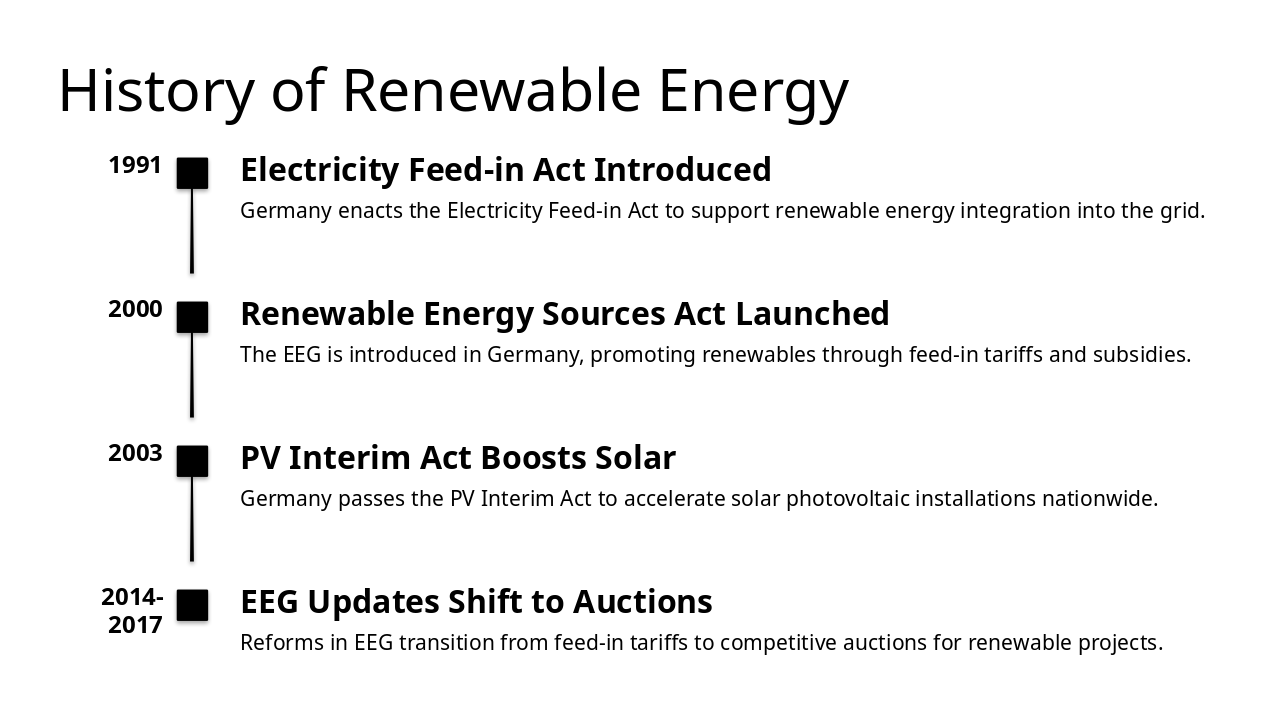
The timeline on the History of Renewable Energy slide outlines key German policy milestones starting in 1991 with the Electricity Feed-in Act, which supported renewable integration into the grid. It continues through 2000's Renewable Energy Sources Act with feed-in tariffs, 2003's PV Interim Act to boost solar installations, and 2014-2017 EEG reforms shifting to competitive auctions for projects.

History of Renewable Energy

1991: Electricity Feed-in Act Introduced Germany enacts the Electricity Feed-in Act to support renewable energy integration into the grid. 2000: Renewable Energy Sources Act Launched The EEG is introduced in Germany, promoting renewables through feed-in tariffs and subsidies. 2003: PV Interim Act Boosts Solar Germany passes the PV Interim Act to accelerate solar photovoltaic installations nationwide. 2014-2017: EEG Updates Shift to Auctions Reforms in EEG transition from feed-in tariffs to competitive auctions for renewable projects.

Slide 6
Slide 7 of 10

Slide 7 - Renewable Energy Statistics

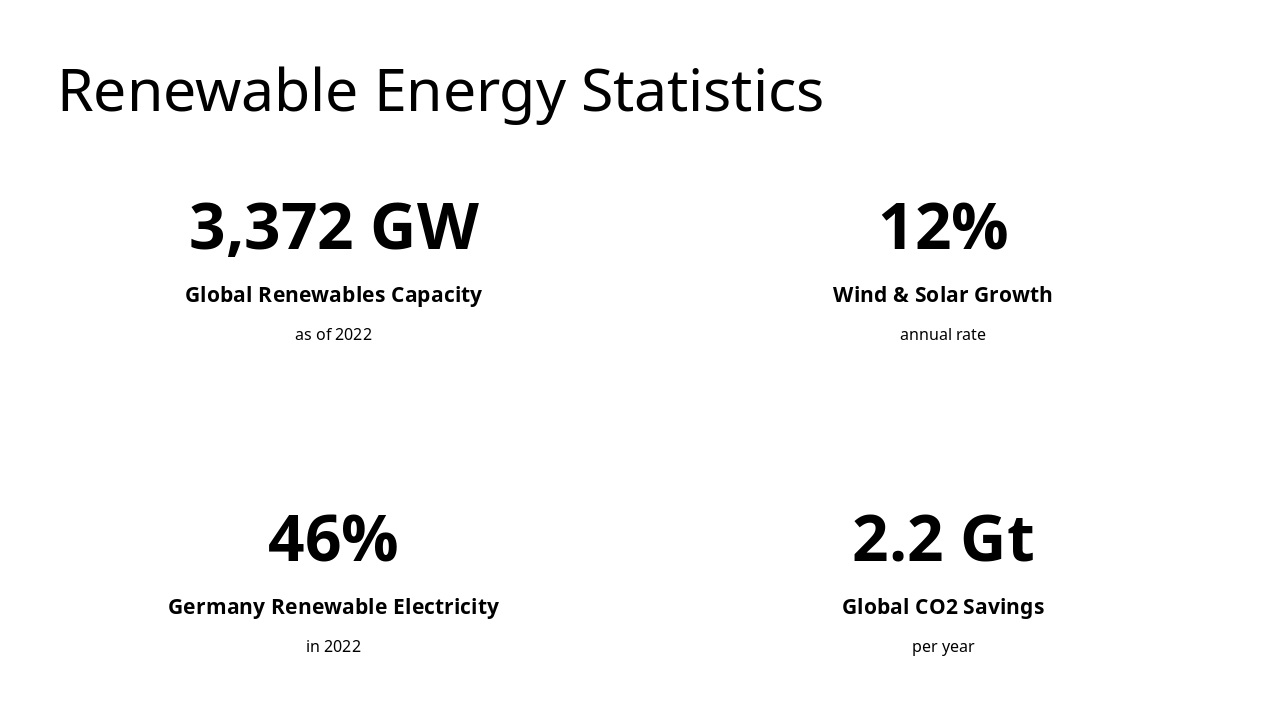
The slide highlights key renewable energy statistics, including a global renewables capacity of 3,372 GW as of 2022 and an annual growth rate of 12% for wind and solar. It also notes that renewables accounted for 46% of Germany's electricity in 2022, contributing to 2.2 Gt of global CO2 savings per year.

Renewable Energy Statistics

  • 3,372 GW: Global Renewables Capacity

as of 2022

  • 12%: Wind & Solar Growth

annual rate

  • 46%: Germany Renewable Electricity

in 2022

  • 2.2 Gt: Global CO2 Savings

per year

Slide 7
Slide 8 of 10

Slide 8 - Pros and Cons

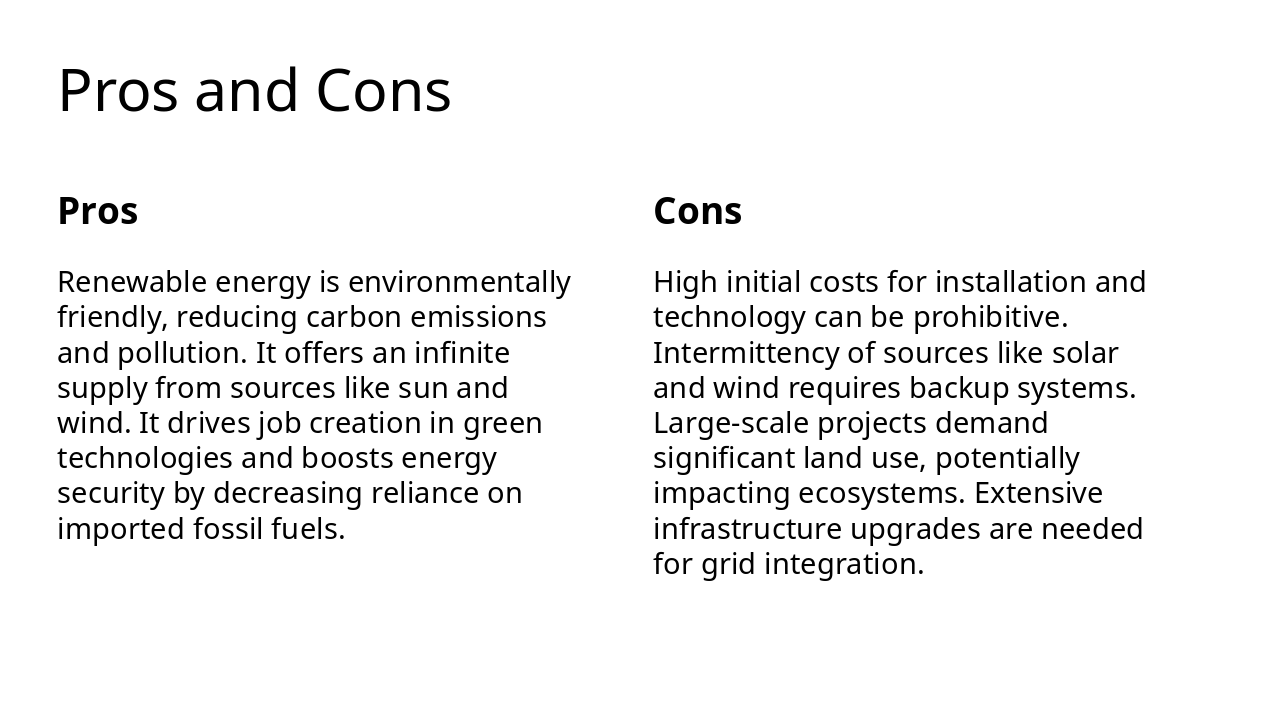
The slide outlines the pros of renewable energy, highlighting its environmental benefits like reduced carbon emissions and pollution, infinite supply from sources such as sun and wind, job creation in green technologies, and enhanced energy security by reducing dependence on imported fossil fuels. On the cons side, it discusses high initial installation costs, the intermittency of sources requiring backup systems, significant land use that could harm ecosystems, and the need for extensive grid infrastructure upgrades.

Pros and Cons

ProsCons
Renewable energy is environmentally friendly, reducing carbon emissions and pollution. It offers an infinite supply from sources like sun and wind. It drives job creation in green technologies and boosts energy security by decreasing reliance on imported fossil fuels.High initial costs for installation and technology can be prohibitive. Intermittency of sources like solar and wind requires backup systems. Large-scale projects demand significant land use, potentially impacting ecosystems. Extensive infrastructure upgrades are needed for grid integration.
Slide 8
Slide 9 of 10

Slide 9 - Expert Insight

The slide, titled "Expert Insight," features a quote slide highlighting the importance of renewable energy. It states: "Renewable energy is not just the future; it's the present we must seize," attributed to Ban Ki-moon, former UN Secretary-General.

Expert Insight

> Renewable energy is not just the future; it's the present we must seize.

— Ban Ki-moon, former UN Secretary-General

Slide 9
Slide 10 of 10

Slide 10 - Conclusion: Embrace Renewables

The conclusion slide, titled "Embrace Renewables," urges securing a cleaner planet through the adoption of renewable energy sources. It features a subtitle calling for support of EEG policies, investment in innovation, and ends with a thank you.

Conclusion: Embrace Renewables

Secure a cleaner planet with renewables.

Support EEG policies and invest in innovation. Thank you!

Slide 10
Powered by AI

Create Your Own Presentation

Generate professional presentations in seconds with Karaf's AI. Customize this presentation or start from scratch.

Create New Presentation

Powered by Karaf.ai — AI-Powered Presentation Generator