Boosting EoDB via Customs & GST Reforms

Generated from prompt:

Ease of Doing Business in Customs & GST (Comprehensive 15-Slide Presentation) Slide 1: Title Slide - Ease of Doing Business in Customs & GST - Improving Efficiency, Transparency & Trade Facilitation - Prepared for Learners, Policy Professionals, and Business Leaders Slide 2: Introduction – Why EoDB Matters - EoDB measures how easy it is to start, operate, and expand a business. - It impacts competitiveness, investment, and innovation. - Customs and taxation reforms are the backbone of trade facilitation. - India’s focus: Simplification + Digitization + Transparency. Slide 3: The Pre-Reform Scenario - Manual paperwork and long clearance times. - Multiple regulatory approvals and poor coordination. - High dwell time at ports (2–3 days average). - Lack of transparency and inconsistent valuation. - High logistics and transaction costs. Slide 4: Modern Customs Principles - Simplification: standardized forms and fewer steps. - Automation: electronic end-to-end processing. - Transparency: rules published online and real-time tracking. - Risk Management: target high-risk cargo only. - Trade Facilitation: business–customs partnership. Slide 5: Key EoDB Measures in Customs - SWIFT (Single Window Interface for Trade) - RMS (Risk Management System) - EDI (Electronic Data Interchange) - AEO (Authorized Economic Operator) program - DPD & DPE (Direct Port Delivery/Entry) - Faceless assessment, e-seals, online duty payment. Slide 6: Single Window System (SWIFT) - One unified portal integrating over 50 government agencies. - Traders upload documents once—shared across departments. - Benefits: Faster clearance, reduced duplication, improved coordination. Slide 7: Risk Management System (RMS) - AI-driven profiling of cargo and traders. - Only high-risk shipments physically inspected. - Low-risk cargo cleared immediately. - Results: 70% reduction in dwell time; efficient resource use. Slide 8: Authorized Economic Operator (AEO) Program - Recognized trusted traders get priority treatment. - Benefits: fewer inspections, faster clearance, deferred payment options. - Builds trust and partnership between customs and industry. Slide 9: Paperless Documentation & Faceless Assessment - Electronic filing, digital signatures, and online payments. - Contactless, paperless, transparent system. - Remote assessment centers promote consistency. - Major reduction in physical interaction and corruption. Slide 10: Impact of Customs Reforms - Clearance time cut by 40–60%. - Reduction in compliance costs. - Higher transparency and predictability. - Improved global ranking in trade facilitation. - Stronger trust between trade and government. Slide 11: Global Benchmarking - Alignment with WTO Trade Facilitation Agreement & WCO SAFE Framework. - Benchmarked against Singapore, Netherlands, South Korea, and UAE. - India recognized as one of the top reforming nations. Slide 12: GST – Catalyst for Ease of Doing Business - Replaced multiple taxes (VAT, excise, service tax) with one unified GST. - Benefits: - One Nation, One Tax - Simplified Registration - Seamless Input Tax Credit (ITC) - Faster logistics and nationwide operations. Slide 13: GST in Action – Real Business Impact - Logistics: Border checkposts removed → travel time reduced by 30%. - Manufacturing: Input credit cut costs by 8–10%. - Retail: Simplified multi-state expansion. - SMEs: Composition scheme eased compliance. - FMCG: Reduced warehouses → 35 to 18; saved crores. Slide 14: Future of EoDB - AI & analytics for predictive risk management. - Blockchain for secure supply chain tracking. - Interoperable digital trade platforms. - Fully paperless, contactless, seamless operations. - Capacity building and inter-agency coordination. Slide 15: Conclusion - EoDB = Simplification + Automation + Transparency. - Customs + GST synergy = Stronger trade ecosystem. - Continuous innovation ensures competitiveness. - India’s EoDB journey is a model for modern, efficient governance.

This 15-slide presentation explores India's Ease of Doing Business (EoDB) enhancements in Customs and GST, from pre-reform challenges to modern principles like SWIFT, RMS, AEO, and faceless assessment

November 27, 202515 slides
Slide 1 of 15

Slide 1 - Ease of Doing Business in Customs & GST

The slide's title is "Ease of Doing Business in Customs & GST," focusing on strategies to enhance efficiency, transparency, and trade facilitation in these areas. It includes a subtitle noting that the content is prepared for learners, policy professionals, and business leaders.

Ease of Doing Business in Customs & GST

Improving Efficiency, Transparency & Trade Facilitation Prepared for Learners, Policy Professionals, and Business Leaders

Source: Comprehensive 15-Slide Presentation

Slide 1 - Ease of Doing Business in Customs & GST
Slide 2 of 15

Slide 2 - Introduction – Why EoDB Matters

Ease of Doing Business (EoDB) assesses the simplicity of starting, operating, and expanding businesses, while boosting competitiveness, attracting investment, and driving innovation. Key reforms in customs and taxation support trade facilitation, with India's approach focusing on simplification, digitization, and transparency.

Introduction – Why EoDB Matters

  • EoDB measures ease of starting, operating, and expanding businesses.
  • Enhances competitiveness, attracts investment, and fosters innovation.
  • Customs and taxation reforms underpin trade facilitation.
  • India's strategy emphasizes simplification, digitization, and transparency.
Slide 2 - Introduction – Why EoDB Matters
Slide 3 of 15

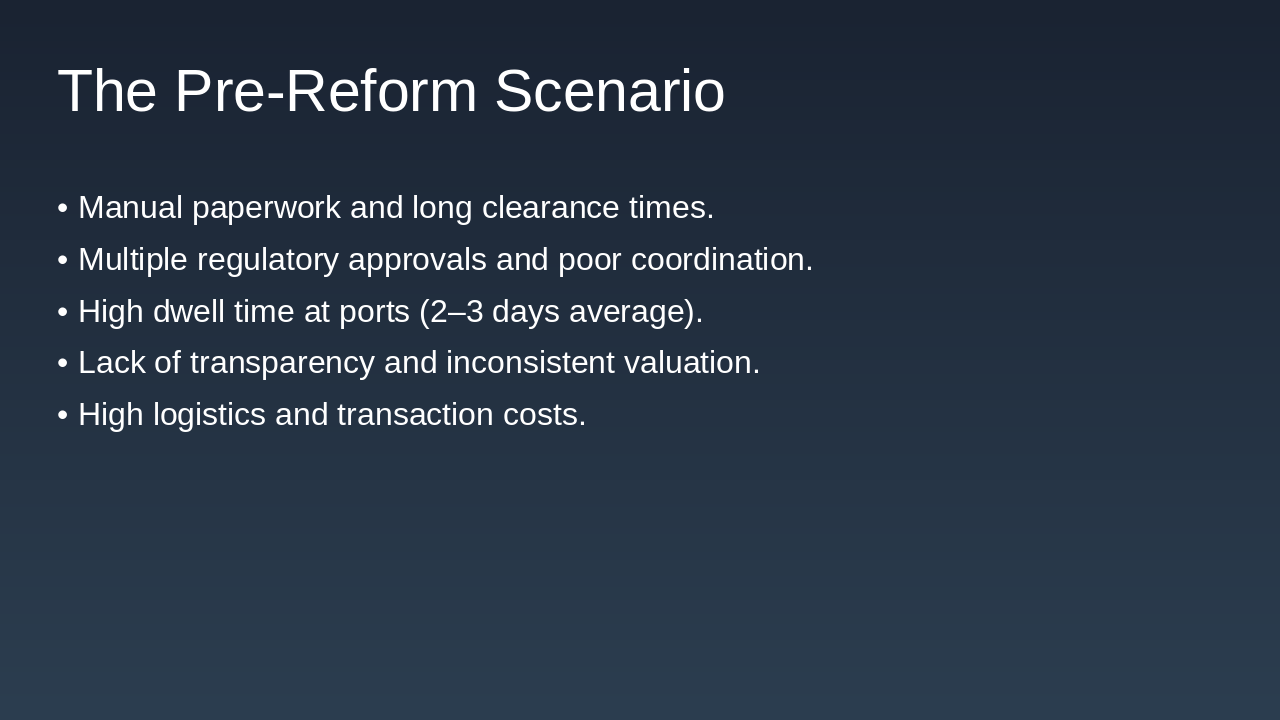
Slide 3 - The Pre-Reform Scenario

Before reforms, the trade clearance process involved manual paperwork, lengthy approval times, and poor coordination among multiple regulators, leading to high dwell times of 2–3 days at ports. This system also suffered from a lack of transparency, inconsistent valuation, and elevated logistics and transaction costs.

The Pre-Reform Scenario

  • Manual paperwork and long clearance times.
  • Multiple regulatory approvals and poor coordination.
  • High dwell time at ports (2–3 days average).
  • Lack of transparency and inconsistent valuation.
  • High logistics and transaction costs.
Slide 3 - The Pre-Reform Scenario
Slide 4 of 15

Slide 4 - Modern Customs Principles

Modern Customs Principles emphasize simplification through standardized forms and reduced procedural steps, alongside automation via electronic end-to-end processing to boost efficiency. They also promote transparency with online rules and real-time tracking, risk management focused on high-risk shipments, and trade facilitation through business-customs partnerships.

Modern Customs Principles

  • Simplification: standardized forms and fewer procedural steps.
  • Automation: electronic end-to-end processing for efficiency.
  • Transparency: rules published online with real-time tracking.
  • Risk Management: targeting only high-risk cargo shipments.
  • Trade Facilitation: fostering business-customs partnerships.
Slide 4 - Modern Customs Principles
Slide 5 of 15

Slide 5 - Key EoDB Measures in Customs

The slide outlines key Ease of Doing Business (EoDB) measures in customs, including the Single Window Interface (SWIFT) for streamlined documentation, Risk Management System (RMS) for targeted inspections, and Electronic Data Interchange (EDI) for paperless processing. It also highlights the Authorized Economic Operator (AEO) program for trusted traders, Direct Port Delivery and Entry (DPD & DPE) for faster clearance, and Faceless Assessment using remote evaluation, e-seals, and online payments.

Key EoDB Measures in Customs

  • SWIFT: Single Window Interface for streamlined trade documentation.
  • RMS: Risk Management System for targeted inspections.
  • EDI: Electronic Data Interchange for paperless processing.
  • AEO Program: Authorized Economic Operator for trusted traders.
  • DPD & DPE: Direct Port Delivery and Entry for faster clearance.
  • Faceless Assessment: Remote evaluation with e-seals and online payments.
Slide 5 - Key EoDB Measures in Customs
Slide 6 of 15

Slide 6 - Single Window System (SWIFT)

The Single Window System (SWIFT) integrates over 50 government agencies into a unified portal, enabling single document uploads that are shared across departments to reduce duplication and streamline efforts. It accelerates clearance times for trade processing while improving inter-agency coordination and collaboration.

Single Window System (SWIFT)

  • Integrates over 50 government agencies into a unified portal.
  • Enables single document upload shared across all departments.
  • Accelerates clearance times for efficient trade processing.
  • Reduces duplication of submissions and efforts.
  • Improves coordination and inter-agency collaboration.

Source: Ease of Doing Business in Customs & GST

Speaker Notes
One unified portal integrating over 50 government agencies. Traders upload documents once—shared across departments. Benefits: Faster clearance, reduced duplication, improved coordination.
Slide 6 - Single Window System (SWIFT)
Slide 7 of 15

Slide 7 - Risk Management System (RMS)

The Risk Management System (RMS) uses AI-driven profiling to assess cargo and traders, limiting physical inspections to high-risk shipments while granting immediate clearance to low-risk ones. This approach has achieved a 70% reduction in dwell time through efficient resource allocation and utilization.

Risk Management System (RMS)

  • AI-driven profiling of cargo and traders
  • Physical inspection limited to high-risk shipments
  • Immediate clearance for low-risk cargo
  • 70% reduction in dwell time achieved
  • Efficient resource allocation and utilization
Slide 7 - Risk Management System (RMS)
Slide 8 of 15

Slide 8 - Authorized Economic Operator (AEO) Program

The Authorized Economic Operator (AEO) Program recognizes trusted traders by granting them priority customs treatment, including fewer inspections, faster clearance times, and deferred payment options for duties and taxes. It fosters a strong partnership and builds trust between customs authorities and industry stakeholders.

Authorized Economic Operator (AEO) Program

  • Recognizes trusted traders for priority customs treatment.
  • Provides fewer inspections and faster clearance times.
  • Offers deferred payment options for duties and taxes.
  • Builds trust and partnership between customs and industry.
Slide 8 - Authorized Economic Operator (AEO) Program
Slide 9 of 15

Slide 9 - Paperless Documentation & Faceless Assessment

The slide introduces a paperless documentation system featuring electronic filing, digital signatures, and online payments, alongside a contactless process that promotes transparency and efficiency. It also highlights remote assessment centers for greater consistency and fairness, while reducing physical interactions to minimize corruption risks.

Paperless Documentation & Faceless Assessment

  • Electronic filing with digital signatures and online payments.
  • Contactless, paperless system ensures transparency and efficiency.
  • Remote assessment centers enhance consistency and fairness.
  • Reduces physical interactions, minimizing corruption risks.
Speaker Notes
Electronic filing, digital signatures, and online payments. Contactless, paperless, transparent system. Remote assessment centers promote consistency. Major reduction in physical interaction and corruption.
Slide 9 - Paperless Documentation & Faceless Assessment
Slide 10 of 15

Slide 10 - Impact of Customs Reforms

Customs reforms have reduced clearance times by 40–60%, driven by faster processing and efficiency gains, while also cutting compliance costs by 30% through lower administrative burdens. Additionally, these changes have improved the global ranking in trade facilitation by over 20 spots.

Impact of Customs Reforms

  • 40–60%: Clearance Time Reduction
  • Faster processing and efficiency gains

  • 30%: Compliance Costs Cut
  • Lower administrative burdens

  • 20+ spots: Global Ranking Improvement
  • Enhanced trade facilitation position

Slide 10 - Impact of Customs Reforms
Slide 11 of 15

Slide 11 - Global Benchmarking

The Global Benchmarking slide highlights alignment with key international standards, including the WTO Trade Facilitation Agreement and the WCO SAFE Framework. It notes benchmarking against leading nations like Singapore, the Netherlands, South Korea, and the UAE, positioning the country as one of the top global reformers.

Global Benchmarking

  • Aligned with WTO Trade Facilitation Agreement and WCO SAFE Framework.
  • Benchmarked against Singapore, Netherlands, South Korea, and UAE.
  • Recognized as one of the top reforming nations globally.
Slide 11 - Global Benchmarking
Slide 12 of 15

Slide 12 - GST – Catalyst for Ease of Doing Business

This section header slide, titled "GST – Catalyst for Ease of Doing Business" and numbered 12, highlights GST as a key driver for simplifying business operations. It features a subtitle explaining how GST replaces multiple taxes with a unified system, enabling easier registration and seamless input tax credit.

GST – Catalyst for Ease of Doing Business

12

GST – Catalyst for Ease of Doing Business

Replaced multiple taxes with unified GST for simplified registration and seamless input tax credit.

Source: Ease of Doing Business in Customs & GST

Speaker Notes
Replaced multiple taxes (VAT, excise, service tax) with one unified GST. Benefits: One Nation, One Tax. Simplified Registration. Seamless Input Tax Credit (ITC). Faster logistics and nationwide operations.
Slide 12 - GST – Catalyst for Ease of Doing Business
Slide 13 of 15

Slide 13 - GST in Action – Real Business Impact

The slide "GST in Action – Real Business Impact" highlights how the Goods and Services Tax (GST) delivers tangible benefits across sectors, such as reducing logistics travel time by 30% through the removal of border checkposts. It further illustrates impacts like 8–10% cost savings in manufacturing via input tax credits, simplified multi-state expansion in retail, eased compliance for SMEs under the composition scheme, and a reduction from 35 to 18 warehouses in FMCG, saving crores.

GST in Action – Real Business Impact

  • Logistics: Removed border checkposts reduce travel time by 30%.
  • Manufacturing: Input tax credit cuts costs by 8–10%.
  • Retail: Simplified processes enable multi-state expansion.
  • SMEs: Composition scheme eases compliance requirements.
  • FMCG: Warehouses reduced from 35 to 18, saving crores.
Slide 13 - GST in Action – Real Business Impact
Slide 14 of 15

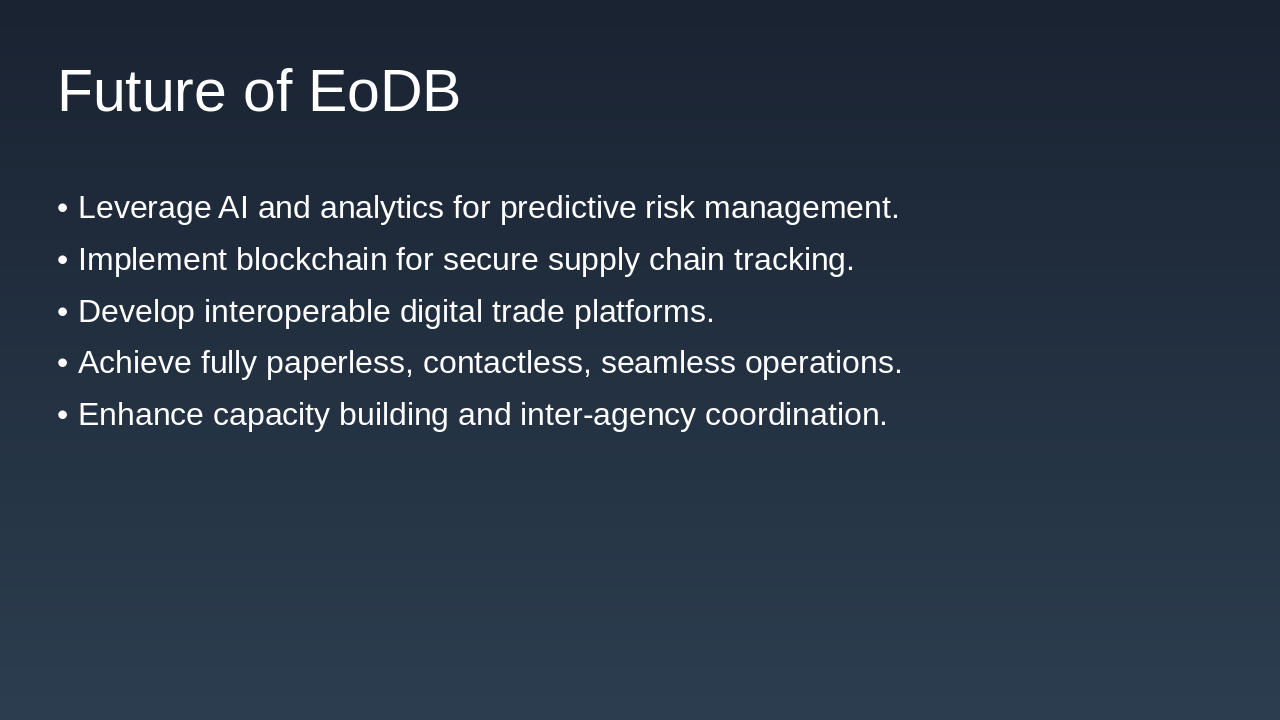
Slide 14 - Future of EoDB

The slide on the Future of Ease of Doing Business (EoDB) outlines key technological advancements, including leveraging AI and analytics for predictive risk management, implementing blockchain for secure supply chain tracking, and developing interoperable digital trade platforms. It also envisions fully paperless, contactless operations alongside enhanced capacity building and inter-agency coordination to streamline global trade.

Future of EoDB

  • Leverage AI and analytics for predictive risk management.
  • Implement blockchain for secure supply chain tracking.
  • Develop interoperable digital trade platforms.
  • Achieve fully paperless, contactless, seamless operations.
  • Enhance capacity building and inter-agency coordination.
Slide 14 - Future of EoDB
Slide 15 of 15

Slide 15 - Conclusion

Ease of Doing Business (EoDB) in India is defined by simplification, automation, and transparency, with synergy between Customs and GST fostering a stronger trade ecosystem and ongoing innovation ensuring competitiveness. The slide positions India's EoDB journey as a model for modern governance, ending with thanks and a call to embrace reforms for boosting the nation's trade future.

Conclusion

EoDB = Simplification + Automation + Transparency.

Customs + GST synergy = Stronger trade ecosystem.

Continuous innovation ensures competitiveness.

India’s EoDB journey is a model for modern, efficient governance.

Closing Message: Thank you for your attention.

Call-to-Action: Embrace reforms to boost India's trade future.

Source: Ease of Doing Business in Customs & GST

Speaker Notes
Summarize key takeaways: EoDB driven by simplification, automation, transparency; synergy between Customs and GST; ongoing innovation; India's model for governance. Closing: Thank you. CTA: Embrace reforms for stronger trade.
Slide 15 - Conclusion

Discover More Presentations

Explore thousands of AI-generated presentations for inspiration

Browse Presentations
Powered by AI

Create Your Own Presentation

Generate professional presentations in seconds with Karaf's AI. Customize this presentation or start from scratch.

Create New Presentation

Powered by Karaf.ai — AI-Powered Presentation Generator