Exploring Artificial Intelligence

Generated from prompt:

Create a presentation about artificial intelligence

This presentation introduces AI fundamentals, including its definition, goals, reasoning, learning, historical evolution, impact stats, visionary quotes, applications in manufacturing and medicine, an

November 9, 202511 slides
Slide 1 of 11

Slide 1 - Introduction to Artificial Intelligence

This title slide introduces the topic of Artificial Intelligence, serving as the opening for a presentation on exploring the world of AI. It includes a subtitle crediting the presenter as [Your Name].

Introduction to Artificial Intelligence

Exploring the World of AI Presented by: [Your Name]

Source: AI Presentation

--- Speaker Notes: Welcome slide with title and subtitle, including presenter placeholder.
Slide 1
Slide 2 of 11

Slide 2 - Presentation Agenda

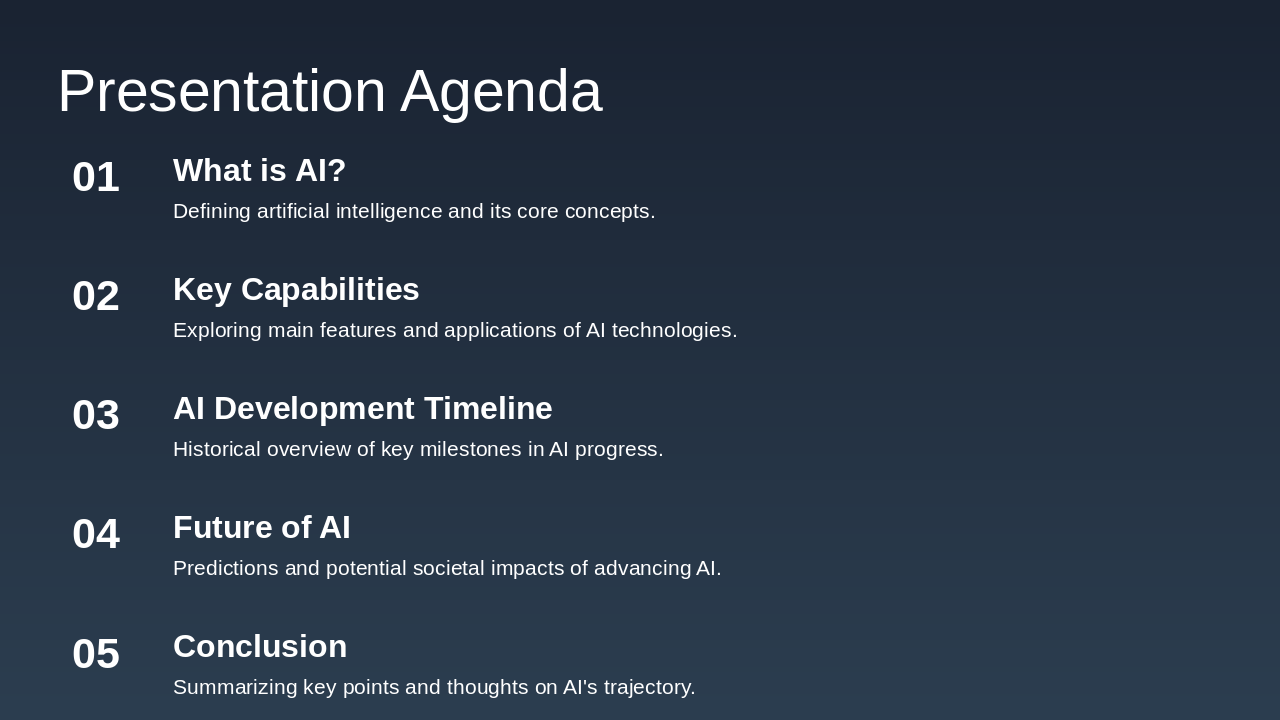
The presentation agenda outlines a structured exploration of artificial intelligence, starting with a definition of AI and its core concepts. It then covers key capabilities and applications, an historical development timeline, predictions for AI's future and societal impacts, and concludes with a summary of main points.

Presentation Agenda

  1. What is AI?

Defining artificial intelligence and its core concepts.

  1. Key Capabilities

Exploring main features and applications of AI technologies.

  1. AI Development Timeline

Historical overview of key milestones in AI progress.

  1. Future of AI

Predictions and potential societal impacts of advancing AI.

  1. Conclusion

Summarizing key points and thoughts on AI's trajectory.

Slide 2
Slide 3 of 11

Slide 3 - What is Artificial Intelligence?

This section header slide, titled "What is Artificial Intelligence?" and numbered as section 02, introduces the fundamental idea of AI. It features a subtitle that defines AI as machines mimicking human intelligence.

What is Artificial Intelligence?

02

What is Artificial Intelligence?

Introducing the core concept of AI as machines mimicking human intelligence.

Source: Presentation about artificial intelligence

--- Speaker Notes: Section introducing the core concept of AI as machines mimicking human intelligence.

Slide 3
Slide 4 of 11

Slide 4 - Definition of AI

Artificial Intelligence (AI) is a branch of computer science that studies intelligent agents capable of performing tasks such as learning and reasoning. It emphasizes perceiving the environment to achieve specific goals.

Definition of AI

  • AI enables computers to perform tasks like learning and reasoning.
  • AI focuses on perceiving the environment and achieving goals.
  • AI is a field in computer science studying intelligent agents.
Slide 4
Slide 5 of 11

Slide 5 - Key Goals of AI

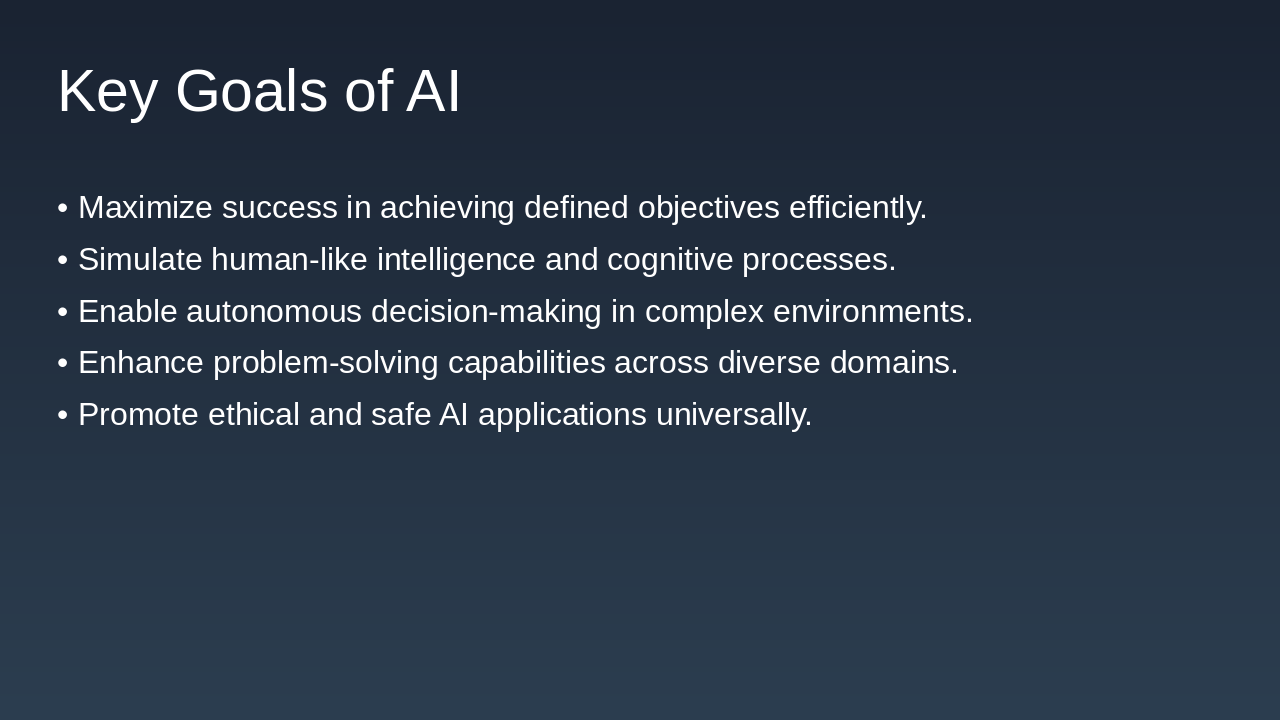
The slide on Key Goals of AI emphasizes maximizing efficiency in achieving objectives, simulating human-like intelligence, and enabling autonomous decision-making in complex settings. It also highlights enhancing problem-solving across diverse areas while promoting ethical and safe AI applications universally.

Key Goals of AI

  • Maximize success in achieving defined objectives efficiently.
  • Simulate human-like intelligence and cognitive processes.
  • Enable autonomous decision-making in complex environments.
  • Enhance problem-solving capabilities across diverse domains.
  • Promote ethical and safe AI applications universally.
Slide 5
Slide 6 of 11

Slide 6 - Reasoning and Learning in AI

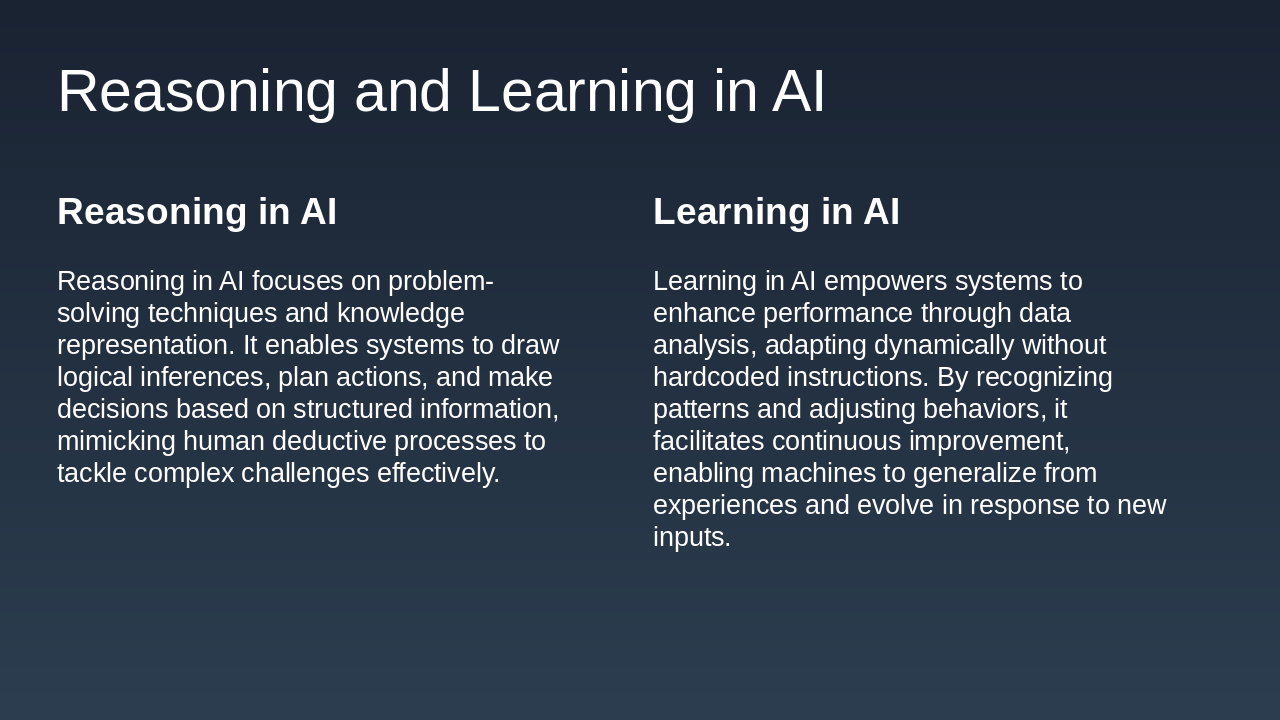
Reasoning in AI emphasizes problem-solving, knowledge representation, and logical inference to mimic human deduction for tackling complex challenges. Learning in AI enables systems to improve performance by analyzing data, recognizing patterns, and adapting dynamically without explicit programming, allowing generalization from experiences.

Reasoning and Learning in AI

Reasoning in AILearning in AI
Reasoning in AI focuses on problem-solving techniques and knowledge representation. It enables systems to draw logical inferences, plan actions, and make decisions based on structured information, mimicking human deductive processes to tackle complex challenges effectively.Learning in AI empowers systems to enhance performance through data analysis, adapting dynamically without hardcoded instructions. By recognizing patterns and adjusting behaviors, it facilitates continuous improvement, enabling machines to generalize from experiences and evolve in response to new inputs.
Slide 6
Slide 7 of 11

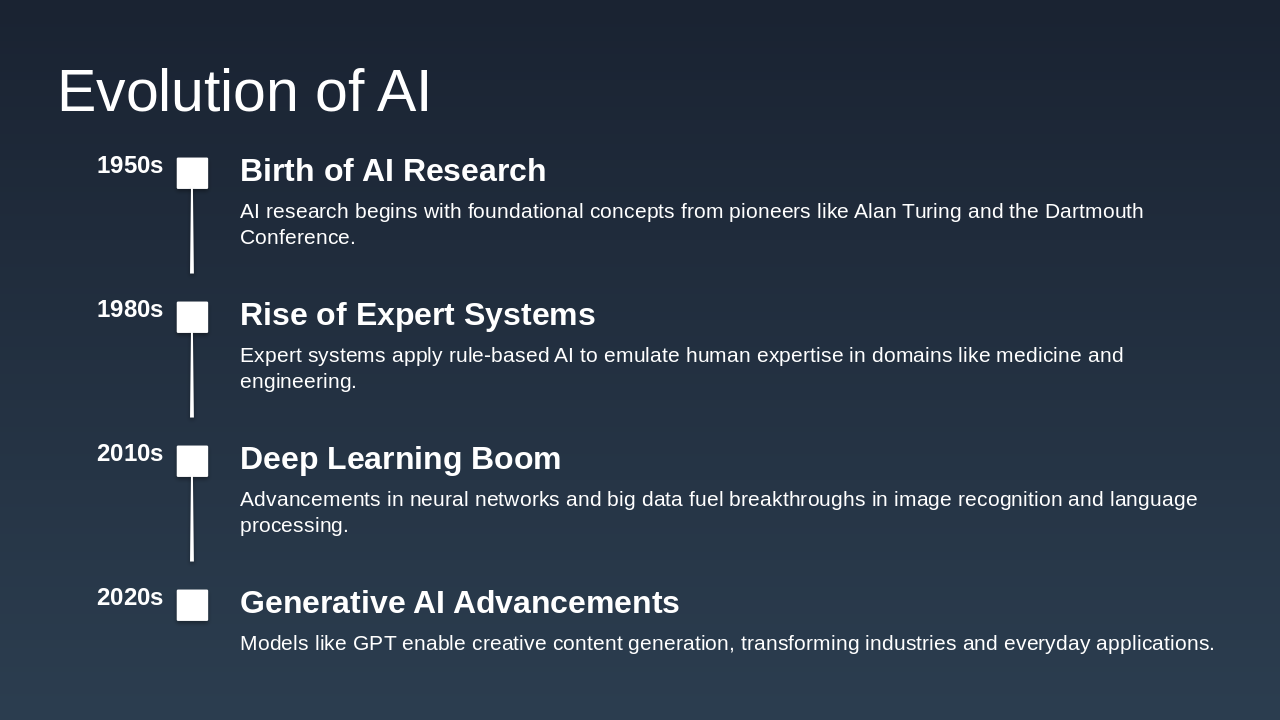
Slide 7 - Evolution of AI

The Evolution of AI timeline traces key milestones starting in the 1950s with the birth of AI research, driven by pioneers like Alan Turing and the Dartmouth Conference. It progresses through the 1980s rise of expert systems for emulating human expertise, the 2010s deep learning boom fueled by neural networks and big data, and the 2020s advancements in generative AI like GPT models transforming industries.

Evolution of AI

1950s: Birth of AI Research AI research begins with foundational concepts from pioneers like Alan Turing and the Dartmouth Conference. 1980s: Rise of Expert Systems Expert systems apply rule-based AI to emulate human expertise in domains like medicine and engineering. 2010s: Deep Learning Boom Advancements in neural networks and big data fuel breakthroughs in image recognition and language processing. 2020s: Generative AI Advancements Models like GPT enable creative content generation, transforming industries and everyday applications.

Slide 7
Slide 8 of 11

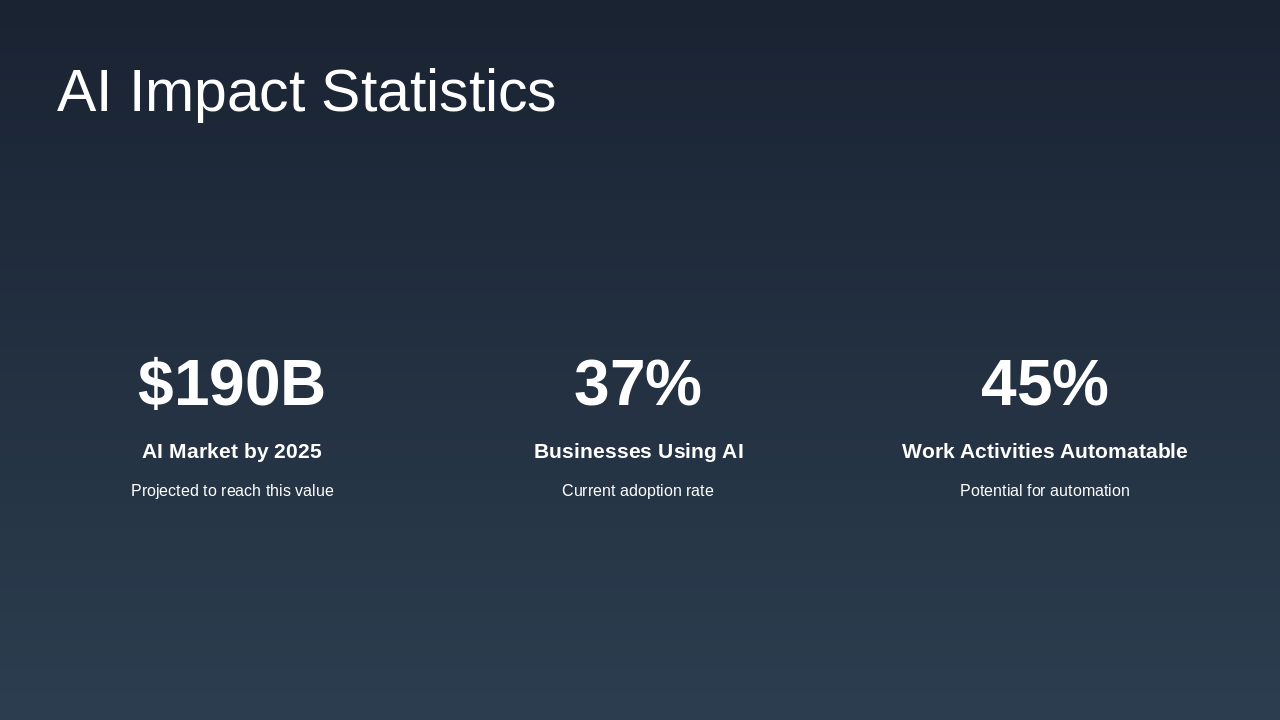
Slide 8 - AI Impact Statistics

The AI market is projected to reach $190 billion by 2025, highlighting significant growth potential. Currently, 37% of businesses are using AI, with 45% of work activities potentially automatable.

AI Impact Statistics

  • $190B: AI Market by 2025

Projected to reach this value

  • 37%: Businesses Using AI

Current adoption rate

  • 45%: Work Activities Automatable

Potential for automation

Slide 8
Slide 9 of 11

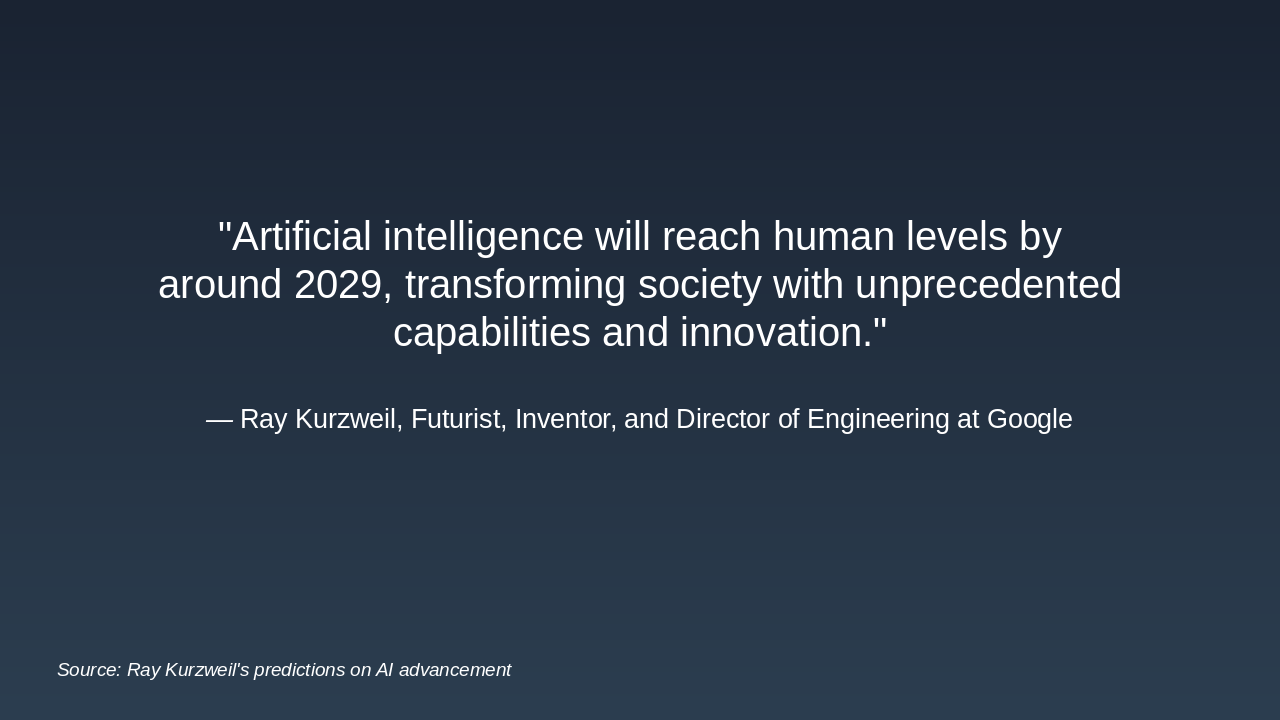
Slide 9 - A Vision for AI

The slide, titled "A Vision for AI," features a quote from Ray Kurzweil, a futurist, inventor, and Google's Director of Engineering. In it, he predicts that artificial intelligence will achieve human-level capabilities by around 2029, ushering in transformative societal innovations.

A Vision for AI

> Artificial intelligence will reach human levels by around 2029, transforming society with unprecedented capabilities and innovation.

— Ray Kurzweil, Futurist, Inventor, and Director of Engineering at Google

Source: Ray Kurzweil's predictions on AI advancement

--- Speaker Notes: Reflects optimism in AI's rapid progress toward human-level intelligence by 2029, in the context of an AI presentation.

Slide 9
Slide 10 of 11

Slide 10 - Visualizing AI Applications

The slide titled "Visualizing AI Applications" features an image illustrating diverse uses of artificial intelligence across industries. It highlights key examples, including robots automating manufacturing for efficiency, neural networks for precise medical image analysis, smart assistants for personalized task management, and AI systems optimizing real-time urban traffic flow.

Visualizing AI Applications

!Image

  • Robots automating manufacturing processes for increased efficiency.
  • Neural networks enabling accurate medical image analysis.
  • Smart assistants providing personalized daily task management.
  • AI systems optimizing urban traffic flow in real-time.

Source: Image from Wikipedia article "Applications of artificial intelligence"

Slide 10
Slide 11 of 11

Slide 11 - Conclusion: The Future of AI

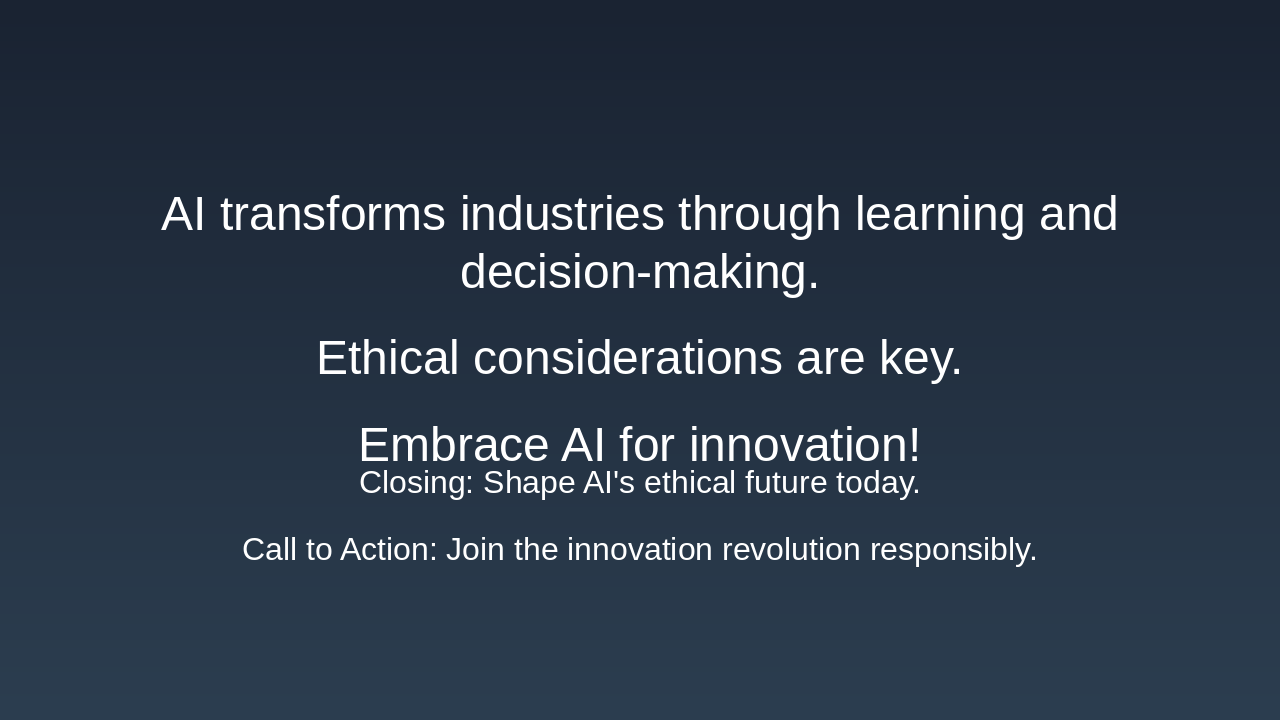
AI is revolutionizing industries by enhancing learning and decision-making capabilities, while emphasizing the importance of ethical considerations to guide its development. The slide urges embracing AI for innovation and calls on viewers to shape its ethical future today by joining the responsible innovation revolution.

Conclusion: The Future of AI

AI transforms industries through learning and decision-making.

Ethical considerations are key.

Embrace AI for innovation!

Closing: Shape AI's ethical future today.

Call to Action: Join the innovation revolution responsibly.

--- Speaker Notes: AI transforms industries through learning and decision-making. Ethical considerations key. Embrace AI for innovation!

Slide 11
Powered by AI

Create Your Own Presentation

Generate professional presentations in seconds with Karaf's AI. Customize this presentation or start from scratch.

Create New Presentation

Powered by Karaf.ai — AI-Powered Presentation Generator