Rockhopper Penguins: Lives, Threats & Hope

Generated from prompt:

Create a visually engaging and educational presentation titled 'Rockhopper Penguins'. Include 12–14 slides covering: introduction, species overview (Northern & Southern Rockhoppers), habitat & ecology, population status/decline, human-driven threats (overfishing, krill industry, pollution), human-penguin conflict, sustainability challenges, extinction causes, conservation organizations and efforts, conflicting solutions, and future outlook. Use bright oceanic colors (blue, white, aqua) with wildlife imagery and clear, student-friendly text. Include a closing references slide. Designed for an AMAS 139 university course group presentation.

This educational presentation explores Rockhopper Penguins' species overview, sub-Antarctic habitats, population declines, human threats like overfishing and pollution, conservation efforts by IUCN an

December 3, 202515 slides
Slide 1 of 15

Slide 1 - Rockhopper Penguins

The slide, titled "Rockhopper Penguins," serves as the title for an educational presentation exploring the lives, threats, and conservation efforts of these birds. Its subtitle welcomes viewers to this journey, specifically designed for the AMAS 139 course.

Exploring Rockhopper Penguins: Lives, Threats, and Conservation

Welcome to an Educational Journey for AMAS 139

Slide 1 - Rockhopper Penguins
Slide 2 of 15

Slide 2 - Presentation Agenda

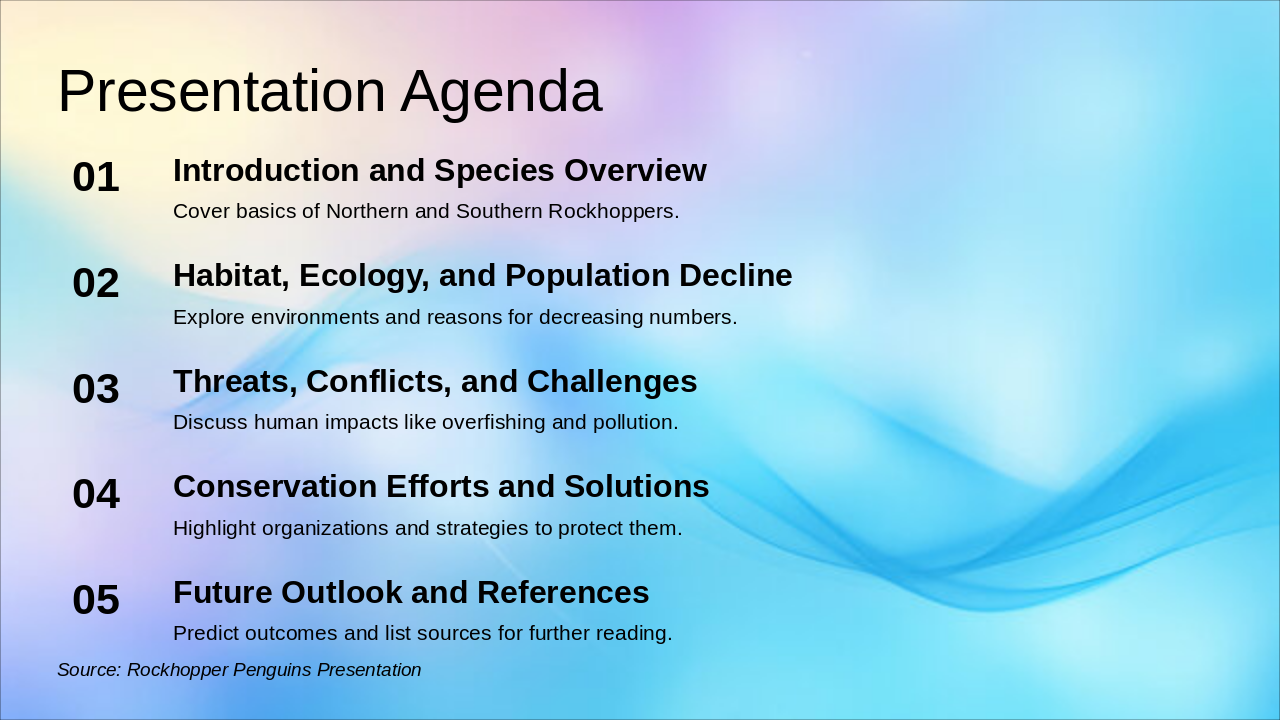
The presentation agenda outlines key topics on Northern and Southern Rockhopper penguins, starting with an introduction and species overview covering their basics. It then progresses through habitat, ecology, and population decline; threats like overfishing and pollution; conservation efforts and solutions; and ends with a future outlook plus references.

Presentation Agenda

  1. Introduction and Species Overview
  2. Cover basics of Northern and Southern Rockhoppers.

  3. Habitat, Ecology, and Population Decline
  4. Explore environments and reasons for decreasing numbers.

  5. Threats, Conflicts, and Challenges
  6. Discuss human impacts like overfishing and pollution.

  7. Conservation Efforts and Solutions
  8. Highlight organizations and strategies to protect them.

  9. Future Outlook and References

Predict outcomes and list sources for further reading. Source: Rockhopper Penguins Presentation

Slide 2 - Presentation Agenda
Slide 3 of 15

Slide 3 - Rockhopper Penguins

This section header slide introduces Rockhopper Penguins, charismatic seabirds known for their distinctive crests. It highlights their hopping behavior on remote islands while facing threats from human activities.

Rockhopper Penguins

01

Introduction

Charismatic seabirds with crests hopping on remote islands amid human threats

Slide 3 - Rockhopper Penguins
Slide 4 of 15

Slide 4 - Species Overview

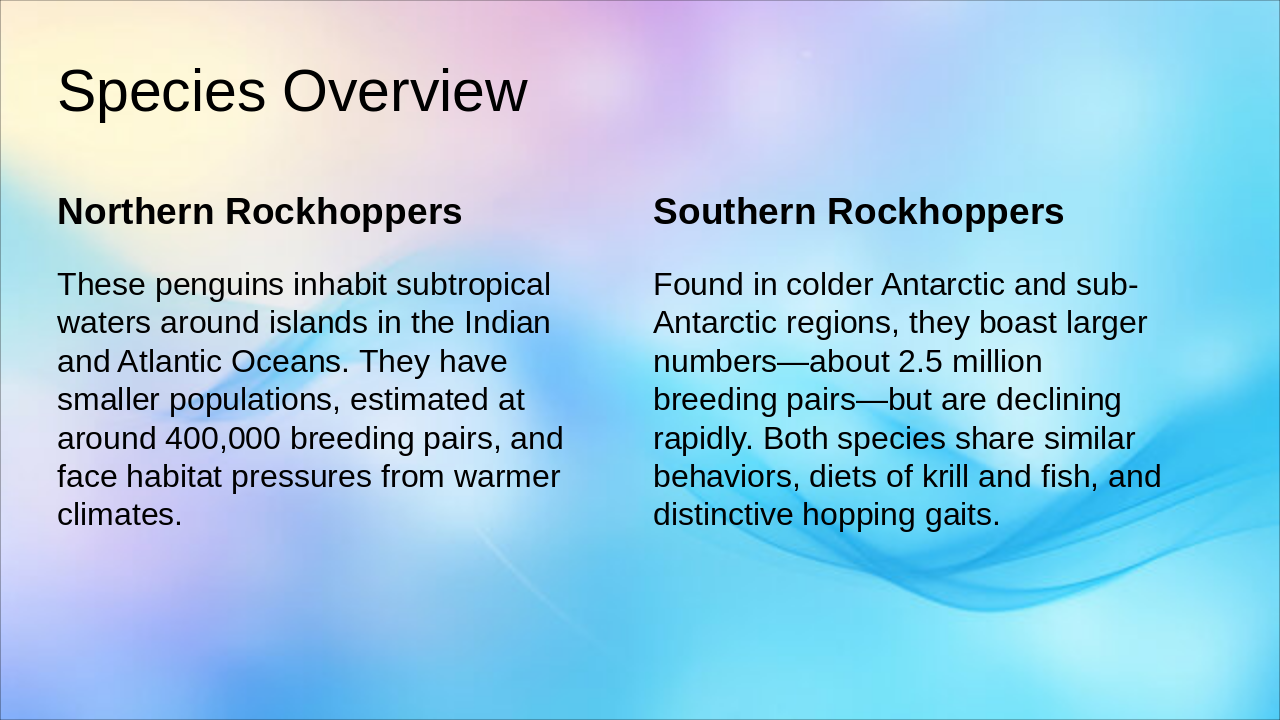
Northern Rockhopper penguins inhabit subtropical waters around islands in the Indian and Atlantic Oceans, with smaller populations of about 400,000 breeding pairs facing habitat pressures from warmer climates. Southern Rockhoppers live in colder Antarctic and sub-Antarctic regions, numbering around 2.5 million breeding pairs but declining rapidly, with both species sharing similar behaviors, krill- and fish-based diets, and distinctive hopping gaits.

Species Overview

Northern RockhoppersSouthern Rockhoppers
These penguins inhabit subtropical waters around islands in the Indian and Atlantic Oceans. They have smaller populations, estimated at around 400,000 breeding pairs, and face habitat pressures from warmer climates.Found in colder Antarctic and sub-Antarctic regions, they boast larger numbers—about 2.5 million breeding pairs—but are declining rapidly. Both species share similar behaviors, diets of krill and fish, and distinctive hopping gaits.
Speaker Notes
Emphasize the key differences in habitat and population trends while noting shared traits like diet and behavior to engage the audience on conservation needs.
Slide 4 - Species Overview
Slide 5 of 15

Slide 5 - Habitat & Ecology

Rockhopper penguins nest on rocky cliffs in sub-Antarctic islands and form lively breeding colonies there seasonally. Their diet consists of krill, fish, and squid, and they migrate annually across the Southern Ocean.

Habitat & Ecology

  • Nest on rocky cliffs in sub-Antarctic islands
  • Diet includes krill, fish, and squid
  • Form lively breeding colonies seasonally
  • Migrate across the Southern Ocean annually
Slide 5 - Habitat & Ecology
Slide 6 of 15

Slide 6 - Rockhopper Habitat Imagery

The slide showcases imagery of rockhopper penguin habitats on windy, rocky sub-Antarctic shores, where they adeptly hop over boulders to reach nests amid crashing waves. Vivid blue skies and ocean waves emphasize their resilient adaptations and specialized behaviors for surviving harsh, cold environments.

Rockhopper Habitat Imagery

!Image

  • Rockhopper penguins thrive on windy, rocky sub-Antarctic shores.
  • They hop adeptly over boulders to reach nests amid crashing waves.
  • Vivid blue skies and ocean waves highlight their resilient adaptations.
  • Harsh environments foster specialized behaviors for survival in cold climates.

Source: Wikipedia - Rockhopper Penguin

Speaker Notes
Discuss how rocky shores and windy conditions shape their unique hopping adaptation.
Slide 6 - Rockhopper Habitat Imagery
Slide 7 of 15

Slide 7 - Population Status & Decline

The slide estimates the global breeding population of the species at around 1.5 million pairs. It highlights a 30-50% decline over the past 30 years, with the northern species classified as critically endangered by the IUCN.

Population Status & Decline

  • ~1.5 million: Global Pairs
  • Breeding population estimate

  • 30-50%: Recent Decline
  • Over past 30 years

  • Critically Endangered: Northern Species

IUCN threat status Source: IUCN Red List & BirdLife International

Speaker Notes
Highlight the urgency of conservation for Northern Rockhoppers and discuss impacts of climate change and fishing.
Slide 7 - Population Status & Decline
Slide 8 of 15

Slide 8 - Human-Driven Threats

Human-driven threats to Rockhopper Penguins include overfishing, which depletes their key food sources, and krill harvesting, which reduces primary prey availability in oceans. Additionally, plastic and oil pollution contaminates their vital breeding grounds.

Human-Driven Threats

  • Overfishing depletes key food sources for Rockhopper Penguins.
  • Krill harvesting reduces primary prey availability in oceans.
  • Plastic and oil pollution contaminates vital breeding grounds.
Speaker Notes
Highlight how these threats directly impact Rockhopper Penguins' survival; use images of polluted oceans and fishing boats.
Slide 8 - Human-Driven Threats
Slide 9 of 15

Slide 9 - Human-Penguin Conflict

Human-Penguin Conflict arises from commercial fisheries depleting shared fish stocks essential for penguin feeding. Shipping routes and tourism further exacerbate the issue by disturbing nesting sites through noise, habitat disruption, and human-induced stress on vulnerable colonies.

Human-Penguin Conflict

  • Commercial fisheries deplete shared fish stocks vital for penguin feeding.
  • Shipping routes disturb nesting sites with noise and habitat disruption.
  • Tourism increases stress on vulnerable colonies through human disturbances.
Slide 9 - Human-Penguin Conflict
Slide 10 of 15

Slide 10 - Sustainability Challenges

Sustainability challenges in the slide focus on balancing fishing quotas with the prey requirements of rockhopper penguins to prevent ecological imbalance. Additionally, climate change alters ocean currents and prey distribution, while limited monitoring in remote habitats obstructs effective conservation efforts.

Sustainability Challenges

  • Balance fishing quotas with rockhopper penguin prey needs.
  • Climate change disrupts ocean currents and prey distribution.
  • Limited monitoring hinders conservation in remote habitats.
Slide 10 - Sustainability Challenges
Slide 11 of 15

Slide 11 - Extinction Causes Timeline

The Extinction Causes Timeline slide outlines the rockhopper penguin population's trajectory, starting with a boom in the 1800s due to abundant krill and fish resources. It then details declines from industrial overfishing in the 1900s, accelerated by warming oceans in the 2000s, culminating in a looming risk of total extinction in the future without intervention.

Extinction Causes Timeline

1800s: Initial Population Boom Rockhopper penguin numbers surge with plentiful krill and fish resources. 1900s: Industrial Fishing Begins Decline Commercial overfishing depletes food sources, starting sharp population reductions. 2000s: Warming Oceans Accelerate Drops Climate change warms seas, disrupting breeding and causing rapid declines. Future: Risk of Extinction Looms Without urgent action, ongoing threats may lead to total extinction.

Slide 11 - Extinction Causes Timeline
Slide 12 of 15

Slide 12 - Conservation Organizations & Efforts

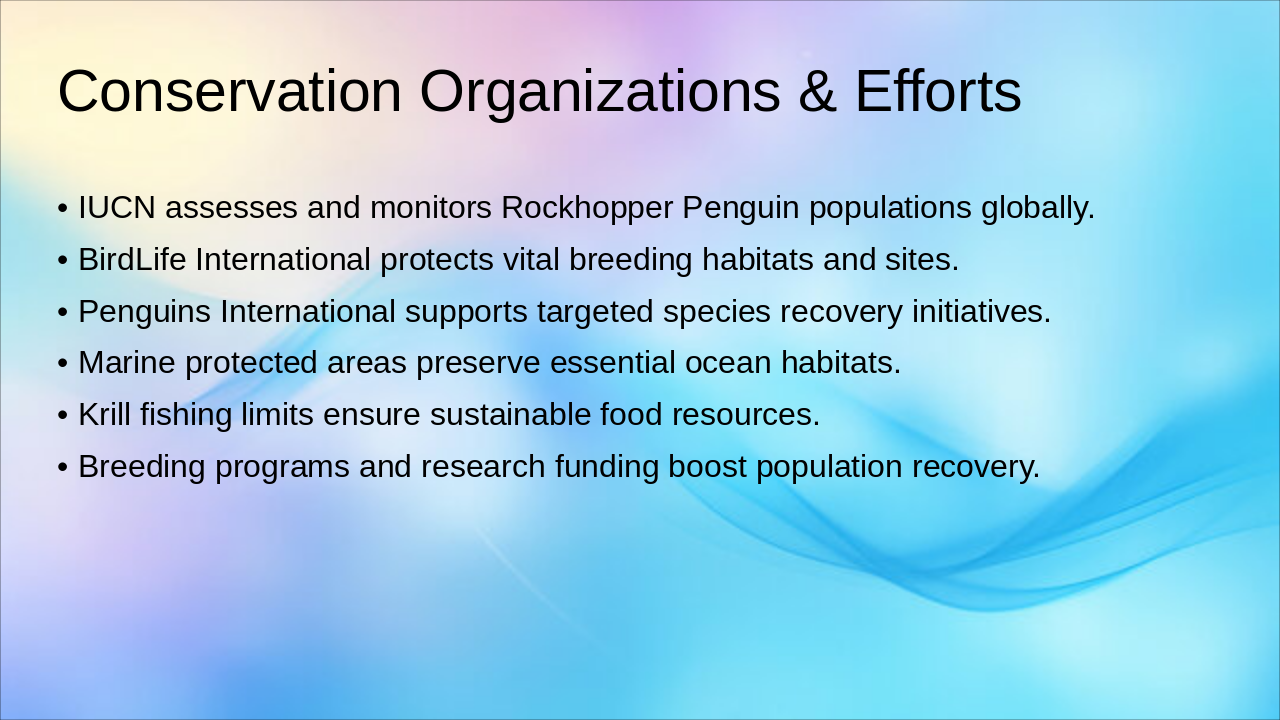
Various conservation organizations, including IUCN, BirdLife International, and Penguins International, actively assess, monitor, and support recovery efforts for Rockhopper Penguin populations and their breeding habitats. Additional initiatives like marine protected areas, krill fishing limits, breeding programs, and research funding help preserve essential ocean ecosystems and ensure sustainable food resources.

Conservation Organizations & Efforts

  • IUCN assesses and monitors Rockhopper Penguin populations globally.
  • BirdLife International protects vital breeding habitats and sites.
  • Penguins International supports targeted species recovery initiatives.
  • Marine protected areas preserve essential ocean habitats.
  • Krill fishing limits ensure sustainable food resources.
  • Breeding programs and research funding boost population recovery.
Speaker Notes
Highlight key organizations and their impactful efforts to engage audience on recovery strategies.
Slide 12 - Conservation Organizations & Efforts
Slide 13 of 15

Slide 13 - Conflicting Solutions

Expanding fishing bans near penguin habitats protects vital krill and fish populations for rockhoppers but risks economic hardship for local fisheries through job losses and reduced livelihoods. Sustainable aquaculture, by contrast, promotes eco-friendly farming of fish and krill to ease pressure on wild stocks, though it requires substantial investments in technology and rigorous regulations to avoid environmental damage.

Conflicting Solutions

Expand Fishing BansSustainable Aquaculture
Implementing broader bans on fishing near penguin habitats safeguards krill and fish populations essential for rockhoppers. However, this can economically strain local fisheries, leading to job losses and reduced livelihoods in coastal communities.Developing eco-friendly fish and krill farming reduces reliance on wild stocks, alleviating pressure on penguin food sources. Success demands significant upfront investments in technology and strict regulations to prevent environmental harm.

Source: Rockhopper Penguins Presentation

Speaker Notes
Discuss how these solutions balance economic and ecological needs for penguin conservation.
Slide 13 - Conflicting Solutions
Slide 14 of 15

Slide 14 - Future Outlook

The Future Outlook slide emphasizes that urgent conservation measures can enable Rockhopper Penguins to rebound, requiring global collaborative efforts focused on sustainable practices and heightened awareness. It calls for collective action, urging viewers to join conservation initiatives and spread the word today to save these birds.

Future Outlook

With urgent conservation, Rockhopper Penguins can rebound. Collaborative efforts needed globally. Hope lies in sustainable practices and awareness.

Together, we can save the Rockhoppers!

Join conservation efforts and spread awareness today.

Speaker Notes
Emphasize hope and urgency in conservation. Highlight global collaboration and sustainable practices. End with closing message and call-to-action to engage audience.
Slide 14 - Future Outlook
Slide 15 of 15

Slide 15 - References

The References slide lists key sources for penguin conservation and ecology, including IUCN Red List assessments on species threats. It also features BirdLife International reports on population trends, National Geographic articles on initiatives, and peer-reviewed studies on Southern Ocean environmental impacts.

References

  • IUCN Red List: Species assessments and threat evaluations
  • BirdLife International reports: Population trends and conservation strategies
  • National Geographic articles: Penguin conservation initiatives and stories
  • Peer-reviewed studies: Southern Ocean ecology and environmental impacts
Slide 15 - References

Discover More Presentations

Explore thousands of AI-generated presentations for inspiration

Browse Presentations
Powered by AI

Create Your Own Presentation

Generate professional presentations in seconds with Karaf's AI. Customize this presentation or start from scratch.

Create New Presentation

Powered by Karaf.ai — AI-Powered Presentation Generator